
Artificial Intelligence in Military Market Size – Industry Structure Evaluation, Demand Drivers Analysis, Regional Growth Analysis and Identification, Competitive Positioning Review & Global Market Size Forecast to 2030
Overview
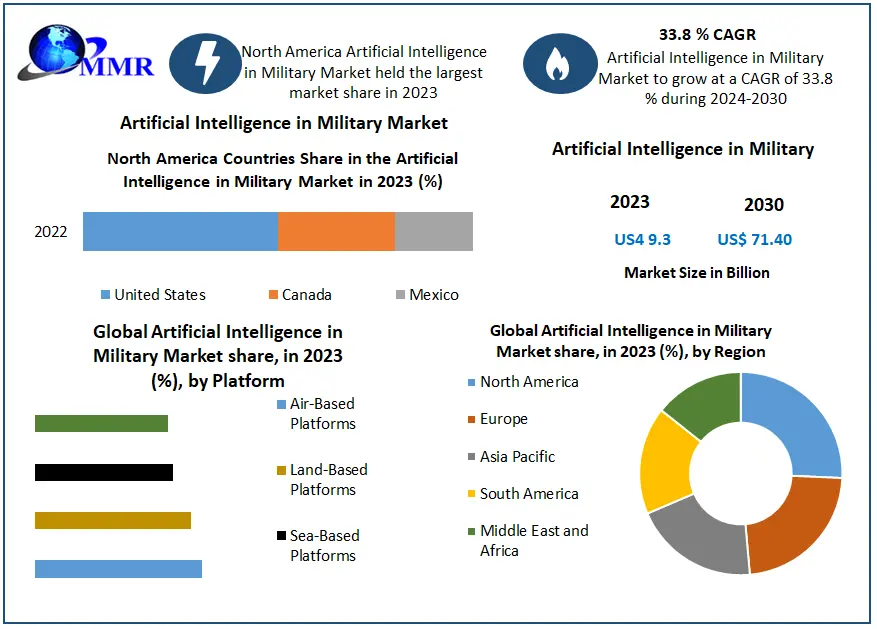
Global Artificial Intelligence in Military Market size was valued at USD 9.3 Bn in 2023 and is expected to reach USD 71.40 Bn by 2030, at a CAGR of 33.8%.
Artificial Intelligence in Military Market Overview
The integration of Artificial Intelligence (AI) into military applications marks a transformative phase in modern warfare, driving the evolution of defense systems across the globe. This advancement rests on several pillars that collectively define the present and future landscape of Artificial Intelligence in the Military Market. AI's most profound impact lies in its ability to revolutionize decision-making processes within military orders. Through real-time data analysis, AI empowers military leaders to swiftly and decisively respond to dynamic situations. This capability significantly enhances the efficiency and effectiveness of resource allocation, strategic planning, and tactical execution, granting military forces a strategic edge in complex and fast-evolving scenarios. This facet has become a linchpin in the adoption and production of AI technologies across defense sectors globally.
 To know about the Research Methodology:-Request Free Sample Report
The driving force behind the AI surge in military applications is its continuous technological advancement. These advancements drive the development of sophisticated autonomous systems and predictive analytics within military frameworks. These AI-driven platforms continually evolve, offering enhanced capabilities such as autonomous weaponry, surveillance systems, and predictive analytics that optimize military operations. The attraction of innovative technology not only bolsters military capabilities but also garners significant interest and investment from defense entities across the globe. The continuous evolution and refinement of AI technologies herald an era of unprecedented innovation within the defense industry, shaping the future of warfare.
Artificial Intelligence in Military Market Dynamics
Driver
Increasing demand for advanced technologies that optimize defense systems to boost Market Growth
The surge in demand for advanced technologies that optimize defense systems is an essential driver boosting the growth of Artificial Intelligence in Military Market. This increasing demand is primarily driven by several key factors shaping the contemporary landscape of global defense. The evolving nature of modern warfare necessitates a shift towards cutting-edge technologies to effectively counter diverse and complex threats. The integration of AI into military applications offers a transformative edge by significantly enhancing operational efficiency, strategic decision-making, and overall combat readiness. The emergence of unconventional challenges such as cyber threats, asymmetric warfare, and technologically sophisticated adversaries, has intensified the need for innovative defense solutions. AI-driven systems offer an adaptive and responsive approach to address these multifaceted challenges, enabling military forces to swiftly adapt to evolving threats in real-time. The pursuit of military superiority in an era defined by rapid technological advancements has propelled nations and defense agencies to invest significantly in AI research, development, and Technology.
AI-powered solutions provide a strategic advantage by revolutionizing traditional defense systems and empowering armed forces with autonomous drones, predictive analytics, and intelligent data processing capabilities. The convergence of AI technologies with military applications unlocks new possibilities, enabling the creation of intelligent systems capable of processing vast amounts of data, generating actionable insights, and augmenting human decision-making. These AI-driven solutions not only improve operational efficiency but also minimize errors, thus strengthening the overall effectiveness of defense systems. The escalating demand for AI technologies in the military domain is a response to the evolving nature of threats, the need for innovative defense solutions, and the quest for strategic advantage in a rapidly evolving global security landscape. This demand drives the growth and development of the Artificial Intelligence in Military Market, positioning AI as a cornerstone in modern defense strategies globally.
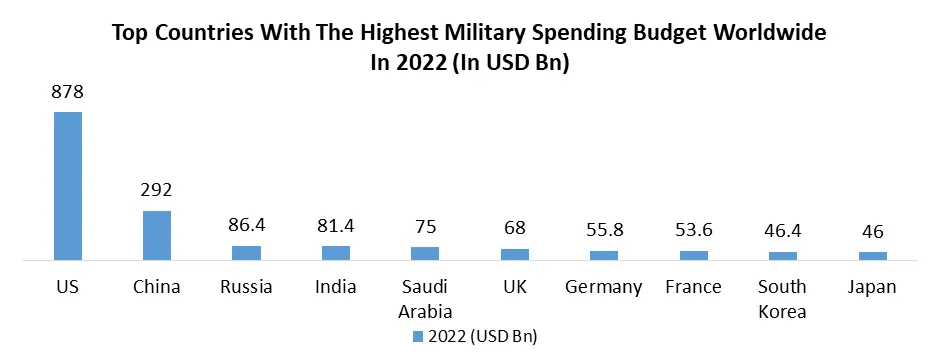
The United States, China, and India lead in military spending. This increasing demand for advanced defense technologies, including Artificial Intelligence in the Military, is driving innovation and investment, reshaping defense systems to optimize capabilities and bolster national security across these nations.
Trend
Integration of AI-powered autonomous systems across various defense applications
AI-driven autonomous systems, including drones, unmanned vehicles, and intelligent robotics, significantly enhance operational capabilities. These systems conduct surveillance, and reconnaissance, and even engage in combat missions with precision and efficiency, reducing risks to human personnel in dangerous environments. Ongoing technological advancements in AI enable the development of sophisticated autonomous systems capable of independent decision-making and adaptation to dynamic environments. This trend aligns with the pursuit of modernizing defense systems to meet evolving threats which boosts Artificial Intelligence in Military Market growth.
AI-powered autonomous systems offer superior operational efficiency and precision in executing missions. Their ability to process data in real time, adapt to changing scenarios, and perform complex tasks with accuracy makes them invaluable assets in military operations. The Technology of autonomous systems minimizes human exposure to potentially hazardous situations, providing a safer operational environment for military personnel. This aspect aligns with the increasing focus on ensuring the safety and security of armed forces during missions.
Nations seek strategic advantages in modern warfare through technological superiority. Integrating AI-powered autonomous systems allows armed forces to stay ahead in the technological race, fostering a capability edge over adversaries. AI-driven autonomous systems optimize resource allocation and logistics by streamlining operations, reducing costs, and improving overall efficiency. These systems perform tasks like monitoring, surveillance, and logistics without direct human intervention.
AI-powered autonomous systems in the Artificial Intelligence in Military Market exhibit versatile applications across multiple defense domains. They cater to reconnaissance, intelligence gathering, border security, disaster response, and other crucial operational requirements. This adaptability makes them highly valuable across various military functionalities and enhances their relevance in diverse scenarios.
Restraint
Ethical and Legal Concerns hamper Market Growth
The use of AI in military applications, particularly in autonomous weapons, raises ethical dilemmas. Concerns regarding the lack of human oversight and control over AI-driven weaponry, which makes independent decisions on engagements, raise questions about adherence to international laws and ethical standards in warfare. AI algorithms, despite their sophistication, exhibit unpredictability in decision-making processes within the Artificial Intelligence in Military Market. This unpredictability raises concerns about the ethical implications of AI-powered systems potentially acting against ethical principles or causing unintended harm due to flawed decision-making, emphasizing the need for ethical considerations and oversight in their development and deployment.
The autonomy of AI-driven systems in the military raises challenges in assigning accountability and responsibility for actions or decisions made by these systems. Determining liability in the event of errors or accidents involving AI-operated military technologies is complex and raises ethical and legal ambiguities. The Technology of AI in military contexts needs to align with international humanitarian laws, including the laws of armed conflict and human rights laws. Ensuring compliance with legal frameworks and ethical guidelines in Artificial Intelligence in Military Market is crucial yet challenging. The opacity of AI decision-making processes poses difficulties in explaining the rationale behind AI-driven decisions, raising challenges in ensuring transparency and accountability within these systems. Ensuring transparency and providing explanations for AI actions, particularly in sensitive military operations, is crucial for ethical considerations and accountability. Concerns persist regarding the potential for unintended escalation in conflicts due to the use of AI-powered autonomous systems. The lack of clear regulations or guidelines for the use of such systems in warfare raises ethical concerns about the risk of unintended consequences or conflicts spiraling out of control.
Artificial Intelligence in Military Market Segment Analysis
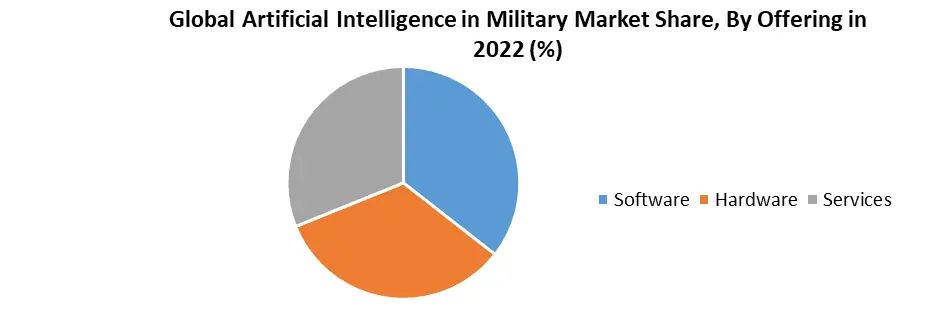
Based on the Offering, Software is expected to hold the largest Artificial Intelligence in Military Market in 2023. Software Offerings encompass the algorithms, neural networks, and AI models that form the core intelligence of AI systems. These software frameworks enable machine learning, natural language processing, computer vision, and other AI functionalities critical for military applications. Software offerings allow for flexibility and customization to meet specific military requirements. They are tailored to address diverse defense needs, including cybersecurity, intelligence analysis, autonomous systems, and decision support. The rapid evolution of AI technologies predominantly occurs within software development. Continuous advancements in AI algorithms, deep learning models, and software architectures drive innovation and the integration of cutting-edge capabilities in military AI systems.
Software-based AI solutions deployed across various hardware platforms and infrastructure, providing scalability and adaptability. They run on different hardware configurations, ensuring compatibility and interoperability across diverse military systems. Software facilitates data processing, analysis, and interpretation, enabling military decision-makers to derive actionable insights from vast amounts of data collected through sensors, surveillance systems, and other sources. Software offerings include AI development platforms, libraries, and toolkits that support the training, testing, and Technology of AI models. They empower developers and researchers to create sophisticated AI systems tailored for military applications. Software services encompass maintenance, updates, and technical support essential for the operational lifecycle of AI systems deployed in military environments. This ongoing support ensures the reliability and effectiveness of AI solutions.
Artificial Intelligence in Military Market Regional Insights
North America dominated Artificial Intelligence in Military Market share and is expected to have the highest growth rate during the forecast period. The U.S. boasts a rapid ecosystem for technological innovation, with many leading tech companies, research institutions and defense contractors actively involved in AI development. This technological prowess allows for cutting-edge advancements in AI applications for military purposes. The United States has one of the largest defense budgets globally, allowing significant investments in AI-driven military technologies. Extensive funding supports research, development, and implementation of AI systems across various defense applications. The U.S. military has prioritized AI integration across its defense systems to maintain technological superiority and strategic advantage. The Defense Department's initiatives including the Joint Artificial Intelligence Center (JAIC) highlight the commitment to AI development and utilization in defense operations.
Collaboration between the U.S. Department of Defense, government agencies, academia, and private sector entities drives the development and advancement of AI solutions within the Artificial Intelligence in Military Market. This collaborative environment fosters innovation and accelerates the evolution of AI technologies for military applications, enhancing military capabilities and global leadership in defense through the adoption and influence of AI. The U.S. military's proactive approach to integrating AI across several domains sets a precedent for other nations. The regulatory environment in the United States is conducive to fostering AI innovation. Regulations that support research and development in AI technologies offer a framework for advancements in the military domain. The U.S. military has a history of pioneering technological advancements and has significant experience in integrating new technologies into its defense systems, offering a solid foundation for AI adoption.
Artificial Intelligence in Military Market Scope: Inquire before buying
| Global Artificial Intelligence in Military Market | |||
|---|---|---|---|
| Report Coverage | Details | ||
| Base Year: | 2023 | Forecast Period: | 2024-2030 |
| Historical Data: | 2018 to 2023 | Market Size in 2023: | US $ 9.3 Bn. |
| Forecast Period 2024 to 2030 CAGR: | 33.8% | Market Size in 2030: | US $ 71.4 Bn. |
| Segments Covered: | by Offering | Software Hardware Services |
|
| by Technology | Machine Learning Natural Language Processing (NLP) Others |
||
| by Platform | Air-Based Platforms Land-Based Platforms Sea-Based Platforms Space-Based Platforms |
||
| by Installation Type | Fixed Installations Mobile Installations Others |
||
| by Application | Autonomous Weapons Systems Cybersecurity and Defense Intelligence Gathering and Analysis Surveillance and Reconnaissance Others |
||
Artificial Intelligence in Military Key Players
Global
1. Lockheed Martin (Bethesda, Maryland, USA)
2. Raytheon Company (Waltham, Massachusetts, USA)
3. Northrop Grumman (Falls Church, Virginia, USA)
4. Thales Group ( Paris, France, Thales )
5. IBM( Armonk, New York, USA, IBM )
North America
1. General Dynamics(Reston, Virginia, USA)
2. Nvidia(Santa Clara, California, USA)
3. Soartech( Ann Arbor, Michigan, USA)
4. SparkCognitio ( Austin, Texas, USA)
5. Charles River Analytics(Cambridge, Massachusetts, USA)
6. SAIC Corporation(Reston, Virginia, USA)
7. Boeing( Chicago, Illinois, USA)
8. Leidos( Reston, Virginia, USA)
9. GovBrain(Washington, D.C., USA)
10. SuperFlex( San Francisco, California, USA)
11. ShieldAI( San Diego, California, USA)
12. PrecisionHawk( Raleigh, North Carolina, USA)
13. DARPA(Arlington, Virginia, USA)
14. MRX Global Holding Corp.( Dallas, Texas, USA)
15. Hi-Tech Robotic System( Tallahassee, Florida, USA)
Europe
1. BAE Systems( London, United Kingdom)
Asia Pacific
2. Centaurus Technology(Bangkok, Thailand)
3. Machine Halo(Bangalore, India)
Frequently Asked Questions:
1] What is the growth rate of Global Artificial Intelligence in Military Market?
Ans. The Global Artificial Intelligence in Military Market is growing at a significant rate of 33.8% during the forecast period.
2] Which region is expected to dominate the Global Artificial Intelligence in Military Market?
Ans. North America is expected to dominate the Artificial Intelligence in Military Market during the forecast period.
3] What is the expected Global Artificial Intelligence in Military Market size by 2030?
Ans. The Artificial Intelligence in Military Market size is expected to reach USD 71.40 Billion by 2030
4] Which are the top players in the Global Artificial Intelligence in Military Market?
Ans. The major top players in the Global Artificial Intelligence in Military Market are BAE Systems Plc., Inc. (London, United Kingdom), Honeywell International, Inc. (Charlotte, North Carolina, USA), Dupont (Wilmington, Delaware, USA), Ceradyne, Inc. (Costa Mesa, California, USA), Safariland LLC (Jacksonville, Florida, USA), Point Blank Enterprises (Pompano Beach, Florida, USA) and others.
5] What are the factors driving the Global Artificial Intelligence in Military Market growth?
Ans. The advancements in AI technologies have revolutionized military operations, enhancing decision-making processes, automating tasks, and augmenting defense capabilities. The integration of AI-powered autonomous systems, including drones and unmanned vehicles is expected to drive market growth during the forecast period.