
IoT Operating System Market Size by Organization size, Component, Operating System, Application, Region – Revenue Pool Analysis, Margin Structure Assessment, Capital Flow Trends, Competitive Benchmarking & Forecast to 2032
Overview
IoT Operating System Market size is expected to reach USD 31.19 Bn by 2032, at a CAGR of 43.65% during the forecast period.
IoT Operating System Market Overview:
The IoT operating systems (OS) is a type of embedded OS that can transfer data through the internet. The IoT operating system is designed to perform within the constraints of the IoT devices; with restrictions on processing capacity, memory, size, and power.
The Global IoT Operating System Market dynamics are thoroughly studied and explained in the MMR report, which helps the reader to understand emerging market trends, drivers, restraints, opportunities, and challenges at the global and regional level for the IoT Operating System Market. Some of the drivers and restraints are illustrated below, their detailed explanation is discussed in the MMR report with other supporting: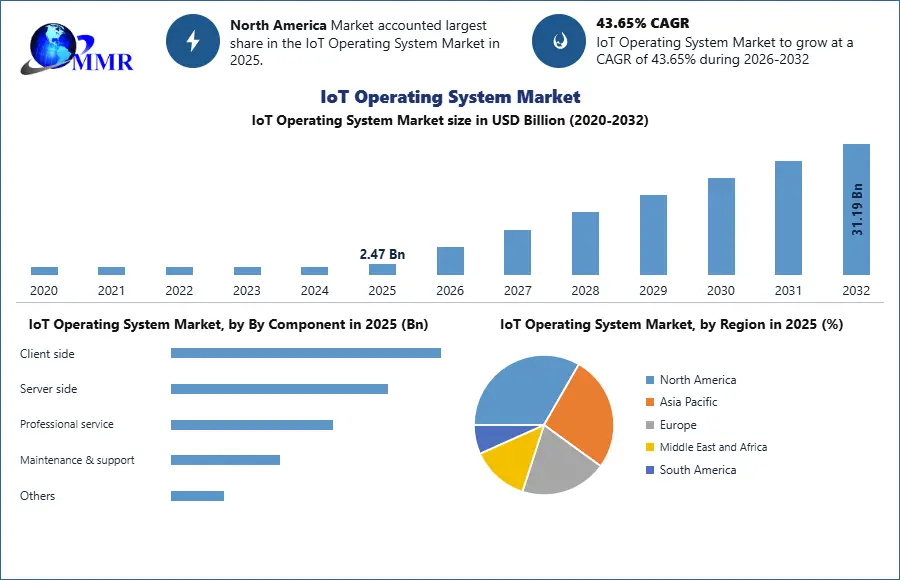 To know about the Research Methodology :- Request Free Sample Report
IoT Operating System Market Dynamics :
Rising Adoption of Smart Connected Devices and Industrial Automation Accelerates Global IoT Operating System Market Growth
The increasing adoption of smart connected devices, industrial automation, and Industry 4.0 technologies is a major driver fueling the growth of the Global IoT Operating System Market. IoT operating systems are widely used in smart homes, healthcare devices, automotive systems, industrial machinery, wearable electronics, and connected infrastructure to manage communication, data processing, and device interoperability. The rapid expansion of Industrial IoT (IIoT), edge computing, and AI-enabled connected ecosystems is significantly increasing demand for lightweight, secure, and scalable IoT operating systems. In addition, growing investments in smart city projects, 5G connectivity, cloud computing, and real-time monitoring systems are further accelerating market growth. Enterprises are increasingly adopting IoT operating systems to improve operational efficiency, remote asset management, predictive maintenance, and automation capabilities. Furthermore, rising demand for energy-efficient embedded systems and low-power wireless communication technologies is supporting the expansion of the Global IoT Operating System Market across industrial and consumer applications.
Cybersecurity Risks and Device Compatibility Challenges Restrict IoT Operating System Market Expansion
Increasing cybersecurity concerns and device compatibility challenges remain significant restraints limiting the growth of the Global IoT Operating System Market. IoT ecosystems involve large volumes of connected devices exchanging sensitive data across networks, making them vulnerable to cyberattacks, malware, data breaches, and unauthorized access. Weak security frameworks and lack of standardized communication protocols across different IoT platforms create operational risks for enterprises and consumers. In addition, interoperability issues between hardware devices, software platforms, and communication technologies increase deployment complexity and integration costs. Many organizations also face challenges in managing software updates, device scalability, and long-term maintenance across diverse IoT environments. Furthermore, high implementation costs and limited technical expertise in developing regions may slow adoption of advanced IoT operating systems. These technological and security-related barriers continue to restrain market growth globally.
Expansion of Edge Computing, AI Integration, and Smart City Projects Creates New Opportunities in the Global IoT Operating System Market
The rapid expansion of edge computing, artificial intelligence integration, and smart city infrastructure is creating substantial growth opportunities in the Global IoT Operating System Market. IoT operating systems integrated with AI and machine learning capabilities enable intelligent automation, real-time analytics, predictive maintenance, and advanced decision-making across connected environments. Growing deployment of autonomous vehicles, smart healthcare systems, connected factories, and intelligent transportation networks is significantly increasing demand for advanced embedded operating systems. Emerging economies in Asia-Pacific, the Middle East, and Latin America are also investing heavily in digital transformation, smart grid projects, and industrial automation, creating strong growth potential for IoT platform providers. Additionally, advancements in low-power semiconductor technologies, edge AI processors, and 5G-enabled IoT communication systems are expected to accelerate innovation and open new revenue opportunities in the Global IoT Operating System Market.
IoT Operating System Market Segment Analysis:
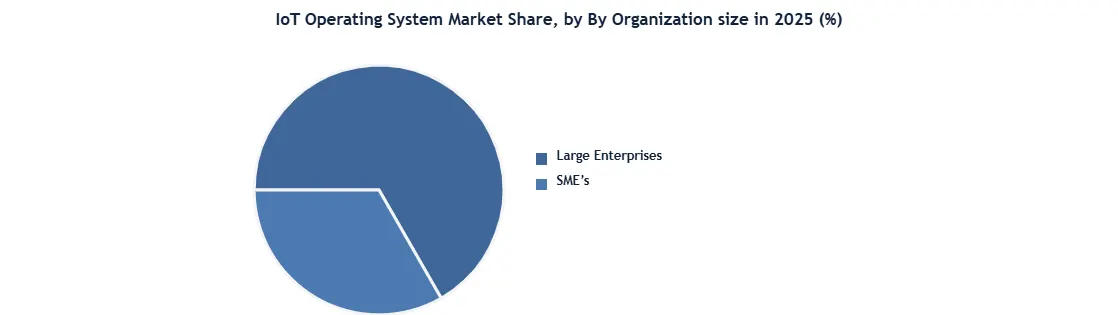
By organization size, the large enterprises segment dominated the market, accounting for a market size of US$ xx Bn. in 2025and expected to reach US$ xx Bn. by 2032 growing at a CAGR of xx% during the forecast period. Large enterprises continue to invest significantly in upgrading traditional IT infrastructure to support changing business management trends, digital transformation initiatives, and advanced application delivery systems. The increasing adoption of cloud computing, IoT platforms, AI-driven analytics, cybersecurity solutions, and enterprise mobility technologies is further driving segment growth.
IoT Operating System Market Regional Analysis:
North America dominated the Global IoT Operating System Market owing to the rapid adoption of Industrial IoT (IIoT), smart connected devices, cloud computing, and advanced automation technologies across the United States and Canada. The region benefits from strong presence of major technology companies, high investment in AI-enabled IoT infrastructure, and increasing deployment of smart home, healthcare, automotive, and manufacturing applications. Rising adoption of edge computing, 5G connectivity, and cybersecurity-focused IoT operating systems is further accelerating market growth in North America.
Meanwhile, Asia-Pacific is witnessing the fastest growth due to rapid industrialization, smart city initiatives, and expanding consumer electronics production in China, India, Japan, and South Korea. Increasing government support for digital transformation and Industry 4.0 projects is boosting demand for embedded IoT operating systems in manufacturing and automotive sectors. Europe also maintains strong market demand driven by industrial automation, energy-efficient infrastructure, and growing adoption of connected healthcare and smart mobility solutions.

Competitive Landscape:
The MMR reports cover recent developments in the global market as organic and inorganic growth strategies. For example, In March 2017, eSol Co., Ltd. introduced eMCOS Scalable POSIX-Compliant RTOS. It provides reliability for embedded systems and superior real-time capacities that demand a high amount of computing function and energy on an independent and distributed basis, like sophisticated driver support systems, autonomous driving systems, industrial IoT and other apps that used state-of-the-art technology for instance AI, profound learning and computer vision. It will accelerate R&D and also decrease production time.
The objective of the report is to present a comprehensive analysis of the global market to the stakeholders in the industry. The past and current status of the industry with forecasted market size and trends are presented in the report with the analysis of complicated data in simple language.
The report covers all the aspects of the industry with a dedicated study of key players that include market leaders, followers, and new entrants. PORTER, SVOR, PESTEL analysis with the potential impact of micro-economic factors of the market have been presented in the report. External as well as internal factors that are supposed to affect the business positively or negatively have been analysed, which will give a clear futuristic view of the industry to the decision-makers.
IoT Operating System Market, Key Highlights:
- Global IoT Operating System Market analysis and forecast, in terms of value.
- Comprehensive study and analysis of market drivers, restraints and opportunities influencing the growth of the global market
- IoT Operating System Market segmentation on the basis of type, source, end-user, and region (country-wise) has been provided.
- Global IoT Operating System Market strategic analysis with respect to individual growth trends, future prospects along with the contribution of various sub-market stakeholders have been considered under the scope of study.
- Global IoT Operating System Market analysis and forecast for five major regions namely North America, Europe, Asia Pacific, the Middle East & Africa (MEA) and Latin America along with country-wise segmentation.
- Profiles of key industry players, their strategic perspective, market positioning and analysis of core competencies are further profiled.
- Competitive developments, investments, strategic expansion and competitive landscape of the key players operating in the global market are also profiled.
IoT Operating System Market Scope: Inquire before buying
| IoT Operating System Market | |||
|---|---|---|---|
| Report Coverage | Details | ||
| Base Year: | 2025 | Forecast Period: | 2026-2032 |
| Historical Data: | 2020 to 2025 | Market Size in 2025: | 2.47 USD Billion |
| Forecast Period 2026-2032 CAGR: | 43.65% | Market Size in 2032: | 31.19 USD Billion |
| Segments Covered: | By Component | Client side Server side Professional service Maintenance & support Others |
|
| By Organization size | Large Enterprises SME’s |
||
| By Operating System | Linux-Based IoT Operating Systems Real-Time Operating Systems (RTOS) Hybrid Kernel Operating Systems Proprietary IoT Operating Systems Open-Source IoT Operating Systems |
||
| By Deployment Model | Cloud-Based Deployment On-Premise Deployment Hybrid Deployment Edge Deployment |
||
| By License Model | Subscription-Based Licensing Per Device Licensing Enterprise Volume Licensing Open-Source with Paid Support |
||
| By Application | Smart Building & Home Automation Capillary Networks Management Smart Utilities Vehicle Telematics Industrial Manufacturing and Automation Smart Healthcare |
||
IoT Operating System Market, by Region
North America (United States, Canada and Mexico)
Europe (UK, France, Germany, Italy, Spain, Sweden, Austria and Rest of Europe)
Asia Pacific (China, South Korea, Japan, India, Australia, Indonesia, Malaysia, Vietnam, Taiwan, Bangladesh, Pakistan and Rest of APAC)
Middle East and Africa (South Africa, GCC, Egypt, Nigeria and Rest of ME&A)
South America (Brazil, Argentina Rest of South America)
IoT Operating System Market, Key Players:
- Microsoft Corporation
- Google LLC
- Amazon Web Services, Inc. (AWS)
- Apple Inc.
- IBM Corporation
- Oracle Corporation
- Cisco Systems, Inc.
- SAP SE
- PTC Inc.
- ARM Holdings plc
- Wind River Systems, Inc.
- BlackBerry Limited (QNX)
- Green Hills Software LLC
- Canonical Ltd.
- Samsung Electronics Co., Ltd.
- Intel Corporation
- Enea AB
- eSol Co., Ltd.
- Kaspersky Lab
- Wittenstein
- SYSGO GmbH
- Renesas Electronics Corporation
- Advantech Co., Ltd
- Huawei Technologies Co., Ltd.
- Analog Devices, Inc.
Others