
Algae Products Market Size by Source, Type, Form, Production Process, Application, Distribution Channel, Region – Revenue Pool Analysis, Margin Structure Assessment, Capital Flow Trends, Competitive Benchmarking & Forecast to 2034
Overview
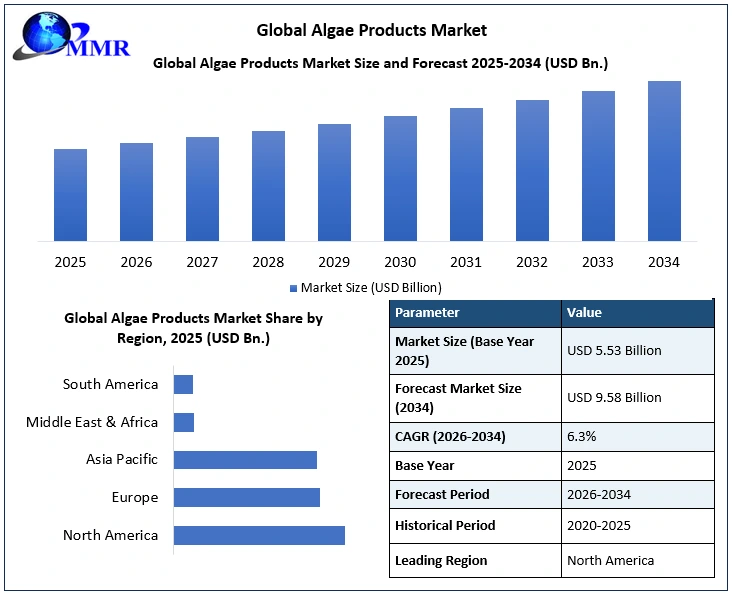
The Algae Products Market size was valued at USD 5.53 Billion in 2025, and the total revenue is expected to grow at CAGR of 6.3 % from 2026 to 2034, reaching USD 9.58 Billion.
Global Algae Products Market Overview
Algae products are commercially processed ingredients obtained from microalgae and macroalgae, including spirulina, chlorella, seaweed products, algal oil, algae protein, algae omega-3, natural algae pigments, hydrocolloids, algae supplements, algae-based fertilizers, and algae feed ingredients. These algae-based products are widely used in food and beverages, dietary supplements, nutraceuticals, pharmaceuticals, cosmetics, animal feed, aquaculture, agriculture, and bio-based products because of their high protein, vitamins, minerals, antioxidants, essential fatty acids, and functional bioactive compounds.
Commercial and industrial algae cultivation has numerous uses, including production of nutraceuticals such as omega-3 fatty acids (as algal oil) or natural food colorants and dyes, food, fertilizers, bioplastics, chemical feedstock (raw material), protein-rich animal/aquaculture feed, pharmaceuticals, and algal fuel, and can also be used as a means of pollution control and natural carbon sequestration.
Global production of farmed aquatic plants, overwhelmingly dominated by seaweeds, grew in output volume from 13.5 million tonnes in 1995, to just over 30 million tonnes in 2016 and 37.8 million tonnes in 2022 and 40 million tonnes in 2024. This increase was the result of production expansions led by China, followed by Malaysia, the Philippines, the United Republic of Tanzania, and the Russian Federation.
The Global Algae Products Market was valued at USD 5.53 Billion in 2025 and is expected to reach USD 9.58 Billion by 2034, growing at a CAGR of 6.3% during 2026–2034. The Algae Products Market growth is driven by rising demand for plant-based protein, algae-based food ingredients, spirulina supplements, chlorella supplements, algae-derived omega-3, natural food colors, seaweed extracts, sustainable aquaculture feed, and organic algae fertilizers. Asia is a major algae production and seaweed cultivation market, and according to the FAO, the region accounted for 76% of global aquatic animal and algae production in 2024, supported by large-scale aquaculture and seaweed farming.
The Maximize Market Research Global Algae Products Market report provides detailed analysis of market size, market forecast, growth drivers, restraints, algae products market trends, market segmentation, regional analysis, competitive landscape, key players, emerging algae applications, and investment opportunities. The report helps manufacturers, algae producers, ingredient suppliers, biotechnology companies, and investors identify high-growth segments and strategic opportunities through 2034.
Global Algae Products Market Growth Outlook
 To know about the Research Methodology :- Request Free Sample Report
Global Algae Products Market Dynamics
Rising demand for algae-based ingredients in cosmetics and personal care is supporting market growth
The increasing use of algae extracts, seaweed ingredients, natural pigments, antioxidants, and bioactive compounds in skincare, anti-aging creams, moisturizers, serums, masks, and spa treatments is driving the Global Algae Products Market. Algae-based ingredients are valued for their natural nutrient content and functional properties, while consumer preference for clean-label, marine-based, plant-derived, and sustainable cosmetic ingredients is encouraging personal care companies to include algae in a wider range of formulations.
High algae cultivation and processing costs are limiting wider market adoption
The relatively high cost of producing commercial algae products is restraining market expansion, particularly in price-sensitive applications. Expenses related to cultivation systems, harvesting, dewatering, drying, extraction, purification, energy consumption, and contamination control can increase the final cost of algae-based ingredients. Advanced systems such as photobioreactors offer better control and product consistency but usually require higher capital and operating investment, which can limit adoption among smaller producers.
Growing use of algae in biofuel production is creating new market opportunities
The rising focus on renewable energy, carbon reduction, and alternative fuel sources is creating new opportunities for algae-based biofuels. Microalgae contain lipids, carbohydrates, and other compounds that can be converted into biodiesel, bio-oil, biogas, hydrogen, and other renewable fuels. Ongoing development in algae biotechnology, wastewater-based cultivation, carbon capture utilization, and integrated biorefineries is improving the long-term commercial potential of algae as a sustainable energy feedstock.
Scaling algae cultivation to commercial production remains a major market challenge
Moving algae production from laboratory and pilot-scale facilities to large-scale commercial operations remains difficult because productivity depends on stable light, temperature, nutrients, water quality, and contamination control. Open ponds, closed systems, and photobioreactors each have different limitations related to productivity, maintenance, energy use, and infrastructure requirements. Maintaining consistent biomass quality while reducing production costs continues to be a major challenge for companies operating in the Global Algae Products Market.
Algae Products Market Segment Analysis
Macroalgae is expected to hold the larger share of the market by source
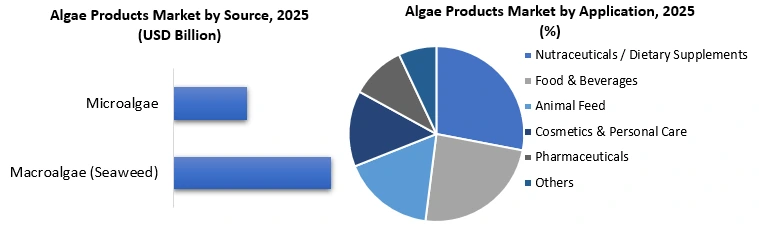
Based on source, the Global Algae Products Market is segmented into Microalgae and Macroalgae (Seaweed), with macroalgae further divided into brown, red, and green algae. Macroalgae is expected to account for the larger market share in 2025, supported by its extensive use in food products, hydrocolloids, fertilizers, animal feed, pharmaceuticals, and personal care applications. Brown and red seaweed are particularly important for producing alginates, carrageenan, agar, and other functional ingredients, while microalgae such as spirulina and chlorella are gaining demand in nutraceuticals, dietary supplements, natural pigments, and high-value protein products.
Nutraceuticals and dietary supplements represent a major application segment
Based on application, the Algae Products Market is segmented into Food & Beverages, Animal Feed, Nutraceuticals/Dietary Supplements, Cosmetics & Personal Care, Pharmaceuticals, and Others. Nutraceuticals and dietary supplements are expected to hold a leading share in 2025, driven by strong demand for spirulina, chlorella, algae-based protein, omega-3 fatty acids, antioxidants, vitamins, and natural health ingredients. Food & beverages also represent a significant application area, supported by the growing use of algae as natural colorants, stabilizers, functional ingredients, and plant-based nutrition sources, while cosmetics and pharmaceuticals continue to create demand for high-value algae extracts and bioactive compounds.
Algae Products Industry Ecosystem
The Global Algae Products Market is competitive, with established ingredient manufacturers and specialized algae companies focusing on product innovation, cultivation efficiency, sustainable sourcing, extraction technology, and expansion into high-value applications such as nutraceuticals, food ingredients, cosmetics, animal feed, and pharmaceuticals. Key players operating in the market include dsm-firmenich, BASF SE, Cargill Incorporated, Corbion N.V., Cyanotech Corporation, DIC Corporation, Euglena Co. Ltd., CP Kelco, Kerry Group, and E.I.D.-Parry. These companies compete through new algae-based products, partnerships, acquisitions, capacity expansion, and development of omega-3 oils, proteins, natural pigments, hydrocolloids, spirulina, chlorella, and specialty bioactive ingredients. For example, Cyanotech Corporation has a strong presence in microalgae-based products such as spirulina and astaxanthin, while Corbion participates in algae-derived lipid and specialty ingredient applications.

Global Algae Products Market Regional Analysis
North America represents a significant share of the Global Algae Products Market, supported by strong demand for algae supplements, omega-3 products, natural food ingredients, cosmetics, and plant-based nutrition. The United States remains a key market because of the presence of established nutraceutical, biotechnology, food ingredient, and personal care companies.
Europe is witnessing steady growth as the use of microalgae, seaweed extracts, algae proteins, hydrocolloids, and natural pigments expands across food, pharmaceuticals, cosmetics, and animal feed. Government-backed sustainability programs and the EU Algae Initiative are also encouraging investment in algae cultivation, processing, and commercialization.
Asia Pacific continues to be the main production base for algae and seaweed products, supported by large-scale cultivation and a strong aquaculture industry. Countries such as China, Indonesia, Japan, South Korea, and the Philippines play an important role in supplying seaweed, hydrocolloids, food ingredients, fertilizers, and feed products. FAO data shows that Asia accounted for 97% of global algae production in 2024, highlighting the region’s strong supply-side position.
South America is developing opportunities in seaweed farming, food ingredients, animal feed, fertilizers, and biotechnology, with countries such as Chile and Brazil showing growing commercial potential. Middle East & Africa remains an emerging market, where increasing interest in microalgae cultivation, aquaculture feed, wastewater treatment, biofuels, and sustainable agriculture is expected to support future market development.
Recent Industry Developments
| Exact Date | Company / Organization | Development | Impact |
| 28 August 2026 | Circular Bio-based Europe Joint Undertaking (CBE JU) | Highlighted new European algae-based industrial projects covering food ingredients, animal feed, bio-based materials, cosmetics, chemicals, and other circular bioeconomy applications. | Strengthens investment and commercialization opportunities for algae-derived products across Europe and supports wider industrial adoption. |
| 24 July 2026 | I3-4-Seaweed Project / EU4Algae | Released a new industry guide focused on the use of seaweed as a food ingredient, including product development, safety, regulation, and commercialization requirements for European food companies. | Supports faster adoption of seaweed ingredients in processed foods and helps manufacturers address regulatory and product-development barriers. |
| 9 June 2026 | DIC Corporation | Developed SACRANEX™ Powder, an algae-derived cosmetic ingredient obtained from cultivated Aphanothece sacrum, with global sales scheduled from June 2026. | Expands the use of algae-based functional ingredients in skincare and clean beauty formulations, strengthening demand from the cosmetics and personal care industry. |
| 20 April 2026 | Corbion | Announced a new U.S. patent covering a DHA-rich algal biomass suspension used in products such as AlgaPrime® DHA LS for aquaculture, animal nutrition, and pet food. | Strengthens Corbion’s intellectual property position in algae-derived omega-3 and supports broader use of sustainable DHA ingredients in feed applications. |
| 14 April 2026 | Fermentalg | Launched OMEGA ΩRIGINS™ EPA/DHA, a new microalgae-derived omega-3 oil range developed for dietary supplements, functional food & beverages, sports nutrition, and pet nutrition. | Expands the supply of high-concentration algae-based EPA and DHA, increasing competition in plant-based omega-3 and premium nutraceutical ingredients. |
| 19 February 2026 | CSIR-CSMCRI and Jagrit Chemicals & Fertilizers Ltd. | Signed a technology-transfer agreement for two seaweed-based agricultural biostimulants, including Kappaphycus sap and a brown-algae liquid plant biostimulant. | Supports commercialization of algae-derived agricultural inputs and expands the role of seaweed products in sustainable farming and reduced chemical fertilizer use. |
| 12 January 2026 | Aker BioMarine | Announced expansion in India and the introduction of Revervia, a high-concentration algae-based DHA ingredient, alongside stronger local distribution and nutraceutical partnerships. | Increases availability of vegetarian algae-derived omega-3 ingredients in India and strengthens competition in the Asia Pacific nutraceutical market. |
Algae Products Market Scope: Inquire before buying
| Algae Products Market | |||
|---|---|---|---|
| Report Coverage | Details | ||
| Base Year: | 2025 | Forecast Period: | 2026-2034 |
| Historical Data: | 2020 to 2025 | Market Size in 2025: | 5.53 USD Billion |
| Forecast Period 2026-2034 CAGR: | 6.3% | Market Size in 2034: | 9.58 USD Billion |
| Segments Covered: | by Source | Microalgae Macroalgae (Seaweed) Brown Algae Red Algae Green Algae |
|
| by Type | Lipids Proteins Carbohydrates Hydrocolloids (Carrageenan, Alginates, Agar) Pigments (Carotenoids, Phycocyanin) Others |
||
| by Form | Powder Liquid Tablets/Capsules Granules Others |
||
| by Application | Food & Beverages Animal Feed Nutraceuticals / Dietary Supplements Cosmetics & Personal Care Pharmaceuticals Others |
||
| by Distribution Channel | B2B B2C Supermarkets/Hypermarkets Specialty Stores Online Retail |
||
Algae Products Market, by Region
North America (United States, Canada and Mexico)
Europe (UK, France, Germany, Italy, Spain, Sweden, Austria and Rest of Europe)
Asia Pacific (China, South Korea, Japan, India, Australia, Indonesia, Malaysia, Vietnam, Taiwan, Bangladesh, Pakistan and Rest of APAC)
Middle East and Africa (South Africa, GCC, Egypt, Nigeria and Rest of ME&A)
South America (Brazil, Argentina Rest of South America)
Key Players / Competitors Profiles Covered in Brief in Global Algae Products Market Report in Strategic Perspective:
1. DIC Corporation
2. Cyanotech Corporation
3. Corbion NV
4. Cargill
5. Archer-Daniels-Midland Company
6. Koninklijke DSM N.V.
7. DuPont de Nemours Inc
8. BASF SE
9. AlgaEnergy
10. Acadian Seaplants Limited
11. Earthrise Nutritionals LLC
12. Euglena Co. Ltd.
13. BlueBioTech International GmbH
14. AlgaeCan Biotech Ltd.
15. Bioprocess Algae LLC
16. Cellana Inc.
17. CP Kelco ApS
18. Wild Irish Seaweeds Ltd.
19. Beijing Leili Marine Bioindustry Inc.
20. ACCEL Carrageenan Corporation
21. Algatechnologies Ltd
22. Algenol
23. Caldic B.V.
24. TBK Manufacturing Corporation
25. E.I.D. Parry
26. AstaReal AB
27. Allmicroalgae – Natural Products S.A.
28. Veramaris
29. Evonik Industries AG
30. Ocean Harvest Technology plc
31. Aker BioMarine ASA
32. Phyco-Biotech
33. Fuqing King Dnarmsa Spirulina Co., Ltd.
34. Tianjin Norland Biotech Co., Ltd.
35. Olmix Group
36. Phycom B.V.
37. Goerlich Pharma GmbH
38. Algae Systems LLC
39. Algaetech International Sdn. Bhd.
40. Algarithm Ingredients Inc.
41. Algix LLC
42. Taiwan Chlorella Manufacturing Company Limited
43. Sophie's Bionutrients Pte. Ltd.
44. AgarGel Indústria e Comércio Ltda.
45. Bioriginal Food & Science Corp.
Frequently Asked Questions:
1] What segments are covered in the Algae Products Market report?
Ans. The segments covered in the Algae Products Market report are based on Source, Type, Form, Production Process, Application, Distribution Channel and region
2] Which region is expected to hold the highest share of the Algae Products Market?
Ans. The North America region is expected to hold the highest share of the Algae Products Market.
3] What is the market size of the Algae Products Market by 2034?
Ans. The market size of the Algae Products Market by 2034 is USD 9.58 Bn.
4] What is the growth rate of the Algae Products Market?
Ans. The Global Algae Products Market is growing at a CAGR of 6.3 % during the forecasting period 2026-2034.
5] What was the market size of the Algae Products Market in 2025?
Ans. The market size of the Algae Products Market in 2025 was USD 5.53 Bn.