AI Powered Content Creation Market Size by Component, Content Type, Deployment Mode, Application, End User, Region – Segment-Level Market Assessment, Growth Opportunity Analysis, Competitive Mapping & Forecast to 2034

17.63%
CAGR (2026-2034)
2.9 USD Bn.
Forecast Market Size
317
Report Pages
143
Market Tables

Overview

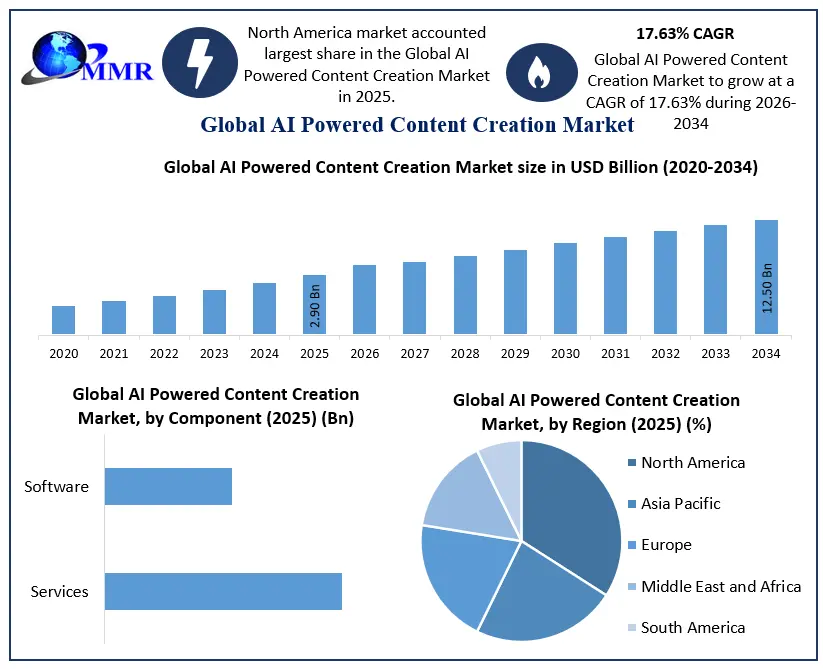
The AI Powered Content Creation Market size was valued at USD 2.90 Billion in 2025 and the total AI Powered Content Creation revenue is expected to grow at a CAGR of 17.63% from 2026 to 2034, reaching USD 12.50 Billion by 2034.

AI Powered Content Creation Market Overview

The market for AI content creation tools is expanding quickly and innovating because of the growing need for high-quality content across various industries. The technologies automate and expedite the creation of content, from writing articles and publishing social media postings to making films and designing graphics, by utilizing artificial intelligence and machine learning algorithms. The requirement for enterprises to increase their content production efforts while preserving consistency and relevancy is one of the main factors propelling this industry. Organizations remain ahead of the competition in competitive marketplaces by using AI content creation solutions to swiftly and efficiently generate massive volumes of content.
AI Powered Content Creation Market Growth Outlook

To know about the Research Methodology :- Request Free Sample Report

Latin America, especially The Chile Region, play an important role which cannot be ignored. The market in Latin America has been expected to grow considerably during the forecast period. The high adoption of advanced technology and the presence of large players in this region are likely to create ample growth opportunities for the market.

AI Powered Content Creation Market Dynamics

Drivers for AI Powered Content Creation Industry

The tools used to automate tasks like image editing, video rendering, or writing saving time and resources for content creators. AI algorithms analyze data to tailor content for specific people, which helps in improving engagement and relevance. More drivers for AI content creation are creatively enhance, scalability, data-driven insight, accessibility, and reduces workload. The increasing demand for personalized marketing experiences is a key driver in the AI Content Marketing market. Consumers today expect customized and relevant content that caters to their specific needs and preferences.

AI technologies enable businesses to analyze vast amounts of data and gain insights into customer behavior, allowing them to deliver highly personalized content at scale. By leveraging AI algorithms and machine learning models, businesses would create targeted campaigns, personalized recommendations, and dynamic content that resonates with individual customers not only enhances customer engagement but also improves conversion rates and customer loyalty. The rising demand for personalization in marketing is driving the adoption of AI Content Marketing solutions, propelling the growth of the market.

Restrains for AI Powered Content Creation Market

One of the significant restraints in the AI powered Content market is the growing concern over data privacy and security. AI relies on collecting and analyzing large volumes of data, including sensitive customer information. This raises concerns regarding the safeguarding of personal data and the potential misuse or unauthorized access to such data. Data breaches and privacy violations severely impact consumer trust and lead to legal and reputational consequences for businesses.

AI content creation lack creativity plus the authenticity of human-created content which will lead to quality issues. Content created by AI infringe copyright laws or produces unethical or misleading content, leading to legal and reputational risk. AI struggle to understand cultural factors, context, and many others factors which lead content to irrelevant or inappropriate target audience. Government regulation and industry standard impose limitation on the use of AI for content creation, particularly in sensitive or regulated sectors such as healthcare, finance, or legal industries.

Opportunity for AI Powered Content Creation Market

The opportunities in AI helps in the analysis of large datasets to uncover valuable insights about audience preferences, behavior, and trends, enabling content creators to tailor their content strategies for maximum impact. AI tools inspire creativity by providing suggestions, introducing ideas, and assisting with tasks in content creation. It helps and empowers content creators to explore and get new ideas concepts and approaches, Some other opportunity points are as follows: Natural Language Processing (NLP), Content localization, Content Curation and discovery, Real-time content creation. The integration of AI with emerging technologies presents significant opportunities in the AI powered Content creation market. AI be combined with technologies such as augmented reality (AR), virtual reality (VR), voice assistants, and chatbots to create immersive and interactive content experiences. For example, AI-powered chatbots engage customers in personalized conversations and provide real-time assistance, enhancing customer engagement and satisfaction. AR and VR technologies enable consumers to visualize products in a virtual environment, improving the shopping experience. The integration of AI with the emerging technologies enhances content marketing strategies, making them more engaging, memorable, and effective. By leveraging the opportunities, businesses differentiate themselves in the market and gain a competitive edge.

Challenges for AI powered content creation market

A significant challenge in the AI Powered Content Creation market is keeping pace with rapid technological advancements. AI technologies and algorithms are continuously evolving, and businesses need to stay updated with the latest developments to remain competitive. However, implementing and integrating new AI solutions be complex and resource-intensive, requiring skilled professionals and substantial investments. The AI Powered Content Creation market face challenges such as maintaining authenticity ensuring quality, avoiding bias in generated content, addressing copyright issues, ethical concerns, copyright and plagiarism, adaptability, complexity, data privacy, and user acceptance. Additionally, as technology evolves, businesses must adapt their content marketing strategies and processes to leverage the full potential of AI. Failure to keep up with the rapid advancements lead to a competitive disadvantage and hinder the effectiveness of content marketing efforts. Overcoming this challenge requires continuous learning, investment in research and development, and a proactive approach to adopting new AI technologies and methodologies.

AI Powered Content Creation Market Segment Analysis:

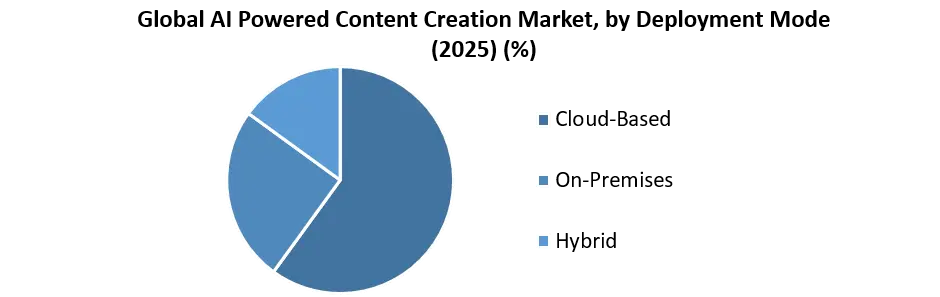
Based on the Deployment Mode, The global AI content creation market is segmented by deployment mode into cloud-based, on-premises, and hybrid solutions. Cloud-based deployment enables users to access AI content creation platforms through the internet, offering scalability, flexible subscriptions, and lower infrastructure requirements. On-premises deployment allows organizations to install and manage AI software within their own IT infrastructure, providing greater control over data security, privacy, and customization. Hybrid deployment combines cloud and on-premises environments, allowing businesses to balance scalability with data governance and operational flexibility. Growing adoption of generative AI, enterprise automation, and secure content workflows supports demand across all three deployment models.AI Powered Content Creation Market by Deployment Mode
 

Based on the Component, The global water treatment system market is segmented by component into software and services. Software includes water treatment monitoring platforms, process-control systems, automation software, predictive maintenance tools, and water-quality management solutions. These technologies help operators monitor treatment performance, optimize chemical consumption, improve operational efficiency, and detect system issues. Services include installation, engineering, commissioning, maintenance, repair, consulting, system integration, and operational support. Growing demand for efficient water management, regulatory compliance, wastewater reuse, and digital water infrastructure supports demand for both components.

Regional Analysis of AI Powered Content Creation Market:

North America holds the leading position in the global AI-powered content creation market, supported by advanced digital infrastructure, high enterprise adoption of generative AI, and the presence of major technology companies. The United States drives regional demand through the adoption of AI-powered writing, image generation, video production, content optimization, and marketing automation platforms. Canada also experiences increasing adoption across advertising, media, education, healthcare, and e-commerce, supported by its growing AI ecosystem and demand for personalized, multilingual content.

Europe represents a significant market, driven by the expansion of digital marketing, creative industries, e-commerce, and enterprise automation. Countries such as the UK, Germany, and France adopt AI-powered content generation tools to improve multilingual communication, automate marketing campaigns, and personalize customer experiences. Demand for responsible AI, data protection, transparency, and content governance also influences platform selection across the region.

Asia Pacific is expected to register the fastest growth during the forecast period. Increasing internet penetration, expanding digital economies, rising social media engagement, and growing e-commerce activities support demand for AI-powered content creation tools. China, India, Japan, South Korea, and Australia are important markets. Businesses increasingly use AI-generated text, images, videos, and multilingual content to reach diverse audiences and improve digital marketing efficiency.

South America experiences growing adoption of AI-powered content creation solutions, particularly in Brazil and Argentina. Expanding digital advertising, social media marketing, online retail, and mobile internet usage create opportunities for automated content generation. Businesses increasingly explore AI writing, translation, image creation, and campaign optimization tools to reduce production costs and engage local-language audiences.

The Middle East and Africa market develops through digital transformation initiatives, increasing investments in AI infrastructure, and expanding online business activities. The UAE, Saudi Arabia, and South Africa are emerging adoption centres. Demand for Arabic-language content, automated advertising, personalized digital experiences, and AI-supported media production creates opportunities for regional and international content technology providers.

AI Powered Content Creation Market competitive landscape

1. September 2026 – Adobe acquires Rilo: Adobe acquires Indian marketing intelligence startup Rilo, strengthening its capabilities in AI-driven marketing automation, campaign management, and brand visibility across AI-powered search platforms.

2. June 2026 – Runway and Lionsgate expand partnership: Runway and Lionsgate announce an expanded strategic collaboration to develop new intellectual property using generative AI. The partnership includes a joint development programme and an equity investment by Lionsgate in Runway.

3. May 2026 – Coty partners with Pencil: Coty partners with generative AI marketing platform Pencil to integrate AI-powered image and video creation into its Consumer Beauty brands, improving content production, campaign deployment, and marketing efficiency.

AI Powered Content Creation Market Scope: Inquiry Before Buying

AI Powered Content Creation Market
Report Coverage Details
Base Year: 2025 Forecast Period: 2026-2034
Historical Data: 2020 to 2025 Market Size in 2025: USD 2.90 Bn.
Forecast Period 2026 to 2034 CAGR: 17.63% Market Size in 2034: USD 12.50 Bn.
Segments Covered: by Component Software
Services
by Content Type Text Content
Image & Graphic Content
Video Content
Audio & Voice Content
3D & Interactive Content
Multimodal Content
by Deployment Mode Cloud-Based
On-Premises
Hybrid
by Organization Size Small & Medium-Sized Enterprises (SMEs)
Large Enterprises
by Technology Transformer-Based Generative Models
Diffusion Models
Generative Adversarial Networks
Other Generative Architectures
Hybrid/Composite AI Architectures
by Customer Type Individual Creators & Freelancers
Businesses & Enterprises
Educational & Non-Profit Organizations
Others
by End-User Industry Media & Entertainment
Advertising & Marketing Agencies
Retail & E-Commerce
IT & Telecommunications
Education
Healthcare
BFSI
Other Enterprises & Industries
by Application Advertising & Promotional Content Creation
Social Media Content Creation
E-Commerce Product Content Creation
Media & Entertainment Content Production
Educational & Training Content Development
Corporate & Business Communications
Website, Blog & Editorial Content Creation
Others

AI Powered Content Creation Market, by Region:

North America (United States, Canada, and Mexico)
Europe (UK, France, Germany, Italy, Spain, Sweden, Austria, and the Rest of Europe)
Asia Pacific (China, South Korea, Japan, India, Australia, Indonesia, Malaysia, Vietnam, Taiwan, Bangladesh, Pakistan, and the Rest of APAC)
Middle East and Africa (South Africa, GCC, Egypt, Nigeria, and the Rest of ME&A)
South America (Brazil, Argentina Rest of South America)

AI Powered Content Creation Market, Key Players:

North America
1. OpenAI
2. Adobe Inc.
3. Google LLC
4. Microsoft Corporation
5. NVIDIA Corporation
6. Jasper AI, Inc.
7. Stability AI Ltd.
8. Copy.ai, Inc.
9. Anyword Inc.
10. Amazon Web Services (AWS)
11. Meta Platforms, Inc.
12. Autodesk, Inc.
13. Cohere
14. Pictory
15. Raw Shorts
16. Hour One
17. OpenText Corporation
18. Emplifi

Europe
1. Synthesia Limited
2. Ryte GmbH
3. Freepik Company S.L.
4. M-Files
5. Content360 Ltd.
6. Paramatrix
7. Semrush

Asia-Pacific (APAC)
1. Baidu, Inc.
2. Pepper Content Pvt. Ltd.
3. GliaCloud
4. Designs.ai
5. Samsung Electronics Co., Ltd.
6. Rct AI
7. Nolibox
8. Midjourney Technologies Inc.
9. AI21 Labs Ltd.

Middle East & Africa (MEA)
1. Glimpse.ai
2. Parametrix

South America
1. Pepper Content
2. Semrush
3. Adobe Inc.
4. Freepik Company S.L.
5. Others

FAQs:

1. What are the growth drivers for the global AI Powered Content Creation market?
Ans. The increasing Digital Transformation, Content creation, Content optimization, Content distribution, Content analysis etc. are expected to be the major driver for the AI Powered Content Creation market.

2. What is the major restraint on the AI Powered Content Creation market growth?
Ans. Lack of Creativity and Human Touch are expected to be the major restraining factor for the market growth.

3. Which region is expected to lead the global AI Powered Content Creation market during the forecast period?
Ans. North America is expected to lead the global market during the forecast period.

4. What was the Global AI Powered Content Creation Market size in 2025??
Ans. The AI Powered Content Creation Market size was valued at USD 2.90 Billion in 2025.

5. What segments are covered in the global AI Powered Content Creation Market report?
Ans. The segments covered in the market report are Component, Content Type, Deployment Mode, Application, Technology,Customer Type, Organization Size, End User and Region.

Table of Contents

1. Global AI Powered Content Creation Market– Industry Landscape 1.1 Global AI Powered Content Creation Market Size, in USD Million, 2025–2034 1.2 Evolution from rule-based automation to generative content systems 1.3 Adoption of AI tools across professional content production workflows 1.4 Enterprise integration of generative AI into digital content operations 1.5 Revenue contribution from AI-generated text, images, audio, and video 1.6 Market growth outlook driven by expanding generative AI applications 1.7 CAGR analysis and long-term market growth outlook, 2025–2034 2. Market Dynamics & Framework Analysis 2.1 Market Trends 2.2 Market Dynamics 2.2.1 Market Drivers 2.2.2 Market Restraints 2.2.3 Opportunities 2.2.4 Challenges 2.3 PORTER’s Five Forces Analysis 2.4 PESTLE Analysis 3. AI Content Creation Cost Structure, Economics & Pricing Dynamics 3.1 Model development costs across proprietary and open-source architectures 3.2 Inference expenses across text, image, audio, and video 3.3 GPU infrastructure costs influencing content generation economics 3.4 Subscription pricing structures across major AI content platforms 3.5 Enterprise licensing models and usage-based billing mechanisms 3.6 Content production cost savings versus conventional workflows 4. AI Content Creation Technology Supply Chain & Ecosystem 4.1 GPU and accelerator supply supporting generative model workloads 4.2 Cloud infrastructure providers serving AI content generation platforms 4.3 Foundation model developers supplying underlying generation capabilities 4.4 Third-party APIs enabling embedded content creation functionality 4.5 Creative software integrations expanding distribution and adoption 4.6 Data providers supporting model training and contextual grounding 5. AI Content Formats, Modalities & Generation Capabilities 5.1 Text generation capabilities across long-form and short-form content 5.2 Image synthesis capabilities across illustrations and commercial creatives 5.3 Video generation capabilities across advertising and storytelling formats 5.4 Audio generation capabilities covering speech, music, and sound 5.5 Multimodal generation combining text, images, audio, and video 5.6 Three-dimensional content generation for immersive digital experiences 6. Generative Model Architecture & Technical Performance 6.1 Large language model architectures supporting text generation tasks 6.2 Diffusion model deployment across image and video synthesis 6.3 Transformer-based systems enabling contextual content generation capabilities 6.4 Fine-tuning methods adapting models to specialized content requirements 6.5 Retrieval-augmented generation improving factual and contextual relevance 6.6 Model latency, throughput, and output quality benchmarking 7. AI Content Creation Workflow Automation & Production 7.1 Prompt-based workflows supporting rapid first-draft content generation 7.2 Automated editing, rewriting, summarization, and content repurposing 7.3 Human review stages within automated publishing workflows 7.4 Batch generation tools supporting high-volume content production 7.5 Workflow orchestration connecting generation, approval, and distribution 7.6 Integration of generated assets into existing production pipelines 8. Industry-Specific AI Content Creation Applications 8.1 Marketing content generation for campaigns and customer acquisition 8.2 E-commerce product descriptions, listings, and promotional imagery generation 8.3 Media publishing workflows supporting articles and editorial production 8.4 Entertainment applications spanning scripts, storyboards, and digital assets 8.5 Corporate communications generating reports, presentations, and internal content 8.6 Educational content generation supporting learning materials and assessments 9. AI Content Distribution Channels & Platform Deployment 9.1 Web-based platforms delivering browser-accessible generation capabilities 9.2 Desktop creative applications embedding generative assistance features 9.3 Mobile applications supporting on-the-go content generation workflows 9.4 API-based deployment within enterprise software and digital platforms 9.5 Cloud-hosted solutions enabling scalable content generation services 9.6 On-premises deployment supporting controlled enterprise environments 10. Personalization, Localization & Audience Adaptation 10.1 Audience-specific content generation using behavioral and preference signals 10.2 Brand-voice customization across marketing and communication assets 10.3 Multilingual generation supporting localized content production 10.4 Regional adaptation of messaging, imagery, and cultural references 10.5 Dynamic creative generation for segmented advertising campaigns 10.6 Context-aware content variations across customer engagement channels 11. Enterprise Integration & Content Operations 11.1 Integration with content management and digital asset platforms 11.2 Connections between generative tools and customer relationship systems 11.3 Enterprise resource integration supporting content approval workflows 11.4 Collaboration features connecting marketing, design, and editorial teams 11.5 Identity management and access controls across content workflows 11.6 Content lifecycle management from creation through archival 12. Creator Economy, Monetization & Commercial Adoption 12.1 Individual creator adoption across independent digital publishing channels 12.2 Agency deployment of generative tools for client deliverables 12.3 Subscription monetization across professional creator platforms 12.4 Enterprise licensing opportunities across large-scale content operations 12.5 Creator marketplace integration for AI-assisted digital asset sales 12.6 Revenue models supporting premium content generation services 13. Training Data, Copyright & Intellectual Property 13.1 Training dataset sourcing across licensed and publicly available content 13.2 Copyright exposure associated with model training data usage 13.3 Ownership provisions governing AI-generated commercial content assets 13.4 Synthetic data utilization across specialized generation applications 13.5 Dataset provenance tracking and content licensing transparency 13.6 Intellectual property disputes affecting commercial platform adoption 14. Content Quality, Performance & Measurement Analytics 14.1 Factual accuracy evaluation across generated text outputs 14.2 Visual consistency assessment across synthetic image collections 14.3 Video coherence and temporal consistency measurement frameworks 14.4 Audio intelligibility and synthetic speech quality evaluation 14.5 Content engagement measurement across digital distribution channels 14.6 Benchmarking generated outputs against professional human-created content 15. AI Content Safety, Security & Regulatory Compliance 15.1 Copyright safeguards across generated commercial content outputs 15.2 Detection mechanisms for harmful and deceptive generated material 15.3 Personal data protection during prompts and content processing 15.4 Security controls against prompt injection and data leakage 15.5 Disclosure requirements for synthetic and AI-generated media 15.6 Regulatory compliance across regional AI deployment environments 16. AI Skills Development, Workforce Readiness & Human-AI Collaboration 16.1 AI literacy requirements across content creation professional roles 16.2 Prompt engineering skills for reliable content generation workflows 16.3 Workforce training needs across generative content production teams 16.4 Human-AI collaboration models for creative task allocation 16.5 Skill gaps affecting enterprise adoption of generative platforms 16.6 Reskilling pathways for changing content production responsibilities 17. Human Governance, Accountability & Oversight of AI Content 17.1 Human approval frameworks for high-impact generated content 17.2 Accountability allocation across developers, deployers, and content publishers 17.3 Editorial oversight protocols for factual and brand-sensitive outputs 17.4 Human intervention thresholds for risky generation scenarios 17.5 Governance committees overseeing enterprise generative AI deployment 17.6 Audit trails documenting review decisions and content approvals 18. Innovation Pipeline, Emerging Technologies & Future Outlook 18.1 Real-time video generation and interactive storytelling advancements 18.2 Agentic AI systems automating multistep content production tasks 18.3 Smaller specialized models enabling efficient domain-specific generation 18.4 Digital avatars and synthetic presenters expanding content formats 18.5 Generative search integration reshaping content discovery workflows 18.6 Emerging model capabilities influencing future commercial adoption 19. Strategic Risks, Adoption Barriers & Market Resilience 19.1 Output inconsistency risks affecting professional content production 19.2 Model dependency risks across concentrated technology providers 19.3 Compute capacity constraints affecting large-scale generation workloads 19.4 Workforce displacement concerns influencing organizational adoption decisions 19.5 Platform outages and service disruptions affecting content continuity 19.6 Trust and reputational risks associated with synthetic media 20. Global AI Powered Content Creation Market Size and Forecast by Segmentation (by Value USD Million) (2025-2034) 20.1 Global AI Powered Content Creation Market Size And Forecast, By Component 20.1.1 Software 20.1.2 Services 20.2 Global AI Powered Content Creation Market Size And Forecast, By Content Type 20.2.1 Text Content 20.2.2 Image & Graphic Content 20.2.3 Video Content 20.2.4 Audio & Voice Content 20.2.5 3D & Interactive Content 20.2.6 Multimodal Content 20.3 Global AI Powered Content Creation Market Size And Forecast, By Deployment Mode 20.3.1 Cloud-Based 20.3.2 On-Premises 20.3.3 Hybrid 20.4 Global AI Powered Content Creation Market Size And Forecast, By Organization Size 20.4.1 Small & Medium-Sized Enterprises (SMEs) 20.4.2 Large Enterprises 20.5 Global AI Powered Content Creation Market Size And Forecast, By Technology 20.5.1 Transformer-Based Generative Models 20.5.2 Diffusion Models 20.5.3 Generative Adversarial Networks 20.5.4 Other Generative Architectures 20.5.5 Hybrid/Composite AI Architectures 20.6 Global AI Powered Content Creation Market Size And Forecast, By Application 20.6.1 Advertising & Promotional Content Creation 20.6.2 Social Media Content Creation 20.6.3 E-Commerce Product Content Creation 20.6.4 Media & Entertainment Content Production 20.6.5 Educational & Training Content Development 20.6.6 Corporate & Business Communications 20.6.7 Website, Blog & Editorial Content Creation 20.6.8 Others 20.7 Global AI Powered Content Creation Market Size And Forecast, By End-User Industry 20.7.1 Media & Entertainment 20.7.2 Advertising & Marketing Agencies 20.7.3 Retail & E-Commerce 20.7.4 IT & Telecommunications 20.7.5 Education 20.7.6 Healthcare 20.7.7 BFSI 20.7.8 Other Enterprises & Industries 20.8 Global AI Powered Content Creation Market Size and Forecast, By Region & Country 20.8.1 North America 20.8.1.1 Canada 20.8.1.2 Mexico 20.8.2 Europe 20.8.2.1 United Kingdom 20.8.2.2 France 20.8.2.3 Germany 20.8.2.4 Italy 20.8.2.5 Spain 20.8.2.6 Sweden 20.8.2.7 Russia 20.8.2.8 Rest of Europe 20.8.3 Asia Pacific 20.8.3.1 China 20.8.3.2 South Korea 20.8.3.3 India 20.8.3.4 Japan 20.8.3.5 Australia 20.8.3.6 Indonesia 20.8.3.7 Philippines 20.8.3.8 Malaysia 20.8.3.9 Vietnam 20.8.3.10 Thailand 20.8.3.11 Rest of Asia Pacific 20.8.4 Middle East & Africa 20.8.4.1 South Africa 20.8.4.2 Saudi Arabia 20.8.4.3 United Arab Emirates 20.8.4.4 Qatar 20.8.4.5 Kuwait 20.8.4.6 Bahrain 20.8.4.7 Oman 20.8.4.8 Egypt 20.8.4.9 Nigeria 20.8.4.10 Rest of Middle East & Africa 20.8.5 South America 20.8.5.1 Brazil 20.8.5.2 Argentina 20.8.5.3 Chile 20.8.5.4 Colombia 20.8.5.5 Rest of South America 21. AI Powered Content Creation Market Competitive Landscape 21.1 Competitive Matrix 21.2 Key Player Benchmarking 21.2.1 Company Name 21.2.2 Headquarters 21.2.3 AI Content Creation Product Portfolio 21.2.4 Image Generation Capabilities 21.2.5 Video Generation Capabilities 21.2.6 Audio and Voice Generation Solutions 21.2.7 Code Generation Capabilities 21.2.8 Generative AI Model Portfolio 21.2.9 AI Integration & Platform Compatibility 21.2.10 AI Governance & Regulatory Compliance 21.2.11 Enterprise Customer Base 21.2.12 Revenue 21.2.13 Market Share 21.2.14 R&D Investment 21.2.15 Operating Margin 21.2.16 Year-on-Year Growth 21.2.17 Geographic Presence 22. Market Structure 22.1 Market Leaders 22.2 Market Followers 22.3 Emerging Players 23. Mergers & Acquisitions Details 23.1 Recent Key Developments 24. Company Profiles: Key Players 24.1 Overview 24.2 Business Portfolio 24.3 Financial Overview 24.4 SWOT Analysis 24.5 Strategic Analysis 24.6 Recent Developments 25. Global Ai Powered Content Creation Market, 40+ Key Players 25.1 OpenAI 25.2 Adobe Inc. 25.3 Google LLC 25.4 Microsoft Corporation 25.5 NVIDIA Corporation 25.6 Jasper AI, Inc. 25.7 Stability AI Ltd. 25.8 Copy.ai, Inc. 25.9 Anyword Inc. 25.10 Amazon Web Services (AWS) 25.11 Meta Platforms, Inc. 25.12 Autodesk, Inc. 25.13 Cohere 25.14 Pictory 25.15 Raw Shorts 25.16 Hour One 25.17 OpenText Corporation 25.18 Emplifi 25.19 Synthesia Limited 25.20 Ryte GmbH 25.21 Freepik Company S.L. 25.22 M-Files 25.23 Content360 Ltd. 25.24 Paramatrix 25.25 Semrush 25.26 Baidu, Inc. 25.27 Pepper Content Pvt. Ltd. 25.28 GliaCloud 25.29 Designs.ai 25.30 Samsung Electronics Co., Ltd. 25.31 Rct AI 25.32 Nolibox 25.33 Midjourney Technologies Inc. 25.34 AI21 Labs Ltd. 25.35 Glimpse.ai 25.36 Parametrix 25.37 Pepper Content 25.38 Semrush 25.39 Adobe Inc. 25.40 Freepik Company S.L. 25.41 Others 26. Generative Model Portfolio & Capability Benchmarking 26.1 Text generation quality across leading foundation models 26.2 Image generation fidelity and prompt adherence comparisons 26.3 Video generation duration, resolution, and motion consistency 26.4 Audio generation quality and voice customization capabilities 26.5 Multimodal input and output support across platforms 26.6 Fine-tuning and customization options for enterprise deployments 27. Platform Features & Workflow Integration Benchmarking 27.1 Content editing and revision tools across platforms 27.2 Template libraries and reusable creative asset availability 27.3 Collaboration, approval, and version-control functionality 27.4 API integration depth across enterprise software ecosystems 27.5 Automated publishing and content distribution capabilities 27.6 Workflow orchestration across multiple generative AI tools 28. Infrastructure, Scalability & Technical Performance Benchmarking 28.1 Inference latency across representative content generation tasks 28.2 Concurrent generation capacity under enterprise workloads 28.3 Cloud infrastructure options and regional availability 28.4 Model deployment flexibility across cloud and private environments 28.5 Reliability and uptime across commercial service tiers 28.6 Computing efficiency across different model architectures 29. Pricing, Commercial Models & Customer Value Benchmarking 29.1 Subscription pricing across creator and professional tiers 29.2 Enterprise contract structures and licensing conditions 29.3 API pricing across text, image, audio, and video 29.4 Free-tier restrictions and paid-feature differentiation 29.5 Usage limits and credit consumption policies 29.6 Customer value relative to content production expenditure 30. Industry Adoption & Customer Use-Case Benchmarking 30.1 Marketing campaign production capabilities across leading platforms 30.2 Publishing workflow automation among media organizations 30.3 Product content generation for digital commerce businesses 30.4 Video localization and avatar deployment across enterprises 30.5 Educational content generation and learning-material customization 30.6 Creative asset development across gaming and entertainment 31. Data Governance, Copyright & Compliance Benchmarking 31.1 Training data transparency across major model providers 31.2 Commercial usage rights for generated content outputs 31.3 Copyright indemnification policies and licensing protections 31.4 Enterprise privacy controls and data retention policies 31.5 Synthetic media labeling and provenance support 31.6 Content moderation and responsible-use safeguards 32. Financial Performance, Investment & Strategic Partnerships 32.1 Revenue contribution from generative content products 32.2 Funding activity and investment in model development 32.3 Capital expenditure on AI computing infrastructure 32.4 Cloud partnerships supporting generative platform distribution 32.5 Acquisitions expanding content generation capabilities 32.6 Strategic alliances with software and media companies 33. Key Findings 34. Strategic Moves & Industry Outlook 35. Research Methodology

Custom Market Research Services

We Will Customise The Research For You, In Case The Report Listed Above Does Not Meet With Your Requirements