
NVIDIA Just Told Every Pharma Plant: Your Robots Are About to Get a Brain
Four days ago, the world’s most powerful chip company rewired the future of the Pharmaceutical Robots Market
Key Highlights
- NVIDIA CEO Jensen Huang at GTC 2026, March 16: “Every industrial company will become a robotics company”
- ABB, FANUC, YASKAWA, KUKA — 2M+ installed robots globally — all integrating NVIDIA’s Isaac AI simulation frameworks and Jetson edge inference chips
- ABB’s GoFa™ collaborative robot now performing full pharmaceutical lab workflows — pipetting, titration, GC loading — autonomously, ISO 5 cleanroom certified
- FANUC deploying cleanroom robots across vial filling, cartoning, and dispensing — meeting ISO 5 pharmaceutical manufacturing standards
- Global Pharmaceutical Robots Market at $229.82B — MMR projects $517.65B by 2032 at 12.3% CAGR
Four days ago, Jensen Huang walked onto a stage in San Jose and said something that should have made every pharmaceutical plant manager sit up straight.
“Every industrial company will become a robotics company.”
He was not speaking metaphorically. He was announcing that NVIDIA — the company whose chips now power everything from ChatGPT to autonomous vehicles — has formally entered the industrial robotics race. Not as a chip supplier. As the operating system.
At GTC 2026, NVIDIA locked down partnerships with every major industrial robot manufacturer simultaneously — ABB, FANUC, KUKA, YASKAWA, and Universal Robots — embedding its Isaac AI simulation frameworks and Jetson edge inference chips directly into their controllers. Two million robots, already installed in factories worldwide, are about to get a software brain upgrade.
Pharmaceutical manufacturing is in the crosshairs.
What ABB Just Demonstrated — And Why It Matters
ABB Robotics showed up at SLAS 2026 in Boston with something the pharmaceutical industry has been asking for since cobots were invented: a robot that can actually run a full lab workflow, not just one step of it.
The GoFa™ collaborative robot performed multi-step analytical processes — solid dispensing, liquid pipetting, vial capping, titration, oven cycling, UV-Vis analysis, and GC loading — autonomously, in sequence, working alongside laboratory personnel without a safety cage. No human hand-off between steps. No batch interruption. The robot handles the entire chain.
The system is built around open interoperability — ABB’s GoFa integrates with Agilent instruments, Mettler Toledo hardware, and LabX management software in a single coordinated workflow. The pharmaceutical plant does not need to rip out its existing equipment. The robot plugs in around it.
That is the shift. Not replacement. Integration.
FANUC’s Cleanroom Bet
FANUC America is deploying pharmaceutical-grade robots across the full manufacturing chain — vial filling, automatic cartoning, dispensing, packaging, and labeling — in cleanroom environments certified to ISO 5 Class standards. Every movement is logged. Every cycle is identical. Every batch record is written automatically.
For a pharmaceutical manufacturer, that last line is the one that matters most. Robots perform repetitive tasks with exact fidelity every cycle — standardized procedures with full automatic tracking stored directly in batch records. In an FDA-audited environment, that is not a productivity story. It is a compliance story. And compliance has no ceiling on value.
FANUC is also collaborating with NVIDIA to bring physical AI to its industrial hardware — supporting ROS 2 programming in Python, lowering the barrier for pharmaceutical manufacturers to deploy AI-driven automation without specialist robotics engineers. A process engineer who knows Python can now program a FANUC robot. That changes the adoption curve entirely.
The Number Behind the Headline
According to Maximize Market Research, the global Pharmaceutical Robots Market is valued at $229.82 billion in 2025 and forecast to reach $517.65 billion by 2032 — a 12.3% CAGR that makes it one of the fastest-compounding segments in all of industrial automation.
MMR’s analysis identifies three catalysts driving this trajectory. First, regulatory pressure: FDA and EMA increasingly favor automated, traceable manufacturing processes over manual ones — creating a compliance tailwind for every robot sale. Second, the cell and gene therapy manufacturing wave — explored in depth in MMR’s Regenerative Medicine Market report — demands cleanroom automation at a scale that human operators cannot sustain. Third, the AI integration now being deployed by ABB and FANUC is compressing payback periods from years to months — removing the ROI hesitation that historically slowed pharmaceutical automation adoption.
The NVIDIA GTC announcements of last week are the accelerant that turns all three catalysts into urgency.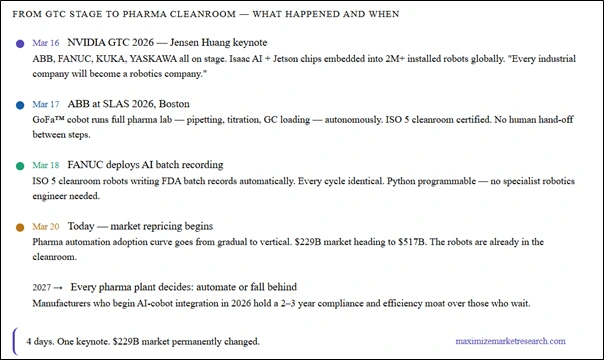
What This Means for Every Pharmaceutical Executive
NVIDIA’s strategy is clear: embed AI into the 2 million robots already installed globally — turning virtual testing and simulation into standard practice before any automation goes live on the factory floor. The pharmaceutical industry, with its extreme cost of errors and regulatory sensitivity, is the ideal proving ground for that model.
The companies that begin integrating AI-enabled cobots into their manufacturing and laboratory workflows in 2026 will have a two-to-three year head start on those that wait. In pharmaceutical manufacturing, a two-year head start on compliance-grade automation is not a competitive advantage. It is a structural moat.
Manufacturers are projected to more than double their use of AI and automation by 2030. The question is not whether pharma plants automate. It is which robot — and which AI — they choose to do it with.
Jensen Huang answered that question four days ago. ABB and FANUC were on the stage with him.
Strategic Market Intelligence
For investment-grade analysis of the automation revolution reshaping pharmaceutical manufacturing: