
Air Products Is Spending USD 5 Billion in the Saudi Desert to Make Green Hydrogen From Wind and Sun
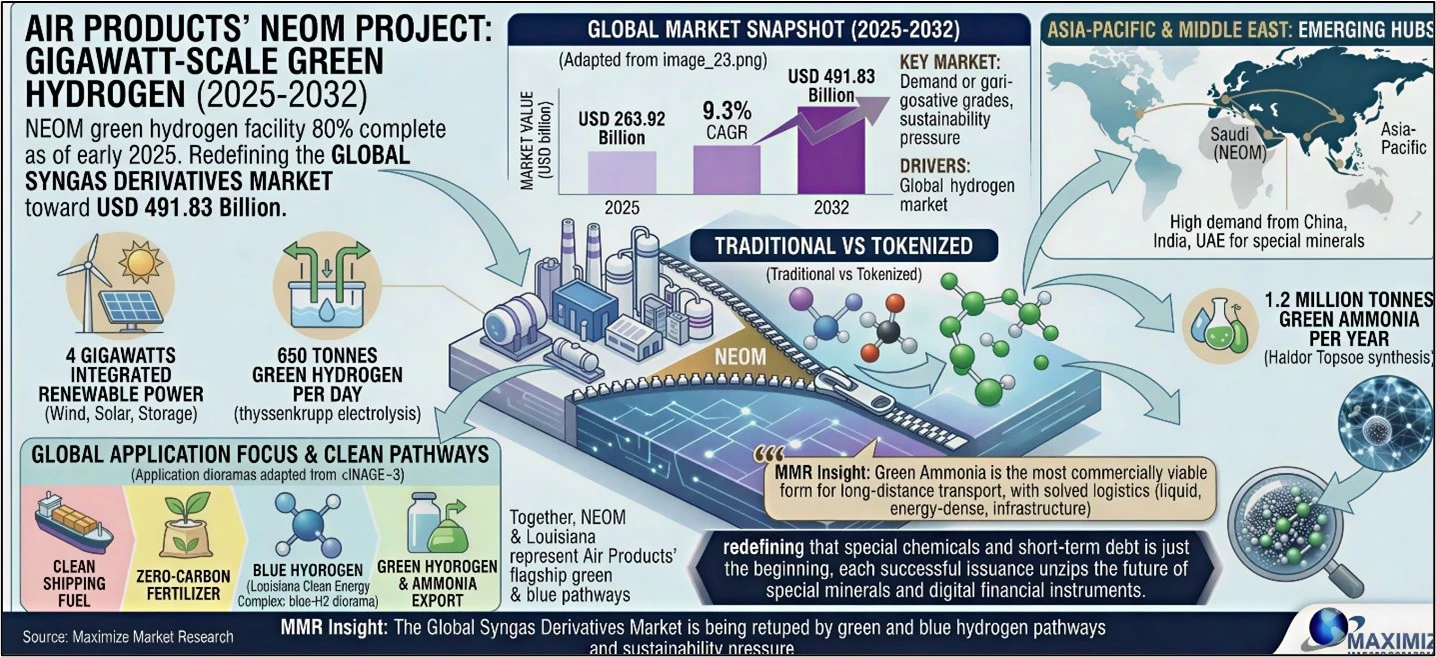
The NEOM green hydrogen facility is 80% complete as of early 2025 and is expected to produce 650 tonnes of green hydrogen per day beginning in late 2026. When it opens, it will be the largest green hydrogen-based ammonia production facility on earth. The syngas derivatives market will never be the same.
In the northwest corner of Saudi Arabia, in a territory called NEOM, something is being built that has no precedent in the history of the energy industry.
A USD 5 billion facility powered entirely by renewable energy – over 4 gigawatts of solar, wind, and storage – is being constructed to produce hydrogen through electrolysis and convert it into green ammonia for export to global markets. No fossil feedstocks. No carbon emissions. No compromise on scale.
The facility is the joint venture of Air Products, ACWA Power, and NEOM. Air Products holds one-third ownership and is the engineering lead. As of early 2025, the project is approximately 80% complete, with green ammonia production expected to commence at the end of 2026.
The Global Syngas Derivatives Market was valued at USD 263.92 billion in 2025 and is projected to reach USD 491.83 billion by 2032 at a CAGR of 9.3%, per Maximize Market Research. The NEOM project sits at the precise intersection of the two forces driving that expansion: the global hydrogen economy and the scale-up of green ammonia as a clean shipping fuel and fertilizer feedstock.
What 650 Tonnes of Green Hydrogen Per Day Actually Means
Scale is easy to announce and hard to execute. The NEOM project’s specifications illustrate what Air Products and its partners are actually building:
- 4 gigawatts of integrated renewable power from solar panels, wind turbines, and battery storage – enough electricity to power millions of homes
- 650 tonnes per day of green hydrogen produced by thyssenkrupp electrolysis technology using only renewable electricity and water
- 2 million tonnes per year of green ammonia produced using Haldor Topsoe synthesis technology, for export to global markets as a clean shipping fuel and zero-carbon fertilizer feedstock
- Zero fossil feedstocks at any point in the production chain, from renewable electricity generation through to ammonia synthesis
MMR Insight: Green ammonia is the most commercially viable form in which to transport green hydrogen over long distances. Ammonia is easier to liquefy and store than hydrogen, carries more energy per unit volume, and has an established global shipping and terminal infrastructure. The NEOM project produces green ammonia precisely because the logistics are solved.
Air Products’ Strategic Pivot: Double Down Where Policy Is Firm
In February 2025, Air Products announced the cancellation of three U.S. hydrogen projects, citing unfavorable economics and regulatory changes. The decision was widely interpreted as a signal that the company is concentrating capital where government support and offtake visibility are strongest.
The NEOM project has both. Saudi Arabia’s Vision 2030 program provides long-term policy backing. The green ammonia offtake is contracted and destined for pre-identified markets. The project economics benefit from a renewable energy cost structure that is among the lowest achievable anywhere on earth.
Air Products is simultaneously progressing the Louisiana Clean Energy Complex in the United States – a blue hydrogen facility pairing steam methane reformers with a 95% carbon capture system – with startup expected in 2028. Together, NEOM and Louisiana represent Air Products’ two flagship large-scale clean hydrogen assets across the green and blue hydrogen pathways.
Final Take
The syngas derivatives market is being restructured by the emergence of green and blue hydrogen pathways that did not commercially exist a decade ago. Air Products, with its 80% complete NEOM project and Louisiana Clean Energy Complex in development, is building the physical infrastructure to lead both pathways simultaneously.
In a market projected to reach nearly USD 492 billion by 2032, the companies that commission gigawatt-scale green hydrogen infrastructure first will write the supply contracts, shape the pricing, and define the standards for everything that follows. Air Products is laying the bricks right now.
Related Reports
Explore related market intelligence reports from Maximize Market Research: