
Yoga Mat Market– Industry Structure Evaluation, Demand Drivers Analysis, Regional Growth Analysis and Identification, Competitive Positioning Review & Global Market Size Forecast to 2034
Overview
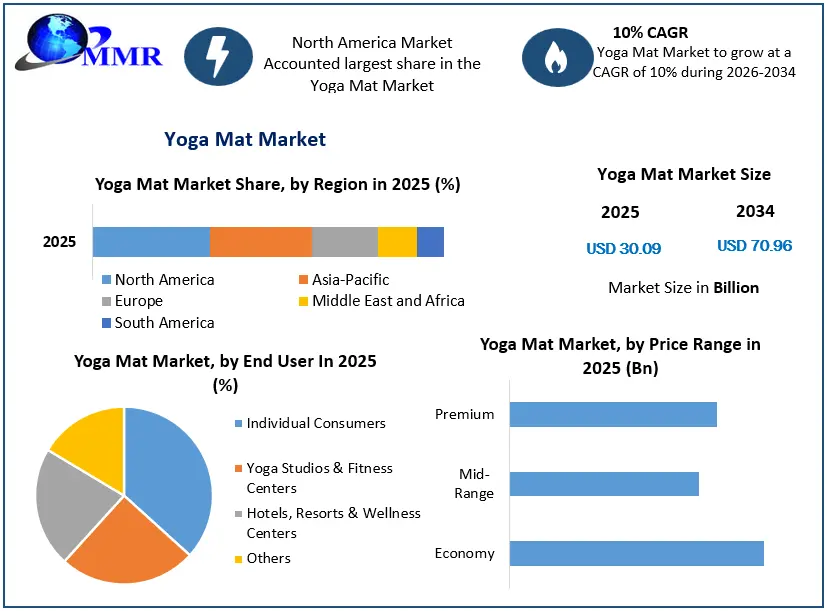
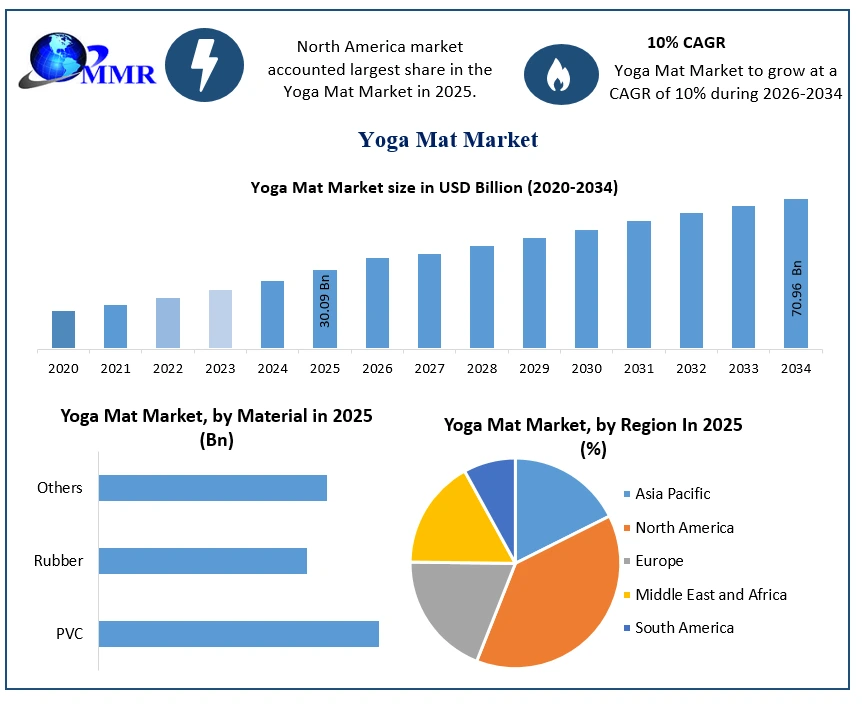
The Yoga Mat Market size was valued at USD 30.09 Billion in 2025 and the total Yoga Mat revenue is expected to grow at a CAGR of 10% from 2026 to 2034, reaching nearly USD 70.96 Billion.
Yoga Mat Market Overview:
Yoga mats are specially made to prevent human’s limbs from slipping while practicing yoga. Previously, yoga mats were mostly made of rubber. Suitable for energetic yoga, modern mats are made of plastic, rubber, and other materials to provide comfort, grip, and proper weight. The 45 degree angled lines help align the standing asana series foot angles with the parsvottasana in an intensive lateral stretch posture. The square in the middle starts with asanas aligned from the Tadasana Mountain Pose and helps keep your legs off for standing asanas.
Yoga Mat Market Growth and Share Analysis
To know about the Research Methodology :- Request Free Sample Report
Yoga Mat Market Dynamics:
Businesses are using the latest technology features such as AI technology and digital connectivity to enable users to effectively perform stretching exercises during yoga and asanas. For example, a yoga mat connected to AI-enabled smart yoga assistant YogiFi was recognized at CES for features such as body position, flexibility, and real-time feedback on power stretching. These factors are driving the demand for yoga mats in the market.
The growing demand for yoga mats made from natural and environmentally friendly materials such as PVC-free and natural rubber is opening new opportunities for companies to expand their business in the segment of naturally available materials.
Increasing awareness of yoga, spiritual practice, and their health benefits is expected to increase the demand for yoga mats. The increased incidence of health problems due to stress and anxiety also affects people's exercise and fitness activities, increasing the consumption of corresponding products. These factors are driving the market growth of yoga mats.
The growing fitness and yoga centers around the world, as well as the growing health and fitness industry, are driving the demand for yoga mats. In addition, increasing government support for spreading meditation and awareness of its benefits to people is driving the market growth.
Increasing incomes in the world population will lead to increased membership in yoga clubs and thus increase demand. Fluctuations in raw material prices can disrupt the production process and restrain the market growth of yoga mats.
Yoga Mat Market Segment Analysis:
By Material, the PVC segment dominated the market with a 41% share in 2025. Polyvinyl chloride (PVC) materials are cheaper than other materials. Increasing demand of PVC, availability, wide range, various colors, etc. These factors are driving the market growth of the segment.
The rubber segment is expected to grow at a CAGR of 3.7 % through the forecast period. Polyurethane (PU) rubber mats are becoming more and more popular due to their environmentally friendly properties. PU is a recyclable, non-toxic, lightweight material. These factors are expected to drive the market growth of the segment through the forecast period.
By Distribution Channel, the Offline segment dominated the market with a 60% share in 2025. Increased penetration and hold of customers, huge range of product, physically consumers can check product before making a purchase. In Tier II and Tier III cities, more and more department stores are expected to promote the product. These factors are driving the market growth of this segment.
The online segment is expected to grow at a CAGR of 6% through the forecast period. It has grown considerably due to the increased use of the internet and smartphones. The main reason for the growth of online shopping is the availability of 24 /7, a wide range of options, and the ability to compare prices. Also, most vendors, including Lululemon and Manduka, have their own online sites where consumers can order products based on their needs and the number of dedicated online retailers such as YogaOutlet.com, Walmart, and Amazon. These factors are expected to drive the market growth through the forecast period.
Yoga Mat Market Regional Insights:
North America dominates the market with a 38% share in 2025. High consumer spending on yoga and fitness products. According to MMR Report, US consumer spending on careful athletic activities such as yoga, tai chi, qigong, Pilates, bears, and other activities increased. The area leads to increased consumption of yoga mats. According to our report, the number of fitness center companies in the United States increased from 86,996 in 2012 to 102,344 in . The presence of higher-income population groups is a major driver of the market in this region.
Asia Pacific is expected to grow at a CAGR of 6 % through the forecast period. Population growth in countries such as India and China and increased consumption of hybrid cotton material in the region are expected to increase the production of hybrid cotton material yoga mats and drive market growth. Increased demand during fitness activities. In India, a total of 13,000 new users downloaded the FITTR Yoga and Fitness application. This sharp increase in downloads is due to increased user awareness of physical fitness. These factors are expected to drive the market growth in this region through the forecast period.
The objective of the report is to present a comprehensive analysis of the Yoga Mat market to the stakeholders in the industry. The past and current status of the industry with the forecasted market size and trends are presented in the report with the analysis of complicated data in simple language. The report covers all the aspects of the industry with a dedicated study of key players that include market leaders, followers, and new entrants.
PORTER, PESTEL analysis with the potential impact of micro-economic factors of the market have been presented in the report. External as well as internal factors that are supposed to affect the business positively or negatively have been analyzed, which will give a clear futuristic view of the industry to the decision-makers.
The report also helps in understanding the Yoga Mat market dynamics, structure by analyzing the market segments and project the Yoga Mat market size. Clear representation of competitive analysis of key players by product, price, financial position, product portfolio, growth strategies, and regional presence in the Yoga Mat market make the report investor’s guide.
Yoga Mat Market Recent Development
| Date | Company | Development | Impact |
|---|---|---|---|
| 15 January 2025 | Decathlon SA | Decathlon announced a major expansion of its eco-friendly fitness line by launching a new range of mats manufactured from sustainably sourced cork and recycled rubber. | The initiative addresses the surge in European consumer demand for sustainable fitness gear while reducing the carbon footprint of classic polymer-based mats. |
| 18 February 2025 | Nike, Inc. | Nike introduced a specialized series of high-grip performance mats designed for high-intensity interval training (HIIT) and yoga fusion classes. | The launch enables Nike to capitalize on hybrid exercise trends by offering specialized mats built for enhanced stability and dynamic movements. |
| 15 May 2025 | Trimax Sports Inc. | Trimax Sports launched a new line of ergonomic performance yoga mats tailored for the European market. | The product rollout strengthens the company's regional presence by providing advanced joint cushioning and non-slip traction features for regular practitioners. |
| 09 October 2025 | Alo Yoga | Alo Yoga launched a digital platform that delivers personalized yoga mat recommendations tailored to user practice styles and preferences. | The tool enhances direct-to-consumer digital engagement and guides practitioners toward high-margin, specialized mat offerings. |
| 15 April 2026 | Manduka LLC | Manduka officially expanded beyond traditional studio yoga products by launching the P/ROX™ Hybrid Fitness Mat. | The commercialization captures the growing hybrid-athlete market with dense closed-cell construction engineered for both footwear and bare-foot traction. |
Yoga Mat Market Scope: Inquiry Before Buying
| Yoga Mat Market | |||
|---|---|---|---|
| Report Coverage | Details | ||
| Base Year: | 2025 | Forecast Period: | 2026-2034 |
| Historical Data: | 2020 to 2025 | Market Size in 2025: | 30.09 USD Billion |
| Forecast Period 2026-2034 CAGR: | 10 % | Market Size in 2034: | 70.96 USD Billion |
| Segments Covered: | by Material | Polyvinyl Chloride (PVC) Thermoplastic Elastomer (TPE) Natural Rubber Synthetic Rubber Polyurethane (PU) Ethylene Vinyl Acetate (EVA) Cork Natural Fibers (Cotton, Jute & Others) Others |
|
| by Thickness | Below 3 mm 3 mm to Below 5 mm 5 mm to Below 8 mm 8 mm and Above |
||
| by Price Range | Economy Mid-Range Premium |
||
| by Distribution Channel | Online Brand-Owned Websites E-Commerce Marketplaces Offline Sporting Goods & Fitness Stores Specialty Yoga & Wellness Stores Supermarkets & Hypermarkets Other Offline Channels |
||
| by End User | Individual Consumers Yoga Studios & Fitness Centers Hotels, Resorts & Wellness Centers Others |
||
Yoga Mat Market, by Region
Asia Pacific (China, South Korea, Japan, India, Australia, Indonesia, Malaysia, Vietnam, Taiwan, Bangladesh, Pakistan and Rest of APAC)
Europe (UK, France, Germany, Italy, Spain, Sweden, Austria and Rest of Europe)
North America (United States, Canada and Mexico)
Middle East and Africa (South Africa, GCC, Egypt, Nigeria and Rest of ME&A)
South America (Brazil, Argentina Rest of South America)
Key Players
1. Lululemon
2. Manduka PROlite
3. Jade Yoga
4. Hugger Mugger Para rubber
5. PrAna Revolutionary
6. Gaiam, Easyoga
7. HATHAYOGA
8. Kharma Khare
9. Hosa Group
10. Yogabum
11. Aerolite
12. Aurorae
13. Barefoot Yoga
14. Keep well
15. Khataland
16. Microcell Composite
17. Yogarugs
18. Copeactive
19. Yogasana, A. Kolckmann
20. JiangXi Lveten Plastic
21. Liforme
22. Starlight Yoga
23. Bean Products
Frequently Asked Questions:
1] What segments are covered in the Yoga Mat Market report?
Ans. The segments covered in the Yoga Mat Market report are based on Material and Distribution Channel.
2] Which region is expected to hold the highest share in the Yoga Mat Market?
Ans. North America Region is expected to hold the highest share in the Yoga Mat Market.
3] What is the market size of Yoga Mat Market by 2034?
Ans. The market size of Yoga Mat Market by 2034 is USD70.96 Bn.
4] Who are the top key players in the Yoga Mat Market?
Ans. Lululemon, Manduka PROlite, Jade Yoga, Hugger Mugger Para rubber, PrAna Revolutionary, Gaiam, Easyoga, HATHAYOGA, Kharma Khare, Hosa Group, Yogabum, Aerolite, Aurorae, Barefoot Yoga, Keep well, Khataland, Microcell Composite, Yogarugs, Copeactive, Yogasana, A. Kolckmann, JiangXi Lveten Plastic, Liforme, Starlight Yoga, Bean Products.
5] What was the Global Yoga Mat Market size in 2025?
Ans: The Global Yoga Mat Market size was USD 30.09 Billion in 2025.