
US Robotic Vacuum Cleaner Market Size by Product Type, Operation Mode, Application, Distribution Channel and End User
Overview
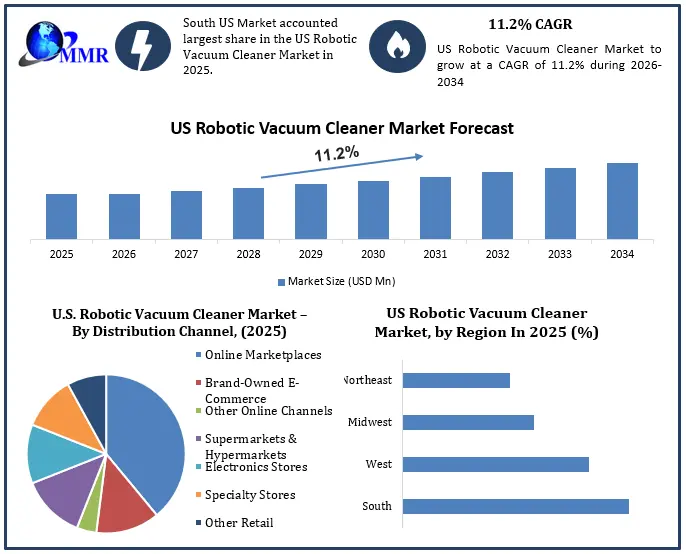
The US Robotic Vacuum Cleaner Market is estimated to be valued at USD 214.42 Million in 2025 and is expected to touch USD 390.68 Million in 2034, recording a CAGR of 11.2%.
US Robotic Vacuum Cleaner Market Definition
The US Robotic Vacuum Cleaner Market is a group of companies that manufacture robotic vacuum cleaners that perform cleaning functions with little or no human effort in the United States. Market participants offer products that use various automated technologies such as navigation, mapping, object detection, programming, app control, auto charging, auto discharging, and others. It also provides robotic vacuum cleaners that provide both vacuuming and mopping functions. The robotic vacuum cleaner market is segmented by product type, function, navigation technology, operation mode, application, distribution channel, and end-use. The market is driven by the rising need for smart home appliances, convenience, advanced technology use in the home cleaning space, replacement, and rising adoption of connected devices in the domestic and commercial sectors.
| Parameter | Value |
| Market Size (Base Year 2025) | USD 214.42 Million |
| Forecast Market Size (2034) | USD 390.68 Million |
| CAGR (2026-2034) | 11.2% |
| Base Year | 2025 |
| Forecast Period | 2026-2034 |
| Historical Period | 2020-2025 |
US Robotic Vacuum Cleaner Market Overview
The US Robotic Vacuum Cleaner Market is established to grow significantly as connected appliances, artificial intelligence, automated cleaning, and time-saving solutions gain greater adoption among US consumers and businesses. The market offers significant opportunities for growth through robotic vacuum-mop combos, self-emptying docks, advanced mapping, pet hair cleaning, AI-powered obstacle avoidance, and connected home device integration. California is a critical state for robotic vacuum cleaner sales in the United States, with a concentration of tech-savvy consumers and an established smart-home appliance market, but New York, Los Angeles, and Chicago are notable other metropolitan areas with demand for robotic vacuum cleaners.
The report covers the robotic vacuum cleaner market in the United States by product type, operation mode, application, charging type, technology, distribution channel, price category, end user, and state plus historical market size, current market size, market outlook and forecast, growth trends, competitive benchmarking, market dynamics, opportunities, challenges, and technology trends. Robotic vacuum cleaner manufacturers and sellers are capitalizing on the need for automated cleaning solutions, particularly to reduce the time spent on cleaning tasks and create better-organized and more hygienic homes and, in some cases, commercial settings.
The robotic vacuum cleaner market is highly competitive, with major companies like iRobot Corporation, Shark Ninja, Roborock, Ecovacs Robotics, Dyson, Samsung, LG, and Eufy looking to differentiate their products through advanced navigation, suction and mopping capabilities, and smart home compatibility. Meanwhile, the market opportunity is limited by the relative simplicity of automated cleaning solutions compared to fully-integrated smart home systems, creating opportunities for robotic vacuum cleaner manufacturers to target the middle ground between basic automated cleaning and fully-integrated smart home cleaning solutions that offer greater levels of automation and convenience for the consumer or business buyer.
US Robotic Vacuum Cleaner Market Growth and Forecast Analysis
To know about the Research Methodology :- Request Free Sample Report
US Robotic Vacuum Cleaner Market Historical Market Size (2020-2025)
| Year | Market Size (USD Mn) | Growth Rate (YoY) |
| 2020 | 132.8 | 7.4% |
| 2021 | 143.42 | 8% |
| 2022 | 157.77 | 10% |
| 2023 | 173.55 | 10% |
| 2024 | 193.17 | 11.3% |
| 2025 | 214.42 | 11% |
US Robotic Vacuum Cleaner Market Key Highlights
• Market Growth: Market Estimated to be USD 390.68 Million by 2034, expanding at an 11.2% CAGR.
• Technology Focus: AI, LiDAR, smart navigation, and automated cleaning drive product development.
• Leading Region: The South US market holds the largest regional market share.
• Strong Competition: Major brands compete through technology, pricing, and product innovation.
• Product Trend: Demand is shifting toward vacuum-and-mop systems and self-emptying models.
• Distribution Growth: Online marketplaces remain an important sales channel.
• Consumer Demand: Convenience, automation, pet-hair cleaning, and smart connectivity support demand.
US Robotic Vacuum Cleaner Market Consumer Insights & Demand Analysis
| Consumer Dimension | Key Insights | Market Implication |
| Pet Owner Demand | ~90 million US households’ own pets; high pet hair volume drives premium robotic vacuum use with tangle-free brushrolls and high-suction models | Pet-specific SKUs earning 20-30% price premiums; Shark and Roomba dominate pet segments |
| Smart Home brand ecosystem loyalty | Deep integration with Amazon Alexa, Google Assistant, and Apple HomeKit driving voice-command use; compatible robots have 2× repurchase rate | Smart compatibility now a standard expectation; unconnected models confined to budget segment below USD 200 |
| Suburban Household Profile | Large open-plan floor areas in suburban homes favor self-emptying docking stations and extended mapping precision for multi-room cleaning routes | High-end self-emptying systems (USD 500-900) outgrowing entry models in revenue contribution |
| Premium Willingness | US consumers among highest globally for premium robotics spend; average selling price rising toward USD 450 for connected models | Strong margin opportunity for brands offering AI routing, auto-cleaning bases, and subscription-based maintenance kits |
US Robotic Vacuum Cleaner Market Dynamics
Rising Smart-Home Adoption and Demand for Automated Cleaning Solutions
The US Robotic Vacuum Cleaner Market is presence driven by increasing adoption of smart-home technologies among consumers, rising preference for automated home appliances, and growing demand among consumers for convenient cleaning solutions that reduce routine household effort. Consumers are integrating connected appliances into their residential environments and are favoring robotic vacuum cleaners with Wi-Fi connectivity, mobile applications, voice-control compatibility, LiDAR-based mapping, obstacle detection, and AI-enabled navigation.
Technological advances such as improvements in suction performance, battery efficiency, self-charging, self-emptying dustbins, vacuum-and-mop functionality, and floor-type recognition are raising the value proposition of robotic vacuum cleaners and are driving their adoption among residential settings. In addition, the proliferation of e-commerce has increased product availability and has facilitated consumer comparison of product specifications and prices. Growing competition from established appliance manufacturers and specialized robotics companies is encouraging continuous innovation, and promotional campaigns and replacement-part ecosystems are supporting customer acquisition and retention. Increasing awareness of time-saving household technologies and demand for programmable cleaning schedules are expected to drive the market across the US.
High Product Costs and Replacement Expenses
The US Robotic Vacuum Cleaner Market has restraints such as the relatively high purchase price of advanced robotic vacuum cleaners compared with conventional vacuum cleaners, as well as additional household owner expenses incurred for filters, brushes, mop pads, batteries, dust bags, and other consumables, which can deter adoption among price-sensitive household segments. The performance of robotic vacuum cleaners can also be impacted by floor configuration, carpet density, furniture arrangement, thresholds, and the presence of cables or small household objects, which can limit consumer satisfaction when cleaning results are not met with expectations.
Additionally, consumer awareness of potential repair costs and the availability of specialized servicing may impact their willingness to purchase a robotic vacuum cleaner. The fragmented range of product specifications can also hinder consumer decision-making as they seek to evaluate the differences between navigation accuracy, suction capability, battery life, and maintenance requirements before purchase. These factors can limit adoption among households that prioritize cost-affordability and straightforward maintenance.
Expansion into Commercial and Specialized Cleaning Applications
The US Robotic Vacuum Cleaner Market has opportunities such as the increasing commercialization of robotic vacuum cleaners among offices, hotels, retail stores, healthcare facilities, educational institutions, airports, and other large indoor environments, among which manufacturers can position the product for repetitive floor maintenance needs. Additional opportunities include the development of specialized robotic vacuum cleaners for households with pets, as well as those with multi-level homes, large floor areas, and diverse flooring materials. Integrating robotic vacuum cleaners into broader home-management platforms offers scope for creating connected cleaning ecosystems, in which manufacturers can encourage synergistic adoption of products.
Subscription-based maintenance programs, replacement-component packages, extended service plans, and software-enabled feature upgrades offer opportunities for generating recurring revenues, following the initial sale of the product. Additionally, partnerships with property-management companies, hospitality operators, facility-service providers, and smart-home platforms can enhance manufacturer adoption among institutional buyers, and opportunities are available for offering customized products based on household size, floor, cleaning frequency, and pet ownership.
Intense Competition and Rapid Technology Obsolescence
The US Robotic Vacuum Cleaner Market has challenges such as the intense competition from international appliance manufacturers, specialized robotics companies, and emerging technology brands, all of which encourage rapid product developments and the shortening of product life cycles. The frequent product developments by manufacturers to incorporate upgraded navigation systems, sensing technologies, cleaning mechanisms, software capabilities, and multifunctional features can increase research and development investment and put downward pressure on product pricing.
The rapid technological advancements can also challenge manufacturers to ensure continued reliability of products in diverse residential environments, which can vary substantially in floor layout, furniture density, flooring material, stairs, thresholds, and household obstacles. The reliability of the software is an additional challenge, as is ensuring compatibility among different smartphone brands, operating systems, connected-home platforms, and voice assistants. Maintaining product quality while managing complex electronics, sensors, motors, batteries, and software components within competitive price ranges poses an additional challenge, and manufacturers must ensure ongoing after-sales service, such as diagnostics, firmware support, and replacement parts, to maintain consumer trust. Consumer confidence in long-term product reliability and differentiation among competitors is critical in such a competitive environment.
US Robotic Vacuum Cleaner Market Segment Analysis
US Robotic Vacuum Cleaner Market, by Product Type
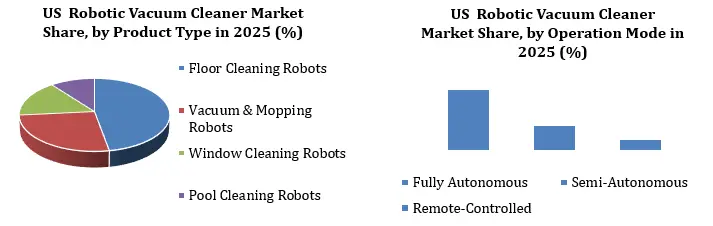
The US Robotic Vacuum Cleaner Market is segmented into Floor Cleaning Robots, Vacuum & Mopping Robots, Window Cleaning Robots, Pool Cleaning Robots, and Others, addressing different cleaning requirements and usage environments. Floor Cleaning Robots represent a major category due to their ability to remove dust, debris, and pet hair from hard floors and carpets, supported by improvements in suction power, navigation, brushes, and room mapping. Vacuum & Mopping Robots are gaining importance as multifunctional solutions combining dry vacuuming and wet-floor cleaning, with innovations including automated mop washing, water management, carpet detection, and self-maintaining docking stations. Window Cleaning Robots serve specialized glass-cleaning requirements through suction systems, edge detection, movement algorithms, and safety mechanisms, while Pool Cleaning Robots focus on automated debris removal with advanced filtration, navigation, wall cleaning, and battery capabilities. The Others category includes specialized robotic cleaning solutions for niche surfaces and environments, supporting product diversification and broader application opportunities across residential and commercial settings.
US Robotic Vacuum Cleaner Market, by Operation Mode
The operation mode includes Fully Autonomous, Semi-Autonomous, and Remote-Controlled robotic vacuum cleaner segments. Fully Autonomous robotic vacuum cleaners use sensors, mapping tools, navigation features, and docking stations to maneuver through the house and perform cleaning tasks with ease. This type of robotic vacuum cleaner market segment is sophisticated and modern as these appliances are self-sufficient and can even dispose of dust and mop the floor. On the other hand, Semi-Autonomous robotic vacuums require some form of manual input, allowing the user to customize the cleaning schedule, area, and other settings. They also have automated features such as navigation, obstacle avoidance, and automated mopping and disposal. Lastly, Remote-Controlled robotic vacuums are operated by the user via a mobile phone or remote control, and are capable of delivering cleaning tasks as per the demands of the user. As a result, the robotic vacuum cleaner industry is segmented into various types and classes, allowing manufacturers to satisfy the diverse demands of consumers.
US Robotic Vacuum Cleaner Market Segment Insights
US Robotic Vacuum Cleaner Market Regional Analysis
The US Robotic Vacuum Cleaner Market has different demands across the South, West, Midwest, and Northeast regions, influenced by demographics, housing types, purchases, technology, and retail accessibility. The South region has significant demand due to the large number of people, existing housing structures, and purchases of products. The West region offers substantial potential for robotic vacuum cleaners due to the region’s technology-inclined nature and its strong presence in California. Finally, with established residential areas and growing acceptance of automated technology, the Midwest is another region with considerable demand for such products. The Northeast region could present significant opportunities with the presence of many apartment buildings and condominiums and a considerable amount of people purchasing robotic vacuum cleaners. The varying lifestyles and purchasing capacities in different US regions create different opportunities for sellers and marketers of robotic vacuum cleaners.
US Robotic Vacuum Cleaner Market Competitive Landscape
The US Robotic Vacuum Cleaner Market is highly competitive and fragmented, with a number of established floor-care companies, specialized robotics manufacturers, and diversified consumer-electronics companies vying for dominance. Thus, the market is contested by iRobot, Shark Ninja, Roborock, ECOVACS, Eufy, Samsung, LG, Dyson, Bissell, Midea, Xiaomi, Panasonic, and other major players. The competition is intense, with companies focusing on robot vacuums’ AI navigation capabilities, mapping technologies (LiDAR and/or camera-based), obstacle detection and avoidance, suction performance, vacuum and mopping capabilities, self-emptying and self-cleaning docks, battery technology, and smart features.
The established companies utilize their extensive retail presence, brand recognition, product portfolios, and consumer electronics sales networks to gain an advantage over the competitors. Meanwhile, specialized robotics companies compete on the basis of technological innovation and the provision of multifunctional solutions. Mid-range and value brands seek to penetrate the US market with competitive pricing, digital retail sales, and multifunctional products. The competitive nature of the market has led to a focus on multifunctional floor-care vacuums, with the companies’ developing products that offer a combination of vacuuming, mopping, auto-maintenance, and smart control features. The key competitive forces comprise product launches, pricing strategies, retail partnerships, software upgrades, and direct-to-consumer sales to strengthen the market presence.
US Robotic Vacuum Cleaner Market Scope: Inquire before buying
| US Robotic Vacuum Cleaner Market | |||
|---|---|---|---|
| Report Coverage | Details | ||
| Base Year: | 2025 | Forecast Period: | 2026-2034 |
| Historical Data: | 2020 to 2025 | Market Size in 2025: | USD 214.42 Mn. |
| Forecast Period 2026 to 2034 CAGR: | 11.2% | Market Size in 2034: | USD 390.68 Mn. |
| Segments Covered: | by Product Type | Floor Cleaning Robots Vacuum & Mopping Robots Window Cleaning Robots Pool Cleaning Robots |
|
| by Operation Mode | Fully Autonomous Semi-Autonomous Remote-Controlled |
||
| by Application | Residential Single-Family Homes Apartments & Condominiums Multi-Story Homes Commercial Offices & Corporate Facilities Hotels & Hospitality Retail & Shopping Facilities Healthcare & Institutional Facilities Others |
||
| by Distribution Channel | Online Online Marketplaces Brand-Owned E-Commerce Other Online Channels Offline Supermarkets & Hypermarkets Electronics Stores Specialty Stores Other Retail |
||
| by End User | Residential Households Commercial Establishments Hospitality Healthcare & Institutional Facilities Others |
||
US Robotic Vacuum Cleaner Market Key Players
1. iRobot Corporation (Roomba)
2. Shark Ninja Operating LLC
3. Roborock Technology Co., Ltd.
4. ECOVACS Robotics Co., Ltd.
5. Anker Innovations Co., Ltd.
6. Samsung Electronics Co., Ltd.
7. LG Electronics Inc.
8. Dyson Limited
9. BISSELL Homecare, Inc.
10. Midea Group Co., Ltd. (Midea / Eureka)
11. Xiaomi Corporation
12. Panasonic Holdings Corporation
13. Haier Smart Home Co., Ltd.
14. Cecotec Innovaciones S.L. (Conga)
15. Neato Robotics, Inc. (Vorwerk Group)
US Robotic Vacuum Cleaner Market Technology & Innovation Trends
| Innovation Area | Current Trend | Market Impact |
| AI-Powered Precision Home Mapping | Multi-floor persistent mapping with furniture recognition enabling selective room targeting and no-go zone management via smartphone app | iRobot Genius and Shark IQ Matrix map technologies setting consumer expectation standard |
| Heated Mop Technology | iRobot Roomba Max 705 Combo (July 2025) features heated mopping for stubborn stain removal and protective cover for carpet areas | setting apart premium mopping performance beyond conventional wet-mop systems |
| Self-Empty + Self-Wash Base Stations | Docking stations automating dustbin emptying, mop pad washing, hot-air drying, and water refilling - reducing human interaction to monthly filter change | Fundamental shift in consumer value: 'set and forget' operation model |
| Pet-Specific AI Detection | Computer vision models trained on pet hair, pet waste, and pet toys enabling navigation avoidance and targeted suction mode activation | SharkNinja PowerDetect NeverTouch Pro launched September 2024 with patent-pending detect technology |
| Voice & App Routine Automation | Deep API integrations with Amazon Alexa routines: 'Alexa, I'm leaving home' triggers automatic multi-room cleaning schedule | brand ecosystem loyalty strategy creating hardware upgrade loyalty within Amazon-connected households |
Frequently Asked Questions (FAQs)
1. What is the current size of the US Robotic Vacuum Cleaner Market?
The US Robotic Vacuum Cleaner Market is valued at USD 214.42 Million in 2025 and is projected to reach USD 390.68 Million by 2034, expanding at an 11.2% CAGR.
2. What are the key factors driving the US Robotic Vacuum Cleaner Market?
Key factors include rising smart-home adoption, demand for automated cleaning, AI-enabled navigation, smart connectivity, self-emptying systems, and vacuum-and-mopping functionality.
3. Which application segment holds the largest share of the US Robotic Vacuum Cleaner Market?
The Residential segment holds the largest share, supported by demand from single-family homes, apartments and condominiums, and multi-story homes.
4. Which region dominates the US Robotic Vacuum Cleaner Market?
The South region dominates the US Robotic Vacuum Cleaner Market, supported by its large residential base and growing adoption of automated cleaning solutions.
5. Who are the major players operating in the US Robotic Vacuum Cleaner Market?
Major players include iRobot Corporation, Shark Ninja Operating LLC, Roborock Technology Co., Ltd., ECOVACS Robotics Co., Ltd., Anker Innovations, Samsung Electronics, LG Electronics, Dyson, BISSELL, and Midea Group.