
US Postbiotics Market Size by Form, Source, Application, Function, Distribution Channel and End User
Overview
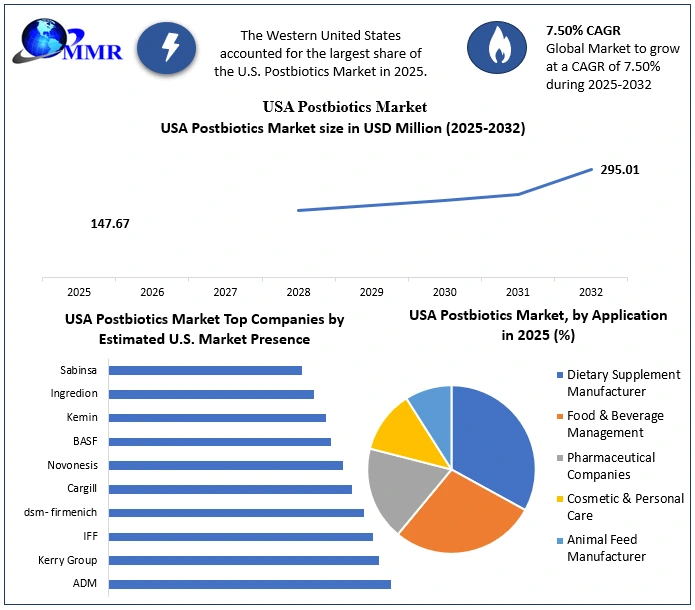
The US Postbiotics Market was valued at USD 147.67 million in 2025 and is projected to reach USD 295.01 million by 2032, expanding at a compound annual growth rate (CAGR) of 7.50% during the forecast period. Market growth is primarily driven by increasing consumer awareness of gut health, the growing prevalence of lifestyle-related disorders, and rising demand for scientifically validated functional ingredients across the food, beverage, nutraceutical, and pharmaceutical industries.
Postbiotics are non-viable microbial cells, cell components, and metabolites produced during the fermentation of beneficial microorganisms. Unlike probiotics, postbiotics do not contain live bacteria, offering superior stability, longer shelf life, and greater resistance to processing and storage conditions. These advantages make them an attractive ingredient for manufacturers developing functional foods, dietary supplements, infant nutrition products, pharmaceuticals, and personal care formulations. Furthermore, their demonstrated health benefits, including improved digestive health, immune modulation, anti-inflammatory activity, and enhanced metabolic function, are accelerating their adoption among U.S. consumers seeking preventive healthcare solutions.
The United States remains one of the most attractive markets for postbiotics due to its advanced healthcare infrastructure, strong investment in microbiome research, and high consumer spending on wellness products. The increasing popularity of clean-label formulations, personalized nutrition, and microbiome-based therapies is encouraging manufacturers to expand their postbiotic product portfolios. In addition, collaborations between biotechnology companies, ingredient suppliers, and research institutions are accelerating product innovation and commercialization, further supporting market expansion.
Some of the Key Market Instances:
• According to the International Scientific Association for Probiotics and Prebiotics (ISAPP), the global dietary supplement market exceeds USD 190 billion, with the United States contributing approximately USD 65–70 billion, highlighting the country's significant potential for postbiotic ingredient manufacturers.
• The U.S. functional food and beverage market surpassed USD 85 billion in 2024, reflecting increasing consumer demand for products that promote digestive health, immunity, and overall wellness, thereby creating favorable conditions for postbiotic-based innovations.
• Rising U.S. healthcare expenditure, which reached USD 5.3 trillion in 2024 (approximately USD 15,474 per capita) and is projected to increase to USD 5.7 trillion in 2025
• With U.S. healthcare spending reaching USD 5.3 trillion in 2024 and projected to rise to USD 5.7 trillion in 2025, increasing investments in preventive healthcare, precision nutrition, and clinically supported wellness are expected to drive demand for scientifically validated postbiotic ingredients. This trend is likely to encourage postbiotic ingredient manufacturer to expand R&D, develop innovative formulations, and form strategic partnerships, creating long-term growth opportunities in the market.
To know about the Research Methodology :- Request Free Sample Report
US Postbiotics Market Key Dynamics
Rising Consumer Focus on Gut Health and Preventive Nutrition Drives U.S. Postbiotics Market Growth
The US Postbiotics Market is witnessing robust growth, driven by increasing consumer awareness of gut health, rising demand for preventive healthcare, and continuous innovation in functional ingredients. Valued at USD 147.67 million in 2025, the market is projected to reach USD 295.01 million by 2032, registering a CAGR of 7.50% during the forecast period. The growing incidence of digestive disorders and lifestyle-related diseases has accelerated the adoption of microbiome-supporting ingredients in dietary supplements, functional foods, and beverages.
The expanding U.S. dietary supplements market, valued at approximately USD 65–70 billion, is creating favorable opportunities for postbiotic ingredient manufacturers as consumers increasingly prefer clinically supported and shelf-stable alternatives to probiotics. Additionally, the functional food and beverage industry, which exceeded USD 85 billion in 2024, continues to witness strong demand for products offering immune and digestive health benefits, thereby supporting postbiotic product innovation.
Another major growth driver is the U.S. digestive health supplements market, valued at over USD 15 billion in 2024, where postbiotics are gaining recognition due to their enhanced stability, safety, and efficacy. Furthermore, the country's healthcare expenditure surpassed USD 4.9 trillion in 2023, reflecting growing investments in preventive healthcare and personalized nutrition. These trends are encouraging biotechnology companies and nutraceutical manufacturers to expand research and commercialization efforts. The increasing adoption of clean-label products, favorable regulatory developments, and strategic partnerships among ingredient suppliers are expected to further strengthen the competitive landscape and generate significant growth opportunities for key players operating in the U.S. postbiotics market over the forecast period.
Regional Insights of the US Postbiotics Market
The Western United States dominates the U.S. postbiotics market, accounting for the largest revenue share due to the strong presence of biotechnology companies, dietary supplement manufacturers, and functional food innovators in states such as California and Washington. California serves as a major hub for microbiome research, supported by leading universities, research institutions, and health-focused startups. The region also benefits from high consumer awareness regarding preventive healthcare, personalized nutrition, and clean-label products, driving demand for postbiotic-based supplements and functional foods.
The Northeast represents the second-largest regional market, led by states including Massachusetts, New York, and New Jersey. The region's well-established pharmaceutical and biotechnology industries, coupled with significant investments in life sciences research, continue to accelerate the commercialization of microbiome-derived ingredients. The presence of major healthcare providers and increasing adoption of clinically validated nutritional products further support market expansion.
The Midwest is witnessing steady growth owing to its strong food processing and nutraceutical manufacturing base. States such as Illinois, Minnesota, and Wisconsin are increasingly incorporating postbiotic ingredients into dairy products, functional beverages, and dietary supplements. Rising consumer preference for digestive health solutions and increasing retail availability through pharmacies and supermarkets are further contributing to regional demand.
The Southern United States is expected to register the fastest growth during the forecast period, driven by rapid population growth, increasing healthcare expenditure, and expanding investments in food innovation across Texas, Florida, and North Carolina. The region is experiencing rising demand for functional nutrition products as consumers become more health conscious and seek immune-supporting and gut-health solutions.
Across all regions, the expansion of e-commerce platforms, direct-to-consumer wellness brands, and increasing investments in microbiome research are expected to strengthen product accessibility and adoption. These regional developments are creating significant growth opportunities for key players operating in the U.S. postbiotics market, enabling them to expand manufacturing capabilities, strengthen distribution networks, and introduce innovative postbiotic formulations tailored to evolving consumer preferences.
US Postbiotics Market Scope: Inquire before buying
| US Postbiotics Market | |||
|---|---|---|---|
| Report Coverage | Details | ||
| Base Year: | 2025 | Forecast Period: | 2026-2032 |
| Historical Data: | 2020 to 2025 | Market Size in 2025: | USD 147.67 Mn. |
| Forecast Period 2026 to 2032 CAGR: | 7.5% | Market Size in 2032: | USD 295.01 Mn. |
| Segments Covered: | by Form | Powder Liquid Capsules & Tablets Paste Others |
|
| by Source | Lactic Acid Bacteria (LAB) Bifidobacteria Bacillus spp. Yeast-Derived Postbiotics Others |
||
| by Application | Functional Foods Functional Beverages Dietary Supplements Infant Nutrition Animal Nutrition Pharmaceuticals Personal Care & Cosmetics |
||
| by Function | Gut Health Support Immune Health Anti-inflammatory Activity Metabolic Health Skin Health Antioxidant Activity Others |
||
| by Distribution Channel | Direct Sales (B2B) Online Retail Pharmacies & Drug Stores Supermarkets & Hypermarkets Specialty Health Stores |
||
| by End User | Food & Beverage Manufacturers Dietary Supplement Manufacturers Pharmaceutical Companies Cosmetic & Personal Care Manufacturers Animal Feed Manufacturers |
||
USA Postbiotics Key Players:
| Company Name | Headquarters (USA) | Core Competencies |
| Archer Daniels Midland (ADM) | Chicago, Illinois | Postbiotic ingredients, microbiome nutrition, functional food ingredients, health & wellness solutions |
| Cargill Incorporated | Wayzata, Minnesota | Functional nutrition ingredients, postbiotic solutions, food innovation, animal nutrition |
| International Flavors & Fragrances (IFF) | New York, New York | Postbiotic ingredients, microbiome science, functional food & beverage solutions |
| Kemin Industries, Inc. | Des Moines, Iowa | Postbiotic technologies, gut health ingredients, human & animal nutrition |
| Sabinsa Corporation | East Windsor, New Jersey | Postbiotic ingredients, nutraceuticals, dietary supplements, clinical nutrition |
| Essential Formulas Incorporated | Roxbury Township, New Jersey | Postbiotic supplements, digestive health, microbiome wellness products |
| Postbiotics Inc. | San Francisco, California | Postbiotic ingredient development, microbiome research, functional health products |
| Maypro Group | Purchase, New York | Specialty nutraceutical ingredients, postbiotic ingredients, dietary supplement solutions |
| Kerry North America | Beloit, Wisconsin | Functional ingredients, postbiotic formulations, nutrition and health solutions |
| Novonesis North America | Franklinton, North Carolina | Microbial fermentation, postbiotic ingredients, probiotic and bioscience solutions |
| DSM-Firmenich North America | Plainsboro, New Jersey | Postbiotic research, nutritional ingredients, microbiome health solutions |
| Lallemand USA | Milwaukee, Wisconsin | Fermentation technologies, microbial ingredients, postbiotic and probiotic solutions |
| NutraScience Labs | Farmingdale, New York | Postbiotic supplement formulation, contract manufacturing, nutraceutical development |
| Plexus Worldwide | Scottsdale, Arizona | Postbiotic-based dietary supplements, gut health, wellness nutrition |
| Synbiotic Health | Romeoville, Illinois | Postbiotic ingredients, probiotics, microbiome innovation, functional nutrition |
Frequently Asked Questions:
1. What is the projected market size of the U.S. Postbiotics Market by 2032?
The U.S. Postbiotics Market was valued at USD 147.67 million in 2025 and is projected to reach USD 295.01 million by 2032, growing at a CAGR of 7.50% during the forecast period.
2. What are the major factors driving the growth of the U.S. Postbiotics Market?
The market is primarily driven by increasing consumer awareness of gut health, rising demand for functional foods and dietary supplements, growing investments in microbiome research, and the preference for shelf-stable, clinically validated bioactive ingredients.
3. Which application segment holds the largest share of the U.S. Postbiotics Market?
The dietary supplements segment holds the largest market share due to increasing consumer demand for preventive healthcare products, followed by functional foods, beverages, pharmaceuticals, and infant nutrition applications.
4. Who are the key players operating in the U.S. Postbiotics Market?
Major companies include ADM, Cargill, International Flavors & Fragrances (IFF), Kerry Group, dsm-firmenich, Novonesis, BASF SE, Kemin Industries, Sabinsa Corporation, Probi AB, BioGaia AB, Lesaffre Group, Lallemand Inc., Ingredion Incorporated, and Stratum Nutrition.
5. Which region dominates the U.S. Postbiotics Market?
The Western United States, particularly California, dominates the market due to the presence of leading biotechnology companies, strong microbiome research capabilities, and high consumer adoption of functional nutrition and wellness products.