
Postbiotics Market Size by Form, Source, Component Type, Distribution Channel, Application and Industry Vertical
Overview
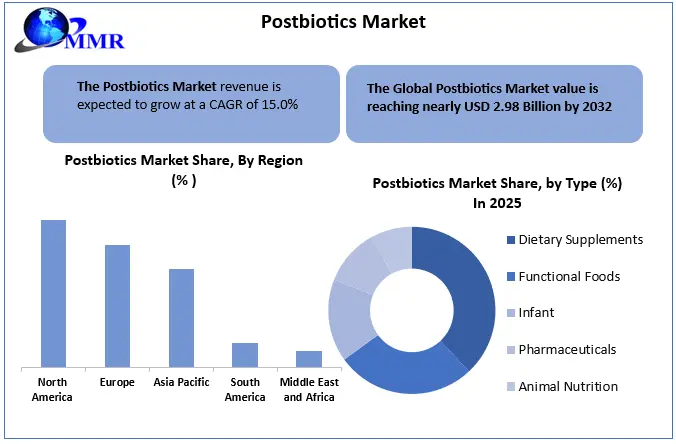
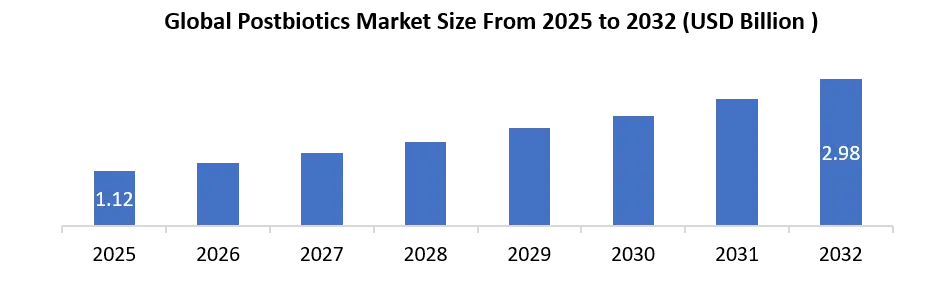
Global Postbiotics Market was valued at USD 1.12 billion in 2025 and is expected to rise to USD 2.98 billion till 2032, indicating a CAGR of 15.0%. Growth in the market is mainly attributed to technological advancements, rising adoption rates in enterprises, digital transformation activities, and investments in innovations.
The Global Postbiotics Market is set to become one of the fastest growing sectors within the micro biome and functional nutrition space. Postbiotics are described in terms of non-viable microbial cells, microbial cell fragments, metabolites, enzymes, peptides, and organic acids and are gaining importance owing to their stability, safety, and scientifically validated health benefits when compared with conventional probiotics.
The growing consumer knowledge regarding gut health, immune health, digestive health, and preventative healthcare is contributing to the growth in the market. There has been an increased use of postbiotics in functional food & beverages, dietary supplements, medicines, and infant nutrition formulas by food manufacturers, nutraceutical companies, pharmaceutical companies, and infant nutrition companies.
The scientific validation of postbiotics in immune modulation, gut health, skin health, metabolic health, and anti-inflammatory applications has led to a rising demand globally.
This report provides detailed information on the key companies operating in the market, their business strategies, innovations, collaborations, mergers, acquisitions, and expansion initiatives, aiding users to measure the degree of competition in the market and formulate effective growth strategies.
• In 2025, North America is expected to account for 36% of the Global Postbiotics Market, followed by Europe (30%), Asia Pacific (24%), South America (6%) and Middle East & Africa (4%). This reveals increasing demand for health & nutrition solutions that utilize the potential of the microbiome in developed economies.
• North America remains the leader in terms of dominance in the postbiotics market, owing to advanced nutraceuticals industry, increased consumer awareness about gut health, and substantial investment in microbiome research, while Asia Pacific leads in terms of the highest growth rate in the postbiotics market.
To know about the Research Methodology :- Request Free Sample Report
Postbiotics Market Dynamics:
Increasing Consumers' Concerns over Their Gut Health and Preventive Wellness Leading the Postbiotics Market to Grow
There have been many growths in the Postbiotics market owing to increasing awareness of the consumers on gut health and immunity along with preventive wellness. With the advancements made in the science of the human microbiome, the habit of purchasing food and other items for gut health and wellness of the consumer has increased. Postbiotics are preferred more than probiotics because they provide health benefits as well as safety. Products such as functional foods, dietary supplements, and baby nutrition products are some of those products.
Progress in the Field of Microbiome Research and Functional Nutrition Creating the Roadmap for the Future Postbiotics Market
The Postbiotics Market is experiencing significant changes owing to the advancements in the field of microbiome research, functional nutrition, and preventive medicine. Some of the key changes in the postbiotics market include the increasing demand for postbiotics ingredients that are scientifically proven to improve digestion, boost immunity, and enhance the wellness of consumers through supplements, functional foods, and beverages. Postbiotics are more stable and have a longer shelf-life than live probiotics and thus, can be easily used in the formulations of different industries. One of the other major changes gaining traction includes the adoption of postbiotics in the infant nutrition products that aid in the development of immune system and gut microbiota of infants. Personalized nutrition is one of the other growing trends that include the development of customized postbiotic products in order to meet the unique health needs of individuals.
Low Levels of Customer Awareness and Absence of Regulatory Frameworks Restrict Growth of Postbiotics Market
Even though there is huge potential for growth in the future, there are several issues that might hinder the growth of the Postbiotics Market. Firstly, one of the main restraints to the development of the postbiotics market is the limited level of customer awareness regarding postbiotics in comparison to other more developed markets like probiotics and prebiotics. Despite the abundance of scientific research on the advantages of postbiotics, many consumers are unaware of their functions and benefits. Another major issue that restrains the growth of postbiotics market is the absence of standardized regulatory frameworks that would regulate postbiotics in different countries. There are a number of issues that vary from country to country, including the definition of the product, health claim approval, labeling guidelines, and safety assessment.
Postbiotics Market Regional Insight:
The North American Postbiotics Market represents the largest regional segment globally, accounting for approximately 36% of the global market share. The region's leadership is driven by high consumer awareness regarding gut health, preventive healthcare, and microbiome-based nutrition solutions. The presence of a well-established nutraceutical industry, strong research and development capabilities, and increasing investments in microbiome science have accelerated the adoption of postbiotic ingredients across dietary supplements, functional foods, pharmaceuticals, and infant nutrition products.
The Asia Pacific region is expected to be the fastest-growing market during the forecast period, supported by rising healthcare expenditure, expanding middle-class populations, growing demand for functional nutrition products, and increasing awareness of digestive wellness. Countries such as China, Japan, India, South Korea, and Australia are witnessing significant growth in dietary supplement consumption and microbiome-focused healthcare innovations. Furthermore, the region's expanding food and beverage industry and increasing investment in biotechnology research continue to strengthen market development.
Europe remains a key market driven by strong regulatory support, scientific advancements in microbiome research, and growing consumer preference for clinically validated health ingredients. Collectively, North America, Europe, and Asia Pacific account for nearly 90% of global market revenue, highlighting their importance in shaping the future of the postbiotics industry.
Postbiotics Market Competitive Landscape:
The Postbiotics Market is characterized by increasing innovation, scientific research, strategic collaborations, and product commercialization initiatives among ingredient manufacturers, nutraceutical companies, biotechnology firms, and microbiome-focused healthcare organizations. Market participants are actively investing in clinical studies, advanced fermentation technologies, and proprietary postbiotic formulations to differentiate their offerings and strengthen their market positions. As consumer demand for gut health, immunity support, and preventive nutrition continues to rise, companies are focusing on developing scientifically validated and application-specific postbiotic ingredients for dietary supplements, functional foods, infant nutrition, pharmaceuticals, and animal health products.
Strategic partnerships between microbiome research companies and food, beverage, and healthcare manufacturers are becoming increasingly common to accelerate product development and market penetration. In addition, companies are expanding their production capacities, enhancing research capabilities, and pursuing acquisitions to strengthen their microbiome portfolios and global distribution networks. The competitive environment is further shaped by growing investments in personalized nutrition, clean-label ingredients, and next-generation microbiome solutions, positioning postbiotics as a rapidly evolving segment within the functional health industry.
Postbiotics Market Scope: Inquire before buying
| Postbiotics Market | |
| Market Size in 2025 | USD 1.12 Bn. |
| Market Size in 2032 | USD 2.98 Bn. |
| CAGR (2025-2032) | 15.0% |
| Historic Data | 2020-2024 |
| Base Year | 2025 |
| Forecast Period | 2026-2032 |
| Segments | |
| By Form | Powder Liquid Capsules Tablets |
| By Source | Lactobacillus Bifidobacterium Streptococcus Saccharomyces Others |
| By Compound Type | Short Chain Fatty Acids (SCFAs) Cell Wall Fragments Enzymes Peptides Organic Acids Exopolysaccharides |
| By Application | Dietary Supplements Functional Foods Functional Beverages Infant Nutrition Pharmaceuticals Animal Nutrition |
| By Distribution Channel | Pharmacies & Drug Stores Supermarkets/Hypermarkets Specialty Stores Online Retail Others |
| By End User | Infants Children Adults Elderly Population |
| By Industry Vertical | Food & Beverage Nutraceuticals Pharmaceuticals Animal Feed Personal Care & Cosmetics |
| Region | North America: United States, Canada, Mexico Europe : Germany, United Kingdom, France, Italy, Spain, Netherlands, Switzerland, Rest of Europe Asia Pacific :China, India, Japan, South Korea, Australia, ASEAN Countries, Rest of Asia Pacific Middle East & Africa : GCC Countries, South Africa, Egypt, Israel, Rest of Middle East & Africa South America: Brazil, Argentina, Chile, Rest of South America |
| Report Coverage | Market Size & Forecast, Market Dynamics, Competitive Landscape, Company Benchmarking, Product Innovation Analysis, Regulatory Landscape, Value Chain Analysis, Regional Insights, Investment Analysis, Strategic Recommendations, Future Growth Opportunities |
Postbiotics Market Key Players:
| Company Name | Region | Core Competencies |
| DSM-Firmenich | Europe | Microbiome science, postbiotic ingredients |
| ADM | North America | Functional nutrition and health ingredients |
| Cargill | North America | Functional food ingredients and bioactives |
| Kerry Group | Europe | Nutritional and microbiome solutions |
| Chr. Hansen | Europe | Microbial and postbiotic health ingredients |
| IFF Health | North America | Probiotics, postbiotics, microbiome innovation |
| Lallemand Health Solutions | North America | Microbial fermentation and postbiotic development |
| Evonik Industries | Europe | Specialty nutrition and health solutions |
| Novonesis | Europe | Biosolutions and microbial technologies |
| Yakult Honsha | Asia Pacific | Gut health and microbiome products |
| Morinaga Milk Industry | Asia Pacific | Infant nutrition and postbiotic innovation |
| BioGaia | Europe | Gut health ingredients and microbiome research |
| Kaneka Corporation | Asia Pacific | Functional health ingredients |
| Sabinsa Corporation | North America | Nutraceutical ingredients and bioactives |
| Nutreco | Europe | Animal nutrition and microbiome solutions |
| Synlogic | North America | Synthetic biology and microbiome therapeutics |
| AOBiome | North America | Microbiome-based health innovations |
| Probi AB | Europe | Probiotic and postbiotic research |
| Biocodex | Europe | Gastrointestinal health products |
| Lactobio | Europe | Precision fermentation and postbiotics |
| AB-Biotics | Europe | Functional ingredients and microbiome products |
| Roquette | Europe | Functional food and nutrition ingredients |
| Glanbia Nutritionals | Europe | Nutritional ingredients and wellness solutions |
| Beneo | Europe | Functional prebiotic and postbiotic ingredients |
| Kemin Industries | North America | Specialty nutrition ingredients |
| Lesaffre | Europe | Fermentation technologies and microbiome science |
| FrieslandCampina Ingredients | Europe | Infant and adult nutrition ingredients |
| Nestlé Health Science | Europe | Clinical nutrition and microbiome solutions |
| Danone | Europe | Functional dairy and gut health products |
| Arla Foods Ingredients | Europe | Bioactive nutritional ingredients |
Frequently Asked Questions
Q1. What is the size of the Postbiotics Market?
The market is valued at USD 1.12 Billion in 2025 and is projected to reach USD 2.98 Billion by 2032.
Q2. What is the expected CAGR?
The market is expected to register a CAGR of 15.0% during 2025–2032.
Q3. Which region dominates the market?
North America leads with approximately 36% market share.
Q4. What are the major applications of postbiotics?
Dietary supplements, functional foods, infant nutrition, pharmaceuticals, and animal nutrition.
Q5. What is driving market growth?
Growing gut health awareness, rising demand for immunity-enhancing products, and expanding microbiome research.
Q6. Which companies are leading the market?
DSM-Firmenich, ADM, Kerry Group, Chr. Hansen, IFF Health, Novonesis, Nestlé Health Science, Danone, and BioGaia.