
Underwater communication system Market Size by Component, Connectivity, Application, End User, Region, Industry-Wide Analysis, Competitive Landscape Assessment & Long-Term Forecast to 2034
Overview
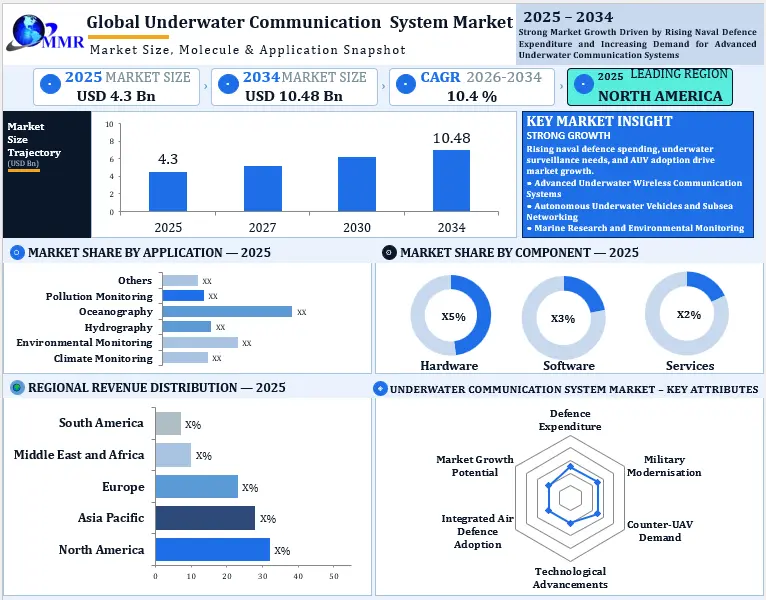
The Underwater Communication System Market was valued at USD 4.3 billion in 2025 and is expected to reach USD 10.48 billion by 2034, growing at a CAGR of 10.4% during the forecast period (2026–2034).
Global Underwater Communication System Market Growth Outlook
Underwater communication systems enable the transmission and reception of data between underwater devices, surface vessels, and monitoring stations. These systems primarily use acoustic, optical, and electromagnetic signals to facilitate communication in marine environments where conventional radio-frequency communication faces limitations. Hydrophones, underwater acoustic modems, transducers, and specialized receivers support underwater signal transmission and reception.
Various modulation techniques, including Frequency Shift Keying (FSK), Phase Shift Keying (PSK), Frequency-Hopping Spread Spectrum (FHSS), Direct-Sequence Spread Spectrum (DSSS), Pulse Position Modulation (PPM), Multiple Frequency Shift Keying (MFSK), and Fast Pulse Position Modulation (FPPM), improve communication performance under different underwater conditions.
The market serves applications such as naval defense, submarine communication, offshore oil and gas exploration, marine research, environmental monitoring, and underwater infrastructure inspection. The increasing adoption of autonomous underwater vehicles (AUVs), growing maritime security requirements, and advancements in underwater acoustic communication technologies support market growth. However, high equipment costs, limited bandwidth, and data transmission challenges remain key barriers to widespread adoption.
Underwater Communication System Market Growth Outlook
To know about the Research Methodology :- Request Free Sample Report
Underwater Communication System Market Scope and Research Methodology
The objective of the report is to present a comprehensive analysis of the Underwater Communication System Market. The Underwater Communication System Market is segmented by Component, Application, Connectivity, and End user. The report on Underwater Communication System market is an investor guide that provides a comprehensive analysis of the competitive benchmarking of major market players in the Underwater Communication System Market by services, revenue, financial status, portfolio, growth strategies, and geographical presence.
Data for the Underwater Communication System Market report is collected by both primary and secondary research methods. Bottom-Up approach was used to estimate the Underwater Communication System Market size.
The report includes detailed analysis of the Underwater Communication System Market by country, regional and global presence. The report is equipped with a competitive analysis of the Underwater Communication System Market players. SWOT, PESTLE and Porter’s Five Force analysis were used to analyse the strengths, weaknesses, and economic conditions of the Underwater Communication System market.
Underwater Communication System Market Dynamics:
Global Underwater Communication Systems Market Drivers: Integration of Underwater Communication Systems in Naval Defense Applications to Drive Market Growth: The increasing integration of underwater communication systems into naval defense operations drives market growth. These systems enable data transmission, underwater navigation, surveillance, and communication between submarines, autonomous underwater vehicles (AUVs), and naval command platforms. In 2025, the growing focus on maritime security, anti-submarine warfare (ASW), mine countermeasure (MCM) operations, and intelligence, surveillance, and reconnaissance (ISR) increases the demand for reliable underwater communication technologies. Acoustic communication modems facilitate data exchange between underwater platforms, where conventional radio-frequency communication faces significant limitations. Furthermore, the need for coordinated underwater missions and improved maritime situational awareness encourages naval forces to integrate advanced communication systems into their defense infrastructure, supporting market growth.
Increasing Demand for Autonomous Underwater Vehicles to Boost Market Growth: The increasing deployment of autonomous underwater vehicles (AUVs) across military, commercial, and scientific applications drives demand for underwater communication systems. AUVs rely on communication technologies to exchange mission data, transmit operational information, and coordinate activities with surface vessels and underwater monitoring stations. In 2025, the growing use of AUVs for mine detection, seabed mapping, underwater surveillance, and infrastructure inspection strengthens the need for reliable underwater communication solutions. These systems support naval operations by facilitating information exchange between autonomous platforms and improving underwater situational awareness. Additionally, the increasing adoption of AUVs in marine research and offshore operations creates further demand for acoustic modems and advanced underwater communication technologies.
Global Underwater Communication Systems Market Restraints
High Installation and Maintenance Costs to Restrain Market Growth: The high installation, development, and maintenance costs of underwater communication systems restrain market growth. These systems require specialized acoustic modems, underwater sensors, signal-processing equipment, and protective components capable of operating under high pressure, corrosion, and challenging marine conditions. Furthermore, deployment and maintenance activities require specialized vessels, skilled personnel, and extensive testing, increasing overall operational expenditure. In 2025, the need for reliable underwater connectivity and advanced equipment increases the importance of investment in system development and integration. These financial requirements limit adoption among smaller research institutions and commercial operators, particularly those operating with constrained budgets. Consequently, high initial investments and ongoing maintenance expenses restrict the widespread adoption of underwater communication systems across cost-sensitive applications.
Limited Data Transmission Speed to Hinder Market Growth: The limited data transmission speed of underwater acoustic communication systems restrains their adoption in data-intensive applications. Acoustic signals support long-distance communication underwater but operate within limited bandwidth and experience signal attenuation, background noise, multipath propagation, and Doppler effects. These factors affect transmission speed, reliability, and the timely delivery of information. In 2025, the demand for high-quality underwater imaging, real-time video transmission, and continuous monitoring increases the need for improved communication performance. However, conventional acoustic systems face limitations when transmitting large volumes of data compared with many terrestrial wireless communication technologies. These constraints create difficulties for applications requiring high-speed data exchange and encourage the development of alternative and hybrid communication technologies.
Global Underwater Communication Systems Market Opportunities
Expanding Applications in Offshore Oil and Gas Operations to Create Market Opportunities: The expanding use of underwater communication systems in offshore oil and gas exploration and production creates significant growth opportunities. These systems facilitate communication between remotely operated vehicles (ROVs), autonomous underwater vehicles, subsea sensors, and offshore control stations. In 2025, the demand for underwater pipeline inspection, seabed mapping, equipment monitoring, and subsea infrastructure maintenance supports the adoption of reliable underwater communication technologies. These systems enable operators to collect underwater data, monitor infrastructure conditions, and coordinate inspection activities in challenging marine environments. Furthermore, the increasing use of automated monitoring and remote operations in offshore industries creates opportunities for manufacturers to develop communication solutions that improve operational efficiency, support asset monitoring, and reduce the need for certain manual inspection activities.
Technological Advancements in Underwater Communication to Create Growth Opportunities: Continuous technological advancements create opportunities to improve the performance and reliability of underwater communication systems. In 2025, research and development activities focus on improving data transmission rates, signal processing, energy efficiency, and communication range. Innovations in software-defined acoustic modems, digital signal processing, artificial intelligence-assisted communication, and hybrid acoustic-optical technologies support the development of advanced underwater communication solutions. Acoustic communication enables longer-range data transmission, while optical communication offers higher data rates over shorter distances under suitable underwater conditions. Combining these technologies helps address the limitations of individual communication methods. These developments create opportunities across naval defense, marine research, offshore energy, environmental monitoring, and autonomous underwater operations.
Global Underwater Communication Systems Market Challenges
Limited Availability of Usable Frequency Bands to Challenge Market Growth: The limited availability of suitable frequency bands and bandwidth presents a significant technical challenge for the underwater communication system market. Underwater communication depends on the physical properties of water, which affect signal propagation, attenuation, and transmission range. Acoustic communication supports relatively long-range transmission but offers limited bandwidth, while optical communication provides higher data rates over shorter distances and is sensitive to water turbidity and scattering. In 2025, system developers continue to address the challenge of balancing transmission speed, communication range, power consumption, and signal reliability. These limitations complicate the development of communication networks that support high-speed data exchange across different underwater environments. Consequently, improving bandwidth utilization and developing adaptive communication technologies remain important priorities for the industry.
Maintaining Reliable Communication in Complex Underwater Environments to Remain a Key Challenge: Maintaining reliable communication under varying underwater conditions remains a major challenge for system developers and end users. Changes in water temperature, salinity, depth, currents, and seabed characteristics affect signal propagation and communication quality. Additionally, background noise, multipath interference, and Doppler effects disrupt signal transmission, particularly when communication involves moving platforms such as submarines and autonomous underwater vehicles. In 2025, the increasing integration of autonomous platforms into naval defense, marine research, and offshore operations increases the need for dependable communication across diverse operating conditions. However, ensuring consistent connectivity between underwater vehicles, surface vessels, and command stations requires advanced signal processing, robust communication protocols, and effective system integration. These technical requirements increase development complexity and challenge the deployment of reliable underwater communication networks.
Underwater communication system Market Segment Analysis:
Based on Component, Hardware segment to dominate the market over the forecast period
Underwater communication hardware components include LCDs, capacitors, resistors, cables, connectors, and many more. These devices are used to transmit messages over water and these electronics components are assembles on circuit board. Components all over the world are manufactured, and provide maintenance for underwater tools and equipment.
Based on Application, environmental monitoring segment is expected to hold the largest market share over the forecast period. Underwater communication systems assist the government in keeping track of the environment. It is possible to track oil and gas industry functions in terms of their environmental impact.
Based on the End-user, military and defense segment to hold the largest market share in terms of revenue over the forecast period
The military makes use of underwater communication system for underwater surveillance and invasion detection. Deployment of communication system within the body of water alert the country to the hazard because adversarial states may plan sabotage via the water.
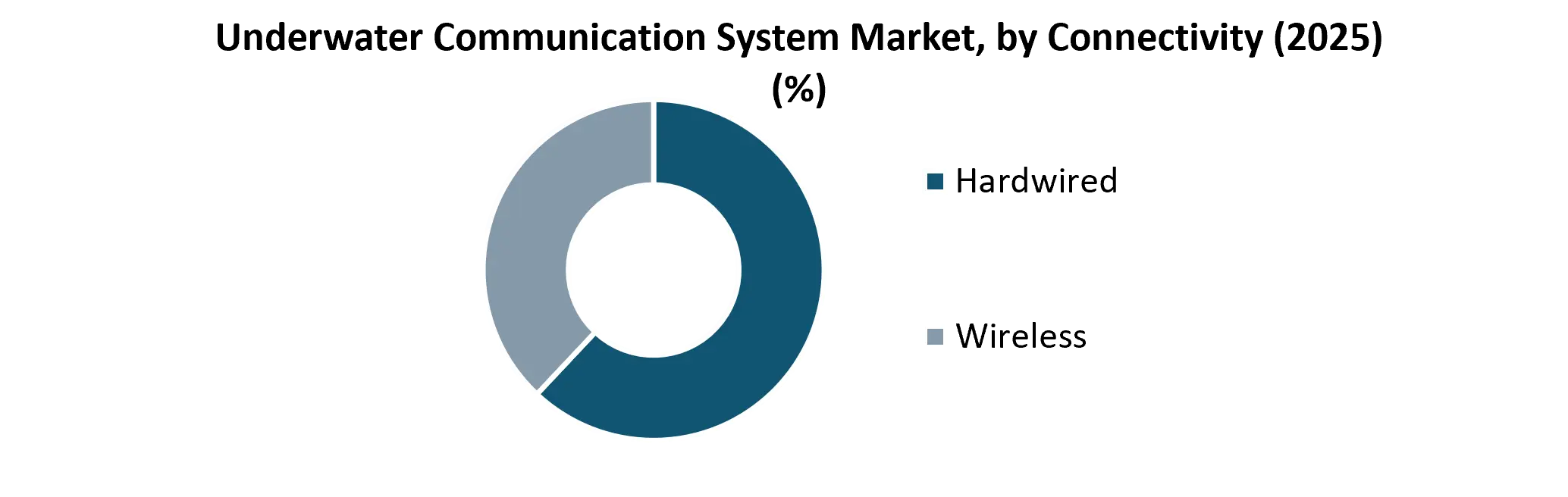
Based on Connectivity, wireless segment is expected to dominate the market over the forecast period
Data is transmitted through water in wireless transmission form. Underwater wireless communication is essential for scientific data collection, underwater exploration, and environmental monitoring.
 Global Underwater Communication System Market Regional Insights
North America is the leading region of the underwater communication system market in 2025, supported by investments in naval defense, submarine modernization, and underwater surveillance technologies. The United States drives regional demand through the adoption of underwater acoustic communication systems, acoustic modems, and autonomous underwater vehicles (AUVs) for military operations. The growing need for secure underwater data transmission, anti-submarine warfare, and maritime security strengthens the adoption of advanced communication technologies. Additionally, offshore oil and gas exploration, subsea infrastructure monitoring, and oceanographic research support demand for underwater wireless communication systems. The presence of established defense contractors, marine technology developers, and advanced research facilities further strengthens North America's position in the global underwater communication system market.
Asia Pacific represents an important regional market in 2025, driven by naval modernization, maritime security requirements, and expanding offshore energy activities. China, India, Japan, South Korea, and Australia contribute to regional demand through investments in submarine communication, autonomous underwater vehicles, and underwater surveillance systems. The increasing use of underwater acoustic modems in anti-submarine warfare, mine countermeasure operations, and intelligence, surveillance, and reconnaissance (ISR) creates opportunities for market expansion. Furthermore, growing marine research activities, seabed exploration, and offshore infrastructure development support the adoption of underwater communication technologies. Increasing investments in autonomous marine platforms and advanced subsea communication solutions position Asia Pacific as an important market for future industry development.
Europe maintains a significant position in the underwater communication system market in 2025, supported by naval defense investments, offshore energy infrastructure, and marine technology research. The United Kingdom, Germany, France, Norway, and Italy contribute to regional demand through submarine modernization, underwater surveillance, and subsea infrastructure protection. The growing need to monitor underwater communication cables, offshore wind installations, and subsea pipelines increases demand for reliable underwater data transmission systems. Additionally, marine research institutions and offshore energy operators use underwater acoustic communication, remotely operated vehicles (ROVs), and autonomous underwater vehicles for infrastructure inspection and environmental monitoring. Continued development of advanced acoustic modems and hybrid underwater communication technologies supports regional market growth.
The Middle East and Africa underwater communication system market develops through offshore oil and gas operations, maritime security requirements, and underwater infrastructure monitoring in 2025. Saudi Arabia, the United Arab Emirates, and South Africa contribute to regional demand through offshore energy projects, naval modernization, and marine research activities. Underwater communication systems support subsea pipeline inspection, equipment monitoring, remotely operated vehicle operations, and underwater data collection. The need for reliable communication between subsea sensors, underwater vehicles, and offshore control stations encourages the adoption of underwater acoustic modems and wireless communication technologies. Furthermore, increasing attention to coastal surveillance and marine environmental monitoring creates additional opportunities for underwater communication system providers.
South America presents opportunities for the underwater communication system market in 2025, particularly through offshore oil and gas exploration, subsea infrastructure development, and marine research. Brazil represents an important regional market because its offshore energy operations require underwater communication for pipeline inspection, seabed mapping, equipment monitoring, and remotely operated vehicle activities. Argentina and Chile also contribute to demand through marine research, underwater resource exploration, and environmental monitoring. The increasing use of autonomous underwater vehicles, underwater sensors, and acoustic communication systems supports the collection and transmission of subsea data. Additionally, the need to monitor offshore installations and improve operational efficiency encourages the adoption of advanced underwater communication technologies across South America.
Global Underwater Communication System Market Competitive Analysis:
The global underwater communication system market is characterized by technological innovation, research and development, and strategic collaborations among key industry participants. Companies focus on developing advanced communication technologies to support naval operations, underwater surveillance, subsea exploration, and marine research. Thales is a prominent player in defence, aerospace, and secure communication technologies. The company invests in research and development to strengthen its technological capabilities and develop advanced solutions for defence and maritime applications. Its expertise in secure communications, sonar-related technologies, and underwater systems supports naval operations and underwater situational awareness.
Teledyne Marine, part of Teledyne Technologies Incorporated, provides technologies for subsea exploration, marine research, and underwater operations. Its portfolio includes marine instrumentation, underwater vehicles, imaging systems, and acoustic technologies that support oceanographic research and subsea monitoring. The company also benefits from collaboration among its technology businesses and industry partners to advance marine technology and develop solutions for underwater applications. Technology licensing, original equipment manufacturer (OEM) product development, co-branded solutions, government programs, and customer-specific product development represent potential areas for industry collaboration.
L3Harris Technologies is another significant participant in the broader defence communications and maritime technology landscape. The company provides communication systems, tactical radios, and advanced technologies for military and government applications. Its portfolio also includes maritime systems, air traffic management, pilot training, space technologies, and weather and environmental sensing solutions. These capabilities support military communications and maritime operations, although its broader communication portfolio is not exclusively focused on underwater communication systems.
| Country | Key Market Focus |
| United States | Naval communication systems, underwater surveillance, defence applications, and subsea technologies |
| France | Underwater acoustic communication, naval defence systems, and maritime technology development |
| United Kingdom | Naval modernization, underwater communication technologies, and maritime surveillance |
| Germany | Underwater sensing, marine engineering, and subsea communication technologies |
| China | Naval modernization, underwater surveillance, and autonomous underwater vehicle (AUV) technologies |
| Japan | Marine robotics, underwater communication systems, and oceanographic research |
| India | Naval communication, underwater surveillance, and indigenous defence technology development |
| Australia | Maritime security, subsea monitoring, underwater surveillance, and marine research |
Underwater Communication System Market Recent Industry Development
| Date | Company | Development | Impact |
| 5 February 2026 | Fincantieri and WSense | Fincantieri signs a strategic agreement with WSense to co-develop wireless underwater technologies and integrate them into its DEEP system for monitoring and protecting critical infrastructure. | Strengthens wireless underwater connectivity, reduces dependence on physical cabling, and supports flexible monitoring of subsea infrastructure. |
| 25 February 2026 | Xalten Systems and Subnero | The Technology Development Board supports the development of a high-performance acoustic antenna system designed for high-data-rate underwater communication and video transmission. | Supports higher-bandwidth underwater data exchange and improves communication capabilities between autonomous underwater platforms. |
| 23 June 2026 | Gabler Group and develogic | Gabler Group secures a contract worth approximately EUR 6 million through develogic to supply secure underwater communication and data-transmission technologies to a European navy. | Strengthens demand for secure subsea communication solutions and expands opportunities in naval and defense applications. |
| 6 July 2026 | Fincantieri | Fincantieri announces agreements to acquire majority stakes in Next Geosolutions, WSense, Graal Tech, and Defcomm, expanding its capabilities in underwater communications, marine robotics, and unmanned systems. | Promotes integrated underwater technology solutions and supports the adoption of wireless communication systems for the Internet of Underwater Things (IoUT). |
| 18 August 2026 | NEC | NEC begins research on an underwater acoustic foundation model using self-supervised learning under a contract from Japan’s Agency for Defense Equipment. | Advances AI-based underwater acoustic analysis, supporting improved interpretation of underwater signals and potential applications in defense, marine research, and environmental monitoring. |
| 1 September 2026 | KONGSBERG | KONGSBERG completes its acquisition of Sonatech, an underwater acoustics specialist supplying sonar and underwater communication solutions. | Expands KONGSBERG’s underwater acoustic technology portfolio and strengthens its position in naval communication and subsea defense systems. |
| 2 October 2026 | Anduril Industries and Popoto Modem | Anduril announces the acquisition of Popoto Modem to advance affordable underwater acoustic communications and multi-node mesh networking for autonomous underwater vehicles. | Supports scalable underwater networking, enabling autonomous vehicles to exchange data and coordinate operations with surface vessels and other underwater assets. |
| 9 October 2026 | AnySignal and Andrenam | AnySignal and Andrenam announce a partnership to develop and commercialize a new family of underwater acoustic communication modems, with initial shipments expected in the first half of 2027. | Encourages integration of underwater acoustic communication with maritime infrastructure, edge processing, and satellite connectivity, supporting more connected subsea operations. |
Underwater Communication System Market Scope: Inquiry Before Buying
| Underwater communication system Market | |||
|---|---|---|---|
| Report Coverage | Details | ||
| Base Year: | 2025 | Forecast Period: | 2026-2034 |
| Historical Data: | 2020 to 2025 | Market Size in 2025: | US $ 4.3 Bn. |
| Forecast Period 2026 to 2034 CAGR: | 10.4% | Market Size in 2034: | US $ 10.48 Bn. |
| Segments Covered: | by Component | Hardware Software Services |
|
| by Connectivity | Hardwired Wireless |
||
| by Application | Climate Monitoring Environmental Monitoring Hydrography Oceanography Pollution Monitoring Others |
||
| by End User | Marine Military & Defense Oil & Gas Scientific Research & Development Others |
||
Underwater Communication System Market, by Region
North America (United States, Canada and Mexico)
Europe (UK, France, Germany, Italy, Spain, Sweden, Austria and Rest of Europe)
Asia Pacific (China, South Korea, Japan, India, Australia, Indonesia, Malaysia, Vietnam, Taiwan, Bangladesh, Pakistan and Rest of APAC)
Middle East and Africa (South Africa, GCC, Egypt, Nigeria and Rest of ME&A)
South America (Brazil, Argentina Rest of South America)
Underwater Communication System Market Key Players Include:
1. Saab AB
2. Thales Group
3. Teledyne Marine
4. Kongsberg Gruppen ASA
5. L3Harris Technologies, Inc.
6. EvoLogics GmbH
7. Sonardyne International Ltd.
8. Ultra Electronics Maritime Systems
9. Sea and Land Technologies Pte Ltd.
10.DSPComm Ltd.
11.Hydromea SA
12.Markey Machinery
13.Desert Star Systems LLC
14.Ceebus Technologies, LLC
15.DIVELINK Underwater Communications Ltd.
16.RJE International, Inc.
17.Subnero Pte. Ltd.
18.General Dynamics Mission Systems, Inc.
19.Lockheed Martin Corporation
20.Nortek AS
21.Moog Inc.
22.Aquatec Group Ltd.
23.Oceaneering International, Inc.
24.Subsea 7 S.A.
25.MacArtney Group
26.BlueComm Limited
27.International Submarine Engineering Ltd. (ISE)
28.Ocean Technology Systems (OTS)
29.AquaBotix Technology Corporation
30.JW Fishers Manufacturing, Inc.
31.LinkQuest, Inc.
32.Hydroacoustics, Inc.
33.Ocean Sonics Ltd.
34.FarSounder, Inc.
35.Advanced Navigation
36.Blueprint Subsea Ltd.
37.EdgeTech
38.Wärtsilä ELAC Nautik GmbH
39.Sercel (Viridien)
40.Tritech International Ltd.
41.Water Linked AS
42.Xeos Technologies Inc.
43.Nautel Ltd.
44.Channel Technologies Group
45.Mitsubishi Electric Corporation
46.NEC Corporation
47.Fujitsu Limited
48.Rafael Advanced Defense Systems Ltd.
49.WSense S.r.l.
Frequently Asked Questions:
1] What is the growth rate of the Global Underwater Communication System Market?
Ans. The Global Underwater communication system Market is growing at a significant rate of 10.4% over the forecast period.
2] Which region is expected to dominate the Global Underwater Communication System Market?
Ans. North America region is expected to dominate the Underwater communication system Market over the forecast period.
3] What is the Global Underwater Communication System Market size by 2034?
Ans. The market size of the Underwater communication system Market is expected to reach USD 10.48 Bn by 2034.
4] Which are the top players of the Global Underwater Communication System Market?
Ans. The major key players of the Global Underwater communication system Market are Saab AB, Thales, Teledyne Marine, Kongsberg, L3Harris Technologies, Inc., EvoLogics GmbH, Sonardyne international ltd.
5] What factors are expected to drive Global Underwater Communication System growth by 2034?
Ans. Naval Defense Application is expected to drive the Underwater communication system Market growth over the forecast period (2026-2034).