Switched mode power supply transformer Market Size by Type, Power Rating, Application, Region, Industry-Wide Analysis, Competitive Landscape Assessment & Long-Term Forecast to 2034

3.04%
CAGR (2026-2034)
1.74 USD Bn.
Forecast Market Size
309
Report Pages
140
Market Tables

Overview

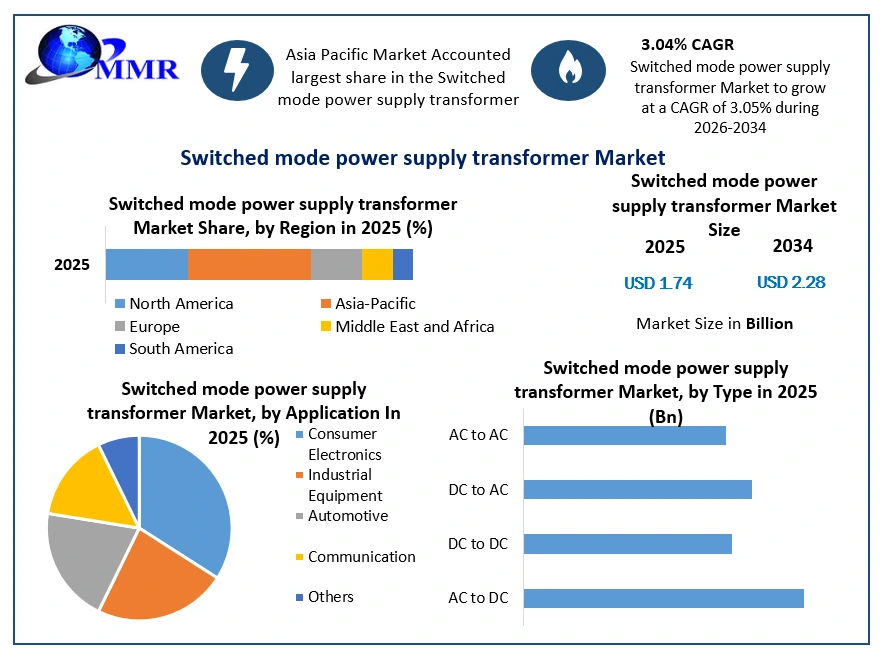
The Switched-Mode Power Supply Transformer Market was valued at USD 1.74 Bn in 2025, and the total revenue of the Switched-Mode Power Supply Transformer Market is expected to grow at a CAGR of 3.04% from 2025 to 2034, reaching USD 2.28 Bn by 2034.

Switched mode power supply transformer Market Overview:

An electronic power supply device with a switching regulator for effectively converting electrical power and supplying the appropriate output voltage is known as a switched mode power supply (SMPS). To make a switch mode power supply, these switching regulators are used with switch mode power supply transformers. These transformers offer isolation between the input and output sides of a switch mode power supply and are used to step up or decrease voltage or current. Switch mode power supply transformers are widely used in commercial and industrial electronic applications. They are typically employed in electronic systems that demand a precise quantity of power, such as a power supply for a computer.

Switched Mode Power Supply Transformer Market Growth and Share Analysis
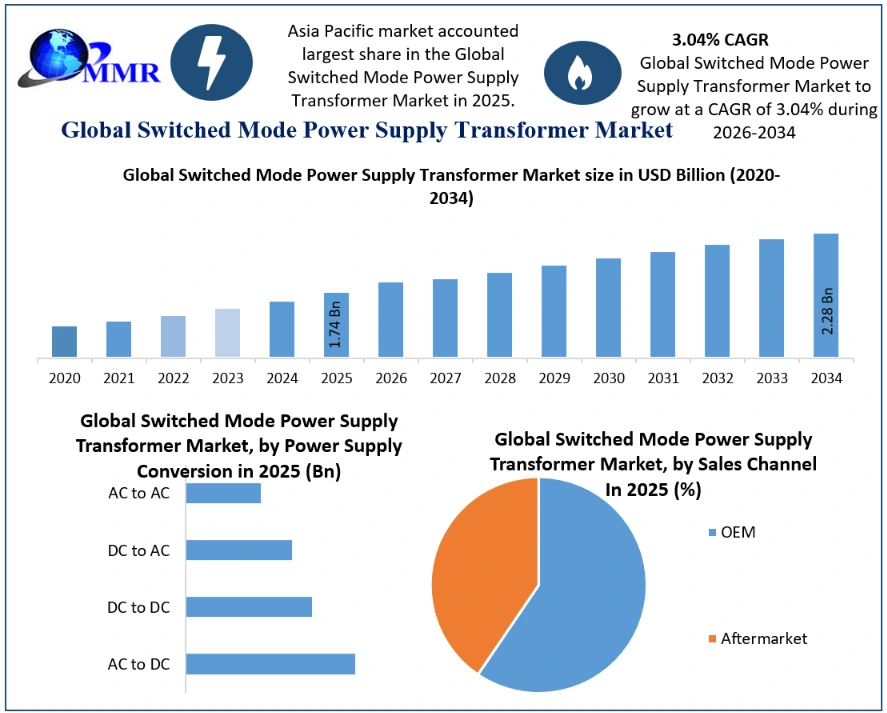
Switched Mode Power Supply Transformer Market Growth

To know about the Research Methodology :- Request Free Sample Report

Switched mode power transformer Market Dynamics:

Switching transformers are becoming more common due to their advantages, which include efficient power consumption, lightweight, small size, and variable power conversion. Switching transformers' ability to operate across a wide frequency range removes the need for hefty frequency transformers. Similarly, their capacity to provide variable power conversion makes them ideal for a wide range of high-reliability applications, including railway systems, industrial machine tools, electric vehicles, and security systems. Over the projected period, the aforementioned reasons and the numerous applications of switching transformers are expected to fuel market growth.

The switch mode power supply market is expected to grow at a CAGR of xx%, xx%, and xx% in North America, Europe, and the Asia Pacific during the forecast period, respectively. Owing to new technical solutions that are efficient and cost-effective. Companies are developing more compact, lighter-weight designs, which help to reduce transportation costs. For example, Pulse The Yageo Company's high frequency current detecting transformer series is small and cost-effective. The New AEC-Q200 qualified PA1005.XXXQNL is the name of the new series. This transformer series may be used in various applications, including feedback control, overload detection, and switching power supply.

Even though switch mode power supply transformers are energy-efficient and cost-effective, the high-frequency noise created by these transformers is predicted to limit their use in all applications. Switch mode power supply transformers are not used in applications that demand high performance and data integrity due to their high-frequency noise. Companies such as Texas Instruments Incorporated and Analog Devices Inc. are developing noise-reduction technologies. For example, Analog Devices' product ADP5135 features multiple-switching buck regulators, which can solve the beat frequency issue because the regulators in the company's products are multiple-switching.

Furthermore, manufacturers' growing desire to reduce carbon dioxide emissions has allowed them to create environmentally beneficial products. Furthermore, market growth is projected to be maintained during the forecast period as the paradigm moves toward downsizing electronic components and IoT's rise.

Switched mode power supply transformer Market Segment Analysis:

Based on Type, the global switched mode power supply transformer is sub-segmented into AC to DC, DC to DC, DC to AC, and AC to AC. The AC to DC SMPS transformer segment dominated the market, driven by its extensive use in consumer electronics, IT hardware, and industrial power supplies. Rising demand for energy-efficient converters in laptops, smartphones, and household appliances significantly supported segment growth. The DC to DC segment also gained traction in automotive and telecom applications due to the increasing adoption of EVs and 5G infrastructure. Meanwhile, DC to AC and AC to AC transformers held a smaller but steady market presence, serving niche applications in inverters and specialised industrial systems.

Based on Application, the switched mode power supply transformer is sub-segmented into communications, industrial, consumer electronics, Automotive and others. The consumer electronics segment dominated the SMPS transformer market in 2024, with strong demand from smartphones, laptops, tablets, and smart home devices requiring lightweight, efficient power solutions. Industrial equipment applications saw growing adoption as automation, robotics, and advanced manufacturing expanded worldwide. The automotive segment emerged as a fast-growing contributor, boosted by rising EV adoption and advanced vehicle electronics. Communication applications, particularly in 5G deployment, also enhanced demand, while other sectors such as medical devices and defence maintained a niche but steady growth.

Switched mode power transformer Market Regional Insights:

In 2025, Asia Pacific contributed more than 33.0% of total sales. Electronic components are in higher demand in nations with large populations, such as China and India. In addition, numerous electronic component makers have production facilities in nations like Taiwan, Singapore, and other Asian countries. As a result of the region's large population and significant demand from manufacturing hubs, the region is anticipated to maintain its dominance from 2025 through 2034.

In the next seven years, North America is expected to grow at a CAGR of more than 2.0 percent. This growth can be ascribed in part to the automobile industry's notable use of technology. The need for DC to DC switch mode power supply in the region is being driven by automobiles with increased capabilities such as the ability to charge gadgets using car batteries. Pulse Electronics, Triad Magnetics, and APX Technologies, Inc. are among the firms contributing to the region's revenue share.

The objective of the report is to present a comprehensive analysis of the global Switched mode power supply transformer Market to the stakeholders in the industry. The past and current status of the industry with the forecasted market size and trends are presented in the report with the analysis of complicated data in simple language. The report covers all the aspects of the industry with a dedicated study of key players that include market leaders, followers, and new entrants.

PORTER, PESTEL analysis with the potential impact of micro-economic factors of the market have been presented in the report. External as well as internal factors that are supposed to affect the business positively or negatively have been analysed, which will give a clear futuristic view of the industry to the decision-makers.

The report also helps in understanding the global Switched mode power supply transformer Market dynamics, structure by analyzing the market segments and project the global Switched mode power supply transformer Market size. Clear representation of competitive analysis of key players by product, price, financial position, product portfolio, growth strategies, and regional presence in the global Switched mode power supply transformer Market make the report investor’s guide.

Switched mode power supply transformer Market Recent Development

Date Company Development Impact
15 January 2025 TDK Corporation TDK announced the expansion of its ultra-compact SMPS transformer series featuring enhanced thermal performance for high-density automotive power supplies. The innovation accelerates adoption in electric vehicle (EV) charging modules by boosting power efficiency by 12%.
12 May 2025 Murata Manufacturing Co., Ltd. Murata introduced a high-frequency planar SMPS transformer line designed for next-generation telecommunications infrastructure and 5G base stations. This development significantly reduces board space requirements while optimizing energy efficiency and thermal dissipation.
18 September 2025 Vishay Intertechnology, Inc. Vishay unveiled a new customized flyback SMPS transformer series certified for medical-grade power supplies and industrial automation systems. The product line strengthens high-voltage isolation safety standards across sensitive healthcare electronic applications.
10 November 2025 Bourns, Inc. Bourns expanded its high-power switch-mode transformer portfolio with AEC-Q200 compliant components engineered for harsh industrial environments. This rollout drives higher reliability in renewable energy inverters and heavy industrial drives.
14 February 2026 Würth Elektronik Würth Elektronik launched an eco-designed SMD SMPS transformer range optimized for high-power-density AI server architectures. The launch meets growing demand for sustainability and reduced power loss in hyper-scale data centers.

Switched mode power supply transformer Market Scope: Inquire before buying

Global Switched mode power supply transformer Market
Report Coverage Details
Base Year: 2025 Forecast Period: 2026-2034
Historical Data: 2020 to 2025 Market Size in 2025: USD 1.74 Bn.
Forecast Period 2026 to 2034 CAGR: 3.04% Market Size in 2034: USD 2.28 Bn.
Segments Covered: by Power-Supply Conversion AC to DC
DC to DC
DC to AC
AC to AC
by Power Rating Up to 50 W
Above 50 W to 150 W
Above 150 W to 500 W
Above 500 W to 1 kW
Above 1 kW to 3 kW
Above 3 kW to 10 kW
Above 10 k
by Transformer Topology Flyback Transformers
Forward Transformers
Push-Pull Transformers
Half-Bridge Transformers
Full-Bridge Transformers
Phase-Shifted Full-Bridge Transformers
LLC Resonant Transformers
Others
by Immediate Host Equipment Power Generation
Generator Excitation Systems
    Turbine Control Systems
    Generator Protection Systems
    Plant DCS & PLC Systems
    Station Battery Chargers
    UPS Systems
    Others
Power Transmission & Distribution
Protection Relays
    Bay Control Units
    Remote Terminal Units (RTUs)
    Teleprotection Systems
    HVDC Control Systems
    FACTS Controllers
    Substation Battery Chargers
    Substation UPS Systems
    Others
by Sales Channel OEM
Aftermarket
by End-Use Industry Power & Utilities
Industrial Automation & Manufacturing
Telecommunications
Data Centers
Renewable Energy
Automotive & Electric Vehicles
Aerospace & Defense
Medical Devices
Consumer Electronics
Railways & Transportation
Oil & Gas
Others

Switched mode power supply transformer Market, by Region

North America (United States, Canada and Mexico)
Europe (UK, France, Germany, Italy, Spain, Sweden, Austria and Rest of Europe)
Asia Pacific (China, South Korea, Japan, India, Australia, Indonesia, Malaysia, Vietnam, Taiwan, Bangladesh, Pakistan and Rest of APAC)
Middle East and Africa (South Africa, GCC, Egypt, Nigeria and Rest of ME&A)
South America (Brazil, Argentina Rest of South America)

Switched mode power supply transformer Market, Key Players are:

North America
1. Coilcraft, Inc. — United States
2. Bourns, Inc. — United States
3. Bel Fuse Inc. — United States
4. Standex International Corporation — United States
5. Triad Magnetics — United States
6. Premier Magnetics, Inc. — United States
7. Datatronics Romoland, Inc. — United States
8. Agile Magnetics, Inc. — United States
9. Precision, Inc. — United States
10. Vanguard Electronics Company — United States
11. PCA Electronics, Inc. — United States
12. MPS Industries, Inc. — United States
13. West Coast Magnetics — United States
14. Renco Electronics, Inc. — United States
15. Pico Electronics, Inc. — United States
16. Butler Winding — United States
17. Custom Coils, Inc. — United States
18. Electronic Craftsmen — Canada
19. Falco Electronics — United States
20. CTM Magnetics, Inc. — United States
21. ICE Components, Inc. — United States
22. Able Coil & Electronics Company, Inc. — United States
23. L/C Magnetics, Inc. — United States
24. Marque Magnetics, Inc. — United States
Europe
25. Würth Elektronik eiSos GmbH & Co. KG — Germany
26. GT elektronik GmbH & Co. KG — Germany
27. KUK Electronic AG — Switzerland
28. PREMO S.L. — Spain
29. Myrra Group — France
30. Talema Group — Ireland
31. BLOCK Transformatoren-Elektronik GmbH — Germany
32. Kaschke Components GmbH — Germany
33. HAHN Elektrobau GmbH — Germany
34. Sirio Inductive Components S.r.l. — Italy
35. Himag Planar Magnetics Ltd. — United Kingdom
36. TT Electronics plc — United Kingdom
37. AGW Electronics Ltd. — United Kingdom
38. Custom Planar Magnetics Ltd. — United Kingdom
39. Scheele-elektrik— Germany
Asia Pacific
40. TDK Corporation — Japan
41. SUMIDA Corporation — Japan
42. Tamura Corporation — Japan
43. Tokyo Coil Engineering Co., Ltd. — Japan
44. Sagami Elec Co., Ltd. — Japan
45. MinebeaMitsumi Inc. — Japan
46. Delta Electronics, Inc. — Taiwan
47. Pulse Electronics, a YAGEO Group company — Taiwan
48. ABC Taiwan Electronics Corp. — Taiwan
49. Coilmaster Electronics Co., Ltd. — Taiwan
50. Elytone Electronic Co., Ltd. — Taiwan
51. Yuan Dean Scientific Co., Ltd. — Taiwan
52. Superworld Electronics (S) Pte. Ltd. — Singapore
53. Eaglerise Electric & Electronic Co., Ltd. — China
54. Mentech Technology Co., Ltd. — China
55. Shenzhen Sunlord Electronics Co., Ltd. — China
56. Elcompo Electronic Industries Pvt. Ltd. — India
57. SVM Private Limited — India
58. Miracle Electronic Devices Pvt. Ltd. — India
59. Shah Electronics — India
60. Wirewound Electronics Pvt. Ltd. — India
61. MEC Enterprise — India
62. Shreejee Electronics Private Limited — India
63. Technic Electronic Corporation — India
64. Shri Components — India
Middle East and Africa
65. Payton Planar Magnetics Ltd. — Israel

Frequently Asked Questions:

1. What is the growth rate of the Global Switched-Mode Power Supply Transformer Market?
Ans: The Global Switched-Mode Power Supply Transformer Market is growing at a CAGR of 3.04% during the forecasting period 2026-2034.

2. What is the scope of the Global Switched-Mode Power Supply Transformer Market report?
Ans: The Global Switched-Mode Power Supply Transformer Market report helps with the PESTEL, PORTER, Recommendations for Investors & Leaders, and market estimation of the forecast period.

3. Who are the key players in the Global Switched-Mode Power Supply Transformer Market?
Ans: The important key players in the Global Switched-Mode Power Supply Transformer Market are – TDK Electronics AG, APX Technologies Inc., Butler Winding, Coil Winding Specialist, Hang Tung Electronic Tec, Infineon Technologies AG, Kunshan Hengyi Electrical Appliance, Prem Magnetics, Premier Magnetics, Prisource Electronics, Infineon Technologies AG, Sumida Corporation, Tamura Corporation, Pulse Electronics, Royal Electronics.

4. What is the study period of this Market?
Ans: The Global Switched-Mode Power Supply Transformer Market is studied from 2020 to 2034.

Table of Contents

1. SECTION A – GLOBAL SWITCHED MODE POWER SUPPLY TRANSFORMER MARKET INTRODUCTION 1.1 Global Switched Mode Power Supply Transformer Market Landscape and Industry Overview 1.1.1 Market Value Growth and Volume Development 1.1.2 Historical Market Development Assessment Across Global Power Infrastructure 1.1.3 Forecast Revenue and Shipment Performance Outlook 1.1.4 Demand and Supply Balance Across Markets 1.1.5 Macroeconomic Conditions Influencing Power Transformer Capital Investments 1.1.6 Long-Term Market Expansion Potential Assessment 1.2 Global Switched Mode Power Supply Transformer Market Dynamics 1.2.1 Switched Mode Power Supply Transformer Market Trends 1.2.2 Switched Mode Power Supply Transformer Market Dynamics 1.2.3 Drivers 1.2.4 Restraints 1.2.5 Opportunities 1.2.6 Challenges 1.2.7 PORTER’s Five Forces Analysis 1.2.8 Supplier Power 1.2.9 Buyer Power 1.2.10 Threat of Substitutes 1.2.11 Threat of New Entrants 1.2.12 Competitive Rivalry 1.2.13 PESTLE Analysis 1.3 Switched Mode Power Supply Transformer Market Dynamics and Commercial Development Analysis 1.3.1 Analysis of Structural Demand Drivers Across Application Environments 1.3.2 Assessment of Adoption Restraints Across Transformer Qualification Requirements 1.3.3 Evaluation of Emerging Opportunities Across Grid Modernization Programs 1.3.4 Examination of Commercialization Challenges Affecting Manufacturer Participation Nationwide 1.3.5 Review of Substitute Technologies Influencing Transformer Design Selection 1.3.6 Analysis of External Influences Shaping Long-Term Market Evolution 1.4 Transformer Pricing Structure and Cost-Transmission Analysis 1.4.1 Analysis of Transformer Pricing Across Topology and Ratings 1.4.2 Assessment of Custom Engineering Premiums Across Application Specifications 1.4.3 Evaluation of Ferrite, Copper and Insulation Cost Transmission 1.4.4 Comparison of Domestic and Imported Product Pricing Structures 1.4.5 Examination of Manufacturer, Distributor and Customer Margin Allocation 1.4.6 Review of Pricing Volatility Across Procurement Contract Cycles 1.5 Global Power-Sector Transformer Demand Analysis 1.5.1 Analysis of Transformer Demand Across Power Generation Equipment 1.5.2 Assessment of Transmission Automation Demand Across Global Utilities 1.5.3 Evaluation of Renewable Integration Requirements Supporting Transformer Adoption 1.5.4 Examination of Replacement Demand Across Installed Electronic Equipment 1.5.5 Comparison of OEM, Aftermarket and Project-Driven Purchasing Requirements 1.5.6 Forecasting of Demand Under Alternative Infrastructure Investment Scenarios 1.6 Domestic and Imported Transformer Supply Availability Analysis 1.6.1 Analysis of Domestic Transformer Manufacturing Availability Across Global Markets 1.6.2 Assessment of Supplier Concentration Across Eligible Product Categories 1.6.3 Evaluation of Imported Transformer Availability and Sourcing Dependence 1.6.4 Examination of Ferrite Core and Winding Material Supply Reliability 1.6.5 Review of Production Lead-Times and Inventory Continuity Requirements 1.6.6 Assessment of Supply Constraints Across High-Reliability Applications Nationwide 1.7 Generation, Transmission, Host-Equipment and Power-Module Opportunity Analysis 1.7.1 Mapping of Transformer Demand Across Generation Control Equipment 1.7.2 Assessment of Transmission Protection Equipment Power-Module Requirements Nationwide 1.7.3 Evaluation of Auxiliary Power Architectures Across Substations and Plants 1.7.4 Examination of Grid Modernization Effects on Transformer Specifications 1.7.5 Comparison of Renewable and Conventional Generation Application Requirements Nationwide 1.7.6 Analysis of Host-Equipment Qualification Pathways Across Global Projects 1.8 High-Frequency Transformer Manufacturing Process and Technology Analysis 1.8.1 Analysis of Magnetic Design and Winding Process Stages 1.8.2 Assessment of Ferrite Core Selection and Preparation Requirements 1.8.3 Evaluation of Insulation, Creepage and Clearance Engineering Practices 1.8.4 Examination of Automated Winding, Termination and Assembly Technologies 1.8.5 Review of Impregnation, Potting, Encapsulation and Curing Processes 1.8.6 Assessment of Electrical, Thermal and Reliability Testing Systems 1.8.7 Digital Lead Generation Expanding Qualified Pipelines 1.8.8 Performance Positioning Supporting Premium Price Realization 1.9 Product Development, Design Innovation and Lifecycle Analysis 1.9.1 Analysis of Planar Transformer Development and Commercialization Pathways 1.9.2 Assessment of High-Frequency Materials Supporting Power-Density Improvements Nationwide 1.9.3 Evaluation of Resonant Topology Transformer Design Innovation Pipelines 1.9.4 Examination of Thermal Management, Miniaturization and Integration Advances 1.9.5 Review of Automated Design, Simulation and Prototyping Capabilities 1.9.6 Analysis of Product-Lifecycle Upgrading, Substitution and Retirement Pathways 1.10 Application Performance, Reliability and Qualification Requirements Analysis 1.10.1 Analysis of Efficiency, Isolation and Regulation Performance Requirements 1.10.2 Assessment of Thermal Rise and Derating Expectations Nationwide 1.10.3 Evaluation of Dielectric Strength and Insulation Coordination Requirements 1.10.4 Examination of Electromagnetic Compatibility Across Host-Equipment Environments Nationwide 1.10.5 Review of Shock, Vibration and Environmental Qualification Requirements 1.10.6 Assessment of Application-Specific Reliability and Lifetime Validation Methods 1.11 Production Economics, Cost Structure and Operational Efficiency Analysis 1.11.1 Analysis of Raw Material Cost Structures Across Transformers 1.11.2 Assessment of Manufacturing Conversion Costs Across Production Scales 1.11.3 Evaluation of Tooling, Testing and Engineering Cost Components 1.11.4 Examination of Labor, Utilities and Quality-Related Operating Costs 1.11.5 Review of Yield, Utilization and Scrap Economics Nationwide 1.11.6 Estimation of Unit Economics Across Topology-Rating Combinations 1.12 Manufacturing Capacity, Infrastructure, Localization and Expansion Analysis 1.12.1 Mapping of Domestic Manufacturing Footprints Across Industrial Clusters 1.12.2 Assessment of Installed Winding, Assembly and Testing Capacity 1.12.3 Evaluation of Facility Utilization and Production Flexibility Levels 1.12.4 Examination of Localization Capabilities Across Materials and Components 1.12.5 Review of Announced Manufacturing Expansion and Modernization Initiatives 1.12.6 Forecasting of Capacity Requirements Under Alternative Demand Scenarios 1.13 Transformer Value Chain and Channel Margins 1.13.1 Mapping of Value Creation Across Transformer Ecosystem Participants 1.13.2 Analysis of Material Supplier Contribution Across Manufacturing Stages 1.13.3 Assessment of Manufacturer Engineering and Production Margin Capture 1.13.4 Evaluation of Distributors, Representatives and Integrator Revenue Participation 1.13.5 Examination of OEM Contracting Structures and Commercial Responsibilities 1.13.6 Review of Profitability Distribution Across Domestic Value Chains 1.14 Transformer Trade, Supply Chain, Distribution and Customer-Access Analysis 1.14.1 Analysis of Eligible Transformer Import and Export Patterns 1.14.2 Assessment of Ferrite Cores and Winding Materials Trade Dependencies 1.14.3 Evaluation of Customs Documentation and Cross-Border Compliance Requirements 1.14.4 Examination of Logistics Lead-Times and Inventory Movement Requirements 1.14.5 Review of Direct-Sales, Distribution and Customer-Access Channel Structures 1.14.6 Assessment of Supply-Chain Resilience Under Disruption Scenarios 1.14.7 Nationwide Supply-Chain Assessment 1.15 Transformer Sustainability, Resource Efficiency and Circular-Economy Analysis 1.15.1 Analysis of Ferrite, Copper and Insulation Sustainability Considerations 1.15.2 Assessment of Manufacturing Energy Consumption and Emissions Profiles 1.15.3 Evaluation of Process Waste Reduction and Material Recovery 1.15.4 Examination of Product Durability Supporting Lifecycle Extension Strategies 1.15.5 Review of Ethical Sourcing Across Critical Material Inputs 1.15.6 Assessment of End-of-Life Recycling and Circularity Pathways Nationwide 1.16 Electrical Standards, Testing, Certification and Compliance Analysis 1.16.1 Analysis of Global Electrical Safety and Compliance Requirements 1.16.2 Assessment of Applicable Transformer Testing and Certification Standards 1.16.3 Evaluation of Insulation, Flammability and Material Compliance Obligations 1.16.4 Examination of Customer-Specific Qualification and Audit Requirements Nationwide 1.16.5 Review of Import Conformity and Documentation Requirements 1.16.6 Assessment of Evolving Standards Affecting Market-Entry Readiness Nationwide 1.17 Manufacturing Investment, Modernization and Capital Deployment Analysis 1.17.1 Analysis of Manufacturing Capital Requirements Across Operating Models 1.17.2 Assessment of Winding Automation and Testing Investment Priorities 1.17.3 Evaluation of Product Development and Laboratory Expenditure Requirements 1.17.4 Examination of Localization Investments Across Components and Materials 1.17.5 Review of Expansion Project Pipelines Across Manufacturing Clusters 1.17.6 Assessment of Commercial Return Considerations Across Investment Pathways 1.18 Global Regional Manufacturing and Market Development Analysis 1.18.1 Analysis of Western Global Manufacturing and Customer Clusters 1.18.2 Assessment of Southern Global Electronics and Engineering Ecosystems 1.18.3 Evaluation of Northern Global Power-Equipment Demand Concentration Patterns 1.18.4 Examination of Eastern Global Generation and Transmission Project Opportunities 1.18.5 Review of Central Global Industrial and Utility Demand 1.18.6 Analysis of Regional Logistics, Localization and Support Readiness 1.19 Generation, Transmission Infrastructure and Project Indicator Analysis 1.19.1 Analysis of Generation Capacity Additions Influencing Transformer Demand 1.19.2 Assessment of Transmission Network Expansion and Modernization Indicators 1.19.3 Evaluation of Substation Automation and Digitalization Deployment Pipelines 1.19.4 Examination of HVDC, FACTS and Renewable-Integration Project Activity 1.19.5 Review of Utility Capital Budgets and Procurement Schedules 1.19.6 Analysis of Protection and Control Equipment Installed-Base Development Nationwide 1.20 OEM, Utility and EPC Procurement Behaviour Analysis 1.20.1 Analysis of OEM Procurement Structures and Decision Authority 1.20.2 Assessment of Utility Tendering and Supplier Qualification Practices 1.20.3 Evaluation of Technical Specifications Governing Transformer Purchasing Decisions 1.20.4 Examination of Contract Duration, Pricing and Delivery Requirements 1.20.5 Review of Switching Barriers and Approved-Vendor Dependencies Nationwide 1.20.6 Assessment of Service Documentation and Traceability Expectations Nationwide 1.21 Strategic Partnerships, Transactions and Manufacturing Expansion Analysis 1.21.1 Analysis of Manufacturer-OEM Partnerships Supporting Design Integration 1.21.2 Assessment of Utility-EPC Collaborations Supporting Project Participation 1.21.3 Evaluation of Technology Licensing and Localization Partnership Models 1.21.4 Examination of Acquisitions Affecting Product Portfolios and Capabilities 1.21.5 Review of Joint Ventures Supporting Global Manufacturing Expansion 1.21.6 Analysis of Distribution Alliances Strengthening Commercial Market Access 1.22 Global Market Entry and Commercial Feasibility Analysis 1.22.1 Analysis of Market-Entry Barriers Across Transformer Applications Nationwide 1.22.2 Assessment of Manufacturing Localization Versus Import Commercialization Pathways 1.22.3 Evaluation of Supplier Qualification Timelines and Approval Requirements 1.22.4 Examination of Channel Partner Selection and Onboarding Criteria 1.22.5 Review of Customer Acquisition Economics Across Targeted Accounts 1.22.6 Assessment of Commercial Scalability Across Global Industrial Clusters 1.23 Switched Mode Power Supply Transformer Market Strategic Risk Assessment 1.23.1 Analysis of Material Availability and Pricing Risk Exposures 1.23.2 Assessment of Demand Volatility Across Infrastructure Investment Cycles 1.23.3 Evaluation of Technology Substitution and Obsolescence Risks Nationwide 1.23.4 Examination of Regulatory Changes and Compliance Disruption Risks 1.23.5 Review of Competitive Intensity and Margin Pressure Exposures 1.23.6 Assessment of Customer Concentration and Qualification Dependency Risks 1.24 Global Switched Mode Power Supply Transformer Market Size and Forecast by Segmentation (2025–2034) 1.24.1 Global Switched Mode Power Supply Transformer Market Size and Forecast by Immediate Host Equipment 1.24.1.1 Power Generation 1.24.1.2 Generator Excitation Systems 1.24.1.3 Turbine Control Systems 1.24.1.4 Generator Protection Systems 1.24.1.5 Plant DCS & PLC Systems 1.24.1.6 Station Battery Chargers 1.24.1.7 UPS Systems 1.24.1.8 Others 1.24.1.9 Power Transmission 1.24.1.10 Protection Relays 1.24.1.11 Bay Control Units 1.24.1.12 Remote Terminal Units (RTUs) 1.24.1.13 Teleprotection Systems 1.24.1.14 HVDC Control Systems 1.24.1.15 FACTS Controllers 1.24.1.16 Substation Battery Chargers 1.24.1.17 Substation UPS Systems 1.24.1.18 Others 1.24.2 Global Switched Mode Power Supply Transformer Market Size and Forecast by Transformer Type 1.24.2.1 Flyback Transformers 1.24.2.2 Forward Transformers 1.24.2.3 Push-Pull Transformers 1.24.2.4 Half-Bridge Transformers 1.24.2.5 Full-Bridge Transformers 1.24.2.6 Phase-Shifted Full-Bridge Transformers 1.24.2.7 LLC Resonant Transformers 1.24.2.8 Others 1.24.3 Global Switched Mode Power Supply Transformer Market Size and Forecast by Power-Supply Conversion 1.24.3.1 AC-to-DC 1.24.3.2 DC-to-DC 1.24.3.3 DC-to-AC 1.24.3.4 AC-to-AC 1.24.4 Global Switched Mode Power Supply Transformer Market Size and Forecast by Power Rating 1.24.4.1 Up to 50 W 1.24.4.2 Above 50 W to 150 W 1.24.4.3 Above 150 W to 500 W 1.24.4.4 Above 500 W to 1 kW 1.24.4.5 Above 1 kW to 3 kW 1.24.4.6 Above 3 kW to 10 kW 1.24.4.7 Above 10 kW 1.24.5 Global Switched Mode Power Supply Transformer Market Size and Forecast by Sales Channel 1.24.5.1 OEM 1.24.5.2 Aftermarket 1.24.6 Global Switched Mode Power Supply Transformer Market Size and Forecast by End-Use Industry 1.24.6.1 Power & Utilities 1.24.6.2 Industrial Automation & Manufacturing 1.24.6.3 Telecommunications 1.24.6.4 Data Centers 1.24.6.5 Renewable Energy 1.24.6.6 Automotive & Electric Vehicles 1.24.6.7 Aerospace & Defense 1.24.6.8 Medical Devices 1.24.6.9 Consumer Electronics 1.24.6.10 Railways & Transportation 1.24.6.11 Oil & Gas 1.24.6.12 Others 2. SECTION B – COMPETITIVE INTELLIGENCE & INDUSTRIAL ECOSYSTEM 2.1 Competitive Landscape 2.1.1 MMR Competition Matrix 2.1.2 Competitive Positioning of Leading Key Players (Revenue and Market Share %) 2.1.3 Key Players Benchmarking 2.1.4 Company Name 2.1.5 Headquarters 2.1.6 SMPS Transformer Product Portfolio 2.1.7 Transformer Topology Coverage 2.1.8 Power Rating Coverage 2.1.9 Power-System Application Coverage 2.1.10 Immediate Host-Equipment Application Coverage 2.1.11 Custom Transformer Design and Engineering Capability 2.1.12 Revenue, 2025 2.1.13 Patent Portfolio and Technology-Licensing Strength 2.1.14 OEM, Utility and EPC Customer Relationships 2.1.15 Distribution and Technical-Support Network Strength 2.1.16 Aftermarket Engineering and Replacement Support Capability 2.1.17 Global Market Presence 2.1.18 Sustainability and ESG Positioning 2.1.19 Recent Product Developments and Strategic Initiatives 2.1.20 Geographic Presence 2.1.21 Market Structure 2.1.22 Market Leaders 2.1.23 Market Followers 2.1.24 Emerging Players 2.1.25 Growth Rate / Y-o-Y (%) of Companies 2.1.26 Profit Margin (%) of Companies 2.1.27 R&D Investments (%) of Companies 2.1.28 Mergers and Acquisitions Details 2.1.29 Recent Key Developments 2.2 Company Market Share and Competitive Positioning Analysis, 2024–2025 2.2.1 Assessment of Company Revenue Shares Using Available Disclosures 2.2.2 Comparison of Competitive Positioning Across Transformer Topology Categories 2.2.3 Evaluation of Application Positioning Across Generation and Transmission Segments 2.2.4 Analysis of Customer Positioning Across OEM and Utility Accounts 2.2.5 Examination of Manufacturing Localization Supporting Competitive Market Positions 2.2.6 Measurement of Competitive Concentration Using Appropriate Analytical Indicators 2.3 Transformer Portfolio, Topology and Application Benchmarking 2.3.1 Benchmarking of Flyback, Forward and Bridge Transformer Portfolios 2.3.2 Comparison of Resonant LLC and Planar Product Capabilities 2.3.3 Assessment of Power-Rating Coverage Across Participating Manufacturer Portfolios 2.3.4 Evaluation of Winding, Mounting and Construction Format Breadth 2.3.5 Benchmarking of Custom Engineering and Qualification Support Capabilities 2.3.6 Comparison of Generation and Transmission Application Coverage Across Companies 2.4 Manufacturing Capacity and Operational Footprint Benchmarking 2.4.1 Mapping of Manufacturing Locations Across Participating Market Companies 2.4.2 Assessment of Global Production and Engineering Footprint Localization 2.4.3 Comparison of Winding, Assembly and Testing Capabilities Nationwide 2.4.4 Benchmarking of Facility Scale Using Officially Available Indicators 2.4.5 Evaluation of Manufacturing Flexibility Across Custom and Catalog Products 2.4.6 Assessment of Operational Scalability Under Alternative Demand Scenarios 2.5 Material Sourcing, Supply Security and Delivery Capability Benchmarking 2.5.1 Comparison of Ferrite, Copper and Insulation Sourcing Capabilities 2.5.2 Assessment of Supplier Diversity and Material Resilience Strategies 2.5.3 Evaluation of Inventory Management Across Participating Operating Models 2.5.4 Benchmarking of Production Lead-Times and Delivery Reliability Indicators 2.5.5 Analysis of Localization Capabilities Across Critical Transformer Inputs 2.5.6 Comparison of Supply Continuity Planning Across Participating Manufacturers 2.6 Transformer Innovation, Patents and Research Benchmarking 2.6.1 Assessment of Transformer Design Innovation Across Participating Companies 2.6.2 Benchmarking of Planar Miniaturization and Power-Density Development Pipelines 2.6.3 Comparison of Resonant Topology and Materials Research Capabilities 2.6.4 Evaluation of Patents and Intellectual-Property Activity Where Available 2.6.5 Review of Design Automation, Simulation and Prototyping Investments 2.6.6 Assessment of Innovation Commercialization Across Global Application Requirements 2.7 Pricing, Profitability and Financial Performance Benchmarking 2.7.1 Comparison of Transformer Price Positioning Across Competitive Portfolios 2.7.2 Assessment of Custom Engineering Premiums Across Manufacturer Offerings 2.7.3 Evaluation of Revenue Development Using Officially Disclosed Information 2.7.4 Analysis of Profitability Indicators Across Available Financial Disclosures 2.7.5 Review of Relevant Business-Segment Performance Among Reporting Companies 2.7.6 Benchmarking of Financial Resilience and Investment Capacity Indicators 2.8 Global Geographic Presence and Commercial Network Analysis 2.8.1 Mapping of Global Commercial Presence Across Participating Manufacturers 2.8.2 Assessment of Regional Sales and Technical-Support Coverage Nationwide 2.8.3 Comparison of Authorized Distribution Networks Across Global Clusters 2.8.4 Evaluation of Application-Engineering Availability Supporting Customer Qualification Processes 2.8.5 Analysis of OEM, Utility and EPC Customer-Access Capabilities 2.8.6 Benchmarking of Service Responsiveness Across Regional Operating Footprints 2.9 Strategic Initiatives, Transactions and Partnership Analysis 2.9.1 Review of Recent Transformer Portfolio Development Initiatives Worldwide 2.9.2 Assessment of Global Manufacturing and Engineering Expansion Initiatives 2.9.3 Analysis of Acquisitions Affecting Product Capabilities and Ownership 2.9.4 Evaluation of OEM, Utility and EPC Partnership Developments 2.9.5 Examination of Localization Agreements Supporting Global Market Participation 2.9.6 Comparison of Sustainability Initiatives Across Participating Transformer Manufacturers 2.10 Competitive Strategy and Market White-Space Assessment 2.10.1 Identification of Topology Portfolio Gaps Across Competitive Offerings 2.10.2 Assessment of High-Power Transformer White-Space Development Opportunities Nationwide 2.10.3 Evaluation of OEM, Utility and EPC Partnership Developments 2.10.4 Examination of Localization Agreements Supporting Global Market Participation 2.10.5 Comparison of Sustainability Initiatives Across Participating Transformer Manufacturers 2.11 Competitive Strategy and Market White-Space Assessment 2.11.1 Identification of Topology Portfolio Gaps Across Competitive Offerings 2.11.2 Assessment of High-Power Transformer White-Space Development Opportunities Nationwide 2.11.3 Evaluation of Planar Product Commercialization Gaps Across Applications 2.11.4 Analysis of Underserved Host-Equipment Categories Across Global Projects 2.11.5 Identification of Regional Support Gaps Across Customer Clusters 2.11.6 Assessment of Localization Opportunities Across Materials and Manufacturing 2.12 Company Profiles: 60+ Key Players 2.12.1 Company Overview 2.12.2 Business Portfolio 2.12.3 Financial Overview 2.12.4 SWOT Analysis 2.12.5 Strategic Analysis 2.12.6 Recent Developments 2.12.7 North America 2.12.7.1 Coilcraft, Inc. — United States 2.12.7.2 Bourns, Inc. — United States 2.12.7.3 Bel Fuse Inc. — United States 2.12.7.4 Standex International Corporation — United States 2.12.7.5 Triad Magnetics — United States 2.12.7.6 Premier Magnetics, Inc. — United States 2.12.7.7 Datatronics Romoland, Inc. — United States 2.12.7.8 Agile Magnetics, Inc. — United States 2.12.7.9 Precision, Inc. — United States 2.12.7.10 Vanguard Electronics Company — United States 2.12.7.11 PCA Electronics, Inc. — United States 2.12.7.12 MPS Industries, Inc. — United States 2.12.7.13 West Coast Magnetics — United States 2.12.7.14 Renco Electronics, Inc. — United States 2.12.7.15 Pico Electronics, Inc. — United States 2.12.7.16 Butler Winding — United States 2.12.7.17 Custom Coils, Inc. — United States 2.12.7.18 Electronic Craftsmen — Canada 2.12.7.19 Falco Electronics — United States 2.12.7.20 CTM Magnetics, Inc. — United States 2.12.7.21 ICE Components, Inc. — United States 2.12.7.22 Able Coil & Electronics Company, Inc. — United States 2.12.7.23 L/C Magnetics, Inc. — United States 2.12.7.24 Marque Magnetics, Inc. — United States 2.12.8 Europe 2.12.8.1 Würth Elektronik eiSos GmbH & Co. KG — Germany 2.12.8.2 GT elektronik GmbH & Co. KG — Germany 2.12.8.3 KUK Electronic AG — Switzerland 2.12.8.4 PREMO S.L. — Spain 2.12.8.5 Myrra Group — France 2.12.8.6 Talema Group — Ireland 2.12.8.7 BLOCK Transformatoren-Elektronik GmbH — Germany 2.12.8.8 Kaschke Components GmbH — Germany 2.12.8.9 HAHN Elektrobau GmbH — Germany 2.12.8.10 Sirio Inductive Components S.r.l. — Italy 2.12.8.11 Himag Planar Magnetics Ltd. — United Kingdom 2.12.8.12 TT Electronics plc — United Kingdom 2.12.8.13 AGW Electronics Ltd. — United Kingdom 2.12.8.14 Custom Planar Magnetics Ltd. — United Kingdom 2.12.8.15 Scheele-elektrik — Germany 2.12.9 Asia Pacific 2.12.9.1 TDK Corporation — Japan 2.12.9.2 SUMIDA Corporation — Japan 2.12.9.3 Tamura Corporation — Japan 2.12.9.4 Tokyo Coil Engineering Co., Ltd. — Japan 2.12.9.5 Sagami Elec Co., Ltd. — Japan 2.12.9.6 MinebeaMitsumi Inc. — Japan 2.12.9.7 Delta Electronics, Inc. — Taiwan 2.12.9.8 Pulse Electronics, a YAGEO Group Company — Taiwan 2.12.9.9 ABC Taiwan Electronics Corp. — Taiwan 2.12.9.10 Coilmaster Electronics Co., Ltd. — Taiwan 2.12.9.11 Elytone Electronic Co., Ltd. — Taiwan 2.12.9.12 Yuan Dean Scientific Co., Ltd. — Taiwan 2.12.9.13 Superworld Electronics (S) Pte. Ltd. — Singapore 2.12.9.14 Eaglerise Electric & Electronic Co., Ltd. — China 2.12.9.15 Mentech Technology Co., Ltd. — China 2.12.9.16 Shenzhen Sunlord Electronics Co., Ltd. — China 2.12.9.17 Elcompo Electronic Industries Pvt. Ltd. — India 2.12.9.18 SVM Private Limited — India 2.12.9.19 Miracle Electronic Devices Pvt. Ltd. — India 2.12.9.20 Shah Electronics — India 2.12.9.21 Wirewound Electronics Pvt. Ltd. — India 2.12.9.22 MEC Enterprise — India 2.12.9.23 Shreejee Electronics Private Limited — India 2.12.9.24 Technic Electronic Corporation — India 2.12.9.25 Shri Components — India 2.12.10 Middle East and Africa 2.12.10.1 Payton Planar Magnetics Ltd. — Israel 3. SECTION C – KEY INSIGHTS, STRATEGIC OUTLOOK & METHODOLOGICAL FRAMEWORK 3.1 Key Findings 3.2 Strategic Moves & Industry Outlook 3.3 Research Methodology

Custom Market Research Services

We Will Customise The Research For You, In Case The Report Listed Above Does Not Meet With Your Requirements