Solar Energy for Data Centers Market Growth and Demand Forecast (2026-2034)

13%
CAGR (2026-2034)
5.12 USD Bn.
Forecast Market Size
313
Report Pages
149
Market Tables

Overview

The Global Solar Energy for Data Centers Market was valued at USD 5.12 billion in 2025 and is projected to reach USD 15.38 billion by 2034, growing at a CAGR of 13% during 2026–2034, according to Maximize Market Research (MMR). The market encompasses solar photovoltaic modules, inverters, mounting structures, engineering and installation services, monitoring technologies, and integrated solar-plus-storage solutions designed to support data center electricity requirements.

Increasing electricity demand from artificial intelligence, cloud computing, hyperscale data centers, and expanding digital infrastructure is driving investment in solar energy systems and renewable power procurement. The adoption of on-site solar generation, off-site solar power purchase agreements, and hybrid solar-plus-storage configurations is strengthening opportunities for technology providers, infrastructure developers, and data center operators.

Maximize Market Research provides comprehensive analysis of market growth drivers, technology advancements, investment economics, regional opportunities, competitive strategies, and emerging business models. The report examines how solar power integration, battery energy storage systems, grid connectivity, and renewable energy procurement strategies influence investment decisions and shape the future development of the Solar Energy Market for Data Centers.

2025 | BASE YEAR

2034 | FORECAST

GROWTH RATE

DC ELECTRICITY

USD 5.12 Bn

USD 15.38 Bn

13.0%

485 TWh

Global Solar Energy for Data Center Market Overview

The market is defined by data-center-attributable solar equipment and services: modules, balance-of-system hardware, EPC, integration, monitoring and solar-plus-storage. On-Site Solar Generation is linked to the facility electrical system; Off-Site Solar Procurement supplies contractual renewable attributes and electricity under local grid rules. A contracted solar PPA is not synonymous with physically continuous solar supply. Market accounting must avoid double-counting PPA energy sales and project equipment revenue.

The full MMR study is designed to assess addressable revenue by the seven approved segmentation dimensions, distinguish project announcements from commissioned capacity, compare operator procurement economics, examine interconnection and storage constraints, and map country investment pipelines and supplier positioning. It supports developers, suppliers, investors and operators.

Global Solar Energy for Data Center Market Growth Outlook
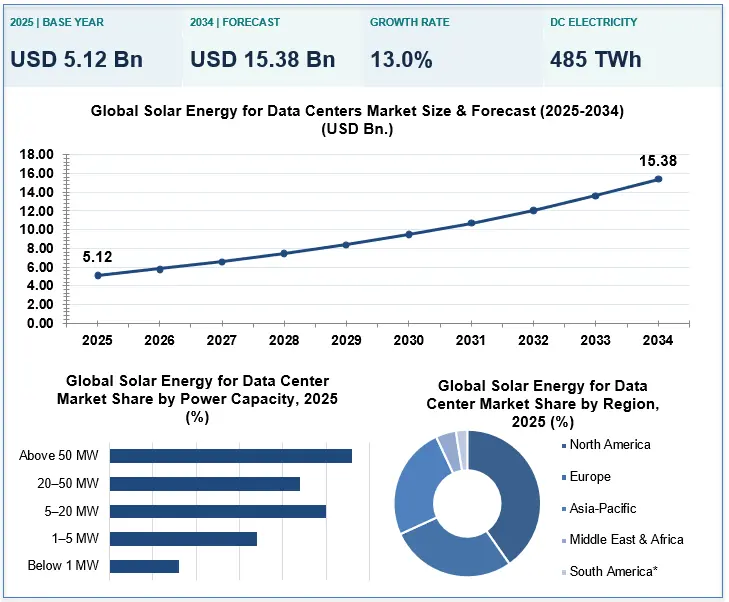
Solar Energy for Data Center Market Growth

To know about the Research Methodology :- Request Free Sample Report

Global Solar Energy for Data Centers Market Industry Demand and Supply Assessment

According to Maximize Market Research (MMR), global data center electricity consumption reached 485 TWh in 2025 and is projected to reach 950 TWh by 2030, driven by AI computing, cloud infrastructure, and hyperscale data center expansion. Rising power requirements are accelerating investments in solar PV systems, renewable power purchase agreements (PPAs), and battery energy storage solutions. Technology companies accounted for 40% of corporate renewable PPAs signed in 2025, strengthening renewable energy procurement.

Global solar capacity additions reached 510 GW in 2025, supporting the availability of solar modules, inverters, and energy storage technologies. However, grid connectivity, transmission constraints, and permitting requirements influence project deployment. Maximize Market Research examines these supply-demand dynamics, infrastructure investments, and renewable energy integration strategies to identify growth opportunities across hyperscale, colocation, enterprise, and edge data centers.

DEMAND-TO-REVENUE MECHANISM

INPUT ENERGY CONVERSION FLEXIBILITY / CONTROL FACILITY POWER BUSINESS OUTCOME
Solar PV modules + mounting Inverters + switchgear EMS + optional BESS Grid intertie + UPS + standby Lower carbon intensity + energy hedge
Off-site solar PPA Market/grid delivery Settlement + hourly matching Utility-supplied data centre Contracted energy + attributes

Global Solar Energy for Data Centers Market Growth Drivers

Growth driver / evidence Commercial mechanism Implication for report buyers
AI / cloud load: 485 to 950 TWh, 2025-2030 New campuses secure long-term power and develop energy procurement programmes Assess procurement pipelines by utility territory and operator type
Renewable corporate PPAs: tech ~40% in 2025 Bankable long-tenor offtake enables developers to finance generation Compare developer, PPA and EPC revenue opportunities
Solar cost: global utility-scale USD 44/MWh in 2025 Low generation costs support hedging where grid and shape costs are manageable Test total delivered cost, not just PV LCOE
Hybrid contracts: Spain 426 MW PV + 600 MWh storage Storage adds dispatch flexibility, increasing control-system and integration scope Evaluate sizing, degradation and contracted delivery obligations

Global Solar Energy for Data Centers Market Restraints and Challenges

Solar power intermittency, high capital investment, land constraints, and grid integration requirements are major challenges in the Global Solar Energy for Data Centers Market. Data centers require uninterrupted electricity, while solar generation varies with weather conditions, seasonal changes, and daylight availability, increasing dependence on grid electricity, battery storage, and backup power systems. Energy storage losses, battery maintenance costs, limited rooftop capacity, land acquisition expenses, transformer procurement delays, and transmission upgrades further affect project economics. Financing requirements, regulatory approvals, electricity tariff fluctuations, grid congestion, and power purchase agreement complexities influence investment decisions. Achieving continuous carbon-free electricity supply requires advanced energy management, reliable storage integration, and coordinated power procurement strategies. Environmental concerns, including solar panel recycling, supply-chain sustainability, land utilization, and water consumption, create additional challenges for developers and data center operators.

Global Solar Energy for Data Centers Emerging Market Opportunities

The Global Solar Energy for Data Centers Market presents significant growth opportunities through expanding renewable energy procurement, hybrid solar systems, and on-site solar installations. Increasing adoption of Off-Site Solar Procurement enables hyperscale and colocation data centers to secure renewable electricity through long-term power purchase agreements, supporting electricity cost stability and sustainability objectives. Growing demand for Hybrid Solar Systems creates opportunities for battery energy storage, engineering, procurement and construction (EPC) services, and intelligent energy management solutions. Additionally, On-Site Solar Generation and rooftop installations support electricity cost optimization across enterprise and edge data centers. For investors, these developments create opportunities in utility-scale solar development, energy storage integration, power infrastructure modernization, and long-term renewable energy contracts. Maximize Market Research identifies scalable solar infrastructure, recurring service revenues, and strategic partnerships with data center operators as key investment areas supporting market expansion through 2034.

Global Solar Energy for Data Centers Market Technology and Innovation Landscape

The Global Solar Energy for Data Centers Market is advancing through high-efficiency Monocrystalline Solar PV, bifacial modules, TOPCon technology, and advanced inverter systems. These technologies improve electricity generation efficiency, optimize land utilization, and strengthen solar power integration across data center facilities. Thin-Film Solar PV technology supports alternative installation requirements, while emerging perovskite solar cells create opportunities for improved conversion efficiency. Technological advancements in photovoltaic manufacturing, intelligent monitoring, and power conversion systems are strengthening solar infrastructure performance and investment opportunities.

Solar-Plus-Storage Power Supply integrates battery energy storage systems, intelligent power conversion, grid-forming inverters, and AI-based energy management technologies. These solutions enable electricity storage, load optimization, grid stability, and improved renewable energy utilization while supporting existing backup power infrastructure. Advanced monitoring platforms, predictive analytics, and smart energy management systems enhance operational efficiency and energy procurement strategies. Maximize Market Research identifies high-efficiency solar technologies, hybrid power integration, and intelligent energy management as key innovation areas supporting market expansion through 2034.

Global Solar Energy for Data Centers Market Segment Analysis

By Solar Technology
The Monocrystalline Solar PV segment holds a strong competitive position in the Global Solar Energy for Data Centers Market, supported by high conversion efficiency, space-efficient electricity generation, and increasing adoption across hyperscale and enterprise data centers. Rising investments in high-efficiency solar panels, TOPCon technology, and bifacial photovoltaic modules strengthen demand for Monocrystalline Solar PV installations. Polycrystalline Solar PV remains relevant for cost-sensitive installations, while Thin-Film Solar PV supports utility-scale solar projects and applications requiring alternative module characteristics. According to Maximize Market Research, advancements in solar photovoltaic technology, module efficiency, and renewable energy infrastructure create opportunities for solar equipment manufacturers and data center energy developers.

By System Configuration
The Grid-Tied Solar Systems segment represents an established configuration in the Solar Energy Market for Data Centers, supported by utility-grid connectivity, renewable electricity procurement, and cost-effective integration with existing power infrastructure. Hybrid Solar Systems present significant growth potential as data center operators increasingly integrate solar photovoltaic generation with battery energy storage systems, smart inverters, and intelligent energy management platforms. These solutions improve renewable electricity utilization, support load management, and strengthen energy flexibility. Off-Grid Solar Systems serve specialized remote and edge data center applications requiring independent power infrastructure. Maximize Market Research identifies solar-plus-storage integration and hybrid renewable energy solutions as important investment opportunities for data center power infrastructure development.
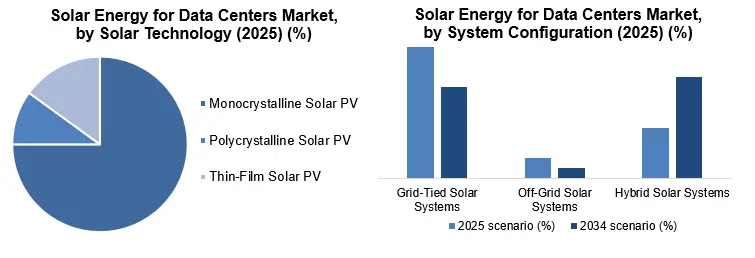
Solar Energy for Data Centers Market by segment

Global Solar Energy for Data Centers Market Regional and Country-Level Analysis

North America holds a strong position in the Global Solar Energy for Data Centers Market, led by the United States, where expanding hyperscale data centers, artificial intelligence infrastructure, and cloud computing investments are accelerating solar energy adoption. Increasing corporate renewable energy procurement, utility-scale solar projects, and long-term power purchase agreements strengthen investment opportunities. The United States benefits from an established solar technology ecosystem, while Canada presents opportunities for renewable electricity integration. Grid connectivity, electricity tariffs, and regulatory policies influence regional market development.

Europe represents a major market for solar-powered data centers, supported by renewable energy targets, corporate decarbonization commitments, and investments in sustainable digital infrastructure. Spain and Italy demonstrate growing adoption of solar power purchase agreements and hybrid solar-plus-storage solutions. Germany, France, and the United Kingdom present opportunities for renewable electricity procurement, while Nordic countries benefit from established clean energy infrastructure. Increasing emphasis on energy efficiency, carbon emissions reduction, and sustainability reporting strengthens demand for solar photovoltaic systems, battery energy storage, and intelligent energy management technologies.

Asia Pacific is witnessing significant expansion in the Solar Energy for Data Centers Market, driven by increasing data center construction, cloud computing adoption, and renewable energy investments. India is emerging as an important market for solar-powered data centers through expanding solar procurement agreements and hyperscale infrastructure development. China strengthens the regional solar photovoltaic supply chain through manufacturing capabilities and technology innovation. Australia, Japan, South Korea, and Singapore present opportunities for rooftop solar installations, hybrid energy systems, and renewable electricity procurement, supported by digital infrastructure expansion.

The Middle East & Africa Solar Energy for Data Centers Market is developing through rising investments in renewable energy infrastructure, digital transformation, and hyperscale data center projects. Saudi Arabia and the UAE offer opportunities for large-scale solar photovoltaic installations, supported by strong solar resources and national energy diversification initiatives. South Africa presents opportunities for renewable electricity procurement, rooftop solar generation, and private power supply arrangements. Increasing demand for sustainable data center infrastructure and integrated solar-plus-storage systems supports regional investment opportunities.

South America presents growing opportunities in the Solar Energy for Data Centers Market, led by Brazil and Chile. Expanding renewable energy infrastructure, corporate power purchase agreements, and digital connectivity investments support solar energy adoption across the region. Brazil benefits from an expanding solar electricity generation sector and increasing data center investments, while Chile offers opportunities for utility-scale solar procurement and renewable energy integration. Growing demand for electricity cost optimization, sustainable cloud infrastructure, and hybrid solar power solutions strengthens the regional market outlook through 2034.

REGIONAL OPPORTUNITY MATRIX

Region / priority countries Market signal Key investment gate
North America | US, Canada Large US 2026 solar PPAs Grid queues, load tariff, PPA basis
Europe | Spain, Italy, UK, Germany Spain hybrid PPA; Italy operating solar; EU reporting Permits, hourly claims, network upgrades
Asia Pacific | India, China, Japan, Singapore, Australia India 83 MW and 21 MWp PPAs Open access, land, cross-border supply
Middle East & Africa | Saudi Arabia, UAE, South Africa Teraco rooftop/off-site strategy Heat, grid security, firm power
South America | Brazil, Chile Brazil national solar 88.1 TWh in 2025 PPA credit, curtailment, FX

Global Solar Energy for Data Centers Market Competitive Landscape

The Global Solar Energy for Data Centers Market features strong competition among solar photovoltaic manufacturers, inverter technology providers, battery energy storage companies, and integrated renewable energy solution developers. Leading solar technology companies, including JinkoSolar, LONGi Green Energy Technology, Trina Solar, JA Solar, Canadian Solar, First Solar, Waaree Energies, and Adani Solar, focus on high-efficiency solar modules, manufacturing expansion, and photovoltaic technology innovation. Sungrow Power Supply, Huawei Digital Power, SMA Solar Technology, SolarEdge Technologies, and Enphase Energy strengthen the market through advanced inverters, power conversion systems, and intelligent energy management solutions. Battery storage providers, including Tesla Energy, CATL, BYD Company, Fluence Energy, and LG Energy Solution, support the development of hybrid solar-plus-storage infrastructure. According to Maximize Market Research, increasing technology investments, strategic partnerships, product innovation, and integrated power infrastructure development are strengthening competitive positioning and creating opportunities across hyperscale, colocation, enterprise, and edge data centers.

COMPETITIVE POSITIONING

Role in power value chain Illustrative approved suppliers Buyer evaluation criteria
PV modules / cells JinkoSolar; LONGi Green Energy Technology; First Solar; Waaree Energies Area yield, bankability, origin, service
Inverters / power electronics Sungrow Power Supply; Huawei Digital Power; SMA Solar Technology; TMEIC Grid code, harmonics, conversion, interoperability
Energy storage / integration Tesla Energy; CATL; BYD Company; Fluence Energy; Wärtsilä Safety, cycling, dispatch, controls
PV + storage product combinations JinkoSolar; Trina Solar / Trina Storage; Sungrow Power Supply Integrated EPC guarantees, EMS, O&M

Global Solar Energy for Data Centers Market Recent Industry Developments | 2026

Date Key Industry Development Project Status / Market Impact
29 Jan 2026 Enfinity Global commenced commercial operations of a 33.8 MWac solar project in Italy supporting Microsoft's renewable energy procurement. Operational solar asset supporting corporate renewable PPAs.
09 Feb 2026 TotalEnergies and Google announced 1 GWp of solar photovoltaic capacity in Texas under 15-year power purchase agreements. Solar projects under development, supporting long-term renewable electricity procurement.
24 Feb 2026 Google and Xcel Energy announced renewable energy infrastructure in Minnesota, including 200 MW of solar generation and 300 MW of energy storage. Planned renewable energy and storage infrastructure supporting grid integration.
26 Feb 2026 Solaria and Merlin Properties signed an agreement covering 426 MW of solar photovoltaic capacity and 600 MWh of battery energy storage in Spain. Contracted hybrid solar-plus-storage project supporting data center electricity requirements.
26 Feb 2026 Digital Edge and Hexa Renewables signed an agreement covering a maximum of 83 MW of solar capacity for data center operations in Navi Mumbai, India. Signed renewable energy PPA with phased electricity delivery.
01 Apr 2026 CleanMax and STT GDC India expanded their renewable energy partnership with 21 MWp of additional solar capacity. Contracted solar capacity strengthening a hybrid renewable energy portfolio exceeding 130 MW.
09 Jun 2026 Meta announced renewable energy agreements in India covering 837 MW and 88 MW of combined solar and wind capacity. Announced renewable energy procurement totaling 925 MW across solar and wind projects.
11 Jun 2026 RWE and Meta signed a 298 MWac solar power purchase agreement in Texas. Solar project under construction, with operations scheduled for 2027.
03 Aug 2026 RWE and Google signed a 15-year power purchase agreement for 155 MWac of solar capacity in Oklahoma. Planned solar development, with operations scheduled for 2028.

Global Solar Energy for Data Centers Market Investment Outlook and Future Market Direction

Investment analysis in the Global Solar Energy for Data Centers Market evaluates solar generation costs, delivered electricity prices, grid infrastructure investments, energy storage requirements, power purchase agreements, and long-term operational expenses. Maximize Market Research (MMR) identifies electricity cost optimization, renewable energy integration, and reliable power infrastructure as major investment priorities. Financing models include corporate power purchase agreements, captive solar ownership, EPC contracts, and hybrid solar-plus-storage projects. Investors focus on project profitability, creditworthiness, equipment warranties, operational risks, and long-term revenue stability to support strategic investment decisions through 2034.

Research Methodology
Market boundaries cover data-center-specific modules, inverters, mounts, EPC, controls and integrated solar-plus-storage installations, not the entire solar sector or all purchased renewable electricity. This RD validates supplied MMR endpoints and interpolates annual values. The evidence review uses public 2026 IEA and IRENA publications, regulator material and dated company announcements. Segment leaders remain hypotheses pending an MMR model. Final commercial market sizing should reconcile bottom-up installed solar MWdc/MWac attributable to data centers, system costs, EPC/integration revenue, project timing and non-duplication of off-site procurement.

Global Solar Energy for Data Centers Market Scope: Inquire before buying

Solar Energy for Data Centers Market
Report Coverage Details
Base Year: 2025 Forecast Period: 2026-2034
Historical Data: 2020 to 2025 Market Size in 2025: USD 5.12 Bn.
Forecast Period 2026 to 2034 CAGR: 13% Market Size in 2034: USD 15.38 Bn.
Segments Covered: by Solar Technology Monocrystalline Solar PV
Polycrystalline Solar PV
Thin-Film Solar PV
by System Configuration Grid-Tied Solar Systems
Off-Grid Solar Systems
Hybrid Solar Systems
by Installation Type Rooftop Solar Systems
Ground-Mounted Solar Systems
Solar Carport Systems
Floating Solar Systems
by Application Direct Electricity Supply
Supplementary Electricity Supply
Solar-Plus-Storage Power Supply
by Power Capacity Below 1 MW
1–5 MW
5–20 MW
20–50 MW
Above 50 MW
by Data Center Type Hyperscale Data Centers
Colocation Data Centers
Enterprise Data Centers
Edge Data Centers
by Deployment Model On-Site Solar Generation
Off-Site Solar Procurement

Global Solar Energy for Data Centers Market, by region

North America (United States, Canada, Mexico)
Europe (Germany, United Kingdom, France, Italy, Spain, Netherlands, Sweden, Norway, Denmark, Finland, Rest of Europe)
Asia Pacific (China, India, Japan, South Korea, Australia, Singapore, Taiwan, Malaysia, Indonesia, Rest of Asia Pacific)
Middle East & Africa (Saudi Arabia, United Arab Emirates, South Africa, Qatar, Oman, Egypt, Rest of Middle East & Africa)
South America (Brazil, Chile, Argentina, Colombia, Peru, Rest of South America)

Global Solar Energy for Data Centers Market, Key Players

1. JinkoSolar
2. LONGi Green Energy Technology
3. Trina Solar
4. JA Solar
5. Tongwei Solar
6. Canadian Solar
7. Astronergy
8. Risen Energy
9. AIKO Solar
10. First Solar
11. Hanwha Qcells
12. Waaree Energies
13. Vikram Solar
14. Adani Solar
15. Sungrow Power Supply
16. Huawei Digital Power
17. SMA Solar Technology
18. GoodWe Technologies
19. Enphase Energy
20. SolarEdge Technologies
21. Ginlong Technologies (Solis)
22. Fronius International
23. TMEIC
24. Tesla Energy
25. CATL
26. BYD Company
27. Fluence Energy
28. Trina Storage
29. LG Energy Solution
30. Wärtsilä

Frequently Asked Questions

What is the Solar Energy Market for Data Centers size in 2034?
MMR forecasts USD 15.38 billion by 2034 from USD 5.12 billion in 2025, an 13% CAGR over nine annual intervals.

What share of data-center electricity comes from solar energy?
No globally comparable verified percentage is available. Solar-specific metered electricity must be distinguished from renewable PPAs and annual certificate matching.

Can solar power run a data center 24 hours a day?
Solar alone cannot guarantee continuous power. Data centers need grid access and/or firm resources, supplemented by UPS, storage and site-specific reliability engineering.

Which solar configuration is most commercially relevant?
Grid-Tied Solar Systems and large Off-Site Solar Procurement arrangements are scalable; Hybrid Solar Systems offer additional storage-integration revenue, subject to demand-shape and connection economics.

What does the MMR report help investors evaluate?
It assesses segment economics, project pipelines, grid risk, supplier portfolios, 2026 developments and 2034 scenarios.

Table of Contents

1. Solar Energy for Data Centers Market Introduction 1.1. Study Assumption and Market Definition 1.2. Scope of the Study 1.3. Executive Summary 2. Global Solar Energy for Data Centers Market: Competitive Landscape 2.1. MMR Competition Matrix 2.2. Competitive Landscape 2.3. Key Players Benchmarking 2.3.1. Company Name 2.3.2. Business Segment 2.3.3. End-user Segment 2.3.4. Revenue (2025) 2.3.5. Company Locations 2.4. Leading Solar Energy for Data Centers Market Companies, by market capitalization 2.5. Market Structure 2.5.1. Market Leaders 2.5.2. Market Followers 2.5.3. Emerging Players 2.6. Mergers and Acquisitions Details 3. Solar Energy for Data Centers Market: Dynamics 3.1. Solar Energy for Data Centers Market Trends by Region 3.1.1. North America Solar Energy for Data Centers Market Trends 3.1.2. Europe Solar Energy for Data Centers Market Trends 3.1.3. Asia Pacific Solar Energy for Data Centers Market Trends 3.1.4. Middle East and Africa Solar Energy for Data Centers Market Trends 3.1.5. South America Solar Energy for Data Centers Market Trends 3.2. Solar Energy for Data Centers Market Dynamics by Region 3.2.1. North America 3.2.1.1. North America Solar Energy for Data Centers Market Drivers 3.2.1.2. North America Solar Energy for Data Centers Market Restraints 3.2.1.3. North America Solar Energy for Data Centers Market Opportunities 3.2.1.4. North America Solar Energy for Data Centers Market Challenges 3.2.2. Europe 3.2.2.1. Europe Solar Energy for Data Centers Market Drivers 3.2.2.2. Europe Solar Energy for Data Centers Market Restraints 3.2.2.3. Europe Solar Energy for Data Centers Market Opportunities 3.2.2.4. Europe Solar Energy for Data Centers Market Challenges 3.2.3. Asia Pacific 3.2.3.1. Asia Pacific Solar Energy for Data Centers Market Drivers 3.2.3.2. Asia Pacific Solar Energy for Data Centers Market Restraints 3.2.3.3. Asia Pacific Solar Energy for Data Centers Market Opportunities 3.2.3.4. Asia Pacific Solar Energy for Data Centers Market Challenges 3.2.4. Middle East and Africa 3.2.4.1. Middle East and Africa Solar Energy for Data Centers Market Drivers 3.2.4.2. Middle East and Africa Solar Energy for Data Centers Market Restraints 3.2.4.3. Middle East and Africa Solar Energy for Data Centers Market Opportunities 3.2.4.4. Middle East and Africa Solar Energy for Data Centers Market Challenges 3.2.5. South America 3.2.5.1. South America Solar Energy for Data Centers Market Drivers 3.2.5.2. South America Solar Energy for Data Centers Market Restraints 3.2.5.3. South America Solar Energy for Data Centers Market Opportunities 3.2.5.4. South America Solar Energy for Data Centers Market Challenges 3.3. PORTER's Five Forces Analysis 3.4. PESTLE Analysis 3.5. Technology Roadmap 3.6. Regulatory Landscape by Region 3.6.1. North America 3.6.2. Europe 3.6.3. Asia Pacific 3.6.4. Middle East and Africa 3.6.5. South America 3.7. Key Opinion Leader Analysis in the Solar Energy for Data Centers Market 3.8. Analysis of Government Schemes and Initiatives For Global Industry 3.9. Solar Energy for Data Centers Market Trade Analysis 3.10. The Global Pandemic Impact on Solar Energy for Data Centers Market 4. Solar Energy for Data Centers Market: Global Market Size and Forecast by Segmentation (in USD Billion) 2025-2034 4.1. Solar Energy for Data Centers Market Size and Forecast, by Solar Technology (2025-2034) 4.1.1. Monocrystalline Solar PV 4.1.2. Polycrystalline Solar PV 4.1.3. Thin-Film Solar PV 4.2. Solar Energy for Data Centers Market Size and Forecast, by System Configuration (2025-2034) 4.2.1. Grid-Tied Solar Systems 4.2.2. Off-Grid Solar Systems 4.2.3. Hybrid Solar Systems 4.3. Solar Energy for Data Centers Market Size and Forecast, by Installation Type (2025-2034) 4.3.1. Rooftop Solar Systems 4.3.2. Ground-Mounted Solar Systems 4.3.3. Solar Carport Systems 4.3.4. Floating Solar Systems 4.4. Solar Energy for Data Centers Market Size and Forecast, by Application (2025-2034) 4.4.1. Direct Electricity Supply 4.4.2. Supplementary Electricity Supply 4.4.3. Solar-Plus-Storage Power Supply 4.5. Solar Energy for Data Centers Market Size and Forecast, by Power Capacity (2025-2034) 4.5.1. Below 1 MW 4.5.2. 1–5 MW 4.5.3. 5–20 MW 4.5.4. 20–50 MW 4.5.5. Above 50 MW 4.6. Solar Energy for Data Centers Market Size and Forecast, by Data Center Type (2025-2034) 4.6.1. Hyperscale Data Centers 4.6.2. Colocation Data Centers 4.6.3. Enterprise Data Centers 4.6.4. Edge Data Centers 4.7. Solar Energy for Data Centers Market Size and Forecast, by Deployment Model (2025-2034) 4.7.1. On-Site Solar Generation 4.7.2. Off-Site Solar Procurement 4.8. Solar Energy for Data Centers Market Size and Forecast, by Region (2025-2034) 4.8.1. North America 4.8.2. Europe 4.8.3. Asia Pacific 4.8.4. Middle East and Africa 4.8.5. South America 5. North America Solar Energy for Data Centers Market Size and Forecast by Segmentation (in USD Billion) 2025-2034 5.1. North America Solar Energy for Data Centers Market Size and Forecast, by Solar Technology (2025-2034) 5.1.1. Monocrystalline Solar PV 5.1.2. Polycrystalline Solar PV 5.1.3. Thin-Film Solar PV 5.2. North America Solar Energy for Data Centers Market Size and Forecast, by System Configuration (2025-2034) 5.2.1. Grid-Tied Solar Systems 5.2.2. Off-Grid Solar Systems 5.2.3. Hybrid Solar Systems 5.3. North America Solar Energy for Data Centers Market Size and Forecast, by Installation Type (2025-2034) 5.3.1. Rooftop Solar Systems 5.3.2. Ground-Mounted Solar Systems 5.3.3. Solar Carport Systems 5.3.4. Floating Solar Systems 5.4. North America Solar Energy for Data Centers Market Size and Forecast, by Application (2025-2034) 5.4.1. Direct Electricity Supply 5.4.2. Supplementary Electricity Supply 5.4.3. Solar-Plus-Storage Power Supply 5.5. North America Solar Energy for Data Centers Market Size and Forecast, by Power Capacity (2025-2034) 5.5.1. Below 1 MW 5.5.2. 1–5 MW 5.5.3. 5–20 MW 5.5.4. 20–50 MW 5.5.5. Above 50 MW 5.6. North America Solar Energy for Data Centers Market Size and Forecast, by Data Center Type (2025-2034) 5.6.1. Hyperscale Data Centers 5.6.2. Colocation Data Centers 5.6.3. Enterprise Data Centers 5.6.4. Edge Data Centers 5.7. North America Solar Energy for Data Centers Market Size and Forecast, by Deployment Model (2025-2034) 5.7.1. On-Site Solar Generation 5.7.2. Off-Site Solar Procurement 5.8. North America Solar Energy for Data Centers Market Size and Forecast, by Country (2025-2034) 5.8.1. United States 5.8.1.1. United States Solar Energy for Data Centers Market Size and Forecast, by Solar Technology (2025-2034) 5.8.1.1.1. Monocrystalline Solar PV 5.8.1.1.2. Polycrystalline Solar PV 5.8.1.1.3. Thin-Film Solar PV 5.8.1.2. United States Solar Energy for Data Centers Market Size and Forecast, by System Configuration (2025-2034) 5.8.1.2.1. Grid-Tied Solar Systems 5.8.1.2.2. Off-Grid Solar Systems 5.8.1.2.3. Hybrid Solar Systems 5.8.1.3. United States Solar Energy for Data Centers Market Size and Forecast, by Installation Type (2025-2034) 5.8.1.3.1. Rooftop Solar Systems 5.8.1.3.2. Ground-Mounted Solar Systems 5.8.1.3.3. Solar Carport Systems 5.8.1.3.4. Floating Solar Systems 5.8.1.4. United States Solar Energy for Data Centers Market Size and Forecast, by Application (2025-2034) 5.8.1.4.1. Direct Electricity Supply 5.8.1.4.2. Supplementary Electricity Supply 5.8.1.4.3. Solar-Plus-Storage Power Supply 5.8.1.5. United States Solar Energy for Data Centers Market Size and Forecast, by Power Capacity (2025-2034) 5.8.1.5.1. Below 1 MW 5.8.1.5.2. 1–5 MW 5.8.1.5.3. 5–20 MW 5.8.1.5.4. 20–50 MW 5.8.1.5.5. Above 50 MW 5.8.1.6. United States Solar Energy for Data Centers Market Size and Forecast, by Data Center Type (2025-2034) 5.8.1.6.1. Hyperscale Data Centers 5.8.1.6.2. Colocation Data Centers 5.8.1.6.3. Enterprise Data Centers 5.8.1.6.4. Edge Data Centers 5.8.1.7. United States Solar Energy for Data Centers Market Size and Forecast, by Deployment Model (2025-2034) 5.8.1.7.1. On-Site Solar Generation 5.8.1.7.2. Off-Site Solar Procurement 5.8.2. Canada 5.8.2.1. Canada Solar Energy for Data Centers Market Size and Forecast, by Solar Technology (2025-2034) 5.8.2.1.1. Monocrystalline Solar PV 5.8.2.1.2. Polycrystalline Solar PV 5.8.2.1.3. Thin-Film Solar PV 5.8.2.2. Canada Solar Energy for Data Centers Market Size and Forecast, by System Configuration (2025-2034) 5.8.2.2.1. Grid-Tied Solar Systems 5.8.2.2.2. Off-Grid Solar Systems 5.8.2.2.3. Hybrid Solar Systems 5.8.2.3. Canada Solar Energy for Data Centers Market Size and Forecast, by Installation Type (2025-2034) 5.8.2.3.1. Rooftop Solar Systems 5.8.2.3.2. Ground-Mounted Solar Systems 5.8.2.3.3. Solar Carport Systems 5.8.2.3.4. Floating Solar Systems 5.8.2.4. Canada Solar Energy for Data Centers Market Size and Forecast, by Application (2025-2034) 5.8.2.4.1. Direct Electricity Supply 5.8.2.4.2. Supplementary Electricity Supply 5.8.2.4.3. Solar-Plus-Storage Power Supply 5.8.2.5. Canada Solar Energy for Data Centers Market Size and Forecast, by Power Capacity (2025-2034) 5.8.2.5.1. Below 1 MW 5.8.2.5.2. 1–5 MW 5.8.2.5.3. 5–20 MW 5.8.2.5.4. 20–50 MW 5.8.2.5.5. Above 50 MW 5.8.2.6. Canada Solar Energy for Data Centers Market Size and Forecast, by Data Center Type (2025-2034) 5.8.2.6.1. Hyperscale Data Centers 5.8.2.6.2. Colocation Data Centers 5.8.2.6.3. Enterprise Data Centers 5.8.2.6.4. Edge Data Centers 5.8.2.7. Canada Solar Energy for Data Centers Market Size and Forecast, by Deployment Model (2025-2034) 5.8.2.7.1. On-Site Solar Generation 5.8.2.7.2. Off-Site Solar Procurement 5.8.3. Mexico 5.8.3.1. Mexico Solar Energy for Data Centers Market Size and Forecast, by Solar Technology (2025-2034) 5.8.3.1.1. Monocrystalline Solar PV 5.8.3.1.2. Polycrystalline Solar PV 5.8.3.1.3. Thin-Film Solar PV 5.8.3.2. Mexico Solar Energy for Data Centers Market Size and Forecast, by System Configuration (2025-2034) 5.8.3.2.1. Grid-Tied Solar Systems 5.8.3.2.2. Off-Grid Solar Systems 5.8.3.2.3. Hybrid Solar Systems 5.8.3.3. Mexico Solar Energy for Data Centers Market Size and Forecast, by Installation Type (2025-2034) 5.8.3.3.1. Rooftop Solar Systems 5.8.3.3.2. Ground-Mounted Solar Systems 5.8.3.3.3. Solar Carport Systems 5.8.3.3.4. Floating Solar Systems 5.8.3.4. Mexico Solar Energy for Data Centers Market Size and Forecast, by Application (2025-2034) 5.8.3.4.1. Direct Electricity Supply 5.8.3.4.2. Supplementary Electricity Supply 5.8.3.4.3. Solar-Plus-Storage Power Supply 5.8.3.5. Mexico Solar Energy for Data Centers Market Size and Forecast, by Power Capacity (2025-2034) 5.8.3.5.1. Below 1 MW 5.8.3.5.2. 1–5 MW 5.8.3.5.3. 5–20 MW 5.8.3.5.4. 20–50 MW 5.8.3.5.5. Above 50 MW 5.8.3.6. Mexico Solar Energy for Data Centers Market Size and Forecast, by Data Center Type (2025-2034) 5.8.3.6.1. Hyperscale Data Centers 5.8.3.6.2. Colocation Data Centers 5.8.3.6.3. Enterprise Data Centers 5.8.3.6.4. Edge Data Centers 5.8.3.7. Mexico Solar Energy for Data Centers Market Size and Forecast, by Deployment Model (2025-2034) 5.8.3.7.1. On-Site Solar Generation 5.8.3.7.2. Off-Site Solar Procurement 6. Europe Solar Energy for Data Centers Market Size and Forecast by Segmentation (in USD Billion) 2025-2034 6.1. Europe Solar Energy for Data Centers Market Size and Forecast, by Solar Technology (2025-2034) 6.1.1. Monocrystalline Solar PV 6.1.2. Polycrystalline Solar PV 6.1.3. Thin-Film Solar PV 6.2. Europe Solar Energy for Data Centers Market Size and Forecast, by System Configuration (2025-2034) 6.2.1. Grid-Tied Solar Systems 6.2.2. Off-Grid Solar Systems 6.2.3. Hybrid Solar Systems 6.3. Europe Solar Energy for Data Centers Market Size and Forecast, by Installation Type (2025-2034) 6.3.1. Rooftop Solar Systems 6.3.2. Ground-Mounted Solar Systems 6.3.3. Solar Carport Systems 6.3.4. Floating Solar Systems 6.4. Europe Solar Energy for Data Centers Market Size and Forecast, by Application (2025-2034) 6.4.1. Direct Electricity Supply 6.4.2. Supplementary Electricity Supply 6.4.3. Solar-Plus-Storage Power Supply 6.5. Europe Solar Energy for Data Centers Market Size and Forecast, by Power Capacity (2025-2034) 6.5.1. Below 1 MW 6.5.2. 1–5 MW 6.5.3. 5–20 MW 6.5.4. 20–50 MW 6.5.5. Above 50 MW 6.6. Europe Solar Energy for Data Centers Market Size and Forecast, by Data Center Type (2025-2034) 6.6.1. Hyperscale Data Centers 6.6.2. Colocation Data Centers 6.6.3. Enterprise Data Centers 6.6.4. Edge Data Centers 6.7. Europe Solar Energy for Data Centers Market Size and Forecast, by Deployment Model (2025-2034) 6.7.1. On-Site Solar Generation 6.7.2. Off-Site Solar Procurement 6.8. Europe Solar Energy for Data Centers Market Size and Forecast, by Country (2025-2034) 6.8.1. United Kingdom 6.8.1.1. United Kingdom Solar Energy for Data Centers Market Size and Forecast, by Solar Technology (2025-2034) 6.8.1.1.1. Monocrystalline Solar PV 6.8.1.1.2. Polycrystalline Solar PV 6.8.1.1.3. Thin-Film Solar PV 6.8.1.2. United Kingdom Solar Energy for Data Centers Market Size and Forecast, by System Configuration (2025-2034) 6.8.1.2.1. Grid-Tied Solar Systems 6.8.1.2.2. Off-Grid Solar Systems 6.8.1.2.3. Hybrid Solar Systems 6.8.1.3. United Kingdom Solar Energy for Data Centers Market Size and Forecast, by Installation Type (2025-2034) 6.8.1.3.1. Rooftop Solar Systems 6.8.1.3.2. Ground-Mounted Solar Systems 6.8.1.3.3. Solar Carport Systems 6.8.1.3.4. Floating Solar Systems 6.8.1.4. United Kingdom Solar Energy for Data Centers Market Size and Forecast, by Application (2025-2034) 6.8.1.4.1. Direct Electricity Supply 6.8.1.4.2. Supplementary Electricity Supply 6.8.1.4.3. Solar-Plus-Storage Power Supply 6.8.1.5. United Kingdom Solar Energy for Data Centers Market Size and Forecast, by Power Capacity (2025-2034) 6.8.1.5.1. Below 1 MW 6.8.1.5.2. 1–5 MW 6.8.1.5.3. 5–20 MW 6.8.1.5.4. 20–50 MW 6.8.1.5.5. Above 50 MW 6.8.1.6. United Kingdom Solar Energy for Data Centers Market Size and Forecast, by Data Center Type (2025-2034) 6.8.1.6.1. Hyperscale Data Centers 6.8.1.6.2. Colocation Data Centers 6.8.1.6.3. Enterprise Data Centers 6.8.1.6.4. Edge Data Centers 6.8.1.7. United Kingdom Solar Energy for Data Centers Market Size and Forecast, by Deployment Model (2025-2034) 6.8.1.7.1. On-Site Solar Generation 6.8.1.7.2. Off-Site Solar Procurement 6.8.2. France 6.8.2.1. France Solar Energy for Data Centers Market Size and Forecast, by Solar Technology (2025-2034) 6.8.2.1.1. Monocrystalline Solar PV 6.8.2.1.2. Polycrystalline Solar PV 6.8.2.1.3. Thin-Film Solar PV 6.8.2.2. France Solar Energy for Data Centers Market Size and Forecast, by System Configuration (2025-2034) 6.8.2.2.1. Grid-Tied Solar Systems 6.8.2.2.2. Off-Grid Solar Systems 6.8.2.2.3. Hybrid Solar Systems 6.8.2.3. France Solar Energy for Data Centers Market Size and Forecast, by Installation Type (2025-2034) 6.8.2.3.1. Rooftop Solar Systems 6.8.2.3.2. Ground-Mounted Solar Systems 6.8.2.3.3. Solar Carport Systems 6.8.2.3.4. Floating Solar Systems 6.8.2.4. France Solar Energy for Data Centers Market Size and Forecast, by Application (2025-2034) 6.8.2.4.1. Direct Electricity Supply 6.8.2.4.2. Supplementary Electricity Supply 6.8.2.4.3. Solar-Plus-Storage Power Supply 6.8.2.5. France Solar Energy for Data Centers Market Size and Forecast, by Power Capacity (2025-2034) 6.8.2.5.1. Below 1 MW 6.8.2.5.2. 1–5 MW 6.8.2.5.3. 5–20 MW 6.8.2.5.4. 20–50 MW 6.8.2.5.5. Above 50 MW 6.8.2.6. France Solar Energy for Data Centers Market Size and Forecast, by Data Center Type (2025-2034) 6.8.2.6.1. Hyperscale Data Centers 6.8.2.6.2. Colocation Data Centers 6.8.2.6.3. Enterprise Data Centers 6.8.2.6.4. Edge Data Centers 6.8.2.7. France Solar Energy for Data Centers Market Size and Forecast, by Deployment Model (2025-2034) 6.8.2.7.1. On-Site Solar Generation 6.8.2.7.2. Off-Site Solar Procurement 6.8.3. Germany 6.8.3.1. Germany Solar Energy for Data Centers Market Size and Forecast, by Solar Technology (2025-2034) 6.8.3.1.1. Monocrystalline Solar PV 6.8.3.1.2. Polycrystalline Solar PV 6.8.3.1.3. Thin-Film Solar PV 6.8.3.2. Germany Solar Energy for Data Centers Market Size and Forecast, by System Configuration (2025-2034) 6.8.3.2.1. Grid-Tied Solar Systems 6.8.3.2.2. Off-Grid Solar Systems 6.8.3.2.3. Hybrid Solar Systems 6.8.3.3. Germany Solar Energy for Data Centers Market Size and Forecast, by Installation Type (2025-2034) 6.8.3.3.1. Rooftop Solar Systems 6.8.3.3.2. Ground-Mounted Solar Systems 6.8.3.3.3. Solar Carport Systems 6.8.3.3.4. Floating Solar Systems 6.8.3.4. Germany Solar Energy for Data Centers Market Size and Forecast, by Application (2025-2034) 6.8.3.4.1. Direct Electricity Supply 6.8.3.4.2. Supplementary Electricity Supply 6.8.3.4.3. Solar-Plus-Storage Power Supply 6.8.3.5. Germany Solar Energy for Data Centers Market Size and Forecast, by Power Capacity (2025-2034) 6.8.3.5.1. Below 1 MW 6.8.3.5.2. 1–5 MW 6.8.3.5.3. 5–20 MW 6.8.3.5.4. 20–50 MW 6.8.3.5.5. Above 50 MW 6.8.3.6. Germany Solar Energy for Data Centers Market Size and Forecast, by Data Center Type (2025-2034) 6.8.3.6.1. Hyperscale Data Centers 6.8.3.6.2. Colocation Data Centers 6.8.3.6.3. Enterprise Data Centers 6.8.3.6.4. Edge Data Centers 6.8.3.7. Germany Solar Energy for Data Centers Market Size and Forecast, by Deployment Model (2025-2034) 6.8.3.7.1. On-Site Solar Generation 6.8.3.7.2. Off-Site Solar Procurement 6.8.4. Italy 6.8.4.1. Italy Solar Energy for Data Centers Market Size and Forecast, by Solar Technology (2025-2034) 6.8.4.1.1. Monocrystalline Solar PV 6.8.4.1.2. Polycrystalline Solar PV 6.8.4.1.3. Thin-Film Solar PV 6.8.4.2. Italy Solar Energy for Data Centers Market Size and Forecast, by System Configuration (2025-2034) 6.8.4.2.1. Grid-Tied Solar Systems 6.8.4.2.2. Off-Grid Solar Systems 6.8.4.2.3. Hybrid Solar Systems 6.8.4.3. Italy Solar Energy for Data Centers Market Size and Forecast, by Installation Type (2025-2034) 6.8.4.3.1. Rooftop Solar Systems 6.8.4.3.2. Ground-Mounted Solar Systems 6.8.4.3.3. Solar Carport Systems 6.8.4.3.4. Floating Solar Systems 6.8.4.4. Italy Solar Energy for Data Centers Market Size and Forecast, by Application (2025-2034) 6.8.4.4.1. Direct Electricity Supply 6.8.4.4.2. Supplementary Electricity Supply 6.8.4.4.3. Solar-Plus-Storage Power Supply 6.8.4.5. Italy Solar Energy for Data Centers Market Size and Forecast, by Power Capacity (2025-2034) 6.8.4.5.1. Below 1 MW 6.8.4.5.2. 1–5 MW 6.8.4.5.3. 5–20 MW 6.8.4.5.4. 20–50 MW 6.8.4.5.5. Above 50 MW 6.8.4.6. Italy Solar Energy for Data Centers Market Size and Forecast, by Data Center Type (2025-2034) 6.8.4.6.1. Hyperscale Data Centers 6.8.4.6.2. Colocation Data Centers 6.8.4.6.3. Enterprise Data Centers 6.8.4.6.4. Edge Data Centers 6.8.4.7. Italy Solar Energy for Data Centers Market Size and Forecast, by Deployment Model (2025-2034) 6.8.4.7.1. On-Site Solar Generation 6.8.4.7.2. Off-Site Solar Procurement 6.8.5. Spain 6.8.5.1. Spain Solar Energy for Data Centers Market Size and Forecast, by Solar Technology (2025-2034) 6.8.5.1.1. Monocrystalline Solar PV 6.8.5.1.2. Polycrystalline Solar PV 6.8.5.1.3. Thin-Film Solar PV 6.8.5.2. Spain Solar Energy for Data Centers Market Size and Forecast, by System Configuration (2025-2034) 6.8.5.2.1. Grid-Tied Solar Systems 6.8.5.2.2. Off-Grid Solar Systems 6.8.5.2.3. Hybrid Solar Systems 6.8.5.3. Spain Solar Energy for Data Centers Market Size and Forecast, by Installation Type (2025-2034) 6.8.5.3.1. Rooftop Solar Systems 6.8.5.3.2. Ground-Mounted Solar Systems 6.8.5.3.3. Solar Carport Systems 6.8.5.3.4. Floating Solar Systems 6.8.5.4. Spain Solar Energy for Data Centers Market Size and Forecast, by Application (2025-2034) 6.8.5.4.1. Direct Electricity Supply 6.8.5.4.2. Supplementary Electricity Supply 6.8.5.4.3. Solar-Plus-Storage Power Supply 6.8.5.5. Spain Solar Energy for Data Centers Market Size and Forecast, by Power Capacity (2025-2034) 6.8.5.5.1. Below 1 MW 6.8.5.5.2. 1–5 MW 6.8.5.5.3. 5–20 MW 6.8.5.5.4. 20–50 MW 6.8.5.5.5. Above 50 MW 6.8.5.6. Spain Solar Energy for Data Centers Market Size and Forecast, by Data Center Type (2025-2034) 6.8.5.6.1. Hyperscale Data Centers 6.8.5.6.2. Colocation Data Centers 6.8.5.6.3. Enterprise Data Centers 6.8.5.6.4. Edge Data Centers 6.8.5.7. Spain Solar Energy for Data Centers Market Size and Forecast, by Deployment Model (2025-2034) 6.8.5.7.1. On-Site Solar Generation 6.8.5.7.2. Off-Site Solar Procurement 6.8.6. Sweden 6.8.6.1. Sweden Solar Energy for Data Centers Market Size and Forecast, by Solar Technology (2025-2034) 6.8.6.1.1. Monocrystalline Solar PV 6.8.6.1.2. Polycrystalline Solar PV 6.8.6.1.3. Thin-Film Solar PV 6.8.6.2. Sweden Solar Energy for Data Centers Market Size and Forecast, by System Configuration (2025-2034) 6.8.6.2.1. Grid-Tied Solar Systems 6.8.6.2.2. Off-Grid Solar Systems 6.8.6.2.3. Hybrid Solar Systems 6.8.6.3. Sweden Solar Energy for Data Centers Market Size and Forecast, by Installation Type (2025-2034) 6.8.6.3.1. Rooftop Solar Systems 6.8.6.3.2. Ground-Mounted Solar Systems 6.8.6.3.3. Solar Carport Systems 6.8.6.3.4. Floating Solar Systems 6.8.6.4. Sweden Solar Energy for Data Centers Market Size and Forecast, by Application (2025-2034) 6.8.6.4.1. Direct Electricity Supply 6.8.6.4.2. Supplementary Electricity Supply 6.8.6.4.3. Solar-Plus-Storage Power Supply 6.8.6.5. Sweden Solar Energy for Data Centers Market Size and Forecast, by Power Capacity (2025-2034) 6.8.6.5.1. Below 1 MW 6.8.6.5.2. 1–5 MW 6.8.6.5.3. 5–20 MW 6.8.6.5.4. 20–50 MW 6.8.6.5.5. Above 50 MW 6.8.6.6. Sweden Solar Energy for Data Centers Market Size and Forecast, by Data Center Type (2025-2034) 6.8.6.6.1. Hyperscale Data Centers 6.8.6.6.2. Colocation Data Centers 6.8.6.6.3. Enterprise Data Centers 6.8.6.6.4. Edge Data Centers 6.8.6.7. Sweden Solar Energy for Data Centers Market Size and Forecast, by Deployment Model (2025-2034) 6.8.6.7.1. On-Site Solar Generation 6.8.6.7.2. Off-Site Solar Procurement 6.8.7. Austria 6.8.7.1. Austria Solar Energy for Data Centers Market Size and Forecast, by Solar Technology (2025-2034) 6.8.7.1.1. Monocrystalline Solar PV 6.8.7.1.2. Polycrystalline Solar PV 6.8.7.1.3. Thin-Film Solar PV 6.8.7.2. Austria Solar Energy for Data Centers Market Size and Forecast, by System Configuration (2025-2034) 6.8.7.2.1. Grid-Tied Solar Systems 6.8.7.2.2. Off-Grid Solar Systems 6.8.7.2.3. Hybrid Solar Systems 6.8.7.3. Austria Solar Energy for Data Centers Market Size and Forecast, by Installation Type (2025-2034) 6.8.7.3.1. Rooftop Solar Systems 6.8.7.3.2. Ground-Mounted Solar Systems 6.8.7.3.3. Solar Carport Systems 6.8.7.3.4. Floating Solar Systems 6.8.7.4. Austria Solar Energy for Data Centers Market Size and Forecast, by Application (2025-2034) 6.8.7.4.1. Direct Electricity Supply 6.8.7.4.2. Supplementary Electricity Supply 6.8.7.4.3. Solar-Plus-Storage Power Supply 6.8.7.5. Austria Solar Energy for Data Centers Market Size and Forecast, by Power Capacity (2025-2034) 6.8.7.5.1. Below 1 MW 6.8.7.5.2. 1–5 MW 6.8.7.5.3. 5–20 MW 6.8.7.5.4. 20–50 MW 6.8.7.5.5. Above 50 MW 6.8.7.6. Austria Solar Energy for Data Centers Market Size and Forecast, by Data Center Type (2025-2034) 6.8.7.6.1. Hyperscale Data Centers 6.8.7.6.2. Colocation Data Centers 6.8.7.6.3. Enterprise Data Centers 6.8.7.6.4. Edge Data Centers 6.8.7.7. Austria Solar Energy for Data Centers Market Size and Forecast, by Deployment Model (2025-2034) 6.8.7.7.1. On-Site Solar Generation 6.8.7.7.2. Off-Site Solar Procurement 6.8.8. Rest of Europe 6.8.8.1. Rest of Europe Solar Energy for Data Centers Market Size and Forecast, by Solar Technology (2025-2034) 6.8.8.1.1. Monocrystalline Solar PV 6.8.8.1.2. Polycrystalline Solar PV 6.8.8.1.3. Thin-Film Solar PV 6.8.8.2. Rest of Europe Solar Energy for Data Centers Market Size and Forecast, by System Configuration (2025-2034) 6.8.8.2.1. Grid-Tied Solar Systems 6.8.8.2.2. Off-Grid Solar Systems 6.8.8.2.3. Hybrid Solar Systems 6.8.8.3. Rest of Europe Solar Energy for Data Centers Market Size and Forecast, by Installation Type (2025-2034) 6.8.8.3.1. Rooftop Solar Systems 6.8.8.3.2. Ground-Mounted Solar Systems 6.8.8.3.3. Solar Carport Systems 6.8.8.3.4. Floating Solar Systems 6.8.8.4. Rest of Europe Solar Energy for Data Centers Market Size and Forecast, by Application (2025-2034) 6.8.8.4.1. Direct Electricity Supply 6.8.8.4.2. Supplementary Electricity Supply 6.8.8.4.3. Solar-Plus-Storage Power Supply 6.8.8.5. Rest of Europe Solar Energy for Data Centers Market Size and Forecast, by Power Capacity (2025-2034) 6.8.8.5.1. Below 1 MW 6.8.8.5.2. 1–5 MW 6.8.8.5.3. 5–20 MW 6.8.8.5.4. 20–50 MW 6.8.8.5.5. Above 50 MW 6.8.8.6. Rest of Europe Solar Energy for Data Centers Market Size and Forecast, by Data Center Type (2025-2034) 6.8.8.6.1. Hyperscale Data Centers 6.8.8.6.2. Colocation Data Centers 6.8.8.6.3. Enterprise Data Centers 6.8.8.6.4. Edge Data Centers 6.8.8.7. Rest of Europe Solar Energy for Data Centers Market Size and Forecast, by Deployment Model (2025-2034) 6.8.8.7.1. On-Site Solar Generation 6.8.8.7.2. Off-Site Solar Procurement 7. Asia Pacific Solar Energy for Data Centers Market Size and Forecast by Segmentation (in USD Billion) 2025-2034 7.1. Asia Pacific Solar Energy for Data Centers Market Size and Forecast, by Solar Technology (2025-2034) 7.1.1. Monocrystalline Solar PV 7.1.2. Polycrystalline Solar PV 7.1.3. Thin-Film Solar PV 7.2. Asia Pacific Solar Energy for Data Centers Market Size and Forecast, by System Configuration (2025-2034) 7.2.1. Grid-Tied Solar Systems 7.2.2. Off-Grid Solar Systems 7.2.3. Hybrid Solar Systems 7.3. Asia Pacific Solar Energy for Data Centers Market Size and Forecast, by Installation Type (2025-2034) 7.3.1. Rooftop Solar Systems 7.3.2. Ground-Mounted Solar Systems 7.3.3. Solar Carport Systems 7.3.4. Floating Solar Systems 7.4. Asia Pacific Solar Energy for Data Centers Market Size and Forecast, by Application (2025-2034) 7.4.1. Direct Electricity Supply 7.4.2. Supplementary Electricity Supply 7.4.3. Solar-Plus-Storage Power Supply 7.5. Asia Pacific Solar Energy for Data Centers Market Size and Forecast, by Power Capacity (2025-2034) 7.5.1. Below 1 MW 7.5.2. 1–5 MW 7.5.3. 5–20 MW 7.5.4. 20–50 MW 7.5.5. Above 50 MW 7.6. Asia Pacific Solar Energy for Data Centers Market Size and Forecast, by Data Center Type (2025-2034) 7.6.1. Hyperscale Data Centers 7.6.2. Colocation Data Centers 7.6.3. Enterprise Data Centers 7.6.4. Edge Data Centers 7.7. Asia Pacific Solar Energy for Data Centers Market Size and Forecast, by Deployment Model (2025-2034) 7.7.1. On-Site Solar Generation 7.7.2. Off-Site Solar Procurement 7.8. Asia Pacific Solar Energy for Data Centers Market Size and Forecast, by Country (2025-2034) 7.8.1. China 7.8.1.1. China Solar Energy for Data Centers Market Size and Forecast, by Solar Technology (2025-2034) 7.8.1.1.1. Monocrystalline Solar PV 7.8.1.1.2. Polycrystalline Solar PV 7.8.1.1.3. Thin-Film Solar PV 7.8.1.2. China Solar Energy for Data Centers Market Size and Forecast, by System Configuration (2025-2034) 7.8.1.2.1. Grid-Tied Solar Systems 7.8.1.2.2. Off-Grid Solar Systems 7.8.1.2.3. Hybrid Solar Systems 7.8.1.3. China Solar Energy for Data Centers Market Size and Forecast, by Installation Type (2025-2034) 7.8.1.3.1. Rooftop Solar Systems 7.8.1.3.2. Ground-Mounted Solar Systems 7.8.1.3.3. Solar Carport Systems 7.8.1.3.4. Floating Solar Systems 7.8.1.4. China Solar Energy for Data Centers Market Size and Forecast, by Application (2025-2034) 7.8.1.4.1. Direct Electricity Supply 7.8.1.4.2. Supplementary Electricity Supply 7.8.1.4.3. Solar-Plus-Storage Power Supply 7.8.1.5. China Solar Energy for Data Centers Market Size and Forecast, by Power Capacity (2025-2034) 7.8.1.5.1. Below 1 MW 7.8.1.5.2. 1–5 MW 7.8.1.5.3. 5–20 MW 7.8.1.5.4. 20–50 MW 7.8.1.5.5. Above 50 MW 7.8.1.6. China Solar Energy for Data Centers Market Size and Forecast, by Data Center Type (2025-2034) 7.8.1.6.1. Hyperscale Data Centers 7.8.1.6.2. Colocation Data Centers 7.8.1.6.3. Enterprise Data Centers 7.8.1.6.4. Edge Data Centers 7.8.1.7. China Solar Energy for Data Centers Market Size and Forecast, by Deployment Model (2025-2034) 7.8.1.7.1. On-Site Solar Generation 7.8.1.7.2. Off-Site Solar Procurement 7.8.2. S Korea 7.8.2.1. S Korea Solar Energy for Data Centers Market Size and Forecast, by Solar Technology (2025-2034) 7.8.2.1.1. Monocrystalline Solar PV 7.8.2.1.2. Polycrystalline Solar PV 7.8.2.1.3. Thin-Film Solar PV 7.8.2.2. S Korea Solar Energy for Data Centers Market Size and Forecast, by System Configuration (2025-2034) 7.8.2.2.1. Grid-Tied Solar Systems 7.8.2.2.2. Off-Grid Solar Systems 7.8.2.2.3. Hybrid Solar Systems 7.8.2.3. S Korea Solar Energy for Data Centers Market Size and Forecast, by Installation Type (2025-2034) 7.8.2.3.1. Rooftop Solar Systems 7.8.2.3.2. Ground-Mounted Solar Systems 7.8.2.3.3. Solar Carport Systems 7.8.2.3.4. Floating Solar Systems 7.8.2.4. S Korea Solar Energy for Data Centers Market Size and Forecast, by Application (2025-2034) 7.8.2.4.1. Direct Electricity Supply 7.8.2.4.2. Supplementary Electricity Supply 7.8.2.4.3. Solar-Plus-Storage Power Supply 7.8.2.5. S Korea Solar Energy for Data Centers Market Size and Forecast, by Power Capacity (2025-2034) 7.8.2.5.1. Below 1 MW 7.8.2.5.2. 1–5 MW 7.8.2.5.3. 5–20 MW 7.8.2.5.4. 20–50 MW 7.8.2.5.5. Above 50 MW 7.8.2.6. S Korea Solar Energy for Data Centers Market Size and Forecast, by Data Center Type (2025-2034) 7.8.2.6.1. Hyperscale Data Centers 7.8.2.6.2. Colocation Data Centers 7.8.2.6.3. Enterprise Data Centers 7.8.2.6.4. Edge Data Centers 7.8.2.7. S Korea Solar Energy for Data Centers Market Size and Forecast, by Deployment Model (2025-2034) 7.8.2.7.1. On-Site Solar Generation 7.8.2.7.2. Off-Site Solar Procurement 7.8.3. Japan 7.8.3.1. Japan Solar Energy for Data Centers Market Size and Forecast, by Solar Technology (2025-2034) 7.8.3.1.1. Monocrystalline Solar PV 7.8.3.1.2. Polycrystalline Solar PV 7.8.3.1.3. Thin-Film Solar PV 7.8.3.2. Japan Solar Energy for Data Centers Market Size and Forecast, by System Configuration (2025-2034) 7.8.3.2.1. Grid-Tied Solar Systems 7.8.3.2.2. Off-Grid Solar Systems 7.8.3.2.3. Hybrid Solar Systems 7.8.3.3. Japan Solar Energy for Data Centers Market Size and Forecast, by Installation Type (2025-2034) 7.8.3.3.1. Rooftop Solar Systems 7.8.3.3.2. Ground-Mounted Solar Systems 7.8.3.3.3. Solar Carport Systems 7.8.3.3.4. Floating Solar Systems 7.8.3.4. Japan Solar Energy for Data Centers Market Size and Forecast, by Application (2025-2034) 7.8.3.4.1. Direct Electricity Supply 7.8.3.4.2. Supplementary Electricity Supply 7.8.3.4.3. Solar-Plus-Storage Power Supply 7.8.3.5. Japan Solar Energy for Data Centers Market Size and Forecast, by Power Capacity (2025-2034) 7.8.3.5.1. Below 1 MW 7.8.3.5.2. 1–5 MW 7.8.3.5.3. 5–20 MW 7.8.3.5.4. 20–50 MW 7.8.3.5.5. Above 50 MW 7.8.3.6. Japan Solar Energy for Data Centers Market Size and Forecast, by Data Center Type (2025-2034) 7.8.3.6.1. Hyperscale Data Centers 7.8.3.6.2. Colocation Data Centers 7.8.3.6.3. Enterprise Data Centers 7.8.3.6.4. Edge Data Centers 7.8.3.7. Japan Solar Energy for Data Centers Market Size and Forecast, by Deployment Model (2025-2034) 7.8.3.7.1. On-Site Solar Generation 7.8.3.7.2. Off-Site Solar Procurement 7.8.4. India 7.8.4.1. India Solar Energy for Data Centers Market Size and Forecast, by Solar Technology (2025-2034) 7.8.4.1.1. Monocrystalline Solar PV 7.8.4.1.2. Polycrystalline Solar PV 7.8.4.1.3. Thin-Film Solar PV 7.8.4.2. India Solar Energy for Data Centers Market Size and Forecast, by System Configuration (2025-2034) 7.8.4.2.1. Grid-Tied Solar Systems 7.8.4.2.2. Off-Grid Solar Systems 7.8.4.2.3. Hybrid Solar Systems 7.8.4.3. India Solar Energy for Data Centers Market Size and Forecast, by Installation Type (2025-2034) 7.8.4.3.1. Rooftop Solar Systems 7.8.4.3.2. Ground-Mounted Solar Systems 7.8.4.3.3. Solar Carport Systems 7.8.4.3.4. Floating Solar Systems 7.8.4.4. India Solar Energy for Data Centers Market Size and Forecast, by Application (2025-2034) 7.8.4.4.1. Direct Electricity Supply 7.8.4.4.2. Supplementary Electricity Supply 7.8.4.4.3. Solar-Plus-Storage Power Supply 7.8.4.5. India Solar Energy for Data Centers Market Size and Forecast, by Power Capacity (2025-2034) 7.8.4.5.1. Below 1 MW 7.8.4.5.2. 1–5 MW 7.8.4.5.3. 5–20 MW 7.8.4.5.4. 20–50 MW 7.8.4.5.5. Above 50 MW 7.8.4.6. India Solar Energy for Data Centers Market Size and Forecast, by Data Center Type (2025-2034) 7.8.4.6.1. Hyperscale Data Centers 7.8.4.6.2. Colocation Data Centers 7.8.4.6.3. Enterprise Data Centers 7.8.4.6.4. Edge Data Centers 7.8.4.7. India Solar Energy for Data Centers Market Size and Forecast, by Deployment Model (2025-2034) 7.8.4.7.1. On-Site Solar Generation 7.8.4.7.2. Off-Site Solar Procurement 7.8.5. Australia 7.8.5.1. Australia Solar Energy for Data Centers Market Size and Forecast, by Solar Technology (2025-2034) 7.8.5.1.1. Monocrystalline Solar PV 7.8.5.1.2. Polycrystalline Solar PV 7.8.5.1.3. Thin-Film Solar PV 7.8.5.2. Australia Solar Energy for Data Centers Market Size and Forecast, by System Configuration (2025-2034) 7.8.5.2.1. Grid-Tied Solar Systems 7.8.5.2.2. Off-Grid Solar Systems 7.8.5.2.3. Hybrid Solar Systems 7.8.5.3. Australia Solar Energy for Data Centers Market Size and Forecast, by Installation Type (2025-2034) 7.8.5.3.1. Rooftop Solar Systems 7.8.5.3.2. Ground-Mounted Solar Systems 7.8.5.3.3. Solar Carport Systems 7.8.5.3.4. Floating Solar Systems 7.8.5.4. Australia Solar Energy for Data Centers Market Size and Forecast, by Application (2025-2034) 7.8.5.4.1. Direct Electricity Supply 7.8.5.4.2. Supplementary Electricity Supply 7.8.5.4.3. Solar-Plus-Storage Power Supply 7.8.5.5. Australia Solar Energy for Data Centers Market Size and Forecast, by Power Capacity (2025-2034) 7.8.5.5.1. Below 1 MW 7.8.5.5.2. 1–5 MW 7.8.5.5.3. 5–20 MW 7.8.5.5.4. 20–50 MW 7.8.5.5.5. Above 50 MW 7.8.5.6. Australia Solar Energy for Data Centers Market Size and Forecast, by Data Center Type (2025-2034) 7.8.5.6.1. Hyperscale Data Centers 7.8.5.6.2. Colocation Data Centers 7.8.5.6.3. Enterprise Data Centers 7.8.5.6.4. Edge Data Centers 7.8.5.7. Australia Solar Energy for Data Centers Market Size and Forecast, by Deployment Model (2025-2034) 7.8.5.7.1. On-Site Solar Generation 7.8.5.7.2. Off-Site Solar Procurement 7.8.6. Indonesia 7.8.6.1. Indonesia Solar Energy for Data Centers Market Size and Forecast, by Solar Technology (2025-2034) 7.8.6.1.1. Monocrystalline Solar PV 7.8.6.1.2. Polycrystalline Solar PV 7.8.6.1.3. Thin-Film Solar PV 7.8.6.2. Indonesia Solar Energy for Data Centers Market Size and Forecast, by System Configuration (2025-2034) 7.8.6.2.1. Grid-Tied Solar Systems 7.8.6.2.2. Off-Grid Solar Systems 7.8.6.2.3. Hybrid Solar Systems 7.8.6.3. Indonesia Solar Energy for Data Centers Market Size and Forecast, by Installation Type (2025-2034) 7.8.6.3.1. Rooftop Solar Systems 7.8.6.3.2. Ground-Mounted Solar Systems 7.8.6.3.3. Solar Carport Systems 7.8.6.3.4. Floating Solar Systems 7.8.6.4. Indonesia Solar Energy for Data Centers Market Size and Forecast, by Application (2025-2034) 7.8.6.4.1. Direct Electricity Supply 7.8.6.4.2. Supplementary Electricity Supply 7.8.6.4.3. Solar-Plus-Storage Power Supply 7.8.6.5. Indonesia Solar Energy for Data Centers Market Size and Forecast, by Power Capacity (2025-2034) 7.8.6.5.1. Below 1 MW 7.8.6.5.2. 1–5 MW 7.8.6.5.3. 5–20 MW 7.8.6.5.4. 20–50 MW 7.8.6.5.5. Above 50 MW 7.8.6.6. Indonesia Solar Energy for Data Centers Market Size and Forecast, by Data Center Type (2025-2034) 7.8.6.6.1. Hyperscale Data Centers 7.8.6.6.2. Colocation Data Centers 7.8.6.6.3. Enterprise Data Centers 7.8.6.6.4. Edge Data Centers 7.8.6.7. Indonesia Solar Energy for Data Centers Market Size and Forecast, by Deployment Model (2025-2034) 7.8.6.7.1. On-Site Solar Generation 7.8.6.7.2. Off-Site Solar Procurement 7.8.7. Malaysia 7.8.7.1. Malaysia Solar Energy for Data Centers Market Size and Forecast, by Solar Technology (2025-2034) 7.8.7.1.1. Monocrystalline Solar PV 7.8.7.1.2. Polycrystalline Solar PV 7.8.7.1.3. Thin-Film Solar PV 7.8.7.2. Malaysia Solar Energy for Data Centers Market Size and Forecast, by System Configuration (2025-2034) 7.8.7.2.1. Grid-Tied Solar Systems 7.8.7.2.2. Off-Grid Solar Systems 7.8.7.2.3. Hybrid Solar Systems 7.8.7.3. Malaysia Solar Energy for Data Centers Market Size and Forecast, by Installation Type (2025-2034) 7.8.7.3.1. Rooftop Solar Systems 7.8.7.3.2. Ground-Mounted Solar Systems 7.8.7.3.3. Solar Carport Systems 7.8.7.3.4. Floating Solar Systems 7.8.7.4. Malaysia Solar Energy for Data Centers Market Size and Forecast, by Application (2025-2034) 7.8.7.4.1. Direct Electricity Supply 7.8.7.4.2. Supplementary Electricity Supply 7.8.7.4.3. Solar-Plus-Storage Power Supply 7.8.7.5. Malaysia Solar Energy for Data Centers Market Size and Forecast, by Power Capacity (2025-2034) 7.8.7.5.1. Below 1 MW 7.8.7.5.2. 1–5 MW 7.8.7.5.3. 5–20 MW 7.8.7.5.4. 20–50 MW 7.8.7.5.5. Above 50 MW 7.8.7.6. Malaysia Solar Energy for Data Centers Market Size and Forecast, by Data Center Type (2025-2034) 7.8.7.6.1. Hyperscale Data Centers 7.8.7.6.2. Colocation Data Centers 7.8.7.6.3. Enterprise Data Centers 7.8.7.6.4. Edge Data Centers 7.8.7.7. Malaysia Solar Energy for Data Centers Market Size and Forecast, by Deployment Model (2025-2034) 7.8.7.7.1. On-Site Solar Generation 7.8.7.7.2. Off-Site Solar Procurement 7.8.8. Vietnam 7.8.8.1. Vietnam Solar Energy for Data Centers Market Size and Forecast, by Solar Technology (2025-2034) 7.8.8.1.1. Monocrystalline Solar PV 7.8.8.1.2. Polycrystalline Solar PV 7.8.8.1.3. Thin-Film Solar PV 7.8.8.2. Vietnam Solar Energy for Data Centers Market Size and Forecast, by System Configuration (2025-2034) 7.8.8.2.1. Grid-Tied Solar Systems 7.8.8.2.2. Off-Grid Solar Systems 7.8.8.2.3. Hybrid Solar Systems 7.8.8.3. Vietnam Solar Energy for Data Centers Market Size and Forecast, by Installation Type (2025-2034) 7.8.8.3.1. Rooftop Solar Systems 7.8.8.3.2. Ground-Mounted Solar Systems 7.8.8.3.3. Solar Carport Systems 7.8.8.3.4. Floating Solar Systems 7.8.8.4. Vietnam Solar Energy for Data Centers Market Size and Forecast, by Application (2025-2034) 7.8.8.4.1. Direct Electricity Supply 7.8.8.4.2. Supplementary Electricity Supply 7.8.8.4.3. Solar-Plus-Storage Power Supply 7.8.8.5. Vietnam Solar Energy for Data Centers Market Size and Forecast, by Power Capacity (2025-2034) 7.8.8.5.1. Below 1 MW 7.8.8.5.2. 1–5 MW 7.8.8.5.3. 5–20 MW 7.8.8.5.4. 20–50 MW 7.8.8.5.5. Above 50 MW 7.8.8.6. Vietnam Solar Energy for Data Centers Market Size and Forecast, by Data Center Type (2025-2034) 7.8.8.6.1. Hyperscale Data Centers 7.8.8.6.2. Colocation Data Centers 7.8.8.6.3. Enterprise Data Centers 7.8.8.6.4. Edge Data Centers 7.8.8.7. Vietnam Solar Energy for Data Centers Market Size and Forecast, by Deployment Model (2025-2034) 7.8.8.7.1. On-Site Solar Generation 7.8.8.7.2. Off-Site Solar Procurement 7.8.9. Taiwan 7.8.9.1. Taiwan Solar Energy for Data Centers Market Size and Forecast, by Solar Technology (2025-2034) 7.8.9.1.1. Monocrystalline Solar PV 7.8.9.1.2. Polycrystalline Solar PV 7.8.9.1.3. Thin-Film Solar PV 7.8.9.2. Taiwan Solar Energy for Data Centers Market Size and Forecast, by System Configuration (2025-2034) 7.8.9.2.1. Grid-Tied Solar Systems 7.8.9.2.2. Off-Grid Solar Systems 7.8.9.2.3. Hybrid Solar Systems 7.8.9.3. Taiwan Solar Energy for Data Centers Market Size and Forecast, by Installation Type (2025-2034) 7.8.9.3.1. Rooftop Solar Systems 7.8.9.3.2. Ground-Mounted Solar Systems 7.8.9.3.3. Solar Carport Systems 7.8.9.3.4. Floating Solar Systems 7.8.9.4. Taiwan Solar Energy for Data Centers Market Size and Forecast, by Application (2025-2034) 7.8.9.4.1. Direct Electricity Supply 7.8.9.4.2. Supplementary Electricity Supply 7.8.9.4.3. Solar-Plus-Storage Power Supply 7.8.9.5. Taiwan Solar Energy for Data Centers Market Size and Forecast, by Power Capacity (2025-2034) 7.8.9.5.1. Below 1 MW 7.8.9.5.2. 1–5 MW 7.8.9.5.3. 5–20 MW 7.8.9.5.4. 20–50 MW 7.8.9.5.5. Above 50 MW 7.8.9.6. Taiwan Solar Energy for Data Centers Market Size and Forecast, by Data Center Type (2025-2034) 7.8.9.6.1. Hyperscale Data Centers 7.8.9.6.2. Colocation Data Centers 7.8.9.6.3. Enterprise Data Centers 7.8.9.6.4. Edge Data Centers 7.8.9.7. Taiwan Solar Energy for Data Centers Market Size and Forecast, by Deployment Model (2025-2034) 7.8.9.7.1. On-Site Solar Generation 7.8.9.7.2. Off-Site Solar Procurement 7.8.10. Rest of Asia Pacific 7.8.10.1. Rest of Asia Pacific Solar Energy for Data Centers Market Size and Forecast, by Solar Technology (2025-2034) 7.8.10.1.1. Monocrystalline Solar PV 7.8.10.1.2. Polycrystalline Solar PV 7.8.10.1.3. Thin-Film Solar PV 7.8.10.2. Rest of Asia Pacific Solar Energy for Data Centers Market Size and Forecast, by System Configuration (2025-2034) 7.8.10.2.1. Grid-Tied Solar Systems 7.8.10.2.2. Off-Grid Solar Systems 7.8.10.2.3. Hybrid Solar Systems 7.8.10.3. Rest of Asia Pacific Solar Energy for Data Centers Market Size and Forecast, by Installation Type (2025-2034) 7.8.10.3.1. Rooftop Solar Systems 7.8.10.3.2. Ground-Mounted Solar Systems 7.8.10.3.3. Solar Carport Systems 7.8.10.3.4. Floating Solar Systems 7.8.10.4. Rest of Asia Pacific Solar Energy for Data Centers Market Size and Forecast, by Application (2025-2034) 7.8.10.4.1. Direct Electricity Supply 7.8.10.4.2. Supplementary Electricity Supply 7.8.10.4.3. Solar-Plus-Storage Power Supply 7.8.10.5. Rest of Asia Pacific Solar Energy for Data Centers Market Size and Forecast, by Power Capacity (2025-2034) 7.8.10.5.1. Below 1 MW 7.8.10.5.2. 1–5 MW 7.8.10.5.3. 5–20 MW 7.8.10.5.4. 20–50 MW 7.8.10.5.5. Above 50 MW 7.8.10.6. Rest of Asia Pacific Solar Energy for Data Centers Market Size and Forecast, by Data Center Type (2025-2034) 7.8.10.6.1. Hyperscale Data Centers 7.8.10.6.2. Colocation Data Centers 7.8.10.6.3. Enterprise Data Centers 7.8.10.6.4. Edge Data Centers 7.8.10.7. Rest of Asia Pacific Solar Energy for Data Centers Market Size and Forecast, by Deployment Model (2025-2034) 7.8.10.7.1. On-Site Solar Generation 7.8.10.7.2. Off-Site Solar Procurement 8. Middle East and Africa Solar Energy for Data Centers Market Size and Forecast by Segmentation (in USD Billion) 2025-2034 8.1. Middle East and Africa Solar Energy for Data Centers Market Size and Forecast, by Solar Technology (2025-2034) 8.1.1. Monocrystalline Solar PV 8.1.2. Polycrystalline Solar PV 8.1.3. Thin-Film Solar PV 8.2. Middle East and Africa Solar Energy for Data Centers Market Size and Forecast, by System Configuration (2025-2034) 8.2.1. Grid-Tied Solar Systems 8.2.2. Off-Grid Solar Systems 8.2.3. Hybrid Solar Systems 8.3. Middle East and Africa Solar Energy for Data Centers Market Size and Forecast, by Installation Type (2025-2034) 8.3.1. Rooftop Solar Systems 8.3.2. Ground-Mounted Solar Systems 8.3.3. Solar Carport Systems 8.3.4. Floating Solar Systems 8.4. Middle East and Africa Solar Energy for Data Centers Market Size and Forecast, by Application (2025-2034) 8.4.1. Direct Electricity Supply 8.4.2. Supplementary Electricity Supply 8.4.3. Solar-Plus-Storage Power Supply 8.5. Middle East and Africa Solar Energy for Data Centers Market Size and Forecast, by Power Capacity (2025-2034) 8.5.1. Below 1 MW 8.5.2. 1–5 MW 8.5.3. 5–20 MW 8.5.4. 20–50 MW 8.5.5. Above 50 MW 8.6. Middle East and Africa Solar Energy for Data Centers Market Size and Forecast, by Data Center Type (2025-2034) 8.6.1. Hyperscale Data Centers 8.6.2. Colocation Data Centers 8.6.3. Enterprise Data Centers 8.6.4. Edge Data Centers 8.7. Middle East and Africa Solar Energy for Data Centers Market Size and Forecast, by Deployment Model (2025-2034) 8.7.1. On-Site Solar Generation 8.7.2. Off-Site Solar Procurement 8.8. Middle East and Africa Solar Energy for Data Centers Market Size and Forecast, by Country (2025-2034) 8.8.1. South Africa 8.8.1.1. South Africa Solar Energy for Data Centers Market Size and Forecast, by Solar Technology (2025-2034) 8.8.1.1.1. Monocrystalline Solar PV 8.8.1.1.2. Polycrystalline Solar PV 8.8.1.1.3. Thin-Film Solar PV 8.8.1.2. South Africa Solar Energy for Data Centers Market Size and Forecast, by System Configuration (2025-2034) 8.8.1.2.1. Grid-Tied Solar Systems 8.8.1.2.2. Off-Grid Solar Systems 8.8.1.2.3. Hybrid Solar Systems 8.8.1.3. South Africa Solar Energy for Data Centers Market Size and Forecast, by Installation Type (2025-2034) 8.8.1.3.1. Rooftop Solar Systems 8.8.1.3.2. Ground-Mounted Solar Systems 8.8.1.3.3. Solar Carport Systems 8.8.1.3.4. Floating Solar Systems 8.8.1.4. South Africa Solar Energy for Data Centers Market Size and Forecast, by Application (2025-2034) 8.8.1.4.1. Direct Electricity Supply 8.8.1.4.2. Supplementary Electricity Supply 8.8.1.4.3. Solar-Plus-Storage Power Supply 8.8.1.5. South Africa Solar Energy for Data Centers Market Size and Forecast, by Power Capacity (2025-2034) 8.8.1.5.1. Below 1 MW 8.8.1.5.2. 1–5 MW 8.8.1.5.3. 5–20 MW 8.8.1.5.4. 20–50 MW 8.8.1.5.5. Above 50 MW 8.8.1.6. South Africa Solar Energy for Data Centers Market Size and Forecast, by Data Center Type (2025-2034) 8.8.1.6.1. Hyperscale Data Centers 8.8.1.6.2. Colocation Data Centers 8.8.1.6.3. Enterprise Data Centers 8.8.1.6.4. Edge Data Centers 8.8.1.7. South Africa Solar Energy for Data Centers Market Size and Forecast, by Deployment Model (2025-2034) 8.8.1.7.1. On-Site Solar Generation 8.8.1.7.2. Off-Site Solar Procurement 8.8.2. GCC 8.8.2.1. GCC Solar Energy for Data Centers Market Size and Forecast, by Solar Technology (2025-2034) 8.8.2.1.1. Monocrystalline Solar PV 8.8.2.1.2. Polycrystalline Solar PV 8.8.2.1.3. Thin-Film Solar PV 8.8.2.2. GCC Solar Energy for Data Centers Market Size and Forecast, by System Configuration (2025-2034) 8.8.2.2.1. Grid-Tied Solar Systems 8.8.2.2.2. Off-Grid Solar Systems 8.8.2.2.3. Hybrid Solar Systems 8.8.2.3. GCC Solar Energy for Data Centers Market Size and Forecast, by Installation Type (2025-2034) 8.8.2.3.1. Rooftop Solar Systems 8.8.2.3.2. Ground-Mounted Solar Systems 8.8.2.3.3. Solar Carport Systems 8.8.2.3.4. Floating Solar Systems 8.8.2.4. GCC Solar Energy for Data Centers Market Size and Forecast, by Application (2025-2034) 8.8.2.4.1. Direct Electricity Supply 8.8.2.4.2. Supplementary Electricity Supply 8.8.2.4.3. Solar-Plus-Storage Power Supply 8.8.2.5. GCC Solar Energy for Data Centers Market Size and Forecast, by Power Capacity (2025-2034) 8.8.2.5.1. Below 1 MW 8.8.2.5.2. 1–5 MW 8.8.2.5.3. 5–20 MW 8.8.2.5.4. 20–50 MW 8.8.2.5.5. Above 50 MW 8.8.2.6. GCC Solar Energy for Data Centers Market Size and Forecast, by Data Center Type (2025-2034) 8.8.2.6.1. Hyperscale Data Centers 8.8.2.6.2. Colocation Data Centers 8.8.2.6.3. Enterprise Data Centers 8.8.2.6.4. Edge Data Centers 8.8.2.7. GCC Solar Energy for Data Centers Market Size and Forecast, by Deployment Model (2025-2034) 8.8.2.7.1. On-Site Solar Generation 8.8.2.7.2. Off-Site Solar Procurement 8.8.3. Nigeria 8.8.3.1. Nigeria Solar Energy for Data Centers Market Size and Forecast, by Solar Technology (2025-2034) 8.8.3.1.1. Monocrystalline Solar PV 8.8.3.1.2. Polycrystalline Solar PV 8.8.3.1.3. Thin-Film Solar PV 8.8.3.2. Nigeria Solar Energy for Data Centers Market Size and Forecast, by System Configuration (2025-2034) 8.8.3.2.1. Grid-Tied Solar Systems 8.8.3.2.2. Off-Grid Solar Systems 8.8.3.2.3. Hybrid Solar Systems 8.8.3.3. Nigeria Solar Energy for Data Centers Market Size and Forecast, by Installation Type (2025-2034) 8.8.3.3.1. Rooftop Solar Systems 8.8.3.3.2. Ground-Mounted Solar Systems 8.8.3.3.3. Solar Carport Systems 8.8.3.3.4. Floating Solar Systems 8.8.3.4. Nigeria Solar Energy for Data Centers Market Size and Forecast, by Application (2025-2034) 8.8.3.4.1. Direct Electricity Supply 8.8.3.4.2. Supplementary Electricity Supply 8.8.3.4.3. Solar-Plus-Storage Power Supply 8.8.3.5. Nigeria Solar Energy for Data Centers Market Size and Forecast, by Power Capacity (2025-2034) 8.8.3.5.1. Below 1 MW 8.8.3.5.2. 1–5 MW 8.8.3.5.3. 5–20 MW 8.8.3.5.4. 20–50 MW 8.8.3.5.5. Above 50 MW 8.8.3.6. Nigeria Solar Energy for Data Centers Market Size and Forecast, by Data Center Type (2025-2034) 8.8.3.6.1. Hyperscale Data Centers 8.8.3.6.2. Colocation Data Centers 8.8.3.6.3. Enterprise Data Centers 8.8.3.6.4. Edge Data Centers 8.8.3.7. Nigeria Solar Energy for Data Centers Market Size and Forecast, by Deployment Model (2025-2034) 8.8.3.7.1. On-Site Solar Generation 8.8.3.7.2. Off-Site Solar Procurement 8.8.4. Rest of ME&A 8.8.4.1. Rest of ME&A Solar Energy for Data Centers Market Size and Forecast, by Solar Technology (2025-2034) 8.8.4.1.1. Monocrystalline Solar PV 8.8.4.1.2. Polycrystalline Solar PV 8.8.4.1.3. Thin-Film Solar PV 8.8.4.2. Rest of ME&A Solar Energy for Data Centers Market Size and Forecast, by System Configuration (2025-2034) 8.8.4.2.1. Grid-Tied Solar Systems 8.8.4.2.2. Off-Grid Solar Systems 8.8.4.2.3. Hybrid Solar Systems 8.8.4.3. Rest of ME&A Solar Energy for Data Centers Market Size and Forecast, by Installation Type (2025-2034) 8.8.4.3.1. Rooftop Solar Systems 8.8.4.3.2. Ground-Mounted Solar Systems 8.8.4.3.3. Solar Carport Systems 8.8.4.3.4. Floating Solar Systems 8.8.4.4. Rest of ME&A Solar Energy for Data Centers Market Size and Forecast, by Application (2025-2034) 8.8.4.4.1. Direct Electricity Supply 8.8.4.4.2. Supplementary Electricity Supply 8.8.4.4.3. Solar-Plus-Storage Power Supply 8.8.4.5. Rest of ME&A Solar Energy for Data Centers Market Size and Forecast, by Power Capacity (2025-2034) 8.8.4.5.1. Below 1 MW 8.8.4.5.2. 1–5 MW 8.8.4.5.3. 5–20 MW 8.8.4.5.4. 20–50 MW 8.8.4.5.5. Above 50 MW 8.8.4.6. Rest of ME&A Solar Energy for Data Centers Market Size and Forecast, by Data Center Type (2025-2034) 8.8.4.6.1. Hyperscale Data Centers 8.8.4.6.2. Colocation Data Centers 8.8.4.6.3. Enterprise Data Centers 8.8.4.6.4. Edge Data Centers 8.8.4.7. Rest of ME&A Solar Energy for Data Centers Market Size and Forecast, by Deployment Model (2025-2034) 8.8.4.7.1. On-Site Solar Generation 8.8.4.7.2. Off-Site Solar Procurement 9. South America Solar Energy for Data Centers Market Size and Forecast by Segmentation (in USD Billion) 2025-2034 9.1. South America Solar Energy for Data Centers Market Size and Forecast, by Solar Technology (2025-2034) 9.1.1. Monocrystalline Solar PV 9.1.2. Polycrystalline Solar PV 9.1.3. Thin-Film Solar PV 9.2. South America Solar Energy for Data Centers Market Size and Forecast, by System Configuration (2025-2034) 9.2.1. Grid-Tied Solar Systems 9.2.2. Off-Grid Solar Systems 9.2.3. Hybrid Solar Systems 9.3. South America Solar Energy for Data Centers Market Size and Forecast, by Installation Type (2025-2034) 9.3.1. Rooftop Solar Systems 9.3.2. Ground-Mounted Solar Systems 9.3.3. Solar Carport Systems 9.3.4. Floating Solar Systems 9.4. South America Solar Energy for Data Centers Market Size and Forecast, by Application (2025-2034) 9.4.1. Direct Electricity Supply 9.4.2. Supplementary Electricity Supply 9.4.3. Solar-Plus-Storage Power Supply 9.5. South America Solar Energy for Data Centers Market Size and Forecast, by Power Capacity (2025-2034) 9.5.1. Below 1 MW 9.5.2. 1–5 MW 9.5.3. 5–20 MW 9.5.4. 20–50 MW 9.5.5. Above 50 MW 9.6. South America Solar Energy for Data Centers Market Size and Forecast, by Data Center Type (2025-2034) 9.6.1. Hyperscale Data Centers 9.6.2. Colocation Data Centers 9.6.3. Enterprise Data Centers 9.6.4. Edge Data Centers 9.7. South America Solar Energy for Data Centers Market Size and Forecast, by Deployment Model (2025-2034) 9.7.1. On-Site Solar Generation 9.7.2. Off-Site Solar Procurement 9.8. South America Solar Energy for Data Centers Market Size and Forecast, by Country (2025-2034) 9.8.1. Brazil 9.8.1.1. Brazil Solar Energy for Data Centers Market Size and Forecast, by Solar Technology (2025-2034) 9.8.1.1.1. Monocrystalline Solar PV 9.8.1.1.2. Polycrystalline Solar PV 9.8.1.1.3. Thin-Film Solar PV 9.8.1.2. Brazil Solar Energy for Data Centers Market Size and Forecast, by System Configuration (2025-2034) 9.8.1.2.1. Grid-Tied Solar Systems 9.8.1.2.2. Off-Grid Solar Systems 9.8.1.2.3. Hybrid Solar Systems 9.8.1.3. Brazil Solar Energy for Data Centers Market Size and Forecast, by Installation Type (2025-2034) 9.8.1.3.1. Rooftop Solar Systems 9.8.1.3.2. Ground-Mounted Solar Systems 9.8.1.3.3. Solar Carport Systems 9.8.1.3.4. Floating Solar Systems 9.8.1.4. Brazil Solar Energy for Data Centers Market Size and Forecast, by Application (2025-2034) 9.8.1.4.1. Direct Electricity Supply 9.8.1.4.2. Supplementary Electricity Supply 9.8.1.4.3. Solar-Plus-Storage Power Supply 9.8.1.5. Brazil Solar Energy for Data Centers Market Size and Forecast, by Power Capacity (2025-2034) 9.8.1.5.1. Below 1 MW 9.8.1.5.2. 1–5 MW 9.8.1.5.3. 5–20 MW 9.8.1.5.4. 20–50 MW 9.8.1.5.5. Above 50 MW 9.8.1.6. Brazil Solar Energy for Data Centers Market Size and Forecast, by Data Center Type (2025-2034) 9.8.1.6.1. Hyperscale Data Centers 9.8.1.6.2. Colocation Data Centers 9.8.1.6.3. Enterprise Data Centers 9.8.1.6.4. Edge Data Centers 9.8.1.7. Brazil Solar Energy for Data Centers Market Size and Forecast, by Deployment Model (2025-2034) 9.8.1.7.1. On-Site Solar Generation 9.8.1.7.2. Off-Site Solar Procurement 9.8.2. Argentina 9.8.2.1. Argentina Solar Energy for Data Centers Market Size and Forecast, by Solar Technology (2025-2034) 9.8.2.1.1. Monocrystalline Solar PV 9.8.2.1.2. Polycrystalline Solar PV 9.8.2.1.3. Thin-Film Solar PV 9.8.2.2. Argentina Solar Energy for Data Centers Market Size and Forecast, by System Configuration (2025-2034) 9.8.2.2.1. Grid-Tied Solar Systems 9.8.2.2.2. Off-Grid Solar Systems 9.8.2.2.3. Hybrid Solar Systems 9.8.2.3. Argentina Solar Energy for Data Centers Market Size and Forecast, by Installation Type (2025-2034) 9.8.2.3.1. Rooftop Solar Systems 9.8.2.3.2. Ground-Mounted Solar Systems 9.8.2.3.3. Solar Carport Systems 9.8.2.3.4. Floating Solar Systems 9.8.2.4. Argentina Solar Energy for Data Centers Market Size and Forecast, by Application (2025-2034) 9.8.2.4.1. Direct Electricity Supply 9.8.2.4.2. Supplementary Electricity Supply 9.8.2.4.3. Solar-Plus-Storage Power Supply 9.8.2.5. Argentina Solar Energy for Data Centers Market Size and Forecast, by Power Capacity (2025-2034) 9.8.2.5.1. Below 1 MW 9.8.2.5.2. 1–5 MW 9.8.2.5.3. 5–20 MW 9.8.2.5.4. 20–50 MW 9.8.2.5.5. Above 50 MW 9.8.2.6. Argentina Solar Energy for Data Centers Market Size and Forecast, by Data Center Type (2025-2034) 9.8.2.6.1. Hyperscale Data Centers 9.8.2.6.2. Colocation Data Centers 9.8.2.6.3. Enterprise Data Centers 9.8.2.6.4. Edge Data Centers 9.8.2.7. Argentina Solar Energy for Data Centers Market Size and Forecast, by Deployment Model (2025-2034) 9.8.2.7.1. On-Site Solar Generation 9.8.2.7.2. Off-Site Solar Procurement 9.8.3. Rest Of South America 9.8.3.1. Rest Of South America Solar Energy for Data Centers Market Size and Forecast, by Solar Technology (2025-2034) 9.8.3.1.1. Monocrystalline Solar PV 9.8.3.1.2. Polycrystalline Solar PV 9.8.3.1.3. Thin-Film Solar PV 9.8.3.2. Rest Of South America Solar Energy for Data Centers Market Size and Forecast, by System Configuration (2025-2034) 9.8.3.2.1. Grid-Tied Solar Systems 9.8.3.2.2. Off-Grid Solar Systems 9.8.3.2.3. Hybrid Solar Systems 9.8.3.3. Rest Of South America Solar Energy for Data Centers Market Size and Forecast, by Installation Type (2025-2034) 9.8.3.3.1. Rooftop Solar Systems 9.8.3.3.2. Ground-Mounted Solar Systems 9.8.3.3.3. Solar Carport Systems 9.8.3.3.4. Floating Solar Systems 9.8.3.4. Rest Of South America Solar Energy for Data Centers Market Size and Forecast, by Application (2025-2034) 9.8.3.4.1. Direct Electricity Supply 9.8.3.4.2. Supplementary Electricity Supply 9.8.3.4.3. Solar-Plus-Storage Power Supply 9.8.3.5. Rest Of South America Solar Energy for Data Centers Market Size and Forecast, by Power Capacity (2025-2034) 9.8.3.5.1. Below 1 MW 9.8.3.5.2. 1–5 MW 9.8.3.5.3. 5–20 MW 9.8.3.5.4. 20–50 MW 9.8.3.5.5. Above 50 MW 9.8.3.6. Rest Of South America Solar Energy for Data Centers Market Size and Forecast, by Data Center Type (2025-2034) 9.8.3.6.1. Hyperscale Data Centers 9.8.3.6.2. Colocation Data Centers 9.8.3.6.3. Enterprise Data Centers 9.8.3.6.4. Edge Data Centers 9.8.3.7. Rest Of South America Solar Energy for Data Centers Market Size and Forecast, by Deployment Model (2025-2034) 9.8.3.7.1. On-Site Solar Generation 9.8.3.7.2. Off-Site Solar Procurement 10. Company Profile: Key Players 10.1. JinkoSolar 10.1.1. Company Overview 10.1.2. Business Portfolio 10.1.3. Financial Overview 10.1.4. SWOT Analysis 10.1.5. Strategic Analysis 10.1.6. Scale of Operation (small, medium, and large) 10.1.7. Details on Partnership 10.1.8. Regulatory Accreditations and Certifications Received by Them 10.1.9. Awards Received by the Firm 10.1.10. Recent Developments 10.2. LONGi Green Energy Technology 10.3. Trina Solar 10.4. JA Solar 10.5. Tongwei Solar 10.6. Canadian Solar 10.7. Astronergy 10.8. Risen Energy 10.9. AIKO Solar 10.10. First Solar 10.11. Hanwha Qcells 10.12. Waaree Energies 10.13. Vikram Solar 10.14. Adani Solar 10.15. Sungrow Power Supply 10.16. Huawei Digital Power 10.17. SMA Solar Technology 10.18. GoodWe Technologies 10.19. Enphase Energy 10.20. SolarEdge Technologies 10.21. Ginlong Technologies (Solis) 10.22. Fronius International 10.23. TMEIC 10.24. Tesla Energy 10.25. CATL 10.26. BYD Company 10.27. Fluence Energy 10.28. Trina Storage 10.29. LG Energy Solution 10.30. Wärtsilä 11. Key Findings 12. Industry Recommendations 13. Solar Energy for Data Centers Market: Research Methodology 14. Terms and Glossary

Custom Market Research Services

We Will Customise The Research For You, In Case The Report Listed Above Does Not Meet With Your Requirements