Global Edge Data Center Market – Industry Outlook, Market Size and Share Analysis, Component and Facility Type Segmentation

21%
CAGR (2026-2034)
16.1 USD Bn.
Forecast Market Size
313
Report Pages
143
Market Tables

Overview

The Edge Data Center Market was valued at USD 16.1 Billion in 2025 and is projected to reach USD 88.9 Billion by 2034, growing at a CAGR of 21%.

Market growth is driven by AI-powered edge computing, 5G network expansion, industrial IoT adoption, and increasing demand for low-latency data processing infrastructure.

2025 BASE YEAR

USD 16.1 billion

2034 FORECAST

USD 88.9 billion

CAGR (2026-2034)

21%

FIVE FORCES RESHAPING DISTRIBUTED INFRASTRUCTURE

01

EDGE AI

Inference near data

02

5G + FIBER

Dense connectivity

03

INDUSTRIAL IoT

Operational telemetry

04

DATA CONTROL

Local processing

05

MODULARITY

Repeatable sites

Global Edge Data Center Market Overview

The Edge Data Center Market comprises distributed data processing facilities that provide computing, storage, networking, power management, and cooling infrastructure closer to end users and connected devices. Edge data centers support low-latency computing, real-time data analytics, AI inference, 5G connectivity, industrial IoT, cloud-edge integration, and content delivery networks. Their applications span IT and telecommunications, BFSI, healthcare, manufacturing, smart cities, logistics, and autonomous systems, enabling faster data processing, improved network performance, and secure digital infrastructure.

The global market outlook indicates expansion from USD 16.1 Billion in 2025 to USD 88.9 Billion by 2034, at a CAGR of 21%. Increasing adoption of modular edge data centers, micro data centers, multi-access edge computing (MEC), AI-powered infrastructure, energy-efficient cooling, and hybrid cloud solutions influences industry growth. North America leads the Edge Data Center Market, supported by established digital infrastructure and cloud adoption, while Asia Pacific presents significant growth opportunities through 5G deployment, industrial automation, and digital transformation investments.

The competitive landscape includes Schneider Electric, Vertiv, Dell Technologies, Hewlett Packard Enterprise, Equinix, and EdgeConneX, with increasing emphasis on scalable infrastructure, managed edge services, and energy-efficient deployments. Maximize Market Research provides comprehensive analysis of market size, industry outlook, component segmentation, facility types, deployment models, application demand, end-use industries, pricing structures, key players, competitive market share, regional opportunities, investment trends, and forecasts through 2034, supporting strategic planning and business expansion decisions.

Global Edge Data Center Market Growth Outlook
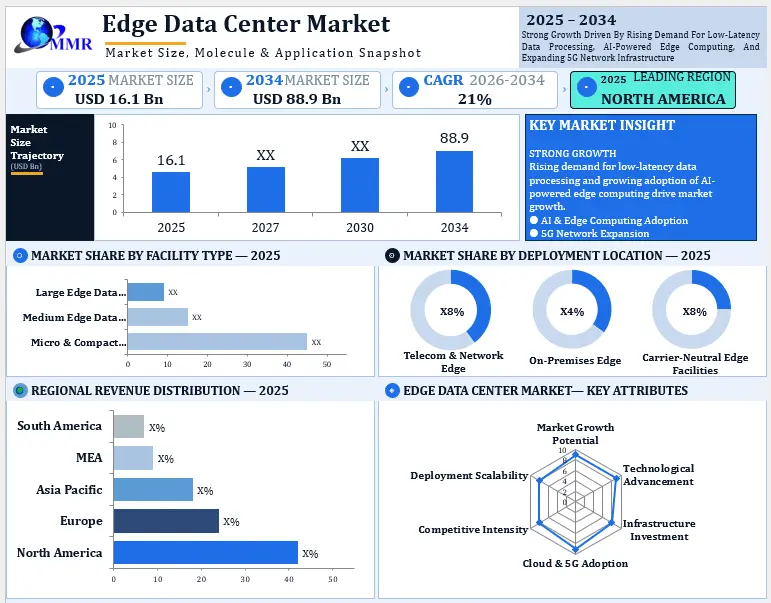
Edge Data Center Market Growth

To know about the Research Methodology :- Request Free Sample Report

STRATEGIC INTERPRETATION


The convergence of AI, 5G, and industrial IoT is positioning edge data centers as a critical foundation of the next generation of digital infrastructure.


- Krishna Ghorpade (Research Analyst | MMR)

Global Edge Data Center Market Size and Demand Indicators

Year

USD billion

Year

USD billion

2025

16.1

2030

41.6

2026

19.5

2031

50.3

2027

23.5

2032

60.8

2028

28.5

2033

73.5

2029

34.4

2034

88.9

The Edge Data Center Market was valued at USD 16.1 Billion in 2025 and is projected to reach USD 88.9 Billion by 2034, reflecting a CAGR of 21%. The market outlook is supported by rising demand for AI-powered edge computing, 5G infrastructure, micro data centers, industrial IoT, real-time data analytics, and low-latency network services. Increasing deployment of distributed IT infrastructure across telecommunications, BFSI, healthcare, manufacturing, and smart cities strengthens demand for modular, scalable, and energy-efficient edge data center solutions.

The expansion of edge AI inference, cloud-edge integration, multi-access edge computing (MEC), private 5G networks, and industrial automation increases requirements for localized computing capacity, high-performance servers, networking equipment, power systems, and advanced cooling infrastructure. North America maintains a strong market position, while Asia Pacific offers significant expansion opportunities through digital infrastructure investment, smart manufacturing, and next-generation connectivity.

Global Edge Data Center Market Cloud-edge Infrastructure Architecture

EDGE-CLOUD DEPLOYMENT MODEL

01  GENERATE

Devices
& sites

Sensors, cameras, user devices, industrial
equipment; local data generation

›

02  RESPOND

Local /
metro edge

Inference, data filtering, caching,
control, continuity and site proximity

›

03  ORCHESTRATE

Regional
/ cloud

Centralized training, storage, analytics,
governance and pooled capacity

As industries become increasingly connected, the need to process information closer to where it is generated is reshaping the Edge Data Center Market. Traditional cloud infrastructure is evolving into a distributed network of micro data centers, edge computing facilities, and hybrid cloud environments, bringing computing power closer to businesses, devices, and end users. This transformation supports faster decision-making, real-time data analytics, and low-latency applications across 5G networks, artificial intelligence (AI), industrial IoT, smart manufacturing, and autonomous systems.

Technologies such as multi-access edge computing (MEC), cloud-edge integration, software-defined networking, edge AI inference, advanced cooling systems, and cybersecurity solutions form the foundation of this emerging digital infrastructure. As demand for seamless connectivity and intelligent automation grows, edge data center architecture plays an increasingly important role in building scalable, energy-efficient, and resilient computing ecosystems.

Global Edge Data Center Market Dynamics

Edge Data Center Market Drivers – Rising AI Inference, Industrial Automation and 5G Network Expansion

The Edge Data Center Market is growing rapidly, driven by demand for low-latency computing, real-time data processing, AI, 5G edge computing, industrial IoT (IIoT), and smart manufacturing. In 2025, 5G networks cover 55% of the global population, supporting multi-access edge computing (MEC), cloud-edge integration, and distributed computing infrastructure. Manufacturing industries increasingly adopt edge AI, predictive maintenance, machine vision, and industrial automation, while telecom operators invest in micro data centers, modular edge data centers, edge servers, and content delivery networks (CDN). Growing adoption of AI inference, edge analytics, and energy-efficient edge computing solutions further accelerates market growth.

Edge Data Center Market Restraints – High Infrastructure Costs, Power Requirements and Deployment Complexity

Despite rising demand, the Edge Data Center Market faces challenges from high infrastructure costs, power constraints, and complex distributed data center management. Deploying micro data centers and modular edge data centers requires investment in cooling systems, network connectivity, cybersecurity, remote monitoring, and maintenance. Global data centers consumed 415 TWh of electricity in 2024, with demand projected to reach nearly 945 TWh by 2030, increasing pressure on energy infrastructure. Grid limitations, permitting delays, and underutilized capacity can restrict edge computing infrastructure expansion. Providers increasingly prioritize energy-efficient edge data centers, automated operations, scalable designs, and total cost of ownership (TCO) optimization.

Edge Data Center Market Opportunities – Modular Infrastructure, Data Sovereignty and Industry-Specific Edge Computing

The Edge Data Center Market presents significant opportunities driven by data security, sovereign edge computing, localized data processing, private 5G, and hybrid cloud infrastructure. Healthcare, BFSI, manufacturing, and government sectors increasingly adopt private cloud, edge AI, and distributed computing to enhance security and real-time performance. The European Union recorded 7,451 secure, climate-neutral edge nodes in 2025, targeting 10,000 by 2030. Rising investments in modular edge data centers, containerized data centers, managed edge services, industrial IoT, and telecom edge infrastructure support scalable, energy-efficient deployments, creating new growth opportunities for edge computing solutions and infrastructure providers.

Edge Data Center Market Challenges – Cybersecurity, Distributed Network Management and Operational Resilience

The Edge Data Center Market faces growing challenges in cybersecurity, infrastructure reliability, and distributed edge computing management. In 2025, on-premises deployments accounted for 89% of qualifying EU edge nodes, highlighting decentralized infrastructure complexity. Edge data center security requires zero-trust architecture, network segmentation, encryption, remote monitoring, automated updates, and disaster recovery solutions. Operators must ensure reliable fiber connectivity, backup power, energy-efficient cooling, and high availability across multiple locations. Rising adoption of edge AI, industrial IoT, private 5G, and mission-critical applications increases demand for secure edge computing solutions, resilient infrastructure, and automated data center management.

Edge Data Center Market Trends – Federated Edge Computing, AI Infrastructure and Energy-Efficient Deployment

The Edge Data Center Market is moving toward a more intelligent and interconnected infrastructure model, where edge facilities operate as coordinated components of a larger digital ecosystem. Emerging trends include federated edge computing, AI-driven workload orchestration, software-defined infrastructure, containerized applications, hybrid cloud integration, liquid cooling, and energy-aware computing. European public edge infrastructure is projected to expand from approximately 1,032 nodes in 2025 to more than 3,500 nodes by 2030, reflecting the increasing importance of shared, distributed computing capacity. Infrastructure providers are focusing on automated workload placement, real-time resource monitoring, renewable energy integration, and improved power usage effectiveness (PUE). The convergence of edge AI, 5G-Advanced connectivity, industrial IoT, smart city infrastructure, and sustainable data center technologies is expected to influence future facility design, pricing models, service delivery, and investment strategies through 2034.

MARKET DYNAMICS | FOUR-PART DECISION LENS

DEMAND CATALYSTS

Edge AI inference • Industrial IoT • 5G and
fiber

Strong use cases still require
customer-specific latency validation.

DEPLOYMENT ENABLERS

Modular design • Infrastructure reuse • Remote
orchestration

Repeatable operating models
improve rollout economics.

INVESTMENT FRICTIONS

Utilization risk • Power scarcity • Cooling
constraints

Site qualification needs to precede capital
commitment.

OPERATING RISKS

Cybersecurity • Physical access • Multi-site
resilience

Distributed operations expand the security
and maintenance perimeter.

Global Edge Data Center Market by Segments

SEGMENTATION SUMMARY

01  COMPONENT

IT equipment; Power and
Cooling Infrastructure; Software and Services

02  FACILITY TYPE

Micro & compact Edge Data
Centers; Medium Edge Data Centers; Large Edge Data Centers

03  DEPLOYMENT
LOCATION

On-Premises Edge; Telecom
& network edge; Carrier-Neutral Edge Facilities

04  APPLICATION

AI inference & Analytics; industrial
IoT & Automation; Content delivery; Interactive Applications; Connected
Mobility; Network Functions

05  END-USE

IT and telecom; Manufacturing; BFSI;
Healthcare; Transportation & Logistics; Retail & E-Commerce; Energy
& Utilities; Government; Media & Entertainment

06  VALUE MODEL

Dedicated Infrastructure; Shared
Colocation; Consumption-Based Edge Services; Managed

By Component – Growing Demand for IT Equipment, Power & Cooling Infrastructure, Software and Services

The Edge Data Center Market by Component is segmented into IT Equipment, Power & Cooling Infrastructure, Software, and Services. IT Equipment, including edge servers, AI accelerators, storage systems, and networking hardware, enables low-latency computing, real-time analytics, and 5G edge applications. Power & Cooling Infrastructure supports reliable, energy-efficient operations through UPS systems, power distribution, and advanced cooling solutions. Software enables edge orchestration, virtualization, cybersecurity, and hybrid cloud integration, while Services cover deployment, remote monitoring, maintenance, and managed edge operations. Growing adoption of industrial IoT, edge AI, smart manufacturing, and multi-access edge computing (MEC) strengthens demand for scalable edge data center solutions.
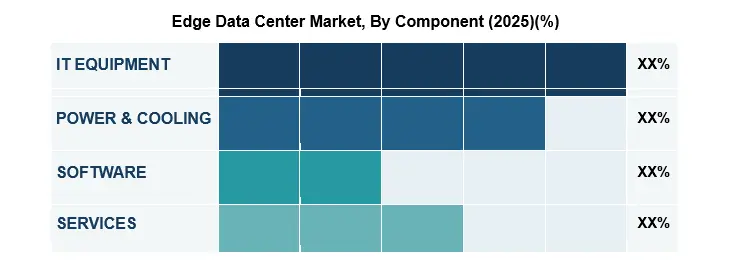
Edge Data Center Market by Component

By End-Use Industry – Rising Adoption of Edge Computing Across IT & Telecom, Manufacturing, BFSI, Healthcare and Digital Industries

As industries increasingly depend on faster connectivity and real-time intelligence, the Edge Data Center Market by end-use industry is growing across nine key sectors: IT & Telecom, Manufacturing, BFSI, Healthcare, Transportation & Logistics, Retail & E-Commerce, Energy & Utilities, Government, and Media & Entertainment. IT and telecom companies adopt 5G edge computing, multi-access edge computing (MEC), and cloud-edge infrastructure to improve network performance and data processing. Manufacturing industries utilize industrial IoT, edge AI inference, predictive maintenance, and smart factory automation, while BFSI and healthcare increasingly rely on secure, low-latency computing for digital transactions, medical imaging, and real-time monitoring. Transportation and logistics benefit from connected mobility and intelligent supply chains, while retail and e-commerce leverage customer analytics and automated inventory systems. Growing investments in smart grids, smart cities, content delivery networks, and immersive digital entertainment further strengthen demand for scalable, energy-efficient edge data center solutions across global industries.
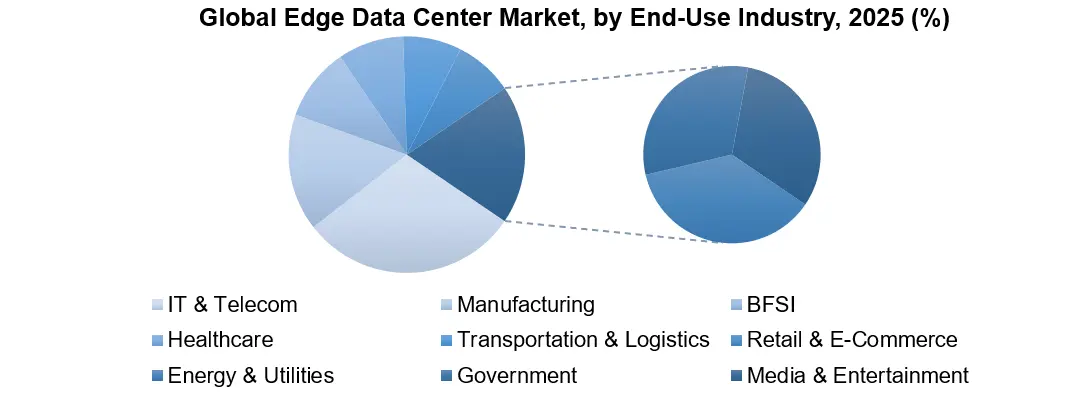
Edge Data Center Market by Enduse Industry

Global Edge Data Center Market Regional Insights

REGIONAL OPPORTUNITY ASSESSMENT

Region

Enterprise
demand

Connectivity

Site pressure

Suggested
starting point

North America

High

High

High

Metro / enterprise

Europe

High

High

High

Secure regional edge

Asia Pacific

High

High

Varies

Industrial / metro

Middle East & Africa

Selective

Selective

Varies

Anchor clusters

South America

Selective

Selective

Varies

Metro / industrial

North America – Leading Market Share and Advanced Edge Computing Infrastructure

North America is the leading region in the Edge Data Center Market in 2025, driven by 5G expansion, AI adoption, cloud computing, IoT, and hyperscale infrastructure investments. The United States leads the regional market, supported by rising demand for low-latency computing, real-time data processing, edge AI, and distributed IT infrastructure. Strong enterprise digitalization across healthcare, manufacturing, telecommunications, and logistics accelerates micro data center and modular edge computing deployments. However, grid limitations, high infrastructure costs, and power availability constrain expansion. US data centers consumed 4.4% of national electricity in 2023, potentially reaching 6.7–12.0% by 2028, highlighting broader infrastructure challenges.

Asia Pacific – Fastest-Growing Region Driven by 5G and Industrial Digitalization

Asia Pacific is expected to register the highest CAGR in the Edge Data Center Market, driven by 5G expansion, AI, cloud computing, industrial IoT, and smart manufacturing. China, India, Japan, and South Korea lead regional opportunities in low-latency computing, real-time data processing, edge AI, and distributed data centers. India recorded 562,971 installed 5G base stations in June 2026, strengthening connectivity infrastructure. Rising demand for micro data centers, modular edge data centers, multi-access edge computing (MEC), and hybrid cloud solutions supports market expansion, while power availability, fiber connectivity, and infrastructure costs remain key challenges.

Europe – Secure Edge Computing and Sustainable Digital Infrastructure

Europe held a significant share of the Edge Data Center Market in 2025, driven by edge computing, industrial automation, data sovereignty, and low-latency data processing. Germany, the United Kingdom, and France lead regional opportunities in secure edge infrastructure, cloud computing, healthcare, and telecommunications. The European Union targets 10,000 secure, climate-neutral edge nodes by 2030, supporting decentralized computing infrastructure. Rising demand for modular edge data centers, edge AI, 5G connectivity, industrial IoT, and hybrid cloud solutions creates growth opportunities. However, energy efficiency regulations, data localization, cybersecurity, and infrastructure costs remain key challenges for regional expansion.

Middle East & Africa – Emerging Edge Computing and Smart City Infrastructure

The Middle East & Africa Edge Data Center Market is expanding through digital transformation, smart cities, 5G connectivity, cloud computing, and IoT adoption. The UAE and Saudi Arabia lead regional opportunities, supported by investments in AI, smart infrastructure, and low-latency computing. South Africa, Nigeria, and Kenya offer emerging opportunities in telecommunications, BFSI, and digital services. Growing demand for micro data centers, modular edge data centers, localized data processing, and hybrid cloud solutions supports infrastructure development. However, power reliability, cooling costs, fiber connectivity, and infrastructure investment remain major challenges for scalable edge computing deployment.

South America – Growing Edge Computing and Digital Infrastructure Expansion

The South America Edge Data Center Market is expanding through rising internet penetration, e-commerce, digital banking, cloud computing, and 5G connectivity. Brazil leads regional opportunities, while Chile, Colombia, and Argentina support demand for low-latency computing, localized data processing, and distributed IT infrastructure. Growing adoption of industrial IoT, mining automation, logistics, content delivery networks (CDN), and real-time analytics drives investments in micro data centers, modular edge data centers, and managed edge services. However, power reliability, fiber connectivity, infrastructure costs, and uneven digital maturity remain key challenges, encouraging scalable edge computing deployments across metropolitan and industrial hubs.

Global Edge Data Center Market Technology, Operations and Sustainability

Compute, networking, and orchestration

A resilient edge architecture begins with workload classification. Real-time inference, safety-related control, local caching, and regulated processing may justify low-latency placement; large model training, archival retention, and infrequent analytics often remain centralized. Network design should include redundant access routes, traffic segmentation, local service discovery, and measurable application-level latency rather than relying only on geographic distance. Container orchestration and infrastructure management can simplify deployment if application dependencies and data synchronization are explicit. The objective is an integrated cloud-edge continuum in which each tier performs the tasks it can deliver most reliably and economically.
Power and thermal engineering

Energy performance is becoming a differentiator in compact data-center deployments. Continuous telemetry should capture IT load, cooling load, power usage effectiveness, peak demand, temperature compliance, and the availability of backup power. Cooling selection must be matched to equipment density and local environment; liquid systems can be appropriate at higher thermal loads but require trained maintenance and careful leak protection. International technical guidance specifically addresses energy management for micro data centers, while recent building-integration research evaluates waste-heat recovery and coordinated control with surrounding facilities.
Security, resilience, and operational controls

Distributed infrastructure requires an operating model designed around limited site access. Secure remote provisioning, device identity, patch automation, encrypted storage, logging, and incident response should be established before commercial scale-up. Procurement should specify physical access protocols, service recovery targets, backup testing, equipment lifecycle policy, and auditability across suppliers. High availability should be designed around actual application criticality: the most demanding workloads may need local redundancy, while tolerant services can fall back to a metropolitan or regional tier. This avoids excessive overengineering while preserving customer confidence in reliability.

EDGE DEPLOYMENT TECHNOLOGY STACK

APPLICATIONS

Edge AI inference  |
real-time analytics  |  content caching

PLATFORM

Workload
orchestration  |  identity
|  observability  |
policy

CONNECTIVITY

Fiber backhaul  |  5G
integration  |  secure network paths

PHYSICAL

Compute and storage  |
power redundancy  |  thermal control

Global Edge Data Center Market Investment, commercial structure and risk

Competitive environment and value chain

Competition is shaped by access to sites, power, networks, skilled operations, and recurring customers. Facilities owners control physical footprint and electrical capacity; connectivity providers control traffic paths; systems integrators deploy and maintain environments; software platforms coordinate workloads; and enterprise buyers determine which use cases convert proximity into spending. Differentiation is strongest when several advantages are combined: reliable fiber diversity, demonstrable latency, standardized deployments, automated management, and transparent service terms. The sector is not inherently winner-take-all because workloads and geography vary, but interoperable platforms can achieve cost and service advantages across an otherwise fragmented location base.

Capital allocation and site-screening discipline

Investment approval should start with a defined catchment and a short list of anchor workloads. Screen potential facilities against power availability, fiber diversity, realistic end-to-end latency, physical risk, security, cooling needs, and service access. Model costs on a per-site and per-utilized-kilowatt basis rather than relying on theoretical installed capacity. Stage deployment: prove reliability and demand at a pilot node, expand only after contracted utilization clears an agreed threshold, and monitor customer concentration. A high-quality location with two credible traffic or enterprise demand sources can be more defensible than a larger footprint without contracted workloads.

FIVE-PART SITE SCREENING CHECKLIST

Criterion

Practical
assessment

Power availability

Firm capacity, resilience, utility lead time
and load profile

Fiber diversity

Independent paths, transport redundancy and
backhaul economics

Local demand and latency

Anchor workloads, service requirement and
actual end-to-end response

Site and physical security

Access controls, environmental exposure,
compliance and location risk

Cooling and
maintenance

Thermal headroom,
service access, remote monitoring and spares

Commercialization and pricing framework

Revenue can come from dedicated racks, reserved compute, managed application hosting, network-function placement, data processing, and recurring support. Pricing structures should align with the specific value delivered: availability for industrial systems, response time for interactive services, secure residency for regulated workloads, or traffic reduction for data-heavy applications. Contracts should address energy-price exposure, connectivity pass-through, service-level credits, equipment refresh, and data portability. Where asset ownership and software management are split, responsibilities must be unambiguous. This lowers disputes, improves renewal prospects, and reduces the risk that the service becomes an undifferentiated infrastructure commodity.

Risk matrix and strategic response

Primary risks include overbuilding ahead of demand, power connection delays, cyber incidents, unplanned maintenance, technology obsolescence, and regulatory change. Their likelihood and financial impact differ substantially by project and should be scored using actual site information before capital is committed. Mitigations include anchor tenancy, diversified fiber routes, redundant power, modular capacity, centralized monitoring, security validation, and staged procurement. The most important strategic distinction is between total addressable use cases and bankable demand. Adoption can accelerate while a poorly located facility remains underutilized; location economics are therefore as material as the broader technology trend.

RISK RESPONSE MAP

EXPOSURE

EARLY WARNING

PREFERRED RESPONSE

COMMERCIAL

Low anchor demand / early
utilization

Pilot-first capacity and signed
workload commitments

INFRASTRUCTURE

Power or fiber delivery
bottlenecks

Validate lead times and
redundant paths before site award

OPERATIONS

High service cost across many
sites

Remote monitoring, consistent
spares and service runbooks

SECURITY

Distributed attack surface and
limited on-site staff

Zero-trust access, segmented
control planes and audit trails

Global Edge Data Center Market Future Outlook through 2034

Over the forecast horizon, edge data centers are likely to become more integrated with AI-enabled operations, industrial networks, digital public infrastructure, and latency-sensitive consumer services. The pace of adoption will depend on stable power, defensible workload economics, and simpler distributed management. Investments should prioritize software-defined operations, energy efficiency, security-by-design, and repeatable local demand discovery. The strongest long-term portfolios will combine central capacity for scale with distributed sites where proximity delivers a measurable advantage. Market potential is considerable, but disciplined site selection and utilization—not the number of deployed boxes—will determine durable returns.

STRATEGIC DEVELOPMENT PATHWAY | 2026–2034

2026–2028

VALIDATE

Anchor demand, power and network diversity; standardize the
site template

2029–2031

REPLICATE

Scale proven deployment patterns and automate distributed
operations

2032–2034

OPTIMIZE

Coordinate workload placement, energy management and portfolio
resilience

Edge Data Center Market Scope: Inquire before buying

Global Edge Data Center Market
Report Coverage Details
Base Year: 2025 Forecast Period: 2026-2034
Historical Data: 2020 to 2025 Market Size in 2025: USD 16.1 Bn.
Forecast Period 2026 to 2034 CAGR: 21% Market Size in 2034: USD 88.9 Bn.
Segments Covered: by Component IT Equipment
Power & Cooling Infrastructure;
Software
Services
by Facility Type Micro & Compact Edge Data Centers
Medium Edge Data Centers
Large Edge Data Centers
by Deployment Location On-Premises Edge
Telecom & Network Edge
Carrier-Neutral Edge Facilities
by Application AI Inference & Analytics
Industrial IoT & Automation
Content Delivery
Interactive Applications
Connected Mobility
Network Functions
by End-Use Industry IT & Telecom
Manufacturing
BFSI
Healthcare
Transportation & Logistics
Retail & E-Commerce
Energy & Utilities
Government
Media & Entertainment
by Revenue Model Dedicated Infrastructure
Shared Colocation
Consumption-Based Edge Services
Managed Application Hosting
Professional Services

Global Edge Data Center Market, by Region

North America (United States, Canada, Mexico)
Europe (United Kingdom, Germany, France, Italy, Spain, Netherlands, Switzerland, Belgium, Russia, Turkey, Sweden, Norway, Denmark, Finland, Poland, Austria, Ireland, Portugal, Greece, Czech Republic, Rest of Europe)
Asia-Pacific (China, India, Japan, South Korea, Australia, New Zealand, Singapore, Malaysia, Thailand, Indonesia, Philippines, Vietnam, Taiwan, Hong Kong, Bangladesh, Pakistan, Sri Lanka, Rest of Asia-Pacific)
Middle East & Africa (United Arab Emirates, Saudi Arabia, Israel, Turkey, Qatar, Kuwait, Oman, Bahrain, Egypt, South Africa, Nigeria, Kenya, Morocco, Algeria, Ghana, Ethiopia, Rest of Middle East & Africa)
South America (Brazil, Argentina, Chile, Colombia, Peru, Ecuador, Uruguay, Paraguay, Bolivia, Venezuela, Rest of South America)

Global Edge Data Center Market, Key Players

1. Equinix
2. Digital Realty
3. EdgeConneX
4. Vapor IO
5. American Tower Corporation
6. 365 Data Centers
7. AtlasEdge Data Centres
8. DartPoints
9. Flexential
10. H5 Data Centers
11. EdgeMicro
12. Compass Datacenters
13. Vantage Data Centers
14. Aligned Data Centers
15. Cologix
16. DataBank
17. CyrusOne
18. CoreSite
19. QTS Data Centers
20. Iron Mountain Data Centers
21. Microsoft
22. Amazon Web Services (AWS)
23. Google Cloud
24. Oracle
25. IBM
26. Dell Technologies
27. Hewlett Packard Enterprise (HPE)
28. Cisco Systems
29. Huawei Technologies
30. Fujitsu
31. Lenovo
32. Supermicro
33. NVIDIA
34. Juniper Networks
35. Arista Networks
36. Nokia
37. Ericsson
38. Schneider Electric
39. Vertiv
40. Eaton
41. Rittal
42. Legrand
43. ABB
44. Delta Electronics
45. Siemens
46. NTT DATA
47. KDDI
48. Zenlayer
49. DXN
50. ST Telemedia Global Data Centres

Edge Data Center Market – Frequently Asked Questions (FAQs)

1. What is the global edge data center market size?
The global edge data center market was valued at USD 16.1 billion in 2025 and is projected to reach USD 88.9 billion by 2034.

2. What is the CAGR of the global edge data center market?
The global edge data center market is expected to grow at a CAGR of approximately 21% during the forecast period from 2026 to 2034.

3. Which region dominates the global edge data center market?
North America is a leading region in the edge data center market, driven by advanced digital infrastructure, strong cloud adoption, investments in data centers, and growing demand for low-latency computing.

4. What are the key factors driving the growth of the edge data center market?
The key growth drivers include increasing adoption of Internet of Things (IoT) devices, expansion of 5G networks, rising demand for real-time data processing, growth in artificial intelligence (AI) applications, and the need to reduce data transmission latency.

5. Who are the key players in the global edge data center market?
Major companies operating in the global edge data center market include Equinix, Digital Realty, EdgeConneX, Vapor IO, American Tower Corporation, AtlasEdge Data Centres, Vertiv, Schneider Electric, Dell Technologies, and Hewlett Packard Enterprise (HPE).

Table of Contents

1. Edge Data Center Market Introduction 1.1. Study Assumption and Market Definition 1.2. Scope of the Study 1.3. Executive Summary 2. Global Edge Data Center Market: Competitive Landscape 2.1. MMR Competition Matrix 2.2. Competitive Landscape 2.3. Key Players Benchmarking 2.3.1. Company Name 2.3.2. Business Segment 2.3.3. End-user Segment 2.3.4. Revenue (2025) 2.3.5. Company Locations 2.4. Leading Edge Data Center Market Companies, by market capitalization 2.5. Market Structure 2.5.1. Market Leaders 2.5.2. Market Followers 2.5.3. Emerging Players 2.6. Mergers and Acquisitions Details 3. Edge Data Center Market: Dynamics 3.1. Edge Data Center Market Trends by Region 3.1.1. North America Edge Data Center Market Trends 3.1.2. Europe Edge Data Center Market Trends 3.1.3. Asia Pacific Edge Data Center Market Trends 3.1.4. Middle East and Africa Edge Data Center Market Trends 3.1.5. South America Edge Data Center Market Trends 3.2. Edge Data Center Market Dynamics by Region 3.2.1. North America 3.2.1.1. North America Edge Data Center Market Drivers 3.2.1.2. North America Edge Data Center Market Restraints 3.2.1.3. North America Edge Data Center Market Opportunities 3.2.1.4. North America Edge Data Center Market Challenges 3.2.2. Europe 3.2.2.1. Europe Edge Data Center Market Drivers 3.2.2.2. Europe Edge Data Center Market Restraints 3.2.2.3. Europe Edge Data Center Market Opportunities 3.2.2.4. Europe Edge Data Center Market Challenges 3.2.3. Asia Pacific 3.2.3.1. Asia Pacific Edge Data Center Market Drivers 3.2.3.2. Asia Pacific Edge Data Center Market Restraints 3.2.3.3. Asia Pacific Edge Data Center Market Opportunities 3.2.3.4. Asia Pacific Edge Data Center Market Challenges 3.2.4. Middle East and Africa 3.2.4.1. Middle East and Africa Edge Data Center Market Drivers 3.2.4.2. Middle East and Africa Edge Data Center Market Restraints 3.2.4.3. Middle East and Africa Edge Data Center Market Opportunities 3.2.4.4. Middle East and Africa Edge Data Center Market Challenges 3.2.5. South America 3.2.5.1. South America Edge Data Center Market Drivers 3.2.5.2. South America Edge Data Center Market Restraints 3.2.5.3. South America Edge Data Center Market Opportunities 3.2.5.4. South America Edge Data Center Market Challenges 3.3. PORTER's Five Forces Analysis 3.4. PESTLE Analysis 3.5. Technology Roadmap 3.6. Regulatory Landscape by Region 3.6.1. North America 3.6.2. Europe 3.6.3. Asia Pacific 3.6.4. Middle East and Africa 3.6.5. South America 3.7. Key Opinion Leader Analysis in the Edge Data Center Market 3.8. Analysis of Government Schemes and Initiatives For Global Industry 3.9. Edge Data Center Market Trade Analysis 3.10. The Global Pandemic Impact on Edge Data Center Market 4. Edge Data Center Market: Global Market Size and Forecast by Segmentation (in USD Billion) 2025-2034 4.1. Edge Data Center Market Size and Forecast, by Component (2025-2034) 4.1.1. IT Equipment 4.1.2. Power & Cooling Infrastructure; 4.1.3. Software 4.1.4. Services 4.2. Edge Data Center Market Size and Forecast, by Facility Type (2025-2034) 4.2.1. Micro & Compact Edge Data Centers 4.2.2. Medium Edge Data Centers 4.2.3. Large Edge Data Centers 4.3. Edge Data Center Market Size and Forecast, by Deployment Location (2025-2034) 4.3.1. On-Premises Edge 4.3.2. Telecom & Network Edge 4.3.3. Carrier-Neutral Edge Facilities 4.4. Edge Data Center Market Size and Forecast, by Application (2025-2034) 4.4.1. AI Inference & Analytics 4.4.2. Industrial IoT & Automation 4.4.3. Content Delivery 4.4.4. Interactive Applications 4.4.5. Connected Mobility 4.4.6. Network Functions 4.5. Edge Data Center Market Size and Forecast, by End-Use Industry (2025-2034) 4.5.1. IT & Telecom 4.5.2. Manufacturing 4.5.3. BFSI 4.5.4. Healthcare 4.5.5. Transportation & Logistics 4.5.6. Retail & E-Commerce 4.5.7. Energy & Utilities 4.5.8. Government 4.5.9. Media & Entertainment 4.6. Edge Data Center Market Size and Forecast, by Revenue Model (2025-2034) 4.6.1. Dedicated Infrastructure 4.6.2. Shared Colocation 4.6.3. Consumption-Based Edge Services 4.6.4. Managed Application Hosting 4.6.5. Professional Services 4.7. Edge Data Center Market Size and Forecast, by Region (2025-2034) 4.7.1. North America 4.7.2. Europe 4.7.3. Asia Pacific 4.7.4. Middle East and Africa 4.7.5. South America 5. North America Edge Data Center Market Size and Forecast by Segmentation (in USD Billion) 2025-2034 5.1. North America Edge Data Center Market Size and Forecast, by Component (2025-2034) 5.1.1. IT Equipment 5.1.2. Power & Cooling Infrastructure; 5.1.3. Software 5.1.4. Services 5.2. North America Edge Data Center Market Size and Forecast, by Facility Type (2025-2034) 5.2.1. Micro & Compact Edge Data Centers 5.2.2. Medium Edge Data Centers 5.2.3. Large Edge Data Centers 5.3. North America Edge Data Center Market Size and Forecast, by Deployment Location (2025-2034) 5.3.1. On-Premises Edge 5.3.2. Telecom & Network Edge 5.3.3. Carrier-Neutral Edge Facilities 5.4. North America Edge Data Center Market Size and Forecast, by Application (2025-2034) 5.4.1. AI Inference & Analytics 5.4.2. Industrial IoT & Automation 5.4.3. Content Delivery 5.4.4. Interactive Applications 5.4.5. Connected Mobility 5.4.6. Network Functions 5.5. North America Edge Data Center Market Size and Forecast, by End-Use Industry (2025-2034) 5.5.1. IT & Telecom 5.5.2. Manufacturing 5.5.3. BFSI 5.5.4. Healthcare 5.5.5. Transportation & Logistics 5.5.6. Retail & E-Commerce 5.5.7. Energy & Utilities 5.5.8. Government 5.5.9. Media & Entertainment 5.6. North America Edge Data Center Market Size and Forecast, by Revenue Model (2025-2034) 5.6.1. Dedicated Infrastructure 5.6.2. Shared Colocation 5.6.3. Consumption-Based Edge Services 5.6.4. Managed Application Hosting 5.6.5. Professional Services 5.7. North America Edge Data Center Market Size and Forecast, by Country (2025-2034) 5.7.1. United States 5.7.1.1. United States Edge Data Center Market Size and Forecast, by Component (2025-2034) 5.7.1.1.1. IT Equipment 5.7.1.1.2. Power & Cooling Infrastructure; 5.7.1.1.3. Software 5.7.1.1.4. Services 5.7.1.2. United States Edge Data Center Market Size and Forecast, by Facility Type (2025-2034) 5.7.1.2.1. Micro & Compact Edge Data Centers 5.7.1.2.2. Medium Edge Data Centers 5.7.1.2.3. Large Edge Data Centers 5.7.1.3. United States Edge Data Center Market Size and Forecast, by Deployment Location (2025-2034) 5.7.1.3.1. On-Premises Edge 5.7.1.3.2. Telecom & Network Edge 5.7.1.3.3. Carrier-Neutral Edge Facilities 5.7.1.4. United States Edge Data Center Market Size and Forecast, by Application (2025-2034) 5.7.1.4.1. AI Inference & Analytics 5.7.1.4.2. Industrial IoT & Automation 5.7.1.4.3. Content Delivery 5.7.1.4.4. Interactive Applications 5.7.1.4.5. Connected Mobility 5.7.1.4.6. Network Functions 5.7.1.5. United States Edge Data Center Market Size and Forecast, by End-Use Industry (2025-2034) 5.7.1.5.1. IT & Telecom 5.7.1.5.2. Manufacturing 5.7.1.5.3. BFSI 5.7.1.5.4. Healthcare 5.7.1.5.5. Transportation & Logistics 5.7.1.5.6. Retail & E-Commerce 5.7.1.5.7. Energy & Utilities 5.7.1.5.8. Government 5.7.1.5.9. Media & Entertainment 5.7.1.6. United States Edge Data Center Market Size and Forecast, by Revenue Model (2025-2034) 5.7.1.6.1. Dedicated Infrastructure 5.7.1.6.2. Shared Colocation 5.7.1.6.3. Consumption-Based Edge Services 5.7.1.6.4. Managed Application Hosting 5.7.1.6.5. Professional Services 5.7.2. Canada 5.7.2.1. Canada Edge Data Center Market Size and Forecast, by Component (2025-2034) 5.7.2.1.1. IT Equipment 5.7.2.1.2. Power & Cooling Infrastructure; 5.7.2.1.3. Software 5.7.2.1.4. Services 5.7.2.2. Canada Edge Data Center Market Size and Forecast, by Facility Type (2025-2034) 5.7.2.2.1. Micro & Compact Edge Data Centers 5.7.2.2.2. Medium Edge Data Centers 5.7.2.2.3. Large Edge Data Centers 5.7.2.3. Canada Edge Data Center Market Size and Forecast, by Deployment Location (2025-2034) 5.7.2.3.1. On-Premises Edge 5.7.2.3.2. Telecom & Network Edge 5.7.2.3.3. Carrier-Neutral Edge Facilities 5.7.2.4. Canada Edge Data Center Market Size and Forecast, by Application (2025-2034) 5.7.2.4.1. AI Inference & Analytics 5.7.2.4.2. Industrial IoT & Automation 5.7.2.4.3. Content Delivery 5.7.2.4.4. Interactive Applications 5.7.2.4.5. Connected Mobility 5.7.2.4.6. Network Functions 5.7.2.5. Canada Edge Data Center Market Size and Forecast, by End-Use Industry (2025-2034) 5.7.2.5.1. IT & Telecom 5.7.2.5.2. Manufacturing 5.7.2.5.3. BFSI 5.7.2.5.4. Healthcare 5.7.2.5.5. Transportation & Logistics 5.7.2.5.6. Retail & E-Commerce 5.7.2.5.7. Energy & Utilities 5.7.2.5.8. Government 5.7.2.5.9. Media & Entertainment 5.7.2.6. Canada Edge Data Center Market Size and Forecast, by Revenue Model (2025-2034) 5.7.2.6.1. Dedicated Infrastructure 5.7.2.6.2. Shared Colocation 5.7.2.6.3. Consumption-Based Edge Services 5.7.2.6.4. Managed Application Hosting 5.7.2.6.5. Professional Services 5.7.3. Mexico 5.7.3.1. Mexico Edge Data Center Market Size and Forecast, by Component (2025-2034) 5.7.3.1.1. IT Equipment 5.7.3.1.2. Power & Cooling Infrastructure; 5.7.3.1.3. Software 5.7.3.1.4. Services 5.7.3.2. Mexico Edge Data Center Market Size and Forecast, by Facility Type (2025-2034) 5.7.3.2.1. Micro & Compact Edge Data Centers 5.7.3.2.2. Medium Edge Data Centers 5.7.3.2.3. Large Edge Data Centers 5.7.3.3. Mexico Edge Data Center Market Size and Forecast, by Deployment Location (2025-2034) 5.7.3.3.1. On-Premises Edge 5.7.3.3.2. Telecom & Network Edge 5.7.3.3.3. Carrier-Neutral Edge Facilities 5.7.3.4. Mexico Edge Data Center Market Size and Forecast, by Application (2025-2034) 5.7.3.4.1. AI Inference & Analytics 5.7.3.4.2. Industrial IoT & Automation 5.7.3.4.3. Content Delivery 5.7.3.4.4. Interactive Applications 5.7.3.4.5. Connected Mobility 5.7.3.4.6. Network Functions 5.7.3.5. Mexico Edge Data Center Market Size and Forecast, by End-Use Industry (2025-2034) 5.7.3.5.1. IT & Telecom 5.7.3.5.2. Manufacturing 5.7.3.5.3. BFSI 5.7.3.5.4. Healthcare 5.7.3.5.5. Transportation & Logistics 5.7.3.5.6. Retail & E-Commerce 5.7.3.5.7. Energy & Utilities 5.7.3.5.8. Government 5.7.3.5.9. Media & Entertainment 5.7.3.6. Mexico Edge Data Center Market Size and Forecast, by Revenue Model (2025-2034) 5.7.3.6.1. Dedicated Infrastructure 5.7.3.6.2. Shared Colocation 5.7.3.6.3. Consumption-Based Edge Services 5.7.3.6.4. Managed Application Hosting 5.7.3.6.5. Professional Services 6. Europe Edge Data Center Market Size and Forecast by Segmentation (in USD Billion) 2025-2034 6.1. Europe Edge Data Center Market Size and Forecast, by Component (2025-2034) 6.1.1. IT Equipment 6.1.2. Power & Cooling Infrastructure; 6.1.3. Software 6.1.4. Services 6.2. Europe Edge Data Center Market Size and Forecast, by Facility Type (2025-2034) 6.2.1. Micro & Compact Edge Data Centers 6.2.2. Medium Edge Data Centers 6.2.3. Large Edge Data Centers 6.3. Europe Edge Data Center Market Size and Forecast, by Deployment Location (2025-2034) 6.3.1. On-Premises Edge 6.3.2. Telecom & Network Edge 6.3.3. Carrier-Neutral Edge Facilities 6.4. Europe Edge Data Center Market Size and Forecast, by Application (2025-2034) 6.4.1. AI Inference & Analytics 6.4.2. Industrial IoT & Automation 6.4.3. Content Delivery 6.4.4. Interactive Applications 6.4.5. Connected Mobility 6.4.6. Network Functions 6.5. Europe Edge Data Center Market Size and Forecast, by End-Use Industry (2025-2034) 6.5.1. IT & Telecom 6.5.2. Manufacturing 6.5.3. BFSI 6.5.4. Healthcare 6.5.5. Transportation & Logistics 6.5.6. Retail & E-Commerce 6.5.7. Energy & Utilities 6.5.8. Government 6.5.9. Media & Entertainment 6.6. Europe Edge Data Center Market Size and Forecast, by Revenue Model (2025-2034) 6.6.1. Dedicated Infrastructure 6.6.2. Shared Colocation 6.6.3. Consumption-Based Edge Services 6.6.4. Managed Application Hosting 6.6.5. Professional Services 6.7. Europe Edge Data Center Market Size and Forecast, by Country (2025-2034) 6.7.1. United Kingdom 6.7.1.1. United Kingdom Edge Data Center Market Size and Forecast, by Component (2025-2034) 6.7.1.1.1. IT Equipment 6.7.1.1.2. Power & Cooling Infrastructure; 6.7.1.1.3. Software 6.7.1.1.4. Services 6.7.1.2. United Kingdom Edge Data Center Market Size and Forecast, by Facility Type (2025-2034) 6.7.1.2.1. Micro & Compact Edge Data Centers 6.7.1.2.2. Medium Edge Data Centers 6.7.1.2.3. Large Edge Data Centers 6.7.1.3. United Kingdom Edge Data Center Market Size and Forecast, by Deployment Location (2025-2034) 6.7.1.3.1. On-Premises Edge 6.7.1.3.2. Telecom & Network Edge 6.7.1.3.3. Carrier-Neutral Edge Facilities 6.7.1.4. United Kingdom Edge Data Center Market Size and Forecast, by Application (2025-2034) 6.7.1.4.1. AI Inference & Analytics 6.7.1.4.2. Industrial IoT & Automation 6.7.1.4.3. Content Delivery 6.7.1.4.4. Interactive Applications 6.7.1.4.5. Connected Mobility 6.7.1.4.6. Network Functions 6.7.1.5. United Kingdom Edge Data Center Market Size and Forecast, by End-Use Industry (2025-2034) 6.7.1.5.1. IT & Telecom 6.7.1.5.2. Manufacturing 6.7.1.5.3. BFSI 6.7.1.5.4. Healthcare 6.7.1.5.5. Transportation & Logistics 6.7.1.5.6. Retail & E-Commerce 6.7.1.5.7. Energy & Utilities 6.7.1.5.8. Government 6.7.1.5.9. Media & Entertainment 6.7.1.6. United Kingdom Edge Data Center Market Size and Forecast, by Revenue Model (2025-2034) 6.7.1.6.1. Dedicated Infrastructure 6.7.1.6.2. Shared Colocation 6.7.1.6.3. Consumption-Based Edge Services 6.7.1.6.4. Managed Application Hosting 6.7.1.6.5. Professional Services 6.7.2. France 6.7.2.1. France Edge Data Center Market Size and Forecast, by Component (2025-2034) 6.7.2.1.1. IT Equipment 6.7.2.1.2. Power & Cooling Infrastructure; 6.7.2.1.3. Software 6.7.2.1.4. Services 6.7.2.2. France Edge Data Center Market Size and Forecast, by Facility Type (2025-2034) 6.7.2.2.1. Micro & Compact Edge Data Centers 6.7.2.2.2. Medium Edge Data Centers 6.7.2.2.3. Large Edge Data Centers 6.7.2.3. France Edge Data Center Market Size and Forecast, by Deployment Location (2025-2034) 6.7.2.3.1. On-Premises Edge 6.7.2.3.2. Telecom & Network Edge 6.7.2.3.3. Carrier-Neutral Edge Facilities 6.7.2.4. France Edge Data Center Market Size and Forecast, by Application (2025-2034) 6.7.2.4.1. AI Inference & Analytics 6.7.2.4.2. Industrial IoT & Automation 6.7.2.4.3. Content Delivery 6.7.2.4.4. Interactive Applications 6.7.2.4.5. Connected Mobility 6.7.2.4.6. Network Functions 6.7.2.5. France Edge Data Center Market Size and Forecast, by End-Use Industry (2025-2034) 6.7.2.5.1. IT & Telecom 6.7.2.5.2. Manufacturing 6.7.2.5.3. BFSI 6.7.2.5.4. Healthcare 6.7.2.5.5. Transportation & Logistics 6.7.2.5.6. Retail & E-Commerce 6.7.2.5.7. Energy & Utilities 6.7.2.5.8. Government 6.7.2.5.9. Media & Entertainment 6.7.2.6. France Edge Data Center Market Size and Forecast, by Revenue Model (2025-2034) 6.7.2.6.1. Dedicated Infrastructure 6.7.2.6.2. Shared Colocation 6.7.2.6.3. Consumption-Based Edge Services 6.7.2.6.4. Managed Application Hosting 6.7.2.6.5. Professional Services 6.7.3. Germany 6.7.3.1. Germany Edge Data Center Market Size and Forecast, by Component (2025-2034) 6.7.3.1.1. IT Equipment 6.7.3.1.2. Power & Cooling Infrastructure; 6.7.3.1.3. Software 6.7.3.1.4. Services 6.7.3.2. Germany Edge Data Center Market Size and Forecast, by Facility Type (2025-2034) 6.7.3.2.1. Micro & Compact Edge Data Centers 6.7.3.2.2. Medium Edge Data Centers 6.7.3.2.3. Large Edge Data Centers 6.7.3.3. Germany Edge Data Center Market Size and Forecast, by Deployment Location (2025-2034) 6.7.3.3.1. On-Premises Edge 6.7.3.3.2. Telecom & Network Edge 6.7.3.3.3. Carrier-Neutral Edge Facilities 6.7.3.4. Germany Edge Data Center Market Size and Forecast, by Application (2025-2034) 6.7.3.4.1. AI Inference & Analytics 6.7.3.4.2. Industrial IoT & Automation 6.7.3.4.3. Content Delivery 6.7.3.4.4. Interactive Applications 6.7.3.4.5. Connected Mobility 6.7.3.4.6. Network Functions 6.7.3.5. Germany Edge Data Center Market Size and Forecast, by End-Use Industry (2025-2034) 6.7.3.5.1. IT & Telecom 6.7.3.5.2. Manufacturing 6.7.3.5.3. BFSI 6.7.3.5.4. Healthcare 6.7.3.5.5. Transportation & Logistics 6.7.3.5.6. Retail & E-Commerce 6.7.3.5.7. Energy & Utilities 6.7.3.5.8. Government 6.7.3.5.9. Media & Entertainment 6.7.3.6. Germany Edge Data Center Market Size and Forecast, by Revenue Model (2025-2034) 6.7.3.6.1. Dedicated Infrastructure 6.7.3.6.2. Shared Colocation 6.7.3.6.3. Consumption-Based Edge Services 6.7.3.6.4. Managed Application Hosting 6.7.3.6.5. Professional Services 6.7.4. Italy 6.7.4.1. Italy Edge Data Center Market Size and Forecast, by Component (2025-2034) 6.7.4.1.1. IT Equipment 6.7.4.1.2. Power & Cooling Infrastructure; 6.7.4.1.3. Software 6.7.4.1.4. Services 6.7.4.2. Italy Edge Data Center Market Size and Forecast, by Facility Type (2025-2034) 6.7.4.2.1. Micro & Compact Edge Data Centers 6.7.4.2.2. Medium Edge Data Centers 6.7.4.2.3. Large Edge Data Centers 6.7.4.3. Italy Edge Data Center Market Size and Forecast, by Deployment Location (2025-2034) 6.7.4.3.1. On-Premises Edge 6.7.4.3.2. Telecom & Network Edge 6.7.4.3.3. Carrier-Neutral Edge Facilities 6.7.4.4. Italy Edge Data Center Market Size and Forecast, by Application (2025-2034) 6.7.4.4.1. AI Inference & Analytics 6.7.4.4.2. Industrial IoT & Automation 6.7.4.4.3. Content Delivery 6.7.4.4.4. Interactive Applications 6.7.4.4.5. Connected Mobility 6.7.4.4.6. Network Functions 6.7.4.5. Italy Edge Data Center Market Size and Forecast, by End-Use Industry (2025-2034) 6.7.4.5.1. IT & Telecom 6.7.4.5.2. Manufacturing 6.7.4.5.3. BFSI 6.7.4.5.4. Healthcare 6.7.4.5.5. Transportation & Logistics 6.7.4.5.6. Retail & E-Commerce 6.7.4.5.7. Energy & Utilities 6.7.4.5.8. Government 6.7.4.5.9. Media & Entertainment 6.7.4.6. Italy Edge Data Center Market Size and Forecast, by Revenue Model (2025-2034) 6.7.4.6.1. Dedicated Infrastructure 6.7.4.6.2. Shared Colocation 6.7.4.6.3. Consumption-Based Edge Services 6.7.4.6.4. Managed Application Hosting 6.7.4.6.5. Professional Services 6.7.5. Spain 6.7.5.1. Spain Edge Data Center Market Size and Forecast, by Component (2025-2034) 6.7.5.1.1. IT Equipment 6.7.5.1.2. Power & Cooling Infrastructure; 6.7.5.1.3. Software 6.7.5.1.4. Services 6.7.5.2. Spain Edge Data Center Market Size and Forecast, by Facility Type (2025-2034) 6.7.5.2.1. Micro & Compact Edge Data Centers 6.7.5.2.2. Medium Edge Data Centers 6.7.5.2.3. Large Edge Data Centers 6.7.5.3. Spain Edge Data Center Market Size and Forecast, by Deployment Location (2025-2034) 6.7.5.3.1. On-Premises Edge 6.7.5.3.2. Telecom & Network Edge 6.7.5.3.3. Carrier-Neutral Edge Facilities 6.7.5.4. Spain Edge Data Center Market Size and Forecast, by Application (2025-2034) 6.7.5.4.1. AI Inference & Analytics 6.7.5.4.2. Industrial IoT & Automation 6.7.5.4.3. Content Delivery 6.7.5.4.4. Interactive Applications 6.7.5.4.5. Connected Mobility 6.7.5.4.6. Network Functions 6.7.5.5. Spain Edge Data Center Market Size and Forecast, by End-Use Industry (2025-2034) 6.7.5.5.1. IT & Telecom 6.7.5.5.2. Manufacturing 6.7.5.5.3. BFSI 6.7.5.5.4. Healthcare 6.7.5.5.5. Transportation & Logistics 6.7.5.5.6. Retail & E-Commerce 6.7.5.5.7. Energy & Utilities 6.7.5.5.8. Government 6.7.5.5.9. Media & Entertainment 6.7.5.6. Spain Edge Data Center Market Size and Forecast, by Revenue Model (2025-2034) 6.7.5.6.1. Dedicated Infrastructure 6.7.5.6.2. Shared Colocation 6.7.5.6.3. Consumption-Based Edge Services 6.7.5.6.4. Managed Application Hosting 6.7.5.6.5. Professional Services 6.7.6. Sweden 6.7.6.1. Sweden Edge Data Center Market Size and Forecast, by Component (2025-2034) 6.7.6.1.1. IT Equipment 6.7.6.1.2. Power & Cooling Infrastructure; 6.7.6.1.3. Software 6.7.6.1.4. Services 6.7.6.2. Sweden Edge Data Center Market Size and Forecast, by Facility Type (2025-2034) 6.7.6.2.1. Micro & Compact Edge Data Centers 6.7.6.2.2. Medium Edge Data Centers 6.7.6.2.3. Large Edge Data Centers 6.7.6.3. Sweden Edge Data Center Market Size and Forecast, by Deployment Location (2025-2034) 6.7.6.3.1. On-Premises Edge 6.7.6.3.2. Telecom & Network Edge 6.7.6.3.3. Carrier-Neutral Edge Facilities 6.7.6.4. Sweden Edge Data Center Market Size and Forecast, by Application (2025-2034) 6.7.6.4.1. AI Inference & Analytics 6.7.6.4.2. Industrial IoT & Automation 6.7.6.4.3. Content Delivery 6.7.6.4.4. Interactive Applications 6.7.6.4.5. Connected Mobility 6.7.6.4.6. Network Functions 6.7.6.5. Sweden Edge Data Center Market Size and Forecast, by End-Use Industry (2025-2034) 6.7.6.5.1. IT & Telecom 6.7.6.5.2. Manufacturing 6.7.6.5.3. BFSI 6.7.6.5.4. Healthcare 6.7.6.5.5. Transportation & Logistics 6.7.6.5.6. Retail & E-Commerce 6.7.6.5.7. Energy & Utilities 6.7.6.5.8. Government 6.7.6.5.9. Media & Entertainment 6.7.6.6. Sweden Edge Data Center Market Size and Forecast, by Revenue Model (2025-2034) 6.7.6.6.1. Dedicated Infrastructure 6.7.6.6.2. Shared Colocation 6.7.6.6.3. Consumption-Based Edge Services 6.7.6.6.4. Managed Application Hosting 6.7.6.6.5. Professional Services 6.7.7. Austria 6.7.7.1. Austria Edge Data Center Market Size and Forecast, by Component (2025-2034) 6.7.7.1.1. IT Equipment 6.7.7.1.2. Power & Cooling Infrastructure; 6.7.7.1.3. Software 6.7.7.1.4. Services 6.7.7.2. Austria Edge Data Center Market Size and Forecast, by Facility Type (2025-2034) 6.7.7.2.1. Micro & Compact Edge Data Centers 6.7.7.2.2. Medium Edge Data Centers 6.7.7.2.3. Large Edge Data Centers 6.7.7.3. Austria Edge Data Center Market Size and Forecast, by Deployment Location (2025-2034) 6.7.7.3.1. On-Premises Edge 6.7.7.3.2. Telecom & Network Edge 6.7.7.3.3. Carrier-Neutral Edge Facilities 6.7.7.4. Austria Edge Data Center Market Size and Forecast, by Application (2025-2034) 6.7.7.4.1. AI Inference & Analytics 6.7.7.4.2. Industrial IoT & Automation 6.7.7.4.3. Content Delivery 6.7.7.4.4. Interactive Applications 6.7.7.4.5. Connected Mobility 6.7.7.4.6. Network Functions 6.7.7.5. Austria Edge Data Center Market Size and Forecast, by End-Use Industry (2025-2034) 6.7.7.5.1. IT & Telecom 6.7.7.5.2. Manufacturing 6.7.7.5.3. BFSI 6.7.7.5.4. Healthcare 6.7.7.5.5. Transportation & Logistics 6.7.7.5.6. Retail & E-Commerce 6.7.7.5.7. Energy & Utilities 6.7.7.5.8. Government 6.7.7.5.9. Media & Entertainment 6.7.7.6. Austria Edge Data Center Market Size and Forecast, by Revenue Model (2025-2034) 6.7.7.6.1. Dedicated Infrastructure 6.7.7.6.2. Shared Colocation 6.7.7.6.3. Consumption-Based Edge Services 6.7.7.6.4. Managed Application Hosting 6.7.7.6.5. Professional Services 6.7.8. Rest of Europe 6.7.8.1. Rest of Europe Edge Data Center Market Size and Forecast, by Component (2025-2034) 6.7.8.1.1. IT Equipment 6.7.8.1.2. Power & Cooling Infrastructure; 6.7.8.1.3. Software 6.7.8.1.4. Services 6.7.8.2. Rest of Europe Edge Data Center Market Size and Forecast, by Facility Type (2025-2034) 6.7.8.2.1. Micro & Compact Edge Data Centers 6.7.8.2.2. Medium Edge Data Centers 6.7.8.2.3. Large Edge Data Centers 6.7.8.3. Rest of Europe Edge Data Center Market Size and Forecast, by Deployment Location (2025-2034) 6.7.8.3.1. On-Premises Edge 6.7.8.3.2. Telecom & Network Edge 6.7.8.3.3. Carrier-Neutral Edge Facilities 6.7.8.4. Rest of Europe Edge Data Center Market Size and Forecast, by Application (2025-2034) 6.7.8.4.1. AI Inference & Analytics 6.7.8.4.2. Industrial IoT & Automation 6.7.8.4.3. Content Delivery 6.7.8.4.4. Interactive Applications 6.7.8.4.5. Connected Mobility 6.7.8.4.6. Network Functions 6.7.8.5. Rest of Europe Edge Data Center Market Size and Forecast, by End-Use Industry (2025-2034) 6.7.8.5.1. IT & Telecom 6.7.8.5.2. Manufacturing 6.7.8.5.3. BFSI 6.7.8.5.4. Healthcare 6.7.8.5.5. Transportation & Logistics 6.7.8.5.6. Retail & E-Commerce 6.7.8.5.7. Energy & Utilities 6.7.8.5.8. Government 6.7.8.5.9. Media & Entertainment 6.7.8.6. Rest of Europe Edge Data Center Market Size and Forecast, by Revenue Model (2025-2034) 6.7.8.6.1. Dedicated Infrastructure 6.7.8.6.2. Shared Colocation 6.7.8.6.3. Consumption-Based Edge Services 6.7.8.6.4. Managed Application Hosting 6.7.8.6.5. Professional Services 7. Asia Pacific Edge Data Center Market Size and Forecast by Segmentation (in USD Billion) 2025-2034 7.1. Asia Pacific Edge Data Center Market Size and Forecast, by Component (2025-2034) 7.1.1. IT Equipment 7.1.2. Power & Cooling Infrastructure; 7.1.3. Software 7.1.4. Services 7.2. Asia Pacific Edge Data Center Market Size and Forecast, by Facility Type (2025-2034) 7.2.1. Micro & Compact Edge Data Centers 7.2.2. Medium Edge Data Centers 7.2.3. Large Edge Data Centers 7.3. Asia Pacific Edge Data Center Market Size and Forecast, by Deployment Location (2025-2034) 7.3.1. On-Premises Edge 7.3.2. Telecom & Network Edge 7.3.3. Carrier-Neutral Edge Facilities 7.4. Asia Pacific Edge Data Center Market Size and Forecast, by Application (2025-2034) 7.4.1. AI Inference & Analytics 7.4.2. Industrial IoT & Automation 7.4.3. Content Delivery 7.4.4. Interactive Applications 7.4.5. Connected Mobility 7.4.6. Network Functions 7.5. Asia Pacific Edge Data Center Market Size and Forecast, by End-Use Industry (2025-2034) 7.5.1. IT & Telecom 7.5.2. Manufacturing 7.5.3. BFSI 7.5.4. Healthcare 7.5.5. Transportation & Logistics 7.5.6. Retail & E-Commerce 7.5.7. Energy & Utilities 7.5.8. Government 7.5.9. Media & Entertainment 7.6. Asia Pacific Edge Data Center Market Size and Forecast, by Revenue Model (2025-2034) 7.6.1. Dedicated Infrastructure 7.6.2. Shared Colocation 7.6.3. Consumption-Based Edge Services 7.6.4. Managed Application Hosting 7.6.5. Professional Services 7.7. Asia Pacific Edge Data Center Market Size and Forecast, by Country (2025-2034) 7.7.1. China 7.7.1.1. China Edge Data Center Market Size and Forecast, by Component (2025-2034) 7.7.1.1.1. IT Equipment 7.7.1.1.2. Power & Cooling Infrastructure; 7.7.1.1.3. Software 7.7.1.1.4. Services 7.7.1.2. China Edge Data Center Market Size and Forecast, by Facility Type (2025-2034) 7.7.1.2.1. Micro & Compact Edge Data Centers 7.7.1.2.2. Medium Edge Data Centers 7.7.1.2.3. Large Edge Data Centers 7.7.1.3. China Edge Data Center Market Size and Forecast, by Deployment Location (2025-2034) 7.7.1.3.1. On-Premises Edge 7.7.1.3.2. Telecom & Network Edge 7.7.1.3.3. Carrier-Neutral Edge Facilities 7.7.1.4. China Edge Data Center Market Size and Forecast, by Application (2025-2034) 7.7.1.4.1. AI Inference & Analytics 7.7.1.4.2. Industrial IoT & Automation 7.7.1.4.3. Content Delivery 7.7.1.4.4. Interactive Applications 7.7.1.4.5. Connected Mobility 7.7.1.4.6. Network Functions 7.7.1.5. China Edge Data Center Market Size and Forecast, by End-Use Industry (2025-2034) 7.7.1.5.1. IT & Telecom 7.7.1.5.2. Manufacturing 7.7.1.5.3. BFSI 7.7.1.5.4. Healthcare 7.7.1.5.5. Transportation & Logistics 7.7.1.5.6. Retail & E-Commerce 7.7.1.5.7. Energy & Utilities 7.7.1.5.8. Government 7.7.1.5.9. Media & Entertainment 7.7.1.6. China Edge Data Center Market Size and Forecast, by Revenue Model (2025-2034) 7.7.1.6.1. Dedicated Infrastructure 7.7.1.6.2. Shared Colocation 7.7.1.6.3. Consumption-Based Edge Services 7.7.1.6.4. Managed Application Hosting 7.7.1.6.5. Professional Services 7.7.2. S Korea 7.7.2.1. S Korea Edge Data Center Market Size and Forecast, by Component (2025-2034) 7.7.2.1.1. IT Equipment 7.7.2.1.2. Power & Cooling Infrastructure; 7.7.2.1.3. Software 7.7.2.1.4. Services 7.7.2.2. S Korea Edge Data Center Market Size and Forecast, by Facility Type (2025-2034) 7.7.2.2.1. Micro & Compact Edge Data Centers 7.7.2.2.2. Medium Edge Data Centers 7.7.2.2.3. Large Edge Data Centers 7.7.2.3. S Korea Edge Data Center Market Size and Forecast, by Deployment Location (2025-2034) 7.7.2.3.1. On-Premises Edge 7.7.2.3.2. Telecom & Network Edge 7.7.2.3.3. Carrier-Neutral Edge Facilities 7.7.2.4. S Korea Edge Data Center Market Size and Forecast, by Application (2025-2034) 7.7.2.4.1. AI Inference & Analytics 7.7.2.4.2. Industrial IoT & Automation 7.7.2.4.3. Content Delivery 7.7.2.4.4. Interactive Applications 7.7.2.4.5. Connected Mobility 7.7.2.4.6. Network Functions 7.7.2.5. S Korea Edge Data Center Market Size and Forecast, by End-Use Industry (2025-2034) 7.7.2.5.1. IT & Telecom 7.7.2.5.2. Manufacturing 7.7.2.5.3. BFSI 7.7.2.5.4. Healthcare 7.7.2.5.5. Transportation & Logistics 7.7.2.5.6. Retail & E-Commerce 7.7.2.5.7. Energy & Utilities 7.7.2.5.8. Government 7.7.2.5.9. Media & Entertainment 7.7.2.6. S Korea Edge Data Center Market Size and Forecast, by Revenue Model (2025-2034) 7.7.2.6.1. Dedicated Infrastructure 7.7.2.6.2. Shared Colocation 7.7.2.6.3. Consumption-Based Edge Services 7.7.2.6.4. Managed Application Hosting 7.7.2.6.5. Professional Services 7.7.3. Japan 7.7.3.1. Japan Edge Data Center Market Size and Forecast, by Component (2025-2034) 7.7.3.1.1. IT Equipment 7.7.3.1.2. Power & Cooling Infrastructure; 7.7.3.1.3. Software 7.7.3.1.4. Services 7.7.3.2. Japan Edge Data Center Market Size and Forecast, by Facility Type (2025-2034) 7.7.3.2.1. Micro & Compact Edge Data Centers 7.7.3.2.2. Medium Edge Data Centers 7.7.3.2.3. Large Edge Data Centers 7.7.3.3. Japan Edge Data Center Market Size and Forecast, by Deployment Location (2025-2034) 7.7.3.3.1. On-Premises Edge 7.7.3.3.2. Telecom & Network Edge 7.7.3.3.3. Carrier-Neutral Edge Facilities 7.7.3.4. Japan Edge Data Center Market Size and Forecast, by Application (2025-2034) 7.7.3.4.1. AI Inference & Analytics 7.7.3.4.2. Industrial IoT & Automation 7.7.3.4.3. Content Delivery 7.7.3.4.4. Interactive Applications 7.7.3.4.5. Connected Mobility 7.7.3.4.6. Network Functions 7.7.3.5. Japan Edge Data Center Market Size and Forecast, by End-Use Industry (2025-2034) 7.7.3.5.1. IT & Telecom 7.7.3.5.2. Manufacturing 7.7.3.5.3. BFSI 7.7.3.5.4. Healthcare 7.7.3.5.5. Transportation & Logistics 7.7.3.5.6. Retail & E-Commerce 7.7.3.5.7. Energy & Utilities 7.7.3.5.8. Government 7.7.3.5.9. Media & Entertainment 7.7.3.6. Japan Edge Data Center Market Size and Forecast, by Revenue Model (2025-2034) 7.7.3.6.1. Dedicated Infrastructure 7.7.3.6.2. Shared Colocation 7.7.3.6.3. Consumption-Based Edge Services 7.7.3.6.4. Managed Application Hosting 7.7.3.6.5. Professional Services 7.7.4. India 7.7.4.1. India Edge Data Center Market Size and Forecast, by Component (2025-2034) 7.7.4.1.1. IT Equipment 7.7.4.1.2. Power & Cooling Infrastructure; 7.7.4.1.3. Software 7.7.4.1.4. Services 7.7.4.2. India Edge Data Center Market Size and Forecast, by Facility Type (2025-2034) 7.7.4.2.1. Micro & Compact Edge Data Centers 7.7.4.2.2. Medium Edge Data Centers 7.7.4.2.3. Large Edge Data Centers 7.7.4.3. India Edge Data Center Market Size and Forecast, by Deployment Location (2025-2034) 7.7.4.3.1. On-Premises Edge 7.7.4.3.2. Telecom & Network Edge 7.7.4.3.3. Carrier-Neutral Edge Facilities 7.7.4.4. India Edge Data Center Market Size and Forecast, by Application (2025-2034) 7.7.4.4.1. AI Inference & Analytics 7.7.4.4.2. Industrial IoT & Automation 7.7.4.4.3. Content Delivery 7.7.4.4.4. Interactive Applications 7.7.4.4.5. Connected Mobility 7.7.4.4.6. Network Functions 7.7.4.5. India Edge Data Center Market Size and Forecast, by End-Use Industry (2025-2034) 7.7.4.5.1. IT & Telecom 7.7.4.5.2. Manufacturing 7.7.4.5.3. BFSI 7.7.4.5.4. Healthcare 7.7.4.5.5. Transportation & Logistics 7.7.4.5.6. Retail & E-Commerce 7.7.4.5.7. Energy & Utilities 7.7.4.5.8. Government 7.7.4.5.9. Media & Entertainment 7.7.4.6. India Edge Data Center Market Size and Forecast, by Revenue Model (2025-2034) 7.7.4.6.1. Dedicated Infrastructure 7.7.4.6.2. Shared Colocation 7.7.4.6.3. Consumption-Based Edge Services 7.7.4.6.4. Managed Application Hosting 7.7.4.6.5. Professional Services 7.7.5. Australia 7.7.5.1. Australia Edge Data Center Market Size and Forecast, by Component (2025-2034) 7.7.5.1.1. IT Equipment 7.7.5.1.2. Power & Cooling Infrastructure; 7.7.5.1.3. Software 7.7.5.1.4. Services 7.7.5.2. Australia Edge Data Center Market Size and Forecast, by Facility Type (2025-2034) 7.7.5.2.1. Micro & Compact Edge Data Centers 7.7.5.2.2. Medium Edge Data Centers 7.7.5.2.3. Large Edge Data Centers 7.7.5.3. Australia Edge Data Center Market Size and Forecast, by Deployment Location (2025-2034) 7.7.5.3.1. On-Premises Edge 7.7.5.3.2. Telecom & Network Edge 7.7.5.3.3. Carrier-Neutral Edge Facilities 7.7.5.4. Australia Edge Data Center Market Size and Forecast, by Application (2025-2034) 7.7.5.4.1. AI Inference & Analytics 7.7.5.4.2. Industrial IoT & Automation 7.7.5.4.3. Content Delivery 7.7.5.4.4. Interactive Applications 7.7.5.4.5. Connected Mobility 7.7.5.4.6. Network Functions 7.7.5.5. Australia Edge Data Center Market Size and Forecast, by End-Use Industry (2025-2034) 7.7.5.5.1. IT & Telecom 7.7.5.5.2. Manufacturing 7.7.5.5.3. BFSI 7.7.5.5.4. Healthcare 7.7.5.5.5. Transportation & Logistics 7.7.5.5.6. Retail & E-Commerce 7.7.5.5.7. Energy & Utilities 7.7.5.5.8. Government 7.7.5.5.9. Media & Entertainment 7.7.5.6. Australia Edge Data Center Market Size and Forecast, by Revenue Model (2025-2034) 7.7.5.6.1. Dedicated Infrastructure 7.7.5.6.2. Shared Colocation 7.7.5.6.3. Consumption-Based Edge Services 7.7.5.6.4. Managed Application Hosting 7.7.5.6.5. Professional Services 7.7.6. Indonesia 7.7.6.1. Indonesia Edge Data Center Market Size and Forecast, by Component (2025-2034) 7.7.6.1.1. IT Equipment 7.7.6.1.2. Power & Cooling Infrastructure; 7.7.6.1.3. Software 7.7.6.1.4. Services 7.7.6.2. Indonesia Edge Data Center Market Size and Forecast, by Facility Type (2025-2034) 7.7.6.2.1. Micro & Compact Edge Data Centers 7.7.6.2.2. Medium Edge Data Centers 7.7.6.2.3. Large Edge Data Centers 7.7.6.3. Indonesia Edge Data Center Market Size and Forecast, by Deployment Location (2025-2034) 7.7.6.3.1. On-Premises Edge 7.7.6.3.2. Telecom & Network Edge 7.7.6.3.3. Carrier-Neutral Edge Facilities 7.7.6.4. Indonesia Edge Data Center Market Size and Forecast, by Application (2025-2034) 7.7.6.4.1. AI Inference & Analytics 7.7.6.4.2. Industrial IoT & Automation 7.7.6.4.3. Content Delivery 7.7.6.4.4. Interactive Applications 7.7.6.4.5. Connected Mobility 7.7.6.4.6. Network Functions 7.7.6.5. Indonesia Edge Data Center Market Size and Forecast, by End-Use Industry (2025-2034) 7.7.6.5.1. IT & Telecom 7.7.6.5.2. Manufacturing 7.7.6.5.3. BFSI 7.7.6.5.4. Healthcare 7.7.6.5.5. Transportation & Logistics 7.7.6.5.6. Retail & E-Commerce 7.7.6.5.7. Energy & Utilities 7.7.6.5.8. Government 7.7.6.5.9. Media & Entertainment 7.7.6.6. Indonesia Edge Data Center Market Size and Forecast, by Revenue Model (2025-2034) 7.7.6.6.1. Dedicated Infrastructure 7.7.6.6.2. Shared Colocation 7.7.6.6.3. Consumption-Based Edge Services 7.7.6.6.4. Managed Application Hosting 7.7.6.6.5. Professional Services 7.7.7. Malaysia 7.7.7.1. Malaysia Edge Data Center Market Size and Forecast, by Component (2025-2034) 7.7.7.1.1. IT Equipment 7.7.7.1.2. Power & Cooling Infrastructure; 7.7.7.1.3. Software 7.7.7.1.4. Services 7.7.7.2. Malaysia Edge Data Center Market Size and Forecast, by Facility Type (2025-2034) 7.7.7.2.1. Micro & Compact Edge Data Centers 7.7.7.2.2. Medium Edge Data Centers 7.7.7.2.3. Large Edge Data Centers 7.7.7.3. Malaysia Edge Data Center Market Size and Forecast, by Deployment Location (2025-2034) 7.7.7.3.1. On-Premises Edge 7.7.7.3.2. Telecom & Network Edge 7.7.7.3.3. Carrier-Neutral Edge Facilities 7.7.7.4. Malaysia Edge Data Center Market Size and Forecast, by Application (2025-2034) 7.7.7.4.1. AI Inference & Analytics 7.7.7.4.2. Industrial IoT & Automation 7.7.7.4.3. Content Delivery 7.7.7.4.4. Interactive Applications 7.7.7.4.5. Connected Mobility 7.7.7.4.6. Network Functions 7.7.7.5. Malaysia Edge Data Center Market Size and Forecast, by End-Use Industry (2025-2034) 7.7.7.5.1. IT & Telecom 7.7.7.5.2. Manufacturing 7.7.7.5.3. BFSI 7.7.7.5.4. Healthcare 7.7.7.5.5. Transportation & Logistics 7.7.7.5.6. Retail & E-Commerce 7.7.7.5.7. Energy & Utilities 7.7.7.5.8. Government 7.7.7.5.9. Media & Entertainment 7.7.7.6. Malaysia Edge Data Center Market Size and Forecast, by Revenue Model (2025-2034) 7.7.7.6.1. Dedicated Infrastructure 7.7.7.6.2. Shared Colocation 7.7.7.6.3. Consumption-Based Edge Services 7.7.7.6.4. Managed Application Hosting 7.7.7.6.5. Professional Services 7.7.8. Vietnam 7.7.8.1. Vietnam Edge Data Center Market Size and Forecast, by Component (2025-2034) 7.7.8.1.1. IT Equipment 7.7.8.1.2. Power & Cooling Infrastructure; 7.7.8.1.3. Software 7.7.8.1.4. Services 7.7.8.2. Vietnam Edge Data Center Market Size and Forecast, by Facility Type (2025-2034) 7.7.8.2.1. Micro & Compact Edge Data Centers 7.7.8.2.2. Medium Edge Data Centers 7.7.8.2.3. Large Edge Data Centers 7.7.8.3. Vietnam Edge Data Center Market Size and Forecast, by Deployment Location (2025-2034) 7.7.8.3.1. On-Premises Edge 7.7.8.3.2. Telecom & Network Edge 7.7.8.3.3. Carrier-Neutral Edge Facilities 7.7.8.4. Vietnam Edge Data Center Market Size and Forecast, by Application (2025-2034) 7.7.8.4.1. AI Inference & Analytics 7.7.8.4.2. Industrial IoT & Automation 7.7.8.4.3. Content Delivery 7.7.8.4.4. Interactive Applications 7.7.8.4.5. Connected Mobility 7.7.8.4.6. Network Functions 7.7.8.5. Vietnam Edge Data Center Market Size and Forecast, by End-Use Industry (2025-2034) 7.7.8.5.1. IT & Telecom 7.7.8.5.2. Manufacturing 7.7.8.5.3. BFSI 7.7.8.5.4. Healthcare 7.7.8.5.5. Transportation & Logistics 7.7.8.5.6. Retail & E-Commerce 7.7.8.5.7. Energy & Utilities 7.7.8.5.8. Government 7.7.8.5.9. Media & Entertainment 7.7.8.6. Vietnam Edge Data Center Market Size and Forecast, by Revenue Model (2025-2034) 7.7.8.6.1. Dedicated Infrastructure 7.7.8.6.2. Shared Colocation 7.7.8.6.3. Consumption-Based Edge Services 7.7.8.6.4. Managed Application Hosting 7.7.8.6.5. Professional Services 7.7.9. Taiwan 7.7.9.1. Taiwan Edge Data Center Market Size and Forecast, by Component (2025-2034) 7.7.9.1.1. IT Equipment 7.7.9.1.2. Power & Cooling Infrastructure; 7.7.9.1.3. Software 7.7.9.1.4. Services 7.7.9.2. Taiwan Edge Data Center Market Size and Forecast, by Facility Type (2025-2034) 7.7.9.2.1. Micro & Compact Edge Data Centers 7.7.9.2.2. Medium Edge Data Centers 7.7.9.2.3. Large Edge Data Centers 7.7.9.3. Taiwan Edge Data Center Market Size and Forecast, by Deployment Location (2025-2034) 7.7.9.3.1. On-Premises Edge 7.7.9.3.2. Telecom & Network Edge 7.7.9.3.3. Carrier-Neutral Edge Facilities 7.7.9.4. Taiwan Edge Data Center Market Size and Forecast, by Application (2025-2034) 7.7.9.4.1. AI Inference & Analytics 7.7.9.4.2. Industrial IoT & Automation 7.7.9.4.3. Content Delivery 7.7.9.4.4. Interactive Applications 7.7.9.4.5. Connected Mobility 7.7.9.4.6. Network Functions 7.7.9.5. Taiwan Edge Data Center Market Size and Forecast, by End-Use Industry (2025-2034) 7.7.9.5.1. IT & Telecom 7.7.9.5.2. Manufacturing 7.7.9.5.3. BFSI 7.7.9.5.4. Healthcare 7.7.9.5.5. Transportation & Logistics 7.7.9.5.6. Retail & E-Commerce 7.7.9.5.7. Energy & Utilities 7.7.9.5.8. Government 7.7.9.5.9. Media & Entertainment 7.7.9.6. Taiwan Edge Data Center Market Size and Forecast, by Revenue Model (2025-2034) 7.7.9.6.1. Dedicated Infrastructure 7.7.9.6.2. Shared Colocation 7.7.9.6.3. Consumption-Based Edge Services 7.7.9.6.4. Managed Application Hosting 7.7.9.6.5. Professional Services 7.7.10. Rest of Asia Pacific 7.7.10.1. Rest of Asia Pacific Edge Data Center Market Size and Forecast, by Component (2025-2034) 7.7.10.1.1. IT Equipment 7.7.10.1.2. Power & Cooling Infrastructure; 7.7.10.1.3. Software 7.7.10.1.4. Services 7.7.10.2. Rest of Asia Pacific Edge Data Center Market Size and Forecast, by Facility Type (2025-2034) 7.7.10.2.1. Micro & Compact Edge Data Centers 7.7.10.2.2. Medium Edge Data Centers 7.7.10.2.3. Large Edge Data Centers 7.7.10.3. Rest of Asia Pacific Edge Data Center Market Size and Forecast, by Deployment Location (2025-2034) 7.7.10.3.1. On-Premises Edge 7.7.10.3.2. Telecom & Network Edge 7.7.10.3.3. Carrier-Neutral Edge Facilities 7.7.10.4. Rest of Asia Pacific Edge Data Center Market Size and Forecast, by Application (2025-2034) 7.7.10.4.1. AI Inference & Analytics 7.7.10.4.2. Industrial IoT & Automation 7.7.10.4.3. Content Delivery 7.7.10.4.4. Interactive Applications 7.7.10.4.5. Connected Mobility 7.7.10.4.6. Network Functions 7.7.10.5. Rest of Asia Pacific Edge Data Center Market Size and Forecast, by End-Use Industry (2025-2034) 7.7.10.5.1. IT & Telecom 7.7.10.5.2. Manufacturing 7.7.10.5.3. BFSI 7.7.10.5.4. Healthcare 7.7.10.5.5. Transportation & Logistics 7.7.10.5.6. Retail & E-Commerce 7.7.10.5.7. Energy & Utilities 7.7.10.5.8. Government 7.7.10.5.9. Media & Entertainment 7.7.10.6. Rest of Asia Pacific Edge Data Center Market Size and Forecast, by Revenue Model (2025-2034) 7.7.10.6.1. Dedicated Infrastructure 7.7.10.6.2. Shared Colocation 7.7.10.6.3. Consumption-Based Edge Services 7.7.10.6.4. Managed Application Hosting 7.7.10.6.5. Professional Services 8. Middle East and Africa Edge Data Center Market Size and Forecast by Segmentation (in USD Billion) 2025-2034 8.1. Middle East and Africa Edge Data Center Market Size and Forecast, by Component (2025-2034) 8.1.1. IT Equipment 8.1.2. Power & Cooling Infrastructure; 8.1.3. Software 8.1.4. Services 8.2. Middle East and Africa Edge Data Center Market Size and Forecast, by Facility Type (2025-2034) 8.2.1. Micro & Compact Edge Data Centers 8.2.2. Medium Edge Data Centers 8.2.3. Large Edge Data Centers 8.3. Middle East and Africa Edge Data Center Market Size and Forecast, by Deployment Location (2025-2034) 8.3.1. On-Premises Edge 8.3.2. Telecom & Network Edge 8.3.3. Carrier-Neutral Edge Facilities 8.4. Middle East and Africa Edge Data Center Market Size and Forecast, by Application (2025-2034) 8.4.1. AI Inference & Analytics 8.4.2. Industrial IoT & Automation 8.4.3. Content Delivery 8.4.4. Interactive Applications 8.4.5. Connected Mobility 8.4.6. Network Functions 8.5. Middle East and Africa Edge Data Center Market Size and Forecast, by End-Use Industry (2025-2034) 8.5.1. IT & Telecom 8.5.2. Manufacturing 8.5.3. BFSI 8.5.4. Healthcare 8.5.5. Transportation & Logistics 8.5.6. Retail & E-Commerce 8.5.7. Energy & Utilities 8.5.8. Government 8.5.9. Media & Entertainment 8.6. Middle East and Africa Edge Data Center Market Size and Forecast, by Revenue Model (2025-2034) 8.6.1. Dedicated Infrastructure 8.6.2. Shared Colocation 8.6.3. Consumption-Based Edge Services 8.6.4. Managed Application Hosting 8.6.5. Professional Services 8.7. Middle East and Africa Edge Data Center Market Size and Forecast, by Country (2025-2034) 8.7.1. South Africa 8.7.1.1. South Africa Edge Data Center Market Size and Forecast, by Component (2025-2034) 8.7.1.1.1. IT Equipment 8.7.1.1.2. Power & Cooling Infrastructure; 8.7.1.1.3. Software 8.7.1.1.4. Services 8.7.1.2. South Africa Edge Data Center Market Size and Forecast, by Facility Type (2025-2034) 8.7.1.2.1. Micro & Compact Edge Data Centers 8.7.1.2.2. Medium Edge Data Centers 8.7.1.2.3. Large Edge Data Centers 8.7.1.3. South Africa Edge Data Center Market Size and Forecast, by Deployment Location (2025-2034) 8.7.1.3.1. On-Premises Edge 8.7.1.3.2. Telecom & Network Edge 8.7.1.3.3. Carrier-Neutral Edge Facilities 8.7.1.4. South Africa Edge Data Center Market Size and Forecast, by Application (2025-2034) 8.7.1.4.1. AI Inference & Analytics 8.7.1.4.2. Industrial IoT & Automation 8.7.1.4.3. Content Delivery 8.7.1.4.4. Interactive Applications 8.7.1.4.5. Connected Mobility 8.7.1.4.6. Network Functions 8.7.1.5. South Africa Edge Data Center Market Size and Forecast, by End-Use Industry (2025-2034) 8.7.1.5.1. IT & Telecom 8.7.1.5.2. Manufacturing 8.7.1.5.3. BFSI 8.7.1.5.4. Healthcare 8.7.1.5.5. Transportation & Logistics 8.7.1.5.6. Retail & E-Commerce 8.7.1.5.7. Energy & Utilities 8.7.1.5.8. Government 8.7.1.5.9. Media & Entertainment 8.7.1.6. South Africa Edge Data Center Market Size and Forecast, by Revenue Model (2025-2034) 8.7.1.6.1. Dedicated Infrastructure 8.7.1.6.2. Shared Colocation 8.7.1.6.3. Consumption-Based Edge Services 8.7.1.6.4. Managed Application Hosting 8.7.1.6.5. Professional Services 8.7.2. GCC 8.7.2.1. GCC Edge Data Center Market Size and Forecast, by Component (2025-2034) 8.7.2.1.1. IT Equipment 8.7.2.1.2. Power & Cooling Infrastructure; 8.7.2.1.3. Software 8.7.2.1.4. Services 8.7.2.2. GCC Edge Data Center Market Size and Forecast, by Facility Type (2025-2034) 8.7.2.2.1. Micro & Compact Edge Data Centers 8.7.2.2.2. Medium Edge Data Centers 8.7.2.2.3. Large Edge Data Centers 8.7.2.3. GCC Edge Data Center Market Size and Forecast, by Deployment Location (2025-2034) 8.7.2.3.1. On-Premises Edge 8.7.2.3.2. Telecom & Network Edge 8.7.2.3.3. Carrier-Neutral Edge Facilities 8.7.2.4. GCC Edge Data Center Market Size and Forecast, by Application (2025-2034) 8.7.2.4.1. AI Inference & Analytics 8.7.2.4.2. Industrial IoT & Automation 8.7.2.4.3. Content Delivery 8.7.2.4.4. Interactive Applications 8.7.2.4.5. Connected Mobility 8.7.2.4.6. Network Functions 8.7.2.5. GCC Edge Data Center Market Size and Forecast, by End-Use Industry (2025-2034) 8.7.2.5.1. IT & Telecom 8.7.2.5.2. Manufacturing 8.7.2.5.3. BFSI 8.7.2.5.4. Healthcare 8.7.2.5.5. Transportation & Logistics 8.7.2.5.6. Retail & E-Commerce 8.7.2.5.7. Energy & Utilities 8.7.2.5.8. Government 8.7.2.5.9. Media & Entertainment 8.7.2.6. GCC Edge Data Center Market Size and Forecast, by Revenue Model (2025-2034) 8.7.2.6.1. Dedicated Infrastructure 8.7.2.6.2. Shared Colocation 8.7.2.6.3. Consumption-Based Edge Services 8.7.2.6.4. Managed Application Hosting 8.7.2.6.5. Professional Services 8.7.3. Nigeria 8.7.3.1. Nigeria Edge Data Center Market Size and Forecast, by Component (2025-2034) 8.7.3.1.1. IT Equipment 8.7.3.1.2. Power & Cooling Infrastructure; 8.7.3.1.3. Software 8.7.3.1.4. Services 8.7.3.2. Nigeria Edge Data Center Market Size and Forecast, by Facility Type (2025-2034) 8.7.3.2.1. Micro & Compact Edge Data Centers 8.7.3.2.2. Medium Edge Data Centers 8.7.3.2.3. Large Edge Data Centers 8.7.3.3. Nigeria Edge Data Center Market Size and Forecast, by Deployment Location (2025-2034) 8.7.3.3.1. On-Premises Edge 8.7.3.3.2. Telecom & Network Edge 8.7.3.3.3. Carrier-Neutral Edge Facilities 8.7.3.4. Nigeria Edge Data Center Market Size and Forecast, by Application (2025-2034) 8.7.3.4.1. AI Inference & Analytics 8.7.3.4.2. Industrial IoT & Automation 8.7.3.4.3. Content Delivery 8.7.3.4.4. Interactive Applications 8.7.3.4.5. Connected Mobility 8.7.3.4.6. Network Functions 8.7.3.5. Nigeria Edge Data Center Market Size and Forecast, by End-Use Industry (2025-2034) 8.7.3.5.1. IT & Telecom 8.7.3.5.2. Manufacturing 8.7.3.5.3. BFSI 8.7.3.5.4. Healthcare 8.7.3.5.5. Transportation & Logistics 8.7.3.5.6. Retail & E-Commerce 8.7.3.5.7. Energy & Utilities 8.7.3.5.8. Government 8.7.3.5.9. Media & Entertainment 8.7.3.6. Nigeria Edge Data Center Market Size and Forecast, by Revenue Model (2025-2034) 8.7.3.6.1. Dedicated Infrastructure 8.7.3.6.2. Shared Colocation 8.7.3.6.3. Consumption-Based Edge Services 8.7.3.6.4. Managed Application Hosting 8.7.3.6.5. Professional Services 8.7.4. Rest of ME&A 8.7.4.1. Rest of ME&A Edge Data Center Market Size and Forecast, by Component (2025-2034) 8.7.4.1.1. IT Equipment 8.7.4.1.2. Power & Cooling Infrastructure; 8.7.4.1.3. Software 8.7.4.1.4. Services 8.7.4.2. Rest of ME&A Edge Data Center Market Size and Forecast, by Facility Type (2025-2034) 8.7.4.2.1. Micro & Compact Edge Data Centers 8.7.4.2.2. Medium Edge Data Centers 8.7.4.2.3. Large Edge Data Centers 8.7.4.3. Rest of ME&A Edge Data Center Market Size and Forecast, by Deployment Location (2025-2034) 8.7.4.3.1. On-Premises Edge 8.7.4.3.2. Telecom & Network Edge 8.7.4.3.3. Carrier-Neutral Edge Facilities 8.7.4.4. Rest of ME&A Edge Data Center Market Size and Forecast, by Application (2025-2034) 8.7.4.4.1. AI Inference & Analytics 8.7.4.4.2. Industrial IoT & Automation 8.7.4.4.3. Content Delivery 8.7.4.4.4. Interactive Applications 8.7.4.4.5. Connected Mobility 8.7.4.4.6. Network Functions 8.7.4.5. Rest of ME&A Edge Data Center Market Size and Forecast, by End-Use Industry (2025-2034) 8.7.4.5.1. IT & Telecom 8.7.4.5.2. Manufacturing 8.7.4.5.3. BFSI 8.7.4.5.4. Healthcare 8.7.4.5.5. Transportation & Logistics 8.7.4.5.6. Retail & E-Commerce 8.7.4.5.7. Energy & Utilities 8.7.4.5.8. Government 8.7.4.5.9. Media & Entertainment 8.7.4.6. Rest of ME&A Edge Data Center Market Size and Forecast, by Revenue Model (2025-2034) 8.7.4.6.1. Dedicated Infrastructure 8.7.4.6.2. Shared Colocation 8.7.4.6.3. Consumption-Based Edge Services 8.7.4.6.4. Managed Application Hosting 8.7.4.6.5. Professional Services 9. South America Edge Data Center Market Size and Forecast by Segmentation (in USD Billion) 2025-2034 9.1. South America Edge Data Center Market Size and Forecast, by Component (2025-2034) 9.1.1. IT Equipment 9.1.2. Power & Cooling Infrastructure; 9.1.3. Software 9.1.4. Services 9.2. South America Edge Data Center Market Size and Forecast, by Facility Type (2025-2034) 9.2.1. Micro & Compact Edge Data Centers 9.2.2. Medium Edge Data Centers 9.2.3. Large Edge Data Centers 9.3. South America Edge Data Center Market Size and Forecast, by Deployment Location (2025-2034) 9.3.1. On-Premises Edge 9.3.2. Telecom & Network Edge 9.3.3. Carrier-Neutral Edge Facilities 9.4. South America Edge Data Center Market Size and Forecast, by Application (2025-2034) 9.4.1. AI Inference & Analytics 9.4.2. Industrial IoT & Automation 9.4.3. Content Delivery 9.4.4. Interactive Applications 9.4.5. Connected Mobility 9.4.6. Network Functions 9.5. South America Edge Data Center Market Size and Forecast, by End-Use Industry (2025-2034) 9.5.1. IT & Telecom 9.5.2. Manufacturing 9.5.3. BFSI 9.5.4. Healthcare 9.5.5. Transportation & Logistics 9.5.6. Retail & E-Commerce 9.5.7. Energy & Utilities 9.5.8. Government 9.5.9. Media & Entertainment 9.6. South America Edge Data Center Market Size and Forecast, by Revenue Model (2025-2034) 9.6.1. Dedicated Infrastructure 9.6.2. Shared Colocation 9.6.3. Consumption-Based Edge Services 9.6.4. Managed Application Hosting 9.6.5. Professional Services 9.7. South America Edge Data Center Market Size and Forecast, by Country (2025-2034) 9.7.1. Brazil 9.7.1.1. Brazil Edge Data Center Market Size and Forecast, by Component (2025-2034) 9.7.1.1.1. IT Equipment 9.7.1.1.2. Power & Cooling Infrastructure; 9.7.1.1.3. Software 9.7.1.1.4. Services 9.7.1.2. Brazil Edge Data Center Market Size and Forecast, by Facility Type (2025-2034) 9.7.1.2.1. Micro & Compact Edge Data Centers 9.7.1.2.2. Medium Edge Data Centers 9.7.1.2.3. Large Edge Data Centers 9.7.1.3. Brazil Edge Data Center Market Size and Forecast, by Deployment Location (2025-2034) 9.7.1.3.1. On-Premises Edge 9.7.1.3.2. Telecom & Network Edge 9.7.1.3.3. Carrier-Neutral Edge Facilities 9.7.1.4. Brazil Edge Data Center Market Size and Forecast, by Application (2025-2034) 9.7.1.4.1. AI Inference & Analytics 9.7.1.4.2. Industrial IoT & Automation 9.7.1.4.3. Content Delivery 9.7.1.4.4. Interactive Applications 9.7.1.4.5. Connected Mobility 9.7.1.4.6. Network Functions 9.7.1.5. Brazil Edge Data Center Market Size and Forecast, by End-Use Industry (2025-2034) 9.7.1.5.1. IT & Telecom 9.7.1.5.2. Manufacturing 9.7.1.5.3. BFSI 9.7.1.5.4. Healthcare 9.7.1.5.5. Transportation & Logistics 9.7.1.5.6. Retail & E-Commerce 9.7.1.5.7. Energy & Utilities 9.7.1.5.8. Government 9.7.1.5.9. Media & Entertainment 9.7.1.6. Brazil Edge Data Center Market Size and Forecast, by Revenue Model (2025-2034) 9.7.1.6.1. Dedicated Infrastructure 9.7.1.6.2. Shared Colocation 9.7.1.6.3. Consumption-Based Edge Services 9.7.1.6.4. Managed Application Hosting 9.7.1.6.5. Professional Services 9.7.2. Argentina 9.7.2.1. Argentina Edge Data Center Market Size and Forecast, by Component (2025-2034) 9.7.2.1.1. IT Equipment 9.7.2.1.2. Power & Cooling Infrastructure; 9.7.2.1.3. Software 9.7.2.1.4. Services 9.7.2.2. Argentina Edge Data Center Market Size and Forecast, by Facility Type (2025-2034) 9.7.2.2.1. Micro & Compact Edge Data Centers 9.7.2.2.2. Medium Edge Data Centers 9.7.2.2.3. Large Edge Data Centers 9.7.2.3. Argentina Edge Data Center Market Size and Forecast, by Deployment Location (2025-2034) 9.7.2.3.1. On-Premises Edge 9.7.2.3.2. Telecom & Network Edge 9.7.2.3.3. Carrier-Neutral Edge Facilities 9.7.2.4. Argentina Edge Data Center Market Size and Forecast, by Application (2025-2034) 9.7.2.4.1. AI Inference & Analytics 9.7.2.4.2. Industrial IoT & Automation 9.7.2.4.3. Content Delivery 9.7.2.4.4. Interactive Applications 9.7.2.4.5. Connected Mobility 9.7.2.4.6. Network Functions 9.7.2.5. Argentina Edge Data Center Market Size and Forecast, by End-Use Industry (2025-2034) 9.7.2.5.1. IT & Telecom 9.7.2.5.2. Manufacturing 9.7.2.5.3. BFSI 9.7.2.5.4. Healthcare 9.7.2.5.5. Transportation & Logistics 9.7.2.5.6. Retail & E-Commerce 9.7.2.5.7. Energy & Utilities 9.7.2.5.8. Government 9.7.2.5.9. Media & Entertainment 9.7.2.6. Argentina Edge Data Center Market Size and Forecast, by Revenue Model (2025-2034) 9.7.2.6.1. Dedicated Infrastructure 9.7.2.6.2. Shared Colocation 9.7.2.6.3. Consumption-Based Edge Services 9.7.2.6.4. Managed Application Hosting 9.7.2.6.5. Professional Services 9.7.3. Rest Of South America 9.7.3.1. Rest Of South America Edge Data Center Market Size and Forecast, by Component (2025-2034) 9.7.3.1.1. IT Equipment 9.7.3.1.2. Power & Cooling Infrastructure; 9.7.3.1.3. Software 9.7.3.1.4. Services 9.7.3.2. Rest Of South America Edge Data Center Market Size and Forecast, by Facility Type (2025-2034) 9.7.3.2.1. Micro & Compact Edge Data Centers 9.7.3.2.2. Medium Edge Data Centers 9.7.3.2.3. Large Edge Data Centers 9.7.3.3. Rest Of South America Edge Data Center Market Size and Forecast, by Deployment Location (2025-2034) 9.7.3.3.1. On-Premises Edge 9.7.3.3.2. Telecom & Network Edge 9.7.3.3.3. Carrier-Neutral Edge Facilities 9.7.3.4. Rest Of South America Edge Data Center Market Size and Forecast, by Application (2025-2034) 9.7.3.4.1. AI Inference & Analytics 9.7.3.4.2. Industrial IoT & Automation 9.7.3.4.3. Content Delivery 9.7.3.4.4. Interactive Applications 9.7.3.4.5. Connected Mobility 9.7.3.4.6. Network Functions 9.7.3.5. Rest Of South America Edge Data Center Market Size and Forecast, by End-Use Industry (2025-2034) 9.7.3.5.1. IT & Telecom 9.7.3.5.2. Manufacturing 9.7.3.5.3. BFSI 9.7.3.5.4. Healthcare 9.7.3.5.5. Transportation & Logistics 9.7.3.5.6. Retail & E-Commerce 9.7.3.5.7. Energy & Utilities 9.7.3.5.8. Government 9.7.3.5.9. Media & Entertainment 9.7.3.6. Rest Of South America Edge Data Center Market Size and Forecast, by Revenue Model (2025-2034) 9.7.3.6.1. Dedicated Infrastructure 9.7.3.6.2. Shared Colocation 9.7.3.6.3. Consumption-Based Edge Services 9.7.3.6.4. Managed Application Hosting 9.7.3.6.5. Professional Services 10. Company Profile: Key Players 10.1. Equinix 10.1.1. Company Overview 10.1.2. Business Portfolio 10.1.3. Financial Overview 10.1.4. SWOT Analysis 10.1.5. Strategic Analysis 10.1.6. Scale of Operation (small, medium, and large) 10.1.7. Details on Partnership 10.1.8. Regulatory Accreditations and Certifications Received by Them 10.1.9. Awards Received by the Firm 10.1.10. Recent Developments 10.2. Digital Realty 10.3. EdgeConneX 10.4. Vapor IO 10.5. American Tower Corporation 10.6. 365 Data Centers 10.7. AtlasEdge Data Centres 10.8. DartPoints 10.9. Flexential 10.10. H5 Data Centers 10.11. EdgeMicro 10.12. Compass Datacenters 10.13. Vantage Data Centers 10.14. Aligned Data Centers 10.15. Cologix 10.16. DataBank 10.17. CyrusOne 10.18. CoreSite 10.19. QTS Data Centers 10.20. Iron Mountain Data Centers 10.21. Microsoft 10.22. Amazon Web Services (AWS) 10.23. Google Cloud 10.24. Oracle 10.25. IBM 10.26. Dell Technologies 10.27. Hewlett Packard Enterprise (HPE) 10.28. Cisco Systems 10.29. Huawei Technologies 10.30. Fujitsu 10.31. Lenovo 10.32. Supermicro 10.33. NVIDIA 10.34. Juniper Networks 10.35. Arista Networks 10.36. Nokia 10.37. Ericsson 10.38. Schneider Electric 10.39. Vertiv 10.40. Eaton 10.41. Rittal 10.42. Legrand 10.43. ABB 10.44. Delta Electronics 10.45. Siemens 10.46. NTT DATA 10.47. KDDI 10.48. Zenlayer 10.49. DXN 10.50. ST Telemedia Global Data Centres 11. Key Findings 12. Industry Recommendations 13. Edge Data Center Market: Research Methodology 14. Terms and Glossary

Custom Market Research Services

We Will Customise The Research For You, In Case The Report Listed Above Does Not Meet With Your Requirements