
Software as a Service (SaaS) Market – Industry Structure Evaluation, Demand Drivers Analysis, Regional Growth Analysis and Identification, Competitive Positioning Review & Global Market Size Forecast to 2034
Overview
The Software as a Service SaaS Market size was valued at USD 287.34 Billion in 2025 and the total Software as a Service SaaS revenue is expected to grow at a CAGR of 18.82% from 2026 to 2034, reaching nearly USD 1356.45 Billion.
Software as a Service SaaS Market Overview
Software as a service SaaS is a way of delivering applications over the Internet—as a service. Instead of installing and maintaining software, it is possible to simply access it via the Internet, freeing yourself from complex software and hardware management. SaaS applications are sometimes called Web-based software, on-demand software, or hosted software. SaaS applications run on a SaaS provider’s servers. The provider manages access to the application, including security, availability, and performance.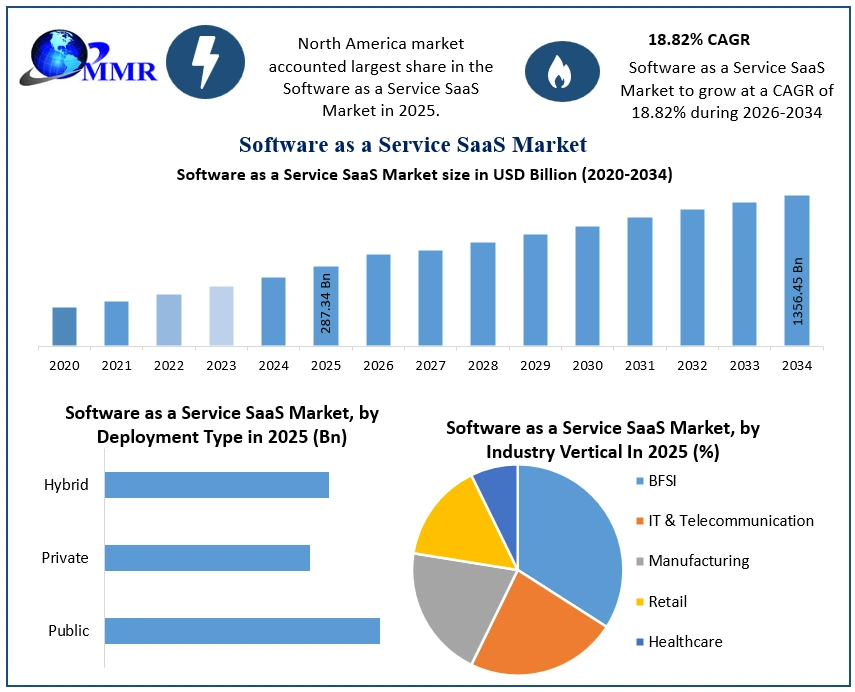
To know about the Research Methodology :- Request Free Sample Report
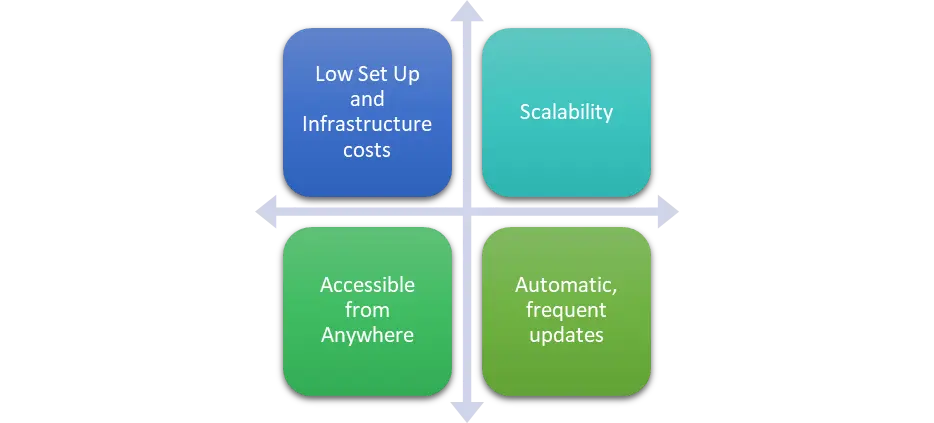
The Software as a Service SaaS market has been growing significantly, driven by factors such as the increasing adoption of cloud computing, digital transformation initiatives across industries, and the shift from perpetual licensing to subscription-based models. SaaS offers several advantages over traditional software models, including lower upfront costs, scalability, automatic updates, accessibility from anywhere with an internet connection, and often better collaboration features. These benefits made SaaS particularly attractive to small and medium-sized businesses (SMBs) as well as large enterprises.
Software as a Service SaaS Market Dynamics
SaaS applications are accessible to any customer with an internet connection and an internet-connected user device. SaaS applications typically run in any web browser; on mobile devices, SaaS applications run more effectively on a mobile or tablet app. A few SaaS applications, such as Adobe Acrobat, offer or require a dedicated thin client that users download and install on their computers, which significantly boosts the Software as a Service SaaS Market growth. The global Software as a Service SaaS market is currently worth about $3 trillion, and our estimates indicate it surge to $10 trillion by . The median revenue growth rate of 100 public SaaS companies in the United States with revenues above $100 million was 22 percent as of mid-, with the top quartile’s growth rates above 40 percent.
Growing demand among businesses for a single solution to help them solve business problems propels growth of the Software as a Service SaaS market. Software as a Service SaaS companies use SaaS Platform software, which integrates a variety of applications such as customer relationship management (CRM), business intelligence, supply chain management, and e-commerce systems and is customized for specific business needs and deployed across corporate networks on a variety of cloud platforms. As firms grow, companies demand business-oriented SaaS platforms that encode corporate policies, rules, and processes and are built in compliance with specific business requirements. With rise in number of mobile users in offices, these apps help employees perform better. This also aids in improvement of communication, increases corporate efficiency, and allows them to uncover new revenue-generating software as a service SaaS market opportunities.
Trends in Software as a Service SaaS Market
1. Artificial Intelligence: Autonomous innovations empower organizations across industries with the ability to drive greater product, service, or content personalization while gaining a deeper, data-driven understanding of the needs of their audience.
2. Machine Learning: Machine Learning (ML), a subset of AI, is utilized in SaaS to automate responsiveness in customer service reports and applications, such as AI-powered chat operations with live chatbots. It also automate the onboarding process of SaaS.
3. Vertical SaaS
4. Migration to PaaS
5. The growing need for API connections
Benefits of Software as a Service SaaS
Security issues and Integration challenges to restrain Software as a Service SaaS Market growth
For SaaS consumers, security is a key issue, particularly they are concerned about data privacy, compliance, and defense against cyberattacks. SaaS solution trust is severely damaged by instances of data breaches or security flaws. It is difficult to integrate SaaS apps with other software programs and the current IT infrastructure, particularly in enterprises that use outdated systems, which is expected to limit the Software as a Service SaaS Market growth. Seamless integration is hampered by interoperability constraints, compatibility concerns, and data migration difficulties. Slow Internet connections reduce performance, especially if the cloud servers are accessed from far distances. Internal networks tend to be faster than Internet connections. Due to its remote nature, SaaS solutions also suffer from a loss of control and a lack of customization.
Software as a Service SaaS Market Segment Analysis
Based on Deployment Type, the market is segmented into Public, Private, and Hybrid. Hybrid segment dominated the market in 2024 and is expected to hold the largest Software as a Service SaaS Market share over the forecast period. The growth is attributed to the rising adoption of hybrid cloud solutions across government departments, public sector organizations, banking & financial institutions, and others. Cloud policies are evolving around the globe due to increased demand for cloud services. For instance,
In 2025, the Cloud First policy was replaced by "Cloud Smart3" in many regional and national governments due to increased demand for flexibility, visibility, speed, advanced security, and control across different environments. According to a survey conducted by Microsoft in January, 86% of the U.S.-based respondents were planning to increase their investment in hybrid cloud and multi-cloud.
Based on Enterprise Type, the market is segmented into Large Enterprises and SMEs. SME segment dominated the market in 2024 and is expected to hold the largest Software as a Service SaaS Market share over the forecast period. The on-demand software as a service consumption model has transformed the IT landscape and it's been widely adopted by SMEs. SMEs often have small budgets and cannot afford initial capital expenditures or ongoing service and maintenance costs of traditional IT infrastructures. This is why software as a service is an attractive option due to its cost-effectiveness, availability, and scalability. Investments for product development are also boosting the demand for these solutions. For instance,
In April 2024, Taclia, a software-as-a-service startup, announced a solution to digitize everyday management processes. The company secured USD 6.7 million in funding to scale the development of its solution.
Software as a Service SaaS Market Regional Insight
The software as a service SaaS market is spread across North America, Europe, Asia Pacific (APAC), the Middle East and Africa, and Latin America. North America held the largest share of the global software as a service SaaS market in 2025 and is expected to dominate the market over the forecast period. In 2025, the US accounted for the highest share followed by Canada and Mexico. Due to the presence of countries with convenient economic policies, high gross domestic product (GDP), and quick adoption of the latest software as a service technology, the North American software as a service SaaS market is predicted to grow remarkably.
As of March , the count of SaaS companies in the US and Canada was 17,000 and 2,000 respectively. SaaS companies from the US cater to nearly 14 billion customers across the world. The SaaS industry across the US is anticipated to account for a value of $225 billion by .
Germany is expected to hold the highest European software as a service SaaS market share over the forecast period. The count of SaaS unicorns raised from 44 in to in . In , around 21% of the European tech community was of the opinion that hiring talent is one of the greatest challenges. This gave rise to the demand for various SaaS recruitment software. In , the average European software as a service SaaS startup raised €1 million ($1.08 million) at seed. In , this figure grew to €2.2 million ($2.49 million). The increasing funding is contributing enormously to the European software as a service SaaS market growth.
In May , Stibo Systems, a leading global provider of master data management software, joined Microsoft partner program as an independent software exporter to create and host cloud-based software as a Service on Microsoft Azure. Stibo Systems improved its cloud services with support and guidance from Microsoft. This integration helps customers improve short and long-term performance of their cloud investments and resources.
Software as a Service SaaS Market Recent Industry Development
| Date | Company | Development | Impact |
|---|---|---|---|
| 19 May 2026 | AVEVA | The company signed a multi-year Strategic Collaboration Agreement with Amazon Web Services to build and expand its CONNECT industrial intelligence platform using a multi-cloud architecture. | This integration delivers advanced public and private SaaS capabilities, lowering infrastructure management expenses while empowering industrial customers with scalable, agentic AI workflows. |
| 19 May 2026 | SDG Corporation | The enterprise formed a strategic alliance with Zluri to launch a joint, modern Identity Governance and Administration platform customized for cloud ecosystems. | The partnership automates provisioning, lifecycle tracking, and compliance enforcement, maximizing operational security posture for organizations struggling with decentralized SaaS application footprint explosion. |
| 14 April 2026 | HubSpot | The company updated its monetization strategy for the Breeze Customer Agent and Prospecting Agent, transitioning to an outcome-based pricing system governed via HubSpot Credits. | This hybrid consumption structure guarantees budget predictability for SMBs, scaling charges down to $0.50 per resolved conversation to explicitly align SaaS spend with tangible commercial value. |
| 25 September 2025 | HubSpot | The customer platform provider officially achieved a Leader positioning within the 2025 Gartner® Magic Quadrant™ for B2B Marketing Automation Platforms. | This structural milestone reinforces its market authority in delivering unified, cloud-native operational ecosystems that integrate advanced AI features directly into core Smart CRM architecture. |
| 15 September 2025 | Cloudaware | The vendor deployed its modular, SaaS-based cloud management architecture for The Coca-Cola Company to optimize tracking across multi-cloud environments. | The software integration unified tracking across Microsoft Azure, AWS, and Google Compute Engine, significantly lowering data discovery cycles from several weeks down to mere minutes. |
| 27 January 2025 | Deloitte | The organization finalized an asset acquisition of SimplrOps, a niche enterprise SaaS company focused on automating Workday, SAP, and Oracle environments. | The transaction expands the firm's Human Capital service line by delivering a standalone, automated SaaS management product that maximizes enterprise technology return on investment (ROI). |
Software as a Service SaaS Market Scope: Inquire before buying
| Global Software as a Service SaaS Market | |||
|---|---|---|---|
| Report Coverage | Details | ||
| Base Year: | 2025 | Forecast Period: | 2026-2034 |
| Historical Data: | 2020 to 2025 | Market Size in 2026: | USD 287.34 Bn. |
| Forecast Period 2026 to 2034 CAGR: | 18.82% | Market Size in 2034: | USD 1356.45 Bn. |
| Segments Covered: | by Deployment Type | Public Private Hybrid |
|
| by Application | Customer Relationship Management (CRM) Enterprise Resource Planning (ERP) Content, Collaboration & Communication BI & Analytics Human Capital Management Others |
||
| by Enterprise Type | Large Enterprises SMEs |
||
| by Industry Vertical | BFSI IT & Telecommunication Manufacturing Retail Healthcare Education Others |
||
Software as a Service SaaS Market , by Region
North America (United States, Canada and Mexico)
Europe (UK, France, Germany, Italy, Spain, Sweden, Austria and Rest of Europe)
Asia Pacific (China, South Korea, Japan, India, Australia, Indonesia, Malaysia, Vietnam, Taiwan, Bangladesh, Pakistan and Rest of APAC)
Middle East and Africa (South Africa, GCC, Egypt, Nigeria and Rest of ME&A)
South America (Brazil, Argentina Rest of South America)
Leading Software as a Service SaaS keyplayers include:
1. Google Inc. (California)
2. Fujitsu Ltd. (Japan)
3. Amazon.com Inc., (Seattle, Washington)
4. IBM Corporation (Armonk, New York)
5. HP (US)
6. Oracle Corporation (Texas)
7. SAP SE (Walldorf, Germany)
8. Microsoft Corporation (Redmond, Washington)
9. Salesforce (San Francisco)
10. Zuora (California)
11. Concur Technologies (US)
12. Nvidia (California)
13. Medidata Solutions (US)
14. NetSuite Inc. (Austin, Texas)
15. ServiceNow, Inc. (Santa Clara)
16. Infosys (Bengaluru, India)
17. TCS (Mumbai, India)
18. Accenture Plc (Dublin, Ireland)
Frequently asked Questions:
1. What is SaaS and how does it differ from traditional software?
Ans: SaaS stands for Software as a Service, where applications are delivered over the Internet. Unlike traditional software, there's no need for installation or maintenance, as users access it via the web.
2. What are the advantages of using SaaS?
Ans: SaaS offers lower upfront costs, scalability, automatic updates, accessibility from anywhere, and better collaboration features compared to traditional software models.
3. What are the key drivers of the SaaS market growth?
Ans: Factors driving SaaS market growth include cloud adoption, digital transformation initiatives, and the shift to subscription-based models.
4. What are some trends in the SaaS market?
Ans: Trends include the integration of artificial intelligence, machine learning automation, vertical SaaS solutions, migration to Platform as a Service (PaaS), and the growing need for API connections.
5. What was the Global Software as a Service SaaS Market size in 2025?
Ans: The Global Software as a Service SaaS Market size was USD 287.34 Billion in 2025.