
Smart Transportation Market Size – Industry Structure Evaluation, Demand Drivers Analysis, Regional Growth Analysis and Identification, Competitive Positioning Review & Global Market Size Forecast to 2032
Overview
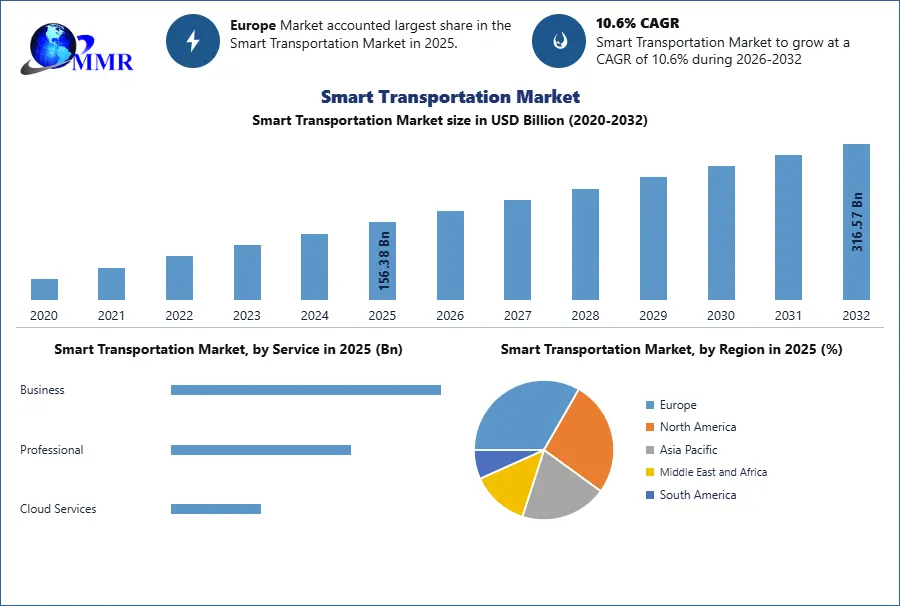
Smart Transportation Market was valued at USD 156.38 Billion in 2025, and is expected to reach USD 316.57 Billion by 2032, exhibiting a CAGR of 10.6% during the forecast period (2026-2032).
Increasing demand for smart transportation and smart cities, traffic management systems, ticket management systems, security surveillance systems, and cloud services, among other things, are key influencing factors. Along with this, government investments in the burgeoning concept of smart cities have a significant influence on the Smart Transportation Market.
The above mentioned variables combined generate potential for smart transportation industry growth, but constraints such as the demand of costly capital investments and a huge database required of road network pose smart transportation market restrictions. During the forecast period, however, each element will have a distinct influence on the smart transportation industry.
Introduction of advanced parking management system:
With the increased usage of automobiles, parking is becoming an increasingly difficult task in cities and towns around the world. With an increase in the need for Smart Transportation Market, the innovative parking management system is launched. Advanced parking management systems (APMS) assist customers in swiftly finding parking spaces, decreasing annoyance and improving the visiting experience. Traditional traveller information systems, as well as specialist parking management software, are incorporated into advanced parking management systems.
 To know about the Research Methodology :- Request Free Sample Report
Rising demand for efficient transportation networks across the world:
Smart transportation makes use of information technology and artificial intelligence to manage and coordinate transportation networks more effectively. The use of a smart transportation network helps the travelling population to have a better understanding of the traffic for improved coordination and driver safety.
The sale of autos is increasing the demand for smart transportation since an increase in the number of vehicles on the road causes traffic congestion. Furthermore, the growing desire for smart cities is a significant element driving the rise in demand for smart transportation.
Encouragement for the development and promotion of green fuels:
The usage of non-renewable resources such as coal and oil has a detrimental influence on the environment since they emit a lot of greenhouse gases, which can damage the earth's climate, which is why the world is experiencing an energy crisis. Transportation, being a significant source of greenhouse gas emissions, is the primary goal for reducing air pollution and achieving a sustainable environment.
This results in the usage of green fuels, which are environmentally beneficial and have no detrimental influence on the local environment. As a result, the demand for green fuels is rising since they enable clean burning and prevent dangerous substances from entering our environment. Smart cities, and hence smart mobility, necessitate the development and marketing of green fuel.
Large database requirement for a road network:
Smart transportation includes a variety of solution systems such as ticket management systems, traffic management systems, and cloud services. These systems and services make extensive use of data, which is kept in a database. As a result, managing enormous volumes of data has become onerous. As a result, one of the disadvantages of smart transportation is the transformation and storage of vast volumes of data in databases.
High capital investments:
The world population is growing faster than the capacity of roads, rail, and other modes of transportation. Because emerging nations such as India and Indonesia lack sophisticated information technology (IT) infrastructure, this stress on transportation infrastructure promotes additional capital investment in the smart transportation market.
Investments in an emerging idea of smart cities:
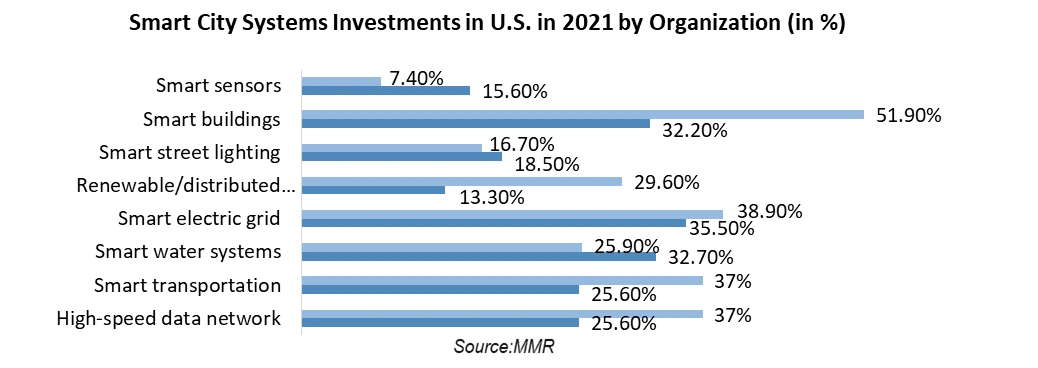
The smart city concept is vital for driving economic growth and improving people's quality of life by allowing local development and utilising technology to achieve smart results for inhabitants. Emerging technologies such as smart transportation, smart ticket management systems, smart traffic management systems, cloud services, and others are required for the development of smart cities. Several governments are investing in smart cities to improve people's quality of life and to transition the country from developing to developed status.
 Smart Transportation Market Dynamics
Smooth Flow of Traffic and Time-Efficiency to drive the smart transportation market growth
Intelligent systems, such as traffic management and ticket management systems, are used in the Smart Commuting Market to make transportation easier and faster, saving time. Smart freight trucks, for example, use several computerised control systems to manage the engine's fuel-injection timing, emissions management, turbocharger functioning, and transmission shift schedule, among other things. These on-board diagnostics systems monitor and report on the performance of all of these subsystems, assisting in improving vehicle economy while maintaining or decreasing emissions.
This saves time and energy by enhancing the efficiency of freight vehicle operations, which include routines at entry/exit to make the most of the freight network. The Intelligent Transportation Society of America estimates that intelligent transportation systems (ITS) might reduce oil consumption and related greenhouse gas emissions by 2% to 4% each year over the next ten years as these technologies mature in the smart transportation market. Furthermore, vehicles outfitted with blind-spot monitoring and other driving aids prevent accidents and save time during high traffic hours.
The Rising Demand for Efficient Transportation Networks across the World
Rising vehicle numbers cause significant traffic congestion in conventional traffic management systems, necessitating the need for a Smart Transportation Market network to assist alleviate traffic congestion. This will improve the transportation network's safety, sustainability, and efficiency.
The number of cars on the road is steadily growing, causing traffic jams. As a result, most customers are increasingly looking for Smart Transportation Market choices that can effortlessly navigate the roads with the least amount of congestion.
Encouraging the Development and Promotion of Green Fuels to drive the growth of smart transportation industry
Many good effects may be noticed if individuals adopt environmentally friendly practises such as using public transportation, fuel-efficient automobiles, and cleaner fuels such as CNG and LPG, as well as electric cars and trucks, which emit fewer emissions than their traditional counterparts. By 2027, the Indian government has authorised a plan to install electric car charging stations in all metropolitan areas and along all state and national roads.
Many good effects may be noticed if individuals adopt environmentally friendly practises such as using public transportation, fuel-efficient automobiles, and cleaner fuels such as CNG and LPG, as well as electric cars and trucks, which emit fewer emissions than their traditional counterparts. By 2027, the Indian government has authorised a plan to install electric car charging stations in all metropolitan areas and along all state and national roads.
Investments in Emerging Ideas of Smart Cities to drive the growth of smart transportation market
People are increasingly interested in smart traffic management systems and smart ticketing systems as technology advances. Various governments are taking steps to promote the smart city concept. For example, the Government of India has a purpose to construct 100 smart cities with the objective of improving the quality of life by utilising technology to increase service efficiency and suit the demands of inhabitants.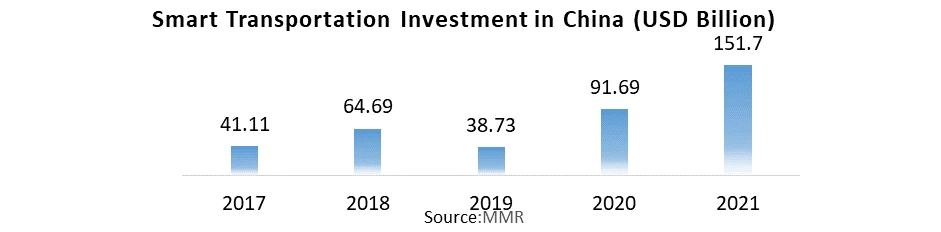 Introduction of Parking Management Systems to drive the smart transportation market growth
Because of the growing number of vehicle owners and the difficulty of parking places, smart parking solutions under the Smart Transportation Market system must be implemented. The current intelligent parking management systems meet the need by allowing parking spot operators to provide their customers with high levels of parking conveniences such as minimal time waste, cashless & contactless payment options, enhanced vehicle security, and the ability to pre-book parking spots. As a result, the need for Smart Transportation Market solutions has skyrocketed.
High Capital Investment to restraint the smart transportation market growth
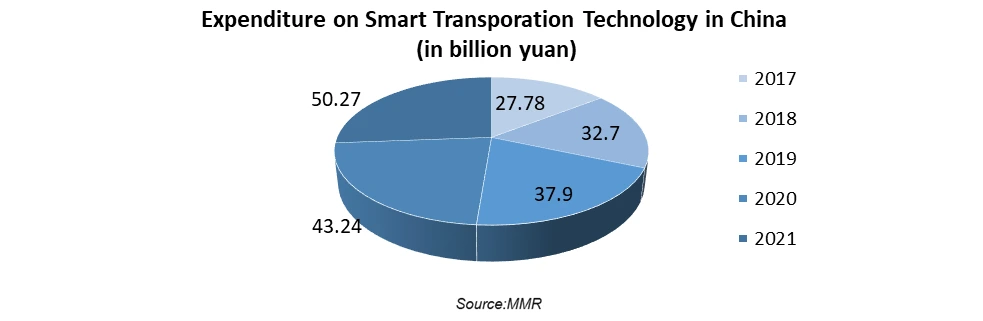
Smart Transportation Market is a widely demanded technology due to its advantages over traditional transportation methods such as time-efficiency, cost-efficiency, high security, and quicker speed. Developed nations such as the United States and the United Kingdom can afford the capital expenditures needed for the Smart Transportation Market, however developing countries such as India and Pakistan cannot afford to a lack of information technology infrastructure.
Large Database Requirements of Road Network to restraint the smart transportation industry growth
As the number of cars on the road grows across the world, information maintenance systems are needed to handle all transport network-related data as the need for smart transportation grows. In bigger systems, a graphical database is used to handle enormous databases. Basic functions inside the car, including as route direction, situational awareness, and collision avoidance, rely on advancements in core technologies such as image processing, artificial intelligence, fuzzy logic, neural networks, adaptive control, and semantic networks.
Smart Transportation Market Segment Analysis
Based on Solution, in 2022, the traffic management system solutions segment dominated the world Smart Transportation Market solutions market, thanks to rapid urbanization, increasing environmental concerns, and demand for real-time information. The traffic management system is widely employed in North America as a result of the government's increased emphasis on traffic management and different efforts in North America aimed at traffic management solutions and services.
Major trends in the traffic management system market include real-time traffic management, remote monitoring systems, data management, Software as a Service (SaaS)-based solutions, and the Internet of Things. The primary prospects for the traffic management system market include rapid urbanisation and the rising notion of smart cities and smart traffic.
Based on Service, in 2022, the cloud service segment dominated the global Smart Transportation Market, due to their ability to provide solutions to access different computing solutions such as managing and accessing data remotely. Furthermore, cloud services provide many benefits such as flexibility in the capacity of the cloud space, automated software upgrades, remote work from anywhere, and so on.
The Smart Transportation Market is dominated by cloud services. The key trend in the cloud services market is the provision of industry-specific business applications. Furthermore, cloud infrastructure as a service (IaaS), cloud management, and cloud application infrastructure as a service all contribute to the market's growth.
High and fast growing demand for Smart Transportation Industry services, with cloud technology providing the requisite information capacity, are some of the drivers accelerating the growth of the cloud services market. Cloud technology has evolved as a result of technological breakthroughs and rising need for distant data storage, access, and administration. It is expected to continue in the future, as advanced information and communication technologies are developed.
 Smart Transportation Market Regional Insights
Europe dominated the global Smart Transportation Market thanks to major infrastructure providers in this region, which includes highly advanced Smart Transportation Market systems and solutions. This region accounted for 33.15% of the market in 2022 and is expected to be the fastest growing market during the forecast period, with a CAGR of 18.65%. The increasing demand for Smart Transportation Industry and consumer concern for the environment are the primary driving factors for this market.
Investment in a new smart city concept provides a potential for the Europe Smart Transportation Market. The Smart Transportation Market in the United Kingdom was worth USD xx million in 2022 and is expected to increase at a CAGR of 19.35% during the forecast period.
In 2021, the North America Smart Transportation Market revenue was USD 16,216 million, with a CAGR of 41.73%. Smart technology, rising living standards, and government initiatives are driving the Smart Transportation Market business. The growing demand for Smart Transportation Industry and user worries about the environment are the primary growth drivers in the North American market. Investment in smart cities is a new concept that presents an opportunity for the Smart Transportation Market business.
In 2021, the United States dominated the North American Smart Transportation Market. The U.S. Smart Transportation Market was worth USD xx million in 2021 and is expected to increase at a CAGR of 18.69% during the forecast period.
Smart Transportation Market Scope: Inquire before buying
| Smart Transportation Market | |||
|---|---|---|---|
| Report Coverage | Details | ||
| Base Year: | 2025 | Forecast Period: | 2026-2032 |
| Historical Data: | 2020 to 2025 | Market Size in 2025: | 156.38 USD Billion |
| Forecast Period 2026-2032 CAGR: | 10.6% | Market Size in 2032: | 316.57 USD Billion |
| Segments Covered: | by Transportation Mode | Roadways Railways Airways Maritime |
|
| by Application | Shared mobility Route information and route guidance Transit hubs Autonomous/driverless vehicles Video management Others |
||
| by Solution | Ticketing Management System Parking Management & Guidance System Integrated Supervision System Traffic Management System |
||
| by Service | Business Professional Cloud Services |
||
Smart Transportation Market, by Region
North America (United States, Canada and Mexico)
Europe (UK, France, Germany, Italy, Spain, Sweden, Austria and Rest of Europe)
Asia Pacific (China, South Korea, Japan, India, Australia, Indonesia, Malaysia, Vietnam, Taiwan, Bangladesh, Pakistan and Rest of APAC)
Middle East and Africa (South Africa, GCC, Egypt, Nigeria and Rest of ME&A)
South America (Brazil, Argentina Rest of South America)
Smart Transportation Market, Key Players are
- Accenture plc
- Alstom SA
- Cisco Systems Inc
- Cubic Corporation
- General Electric Company
- Indra Sistemas SA
- International Business Machines Corporation
- Kapsch TrafficCom AG
- LG CNS Corporation
- Xerox Holdings Corporation
- Siemens AG
- Thales Group
- Huawei Technologies Co Ltd
- SAP SE
- Hitachi Ltd
- Toshiba Corporation
- TomTom NV
- Q Free ASA
- Bentley Systems Incorporated
- Schneider Electric
- Bombardier Inc
- TransCore LP
- Iteris Inc
- Garmin Ltd
- Trapeze Software Group Inc
- Conduent Inc
- Atkins SNC Lavalin Group
- Efkon AG
- ST Engineering Ltd
- Oracle Corporation
Frequently Asked Questions:
1] What are different transportation mode in Smart Transportation Market?
Ans. Airways, Roadways, Railways and Maritime are the main shipping types of Smart Transportation Market.
2] What region dominated the Smart Transportation Market in 2025?
Ans. Europe region dominated the Smart Transportation Market in 2025.
3] Which region is estimated to fuel the growth of the Market?
Ans. The Smart Transportation Market is estimated to grow the fastest in Europe and Asia Pacific region.
4] What is the estimated market size of the Market?
Ans. The estimated market size of the Smart Transportation Market is USD 316.57 Bn. by 2032.
5] What are the major players in the Market?
Ans. Thales, Huawei, Siemens, IBM, Cisco Systems, and SAP are the major players in the Smart Transportation Market.