
Global Cargo Transportation Insurance Market by Coverage, by Commodity Type, by Cargo Value, by Form of Transport, by Mode of Transportation, by Policy Type, by Application, by Region and Forecast 2034
Overview
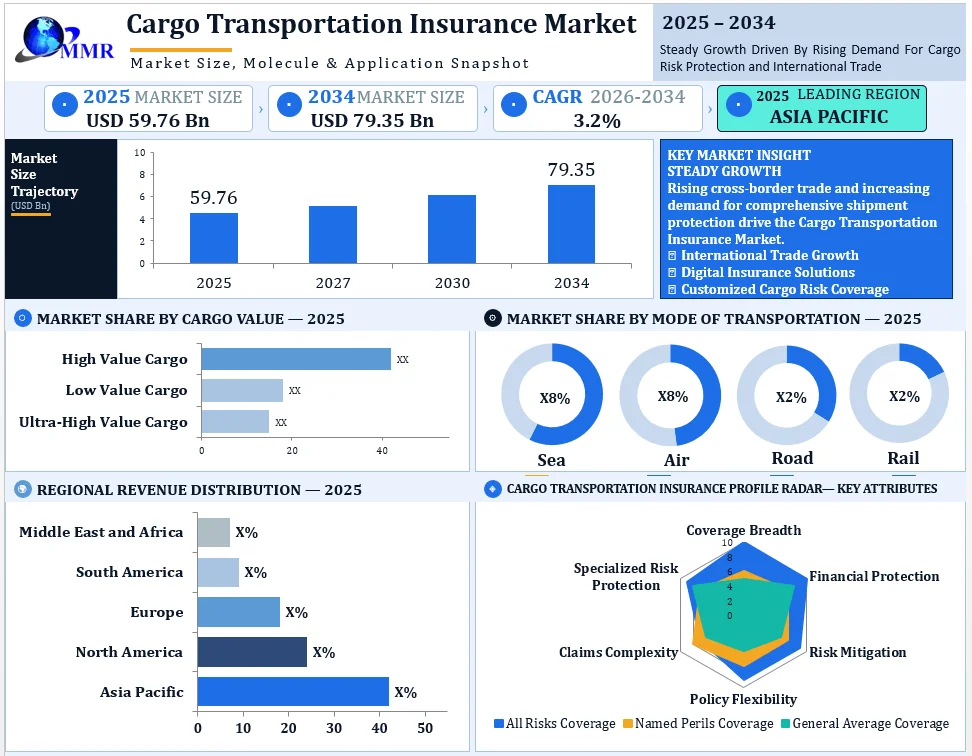
The Global Cargo Transportation Insurance Market size was valued at USD 59.76 Billion in 2025, and is expected to grow by 3.2 % from 2026 to 2034, reaching USD 79.35 Billion by 2034.
Cargo Transportation Insurance Market Overview
The Cargo Transportation Insurance Market refers to insurance solutions that protect goods against financial losses caused by insured risks during domestic and international transportation. It covers cargo moving through road, rail, sea, and air freight networks, helping manufacturers, exporters, importers, shipping companies, and logistics providers manage risks associated with theft, accidental damage, fire, and transit disruptions. Cargo insurance supports supply chain security by reducing financial uncertainty and protecting the value of goods in transit.
The Cargo Transportation Insurance Market is evolving with international trade, cross-border e-commerce, complex logistics networks, and increasing demand for reliable freight risk management. Growing shipments of high-value products, industrial equipment, agricultural commodities, and pharmaceutical goods are encouraging businesses to adopt marine cargo insurance, freight transportation insurance, and international cargo insurance policies. Asia Pacific is a leading region, supported by its strong manufacturing base, export-oriented economies, and extensive maritime trade activities. Insurance providers such as Allianz, AXA, and Chubb contribute to the market through commercial cargo insurance, marine insurance, and tailored risk protection solutions. Trade information published by the World Trade Organization and maritime transport analysis from the United Nations Conference on Trade and Development help explain changing trade flows and transportation risks influencing cargo insurance demand.
The MMR report provides an assessment of cargo transportation insurance market trends, competitive positioning, regional performance, insurance coverage types, distribution channels, and growth drivers, restraints, and opportunities. Key opportunities arise from digital insurance platforms, customized cargo risk assessment, real-time shipment monitoring, and insurance solutions for emerging e-commerce and logistics businesses. These developments create opportunities for insurers to improve risk management, strengthen customer relationships, and address the changing needs of domestic and international freight transportation.
Cargo Transportation Insurance Market Size, Growth and Share Analysis
To know about the Research Methodology :- Request Free Sample Report
Cargo Transportation Insurance Market Key Highlights
| Key Highlight | Analytical Insight |
| Steady Market Growth | The Cargo Transportation Insurance Market reaches USD 79.35 billion by 2034, supported by international trade, freight movement, and increasing demand for cargo risk protection. |
| Asia Pacific Regional Leadership | Strong manufacturing activity, export-oriented economies, and maritime trade networks position Asia Pacific as a leading regional market. |
| Sea Freight Insurance Dominance | Sea transportation remains a major demand contributor because businesses move bulk commodities, industrial machinery, and manufactured goods through maritime routes. |
| Import and Export Enterprise Demand | Cross-border shipments and complex international supply chains encourage importers and exporters to adopt comprehensive cargo insurance policies. |
| Digital Insurance Transformation | Automated underwriting, online policy issuance, and digital claims processing improve accessibility and efficiency for cargo owners and logistics businesses. |
| Rising Demand for Specialized Coverage | High-value electronics, pharmaceuticals, industrial equipment, and temperature-sensitive products create opportunities for customized cargo insurance solutions. |
| Risk-Based Underwriting and Route Security | Geopolitical uncertainty, cargo theft, extreme weather, and changing shipping routes increase the importance of data-driven risk assessment and tailored transportation insurance. |
Cargo Transportation Insurance Market Dynamics
Growing E-commerce industry to drive the growth Cargo Transportation Insurance Market
The significantly increases shipment volumes, delivery frequency, and cross-border trade drives the growth of E-commerce industry. The diversity of e-commerce shipments from electronics and apparel to perishables demands customized, flexible policies, while rising international trade adds complexity through multimodal transport and customs risks. Technological integration, such as real-time tracking, AI-driven risk assessment, and automated claims processing, further strengthens the appeal and efficiency of cargo insurance, with innovations such as Echo Global Logistics’ EchoInsure+ offering fast, deductible-free claims for small shipments. India’s booming digital economy, supported by over 944 million internet subscribers, 100% FDI in e-commerce, and increasing investments from major players such as Flipkart, Walmart, and Google, is amplifying cargo flows. Social commerce, quick commerce, and growing tier-2 and tier-3 city participation are expanding delivery networks, increasing exposure to logistical risks. As regulatory requirements tighten and businesses aim to maintain consumer trust, cargo insurance becomes an essential safeguard-commerce growth directly fuels demand for cargo transportation insurance by amplifying shipment volume, value, and complexity necessitating advanced, tailored coverage to protect goods across diverse and high-risk delivery environments.
Fluctuating Freight Costs limits the Cargo Transportation Insurance Market growth
Fluctuating rates create uncertainty, discouraging long-term commitments from customers and complicating pricing strategies for insurers. In 2025, ocean freight rates exceeded $6,000–$7,000 per 40-foot container at peak times due to tariff-driven frontloading and capacity imbalances, before declining sharply as supply improved. Such volatility disrupts stable premium setting and impacts market growth. Rapidly changing freight costs, shifting trade routes, and modal shifts such as increased rail use add complexity to risk assessment, raising operational costs for underwriters. This often results in higher premiums or restricted coverage, particularly affecting cost-sensitive small and medium-sized enterprises that reduce or forgo insurance during cost spikes. Freight volatility often coincides with supply chain disruptions, including port congestion, labor strikes, and geopolitical tensions, which heighten risks and claims.
Developing flexible, usage-based policies to adapt to these fluctuations is costly and operationally challenging, limiting insurers’ ability to offer competitive, customized products. Unpredictable freight rates undermine pricing stability, increase underwriting challenges, and reduce demand, collectively restraining the Cargo Transportation Insurance Market’s growth potential.
Digital Insurance Platforms and Real-Time Cargo Monitoring Create New Growth Opportunities
Digital transformation presents significant opportunities for the Cargo Transportation Insurance Market through online policy issuance, automated underwriting, shipment tracking, and data-driven cargo risk assessment. Insurers can use information from global positioning systems, Internet of Things sensors, electronic shipping documents, and logistics management platforms to assess route conditions, monitor temperature-sensitive shipments, and improve claims verification. Customized insurance products for small and medium-sized enterprises, e-commerce sellers, freight forwarders, and international traders can improve access to cargo protection through flexible premiums and shipment-specific coverage. Parametric insurance models, where applicable, may also support faster payouts when predefined and verifiable conditions are met. Partnerships between insurers, digital freight platforms, shipping companies, and technology providers create additional opportunities to deliver more transparent, responsive, and customer-focused cargo transportation insurance solutions.
Fraud Prevention and Changing Transportation Risks Complicate Cargo Transportation Insurance Market Growth
The Cargo Transportation Insurance Market must address cargo theft, fraudulent claims, inaccurate shipment declarations, geopolitical disruptions, extreme weather, and inconsistent risk information across international freight networks. Insurers often face difficulties distinguishing genuine cargo damage from inadequate packaging, improper handling, pre-existing defects, or losses excluded under policy terms. Changes in shipping routes, port congestion, trade restrictions, and transportation security conditions can also affect underwriting decisions and claims exposure. For example, a shipment diverted from its planned maritime route may encounter different transit durations, handling requirements, and insured risks, requiring careful review of policy conditions. Improving fraud detection, standardizing digital documentation, strengthening carrier partnerships, and developing reliable risk assessment models remain important priorities for insurers seeking to maintain profitable underwriting while delivering dependable cargo insurance protection to businesses.
Cargo Transportation Insurance Market Key Trends
| Trend | Description |
| Digital Cargo Insurance Underwriting | Insurers are adopting digital underwriting tools to assess shipment details, cargo value, transportation routes, and risk exposure more efficiently. Automated documentation and digital policy issuance are helping simplify cargo insurance purchasing for exporters, importers, and freight forwarders. |
| Data-Driven Shipment Risk Assessment | Cargo insurers are increasingly using shipment records, tracking information, and risk analytics to evaluate potential losses. These capabilities help insurers make better-informed underwriting decisions and improve cargo insurance coverage for sensitive and high-value goods. |
| Rising Demand for Specialized High-Value Cargo Coverage | Shipments of semiconductors, electric vehicle components, lithium batteries, and pharmaceutical products are encouraging insurers to refine coverage according to cargo value, handling requirements, and transit conditions. |
| Geopolitical Risk and Shipping Route Adjustments | Changes in maritime routes and regional security conditions are influencing cargo insurance underwriting, war-risk considerations, and policy terms. Insurers are paying closer attention to route changes, transit delays, and exposure around strategically important shipping corridors. |
| Digital Distribution and Embedded Cargo Insurance | Online insurance platforms and partnerships with logistics providers are making cargo insurance easier to purchase during shipment booking. This approach offers opportunities to serve smaller exporters, online sellers, and businesses with frequent domestic and international deliveries. |
| Climate Risk and Supply Chain Resilience | Weather-related disruptions, port closures, and unexpected transportation delays are encouraging businesses to review cargo protection and supply chain risk management. Insurers are giving greater attention to route vulnerability, cargo accumulation, and the specific terms governing weather-related losses. |
Cargo Transportation Insurance Market Segment Analysis
Based on Mode of Transportation, the Cargo Transportation Insurance Market is segmented into Air, Sea, Road and Rail. The marine cargo insurance held the largest market share in the year 2025. The high volume of global trade conducted via sea routes. Shipping remains the most cost-effective and practical mode for transporting large quantities of goods, including bulk commodities, machinery, and manufactured products, across long distances. The rise in international trade agreements, expansion of e-commerce, and growing demand for raw materials have significantly increased maritime shipping activities. The sea transport faces higher exposure to risks such as storms, piracy, collisions, and cargo damage during loading or unloading, making insurance coverage essential for shippers and freight forwarders. The value and variety of goods transported by sea often require comprehensive policies, further driving premium volumes. Technological advancements in marine logistics and the growth of containerization have also boosted cargo volumes, reinforcing the dominant position of marine cargo insurance in the market.
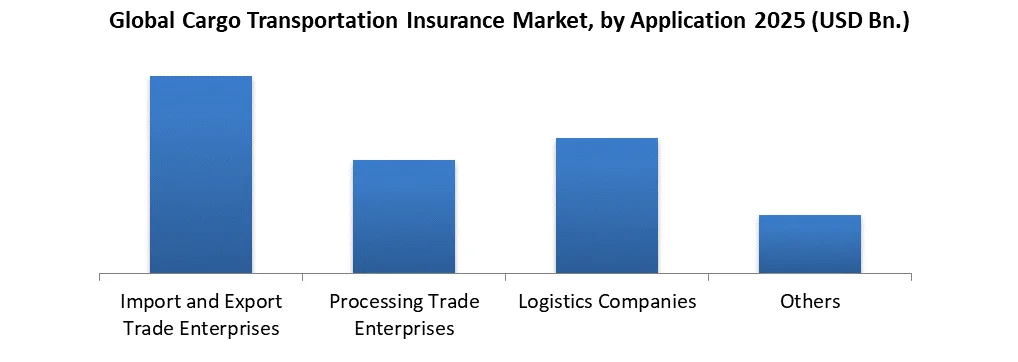
Based on the Application, the Cargo Transportation Insurance Market is segmented into Import & Export Trade Enterprises, Processing Trade Enterprises, Logistics Companies and Others. The Import & Export Trade Enterprises cargo insurance held the largest market share in the year 2025. Due to the rapid expansion of global trade and the increasing complexity of international supply chains. These enterprises consistently engage in high-value cross-border transactions, making them more exposed to risks such as damage, theft, loss, or delays during transit. As international trade volumes surged, particularly in sectors like electronics, automotive, chemicals, and consumer goods, the demand for comprehensive cargo insurance coverage rose significantly.
Rising geopolitical uncertainties, fluctuating freight rates, and stricter regulatory compliance across shipping lanes encouraged importers and exporters to safeguard their shipments through insurance. The growing use of multimodal transport combining sea, air, and land routes has also increased the need for tailored policies that cover multiple risk points. Additionally, digitalization in trade documentation and online cargo insurance platforms has made policy procurement faster and more transparent for these enterprises.
Cargo Transportation Insurance Market Regional Insights
Asia Pacific is the leading region in Cargo Transportation Insurance Market, which benefits from its strong manufacturing base, export-oriented economies, and extensive maritime trade networks. China, India, Japan, and South Korea generate substantial demand for cargo insurance as manufacturers and trading companies transport electronics, automotive components, machinery, textiles, and consumer goods across international markets. Growing port infrastructure, cross-border e-commerce, and multimodal freight operations encourage businesses to protect shipments against theft, damage, and transit disruptions. The region also creates opportunities for marine cargo insurance providers through growing manufacturing activity, digital freight platforms, and rising demand for customized insurance policies among exporters and logistics companies.
North America maintains a strong position in the Cargo Transportation Insurance Market through its advanced logistics infrastructure, established insurance industry, and extensive domestic and international freight networks. The United States, Canada, and Mexico generate demand for cargo insurance across automotive manufacturing, agricultural exports, industrial equipment, pharmaceuticals, and consumer goods. Cross-border trade, particularly through integrated North American supply chains, encourages businesses to adopt transportation insurance that addresses risks across road, rail, air, and sea freight. Digital underwriting, shipment tracking, and data-driven risk assessment also help insurers develop tailored coverage for manufacturers, retailers, freight forwarders, and third-party logistics providers.
Europe remains an important region in the Cargo Transportation Insurance Market because of its interconnected trading economies, established maritime gateways, and extensive road and rail freight networks. Germany, France, the United Kingdom, Italy, and the Netherlands support demand through automotive exports, industrial machinery, chemicals, pharmaceuticals, and high-value manufactured goods. Businesses rely on international cargo insurance to manage transportation risks across multiple countries and shipping routes. The region also encourages demand for specialized cargo coverage through cross-border supply chains, strong logistics services, digital insurance solutions, and increasing attention to environmental disruptions and supply chain resilience.
South America develops its Cargo Transportation Insurance Market through agricultural exports, mineral shipments, food products, and international commodity trade. Brazil, Argentina, Chile, and other regional economies generate demand for marine cargo insurance and inland transportation coverage as businesses move soybeans, coffee, meat, minerals, and industrial products to domestic and overseas destinations. Exporters increasingly consider cargo protection against weather-related damage, port delays, theft, and handling losses. Improvements in logistics infrastructure, international trade connections, and digital insurance distribution create opportunities for insurers to serve agricultural producers, commodity traders, manufacturers, and freight operators.
The Middle East and Africa create opportunities in the Cargo Transportation Insurance Market through strategic shipping corridors, energy-related trade, port development, and growing regional logistics activity. Countries such as the United Arab Emirates, Saudi Arabia, and South Africa support demand as importers, exporters, and logistics companies transport petroleum products, industrial equipment, consumer goods, and agricultural commodities. Major maritime trade routes increase the importance of marine cargo insurance, while developing distribution networks encourage demand for road freight and multimodal cargo coverage. Insurers also find opportunities in specialized shipment protection, digital policy services, and risk management solutions that address route security, extreme weather, and cargo handling challenges.
Cargo Transportation Insurance Market
The Cargo Transportation Insurance Market features strong competition among established insurance providers, specialty marine insurers, reinsurers, and digital insurance platforms. Key players such as Allianz SE, AXA XL, Chubb Limited, Zurich Insurance Group, American International Group, Lloyd’s of London, Tokio Marine Holdings, QBE Insurance Group, and Sompo Holdings compete through comprehensive cargo insurance coverage, international underwriting capabilities, specialized risk assessment, and efficient claims management. Companies strengthen their competitive positioning by developing marine cargo insurance, international freight insurance, import and export cargo protection, and multimodal transportation insurance for manufacturers, trading enterprises, shipping companies, and logistics providers. Digital policy issuance, data-driven underwriting, shipment tracking, and customized insurance solutions also influence competition as customers seek flexible coverage and faster service. Established insurers leverage financial capacity and broker networks, while digital insurance providers focus on simplified policy purchasing and tailored protection for smaller businesses. These strategies shape competitive differentiation, customer retention, product innovation, and long-term opportunities in the Cargo Transportation Insurance Market.
Global Cargo Transportation Insurance Market – Key Players by Region and Country
| REGION | COUNTRY | COMPANY NAME / KEY PLAYER |
|---|---|---|
| North America | United States | American International Group, Inc. (AIG) |
| Chubb – U.S. Insurance Operations |
||
| The Travelers Companies, Inc. |
||
| Great American Insurance Group |
||
| Starr Insurance |
||
| Markel Group Inc. (Markel Insurance) |
||
| The Hartford |
||
| Canada | Intact Insurance | |
| Northbridge Insurance |
||
| Europe | Germany | Allianz SE (Allianz Commercial) |
| HDI Global SE |
||
| France | AXA SA (AXA XL) |
|
| Switzerland | Zurich Insurance Group Ltd. |
|
| United Kingdom | Intact Insurance UK Limited |
|
| Beazley – A Zurich Company |
||
| Liberty Specialty Markets |
||
| Allianz Insurance plc |
||
| Spain | MAPFRE España, Compañía de Seguros y Reaseguros, S.A. |
|
| Asia Pacific | Japan | Tokio Marine & Nichido Fire Insurance Co., Ltd. |
| Mitsui Sumitomo Insurance Co., Ltd. |
||
| Sompo Japan Insurance Inc. |
||
| China | PICC Property and Casualty Company Limited |
|
| Ping An Property & Casualty Insurance Company of China, Ltd. |
||
| South Korea | Samsung Fire & Marine Insurance Co., Ltd. |
|
| India | The New India Assurance Company Limited |
|
| ICICI Lombard General Insurance Company Limited |
||
| Tata AIG General Insurance Company Limited |
||
| Bajaj General Insurance Limited |
||
| HDFC ERGO General Insurance Company Limited |
||
| The Oriental Insurance Company Limited |
||
| United India Insurance Company Limited |
||
| Australia | QBE Insurance Group Limited |
|
| Vero Insurance (Co-underwriter of NTI Marine Protect) |
||
| Singapore | MSIG Insurance (Singapore) Pte. Ltd. |
|
| Malaysia | Etiqa General Insurance Berhad |
|
| Middle East & Africa | United Arab Emirates | Abu Dhabi National Insurance Company (ADNIC) |
| Sukoon Insurance PJSC |
||
| Saudi Arabia | The Company for Cooperative Insurance (Tawuniya) |
|
| Kuwait | Gulf Insurance and Reinsurance Company (GIG-Kuwait) |
|
| South Africa | Santam Limited |
|
| Nigeria | Leadway Assurance Company Limited |
|
| AXA Mansard Insurance Plc |
||
| South America | Brazil | MAPFRE Seguros Gerais S.A. |
| Tokio Marine Seguradora S.A. |
||
| Sompo Seguros S.A. |
||
| Porto Seguro Companhia de Seguros Gerais |
||
| Colombia | Seguros Generales Suramericana S.A. (SURA) |
|
| AXA Colpatria Seguros S.A. |
Cargo Transportation Insurance Market Recent Development
| Month in 2026 | Company | Recent Development |
| February 2026 | AXA XL | AXA XL partnered with United States Marine Insurance Group to distribute Shipper’s Interest insurance, strengthening specialized cargo protection for transportation, logistics, and construction businesses. |
| March 2026 | Chubb | Chubb outlined a maritime insurance facility with the United States International Development Finance Corporation to provide eligible vessels and cargo with war-risk protection for transit through the Strait of Hormuz. |
| April 2026 | Travelers | Travelers joined the expanded maritime reinsurance initiative alongside other United States insurers, supporting additional reinsurance capacity for maritime risks under the facility announced by the United States International Development Finance Corporation. |
| June 2026 | Allianz Commercial | Allianz Commercial published its Safety and Shipping Review for 2026, highlighting geopolitical disruptions, shipping route uncertainty, vessel incidents, and the importance of marine risk management for cargo operators. |
| July 2026 | AXA XL | AXA XL published marine risk insights addressing geopolitical changes, shipping route disruptions, regulatory pressures, and decarbonization challenges affecting maritime businesses and their insurance requirements. |
Cargo Transportation Insurance Market Scope: Inquire before buying
| Cargo Transportation Insurance Market | |||
|---|---|---|---|
| Report Coverage | Details | ||
| Base Year: | 2025 | Forecast Period: | 2026-2034 |
| Historical Data: | 2020 to 2025 | Market Size in 2025: | 59.76 USD Billion |
| Forecast Period 2026-2034 CAGR: | 3.2% | Market Size in 2034: | 79.35 USD Billion |
| Segments Covered: | by Coverage | All Risks Named Perils General Average Contributory Negligence |
|
| by Commodity Type | Manufactured Goods Perishables Dangerous Goods Electronics |
||
| by Cargo Value | Low Value Cargo High Value Cargo Ultra-High Value Cargo |
||
| by Form of Transport | Domestic International |
||
| by Mode of Transportation | Air Sea Road Rail |
||
| by Policy Type | Open Cover Cargo Policy Contingency Insurance Policy Specific Cargo Policy Others |
||
| by Application | Import & Export Trade Enterprises Processing Trade Enterprises Logistics Companies Others |
||
Cargo Transportation Insurance Market By Region
North America (United States, Canada, Mexico)
Europe (United Kingdom, France, Germany, Italy, Spain, Sweden, Russia, Rest of Europe)
Asia Pacific (China, South Korea, Japan, India, Australia, Indonesia, Malaysia, Philippines, Thailand, Vietnam, Rest of Asia Pacific)
Middle East and Africa (MEA) (South Africa, GCC, Nigeria, Rest of MEA)
South America (Brazil, Argentina, Colombia, Chile, Rest of South America)
Cargo Transportation Insurance Market - Frequently Asked Questions
1. Which region has the largest share in the Cargo Transportation Insurance Market?
Ans: Asia Pacific is a leading region in the Cargo Transportation Insurance Market, supported
by strong manufacturing activity, international trade, and export-oriented economies.
2. What is the growth rate of the Cargo Transportation Insurance Market?
Ans: The market Cargo Transportation Insurance Market is growing at CAGR of 3.2
% during the forecast period from 2026 to 2034.
3. What is the scope of the Cargo Transportation Insurance Market report?
Ans: The report covers market segmentation, regional analysis, competitive landscape, market drivers, restraints, opportunities, challenges, and forecast trends.
4. Who are the key players in the Cargo Transportation Insurance Market?
Ans: Key players include Allianz Commercial, AXA XL, Chubb Limited, American International Group, Tokio Marine Holdings, Zurich Insurance Group, and Lloyd’s of London.
5. What is the study period of the Cargo Transportation Insurance Market?
Ans: The market study covers the historical and forecast periods specified in the report, with the forecast period extending from 2026 to 2034.