
Global QR Code Payments Market Size, Share, CAGR, Trends, Segmentation, Regional Analysis 2026-2034
Overview
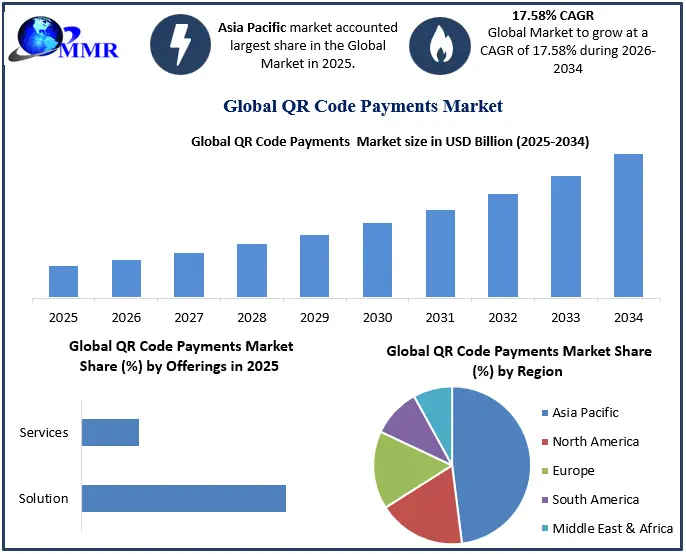
The Global QR Code Payments Market was valued at US$ 15.43 Billion in 2025 and is estimated to reach US$ 18.14 billion in 2026. The market is expected to grow at a CAGR of 17.58% during the forecast period (2026–2034), reaching about US$ 66.27 billion by 2034.
QR Code Payments Market Key Market Highlights
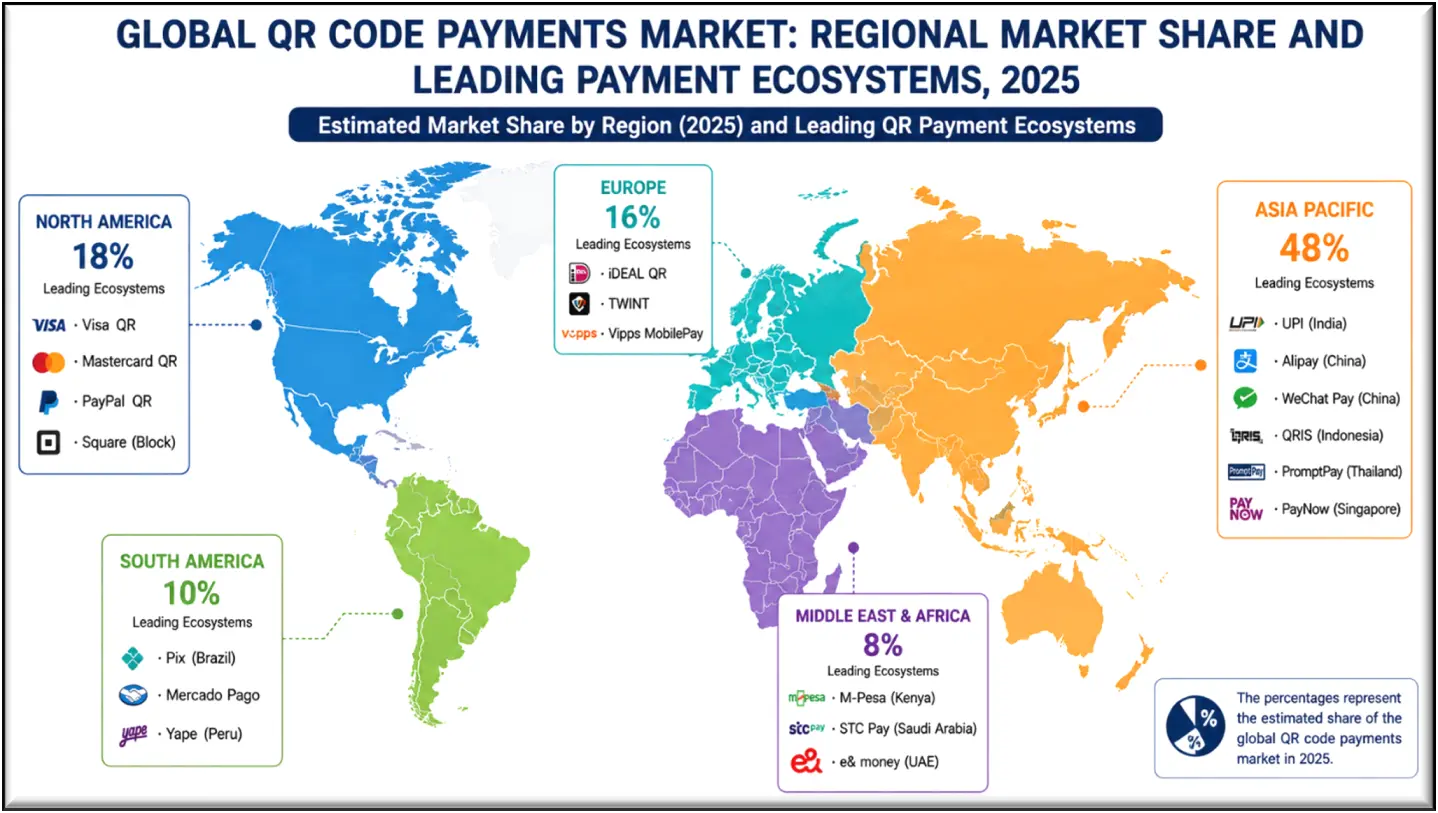
• Asia Pacific dominates the market with a 48% share in 2025.
• Solution leads the By Offering segment in 2025.
• Static QR Code leads the QR Code Type segment in 2025.
• Cross-border QR payments expand through interoperable payment networks.
• Market reaches US$66.27 Billion by 2034, growing at a 17.58% CAGR.
Global QR Code Payments Market Overview:
A QR (Quick Response) code is a type of barcode used in digital transaction spaces to facilitate the rapid, seamless exchange of information. In the context of payments, QR codes can represent transactional information in a machine-readable form. Customers scan this QR code with their smartphone or other devices and initiate the payment process. This process doesn’t require a customer to input data manually; thus, it accelerates the payment process and secures the digital payments system.
The Global QR Code Payments Market is growing as consumers, merchants, banks, and payment service providers are adopting fast, contactless, and smartphone-enabled payment methods. QR codes provide a low-cost payment infrastructure because merchants can accept digital transactions without requiring conventional point-of-sale terminals. This makes the technology particularly attractive to small businesses and emerging economies. The penetration of smartphones, mobile banking applications, digital wallets, and instant payment infrastructure is continuously growing and supporting the adoption of QR-based payments across retail, restaurants, transportation, e-commerce, and peer-to-peer transactions.
The growth of real-time payment ecosystems is strengthening this trend. India’s Unified Payments Interface (UPI) processed around 22,000 crore transactions during 2025, equivalent to around 60 crore transactions per day. This demonstrates the scale that QR-enabled digital payment ecosystems can achieve. Monthly UPI transactions crossed 2,000 crore for the first time in August 2025, reaching 2,001 crore transactions. QR-based merchant payments form an important part of this broader UPI ecosystem, particularly for small retailers and offline merchants. The market is also benefiting from the increasing use of QR payments for merchant transactions, bill payments, transportation, food services, retail purchases, and cross-border payments. NPCI data shows that UPI processed 20.01 billion transactions in August 2025, of which approximately 12.71 billion were person-to-merchant (P2M) transactions in India. This highlights the increasing importance of digital payments in everyday merchant transactions.
Against this backdrop, the Global QR Code Payments Market was valued at US$15.43 billion in 2025 and is growing at a 17.58% CAGR during 2026–2034. Growth is expected to remain strong as payment providers integrate QR codes with digital wallets, account-to-account payments, loyalty programs, and increasingly sophisticated fraud-prevention technologies. Asia Pacific is expected to remain a dominant market, while South America and other emerging economies provide significant growth opportunities as digital payment infrastructure spreads across these regions.
Global QR Code Payments Market Size, Growth & Share Analysis
To know about the Research Methodology :- Request Free Sample Report
QR Code Payments Market Dynamics:
Rising Adoption of Digital Payments Drives the Market
The rapid shift from cash toward digital and real-time payments is a major driver for the QR code payments market. QR codes provide a relatively simple, low-cost acceptance mechanism to merchants where consumers can complete transactions using smartphones and mobile banking or payment applications. The World Bank notes that QR codes can help users transact safely and securely in near real time when integrated with fast-payment systems.
India has deployed over 568.6 million UPI QR codes by FY2024-25, across about 65 million merchants, demonstrating the scalability of this model. This is significantly expanding the physical acceptance infrastructure for QR-based payments.
Security and Fraud Risks Restrain the Market
Security concerns remain a key restraint, particularly with static QR codes that can potentially be replaced, manipulated, or redirected to fraudulent accounts. Therefore, QR-payment ecosystems require stronger authentication, transaction monitoring, encryption, dynamic QR codes, and fraud-detection mechanisms. These additional security requirements can increase implementation complexity and costs for payment providers and merchants.
Cross-Border QR Payment Interoperability Creates Opportunities
The development of interoperable QR-payment networks creates significant opportunities for market growth. Payment platforms and financial institutions are increasingly connecting domestic instant-payment systems and enabling consumers to use familiar applications when making payments abroad. For example, NPCI's UPI Global Acceptance enables QR-code-based international merchant payments at supported locations.
Fragmented QR Standards Challenge Market Expansion
The coexistence of multiple QR standards, payment applications, banking systems, and regulatory frameworks can create interoperability challenges. Merchants operating across different countries may need to support multiple payment schemes, while consumers may encounter limitations depending on their banking application or payment provider. Greater standardization and interoperability are therefore important for achieving seamless global QR payment acceptance.
Global QR Code Payments Market Trends
• Dynamic QR Codes Gain Adoption - Payment providers and merchants are moving towards dynamic QR codes because they can generate transaction-specific information, improve payment accuracy, and support better transaction tracking. Dynamic QR codes also allow merchants to capture richer transaction data and develop more personalized payment services.
• QR Payments Integrate with Digital Wallets - QR codes are being integrated with digital wallets and mobile banking applications on a huge scale. This allows consumers to pay directly through applications they already use. This integration also supports greater interoperability between different wallet networks and payment platforms.
• Cross-Border QR Payments Expand - Payment networks increasingly connect domestic instant-payment systems to enable cross-border QR payments. ASEAN cross-border QR payments reached 12.9 million transactions in the first half of 2025, representing the growth of cross-border payment infrastructure. Interlinked payment infrastructure allows consumers to use their familiar payment applications while traveling and enables merchants to accept payments from international users without requiring separate payment systems.
• Unified QR Standards Improve Interoperability - Countries and payment networks increasingly adopt unified QR standards to allow multiple banks, wallets, and payment providers to operate through a common QR infrastructure. Unified QR codes and APIs are becoming priorities for improving payment-rail interoperability, particularly across Southeast Asia.
Global QR Code Payments Market Segment Analysis:
By Offering, Solution dominates the By Offering segment in 2025. QR payment solutions represent the core infrastructure that enables merchants and consumers to initiate, authenticate, and complete QR-based transactions. The strong adoption of merchant QR acceptance, mobile banking applications, digital wallets, and instant-payment platforms supports the demand for QR payment solutions. NPCI identifies QR codes and merchant payments as integral components of UPI, which enables payments through participating banks and payment applications.
The scale of merchant payments further supports this segment. NPCI recorded 12.71 billion P2M transactions in August 2025. This shows the substantial volume of business-to-consumer digital payment activity within the UPI ecosystem.
Services show strong growth during the forecast period. Payment providers require implementation, integration, transaction processing, security, maintenance, and technical-support services as QR payment ecosystems become more interconnected. The growing adoption of interoperability and standardized payment infrastructure is also increasing the need for supporting services. BIS identifies interoperability and expanded payment- system access as important foundations for improving digital and cross-border payment services.
By QR Code Type, Static QR Code dominates the By QR Code Type segment in 2025. Static QR codes are widely applicable for offline merchant payments because the QR code can remain displayed at a fixed location and the customer enters or confirms the payment amount through the payment application. This makes static QR codes particularly suitable for small retailers, restaurants, service providers, and other merchants requiring simple payment acceptance.

Government-backed payment infrastructure also supports both static and dynamic QR deployment. RBI's payment infrastructure statistics separately track Bharat QR and UPI QR codes; NPCI's UPI guidelines explicitly cover static and dynamic QR codes for offline merchants. Dynamic QR codes grow faster during the forecast period. Dynamic QR codes can incorporate transaction-specific information and automatically populate the payment amount, improving transaction accuracy and reconciliation. NPCI specifically requires online merchants to move toward dynamic QR and other intent-based payment methods. Its RuPay Credit Card on UPI functionality supports scanning both static and dynamic merchant QR codes.
Global QR Code Payment Market Regional Insights:
Global QR Code Payments Market: Regional Market Share and Leading Payment Ecosystems, 2025
Asia Pacific Leads the QR Code Payments Market
Asia Pacific leads the global QR code payments market due to its extensive real-time payment infrastructure, high smartphone penetration, widespread mobile banking, and strong adoption of digital wallets. India, China, Thailand, Singapore, Indonesia, and Malaysia have developed large-scale QR payment infrastructure through systems such as UPI, PromptPay, and QRIS. In India, NPCI reported 23.20 billion UPI transactions in May 2026, with 720 participating banks, demonstrating the scale of the country's real-time payment ecosystem. RBI regulates India's payment ecosystem, and NPCI establishes operational standards for UPI and merchant QR acceptance. Thailand's PromptPay and Thai QR Payment infrastructure also supports domestic and cross-border transactions.
The Bank of Thailand has expanded QR connectivity with neighboring countries and international payment networks. Key players across the region include NPCI, banks, fintech companies, digital-wallet providers, and payment platforms such as PhonePe, Google Pay, Paytm, GrabPay, and Alipay. The region gets strong government support, interoperability initiatives, and increasing cross-border QR payments in Asia Pacific, positioning the region as the dominant market.
Europe Strengthens Regulated QR Payment Infrastructure
Europe is strengthening the QR code payments market through highly regulated instant-payment infrastructure, open banking, digital wallets, and account-to-account payment systems. The European Union's Instant Payments Regulation (EU) 2024/886 came into force in April 2024. The first obligations apply from January 2025, supporting faster euro payments and greater payment-system interoperability.
QR payments are connecting with mobile banking, instant bank transfers, and merchant payment applications, while strong requirements covering customer authentication, fraud prevention, data protection, and consumer rights shape the European QR payment market. Banks, fintech companies, payment service providers, and payment networks form the major ecosystem, with solutions increasingly focused on contactless retail payments, e-commerce, transportation, and cross-border transactions. The region therefore provides a mature regulatory environment for QR code payment solutions, although QR adoption varies across individual European countries because card and contactless payments remain highly established.
North America Expands QR Payment Adoption
North America increases QR payment adoption through the combination of digital wallets, mobile banking, contactless payments, established card networks, and emerging instant-payment infrastructure. In the United States, the Federal Reserve's FedNow Service provides participating financial institutions with 24/7/365 instant-payment capabilities, enabling faster availability of funds and supporting the development of real-time payment applications. QR codes complement established payment methods by enabling merchant payments, mobile-wallet transactions, restaurant ordering, ticketing, loyalty programs, and account-to-account payments. The regional regulatory environment emphasizes consumer protection, cybersecurity, privacy, fraud prevention, and financial-sector oversight. Major participants include banks, fintech companies, digital-wallet providers, payment processors, and card networks. The North America QR code payment market continues to develop as QR functionality becomes increasingly integrated into digital wallets and merchant technology rather than replacing traditional card-based payments.
South America Expands Real-Time QR Payments
South America’s QR code payments market is expanding as central banks and financial institutions develop interoperable real-time payment infrastructure and promote financial inclusion. Brazil represents the region's strongest QR-payment ecosystem through Pix. It is operated by the Central Bank of Brazil, which allows users to initiate payments by scanning QR codes through participating banking and payment applications.
The Central Bank of Brazil states that Pix supports transactions across multiple use cases, including person-to-person, person-to-business, business-to-business, and government-related payments. Brazil's regulatory framework emphasizes interoperability, fraud prevention, transaction security, and oversight of payment institutions, while fintech companies and banks continue increasing Pix-based merchant acceptance. Other South American countries are also developing instant-payment and digital-wallet ecosystems, creating opportunities for South America QR payments, merchant QR acceptance, and cross-border digital transactions. The combination of real-time payment infrastructure, fintech expansion, and increasing smartphone use makes South America one of the faster-growing regional opportunities.
Middle East & Africa Develops QR Payment Infrastructure
Middle East & Africa develops the QR code payments market as governments, central banks, banks, telecom operators, and fintech companies expand digital-payment infrastructure and financial inclusion initiatives. Countries like UAE, Saudi Arabia, Egypt, and South Africa are strengthening mobile-payment, digital-wallet, instant-payment, and merchant-acceptance ecosystems, creating a foundation for Middle East and Africa QR payments. QR codes are particularly useful for small merchants because they can provide digital payment acceptance with comparatively limited physical infrastructure.
Regional payment initiatives increasingly focus on interoperability, cybersecurity, fraud prevention, and cross-border payment connectivity, while central banks and financial regulators establish frameworks for payment service providers and fintech companies. The region therefore presents significant opportunities for QR code payment solutions, particularly as smartphone penetration, e-commerce, tourism, and digital financial services expand.
Global QR Code Payments Market Recent Developments
| Date | Recent Development |
| 30 October 2025 | Bank of Thailand launched Thailand–China cross-border QR payment connectivity, allowing users from China to scan Thai merchant QR codes using Alipay, UnionPay, and WeChat Pay. The initial rollout covered QR codes issued by six Thai banks, strengthening cross-border QR payments for tourism and trade. |
| 13 November 2025 | DBS and Ant International expanded their partnership to strengthen cross-border payments. DBS PayLah! users are being enabled to make QR payments at more than 150 million merchants across over 100 countries through Ant's Alipay+ network. |
| 11 April 2026 | The Government of India highlighted the continued expansion of UPI-based QR payments as part of India's digital-payment transformation, with UPI supporting interoperable bank-account payments and merchant transactions through QR codes. |
| 25 April 2026 | Vietnam and South Korea launched a cross-border QR payment service, strengthening digital-payment connectivity between the two countries and supporting tourism and trade-related transactions. |
| 30 April 2026 | The Government of India reported that UPI-enabled cross-border payments were operational across multiple international markets, including the UAE, Singapore, France, Bhutan, Nepal, Sri Lanka, and Mauritius, expanding the international acceptance of India's QR-enabled payment ecosystem. |
Global QR Code Payments Market Competitive Landscape:
The Global QR Code Payments Market is highly competitive and fragmented because competition spans global payment networks, domestic instant-payment systems, digital wallets, banks, fintech companies, and merchant-payment platforms. Visa, Mastercard, PayPal, UnionPay, Alipay, and WeChat Pay maintain strong positions through extensive merchant networks, digital-wallet integration, payment security, tokenization, and cross-border acceptance. For example, Visa promotes interoperable QR payment solutions through its Visa Ready program, while global payment networks increasingly focus on fraud prevention, AI-enabled risk management, and digital-wallet connectivity.
Regional players strengthens competition by building large government-supported and central-bank-led payment ecosystems. NPCI/UPI in India, Pix in Brazil, QRIS in Indonesia, and PromptPay in Thailand have established strong domestic positions through interoperable QR infrastructure, low-cost real-time payments, and extensive merchant acceptance. India's UPI demonstrates particularly strong adoption, recording 23.20 billion transactions in May 2026, with 720 banks live on the platform. These regional ecosystems compete through merchant expansion, consumer adoption, mobile-wallet integration, rewards, payment convenience, and increasing cross-border connectivity.
Cross-border interoperability, security, merchant acceptance, and transaction scale increasingly determine competitive positioning. Global players hold advantages in international acceptance and cross-border payments. Regional platforms generally achieve stronger domestic adoption through localized infrastructure and regulatory support. Payment providers are investing in dynamic QR codes, fraud detection, tokenization, authentication, and AI-based risk management to strengthen security and differentiate their services. The competitive landscape therefore follows a dual structure, where global payment networks lead in international reach and technology capabilities, while regional payment ecosystems lead in domestic transaction volumes and mass-market QR payment adoption.
Global QR Code Payments Market Scope: Inquire before buying
| QR Code Payments Market | |||
|---|---|---|---|
| Report Coverage | Details | ||
| Base Year: | 2025 | Forecast Period: | 2026-2034 |
| Historical Data: | 2020 to 2025 | Market Size in 2025: | 15.43 USD Billion |
| Forecast Period 2026-2034 CAGR: | 17.58% | Market Size in 2034: | 66.27 USD Billion |
| Segments Covered: | by Offering | Solution Services |
|
| by QR Code Type | Static QR Code Dynamic QR Code |
||
| by Payment Type | Push Payment Pull Payment |
||
| by Transaction Channel | Face-to-Face Remote |
||
| by Application | Retail & E-commerce Restaurants & Food Services Transportation Hospitality Healthcare E-ticket Booking Utilities & Bill Payments Others |
||
| by End User | Retail Consumers Merchants Enterprises Government & Public Institutions |
||
Global QR Code Payments Market by Region
North America (United States, Canada, and Mexico)
Europe (UK, France, Germany, Italy, Spain, Sweden, Austria, and the Rest of Europe)
Asia Pacific (China, South Korea, Japan, India, Australia, Indonesia, Malaysia, Vietnam, Taiwan, Bangladesh, Pakistan, and the Rest of APAC)
Middle East and Africa (South Africa, GCC, Egypt, Nigeria, and the Rest of ME&A)
South America (Brazil, Argentina Rest of South America)
Global QR Code Payments Market Key Players
North America
1. Visa Inc. — U.S.
2. Mastercard Incorporated — U.S.
3. PayPal Holdings, Inc. — U.S.
4. Block, Inc. — U.S.
5. Fiserv, Inc. — U.S.
6. American Express Company — U.S.
7. Stripe, Inc. — U.S.
8. ACI Worldwide, Inc. — U.S.
9. Clover Network, LLC — U.S.
10. Venmo — U.S.
Europe
11. Adyen N.V. — Netherlands
12. Worldline SA — France
13. Nexi S.p.A. — Italy
14. Klarna Bank AB — Sweden
15. Revolut Ltd. — United Kingdom
16. SumUp Limited — United Kingdom
17. Vipps MobilePay — Norway
18. TWINT AG — Switzerland
19. iDEAL / Currence — Netherlands
20. Worldpay, Inc. — United Kingdom
Asia Pacific
21. Ant Group (Alipay) — China
22. Tencent Holdings Limited (WeChat Pay) — China
23. UnionPay International — China
24. National Payments Corporation of India (NPCI) — India
25. PhonePe Private Limited — India
26. One97 Communications Limited (Paytm) — India
27. Google Pay — India
28. BharatPe — India
29. Grab Holdings Limited (GrabPay) — Singapore
30. GoTo Financial (GoPay) — Indonesia
31. DANA — Indonesia
32. OVO — Indonesia
33. Xendit — Indonesia
34. PayNet (DuitNow QR) — Malaysia
35. Bank Indonesia (QRIS) — Indonesia
36. Bank of Thailand (PromptPay / Thai QR Payment) — Thailand
37. PayPay Corporation — Japan
38. Rakuten Pay — Japan
39. LINE Pay — Japan
40. Kakao Pay — South Korea
41. Naver Pay — South Korea
42. MoMo — Vietnam
43. GCash — Philippines
44. Maya — Philippines
South America
45. Banco Central do Brasil (Pix) — Brazil
46. Mercado Pago — Argentina/Brazil
47. Nubank — Brazil
48. PagBank — Brazil
49. StoneCo Ltd. — Brazil
50. Cielo S.A. — Brazil
51. Itaú Unibanco Holding S.A. — Brazil
52. Bradesco S.A. — Brazil
53. Santander Brasil — Brazil
54. Ualá — Argentina
55. MODO — Argentina
56. Yape — Peru
57. Plin — Peru
Middle East & Africa
58. Network International — UAE
59. Fawry for Banking and Payment Technology — Egypt
60. Paymob — Egypt
61. Telr — UAE
62. e& money — UAE
63. STC Bank / STC Pay — Saudi Arabia
64. Moyasar — Saudi Arabia
65. Geidea — Saudi Arabia
66. Tap Payments — Kuwait
67. M-Pesa / Safaricom — Kenya
68. MTN MoMo — Africa
69. Airtel Money — Africa
70. Yoco — South Africa
71. TymeBank — South Africa
72. Standard Bank Group — South Africa
Frequently Asked Questions in QR Code Payments Market
1. What is driving the growth of the QR Code Payments Market?
Growing smartphone penetration, digital wallets, real-time payment infrastructure, merchant digitization, and demand for fast and low-cost transactions drive market growth. The World Bank notes that QR codes can extend fast-payment systems to new users and enable near-real-time transactions.
2. Which region dominates the QR Code Payments Market?
Asia Pacific dominates, supported by large-scale QR and instant-payment ecosystems such as UPI, QRIS, and PromptPay, along with high mobile-payment adoption.
3. Which QR code type leads the market?
Static QR codes lead because they are simple and cost-effective for merchant acceptance, while dynamic QR codes gain adoption where transaction-specific information and automated reconciliation are required.
4. How do cross-border QR payments support market growth?
Cross-border QR interoperability allows consumers to use familiar payment applications internationally, supporting tourism, retail, and trade. The World Bank identifies domestic and cross-border use cases as important applications of evolving fast-payment systems.
5. What is the outlook for the QR Code Payments Market?
The market has a strong growth outlook as 137 countries had access to 24/7 instant-payment services by June 2026, creating an expanding infrastructure base for QR codes and other payment overlays.