
Power Transmission Lines and Towers Market – Industry Structure Evaluation, Demand Drivers Analysis, Regional Growth Analysis and Identification, Competitive Positioning / Landscape Review & Global Market Size Forecast to 2034
Overview
Power Transmission Lines and Towers Market size was valued at USD 17.51 Bn. in 2025 and is expected to reach USD 28.83 Bn. by 2034, at a CAGR of 5.7% from forecast 2026 to 2034.
Power Transmission Lines and Towers Market Overview:
Power transmission lines and towers are the backbone of the electrical infrastructure and facilitate the efficient distribution of electricity through power generation sources to homes, businesses, and industries. These structures are designed to transport electrical energy over long distances while minimizing losses and ensuring a reliable supply of electricity. Also, it is applicable in energy sectors such as transfer long-distance energy, grid connectivity, and renewable energy integration and is used in high voltage and extra high voltage lines.
The power transmission lines and towers Market or industry involves various stakeholders. transmission companies that design, construct, operate, and maintain transmission infrastructure. They invest in new projects and upgrades to ensure a reliable energy supply. Utilities and grid operators, equipment manufacturers, government and regulatory bodies, investors and financial institutions.
Power Transmission Lines and Towers Market Growth and Share Analysis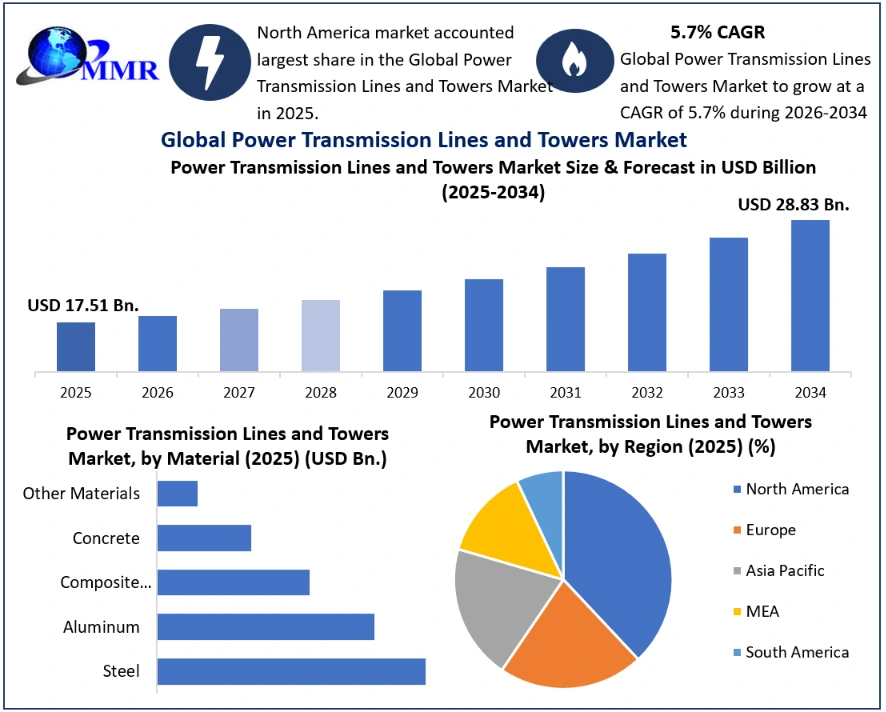
To know about the Research Methodology :- Request Free Sample Report
Power Transmission Lines and Towers Market Dynamics: Driver, Opportunity, Trends and Restrain Factors
Increasing Energy Demand and Renewable Energy Integration to Drive the Market
The increasing population and urbanization are key growth driver that increases the energy demand across the world and boost the Power Transmission Lines and Towers Market growth. Also, this helps to expand power transmission infrastructure as well as the need for modernization to improve efficiency and reliability. As a result, investments are being made in building new transmission lines and towers, as well as upgrading existing ones, to ensure a stable supply of electricity and accommodate the integration of renewable energy sources into the grid. The transition towards cleaner and more sustainable energy sources, such as wind, solar, and hydroelectric power, requires significant transmission infrastructure. Often, renewable energy sources are located in remote areas where traditional infrastructure is limited. Power transmission lines and towers are essential for transporting electricity generated from these sources to population centers.
For instance, the U.S. is making progress in building power lines, with 36 high-voltage transmission projects ready to commence construction, according to a report by consultancy Grid Strategies for Americans for a Clean Energy Grid. These projects, representing a $64 billion investment, aim to enhance grid reliability and support the integration of 187 gigawatts of new renewable energy capacity, potentially generating 1.3 million direct construction these projects only meet a fraction of the necessary investment to achieve a zero-carbon grid. Policy changes related to planning, permitting, and funding are essential to overcome barriers and facilitate a more significant transformation of power.
Government Initiatives and Energy Policies to Fuel the Market Growth
Governments across the region and regulatory bodies are implementing energy policies that emphasize the development of reliable and resilient power transmission systems. These policies are often aimed at reducing carbon emissions, increasing energy security, and fostering economic growth. Governments incentivize private sector investments in transmission infrastructure through grants, subsidies, or regulatory mechanisms. Such initiatives create a conducive environment for growth in the power transmission lines and towers market, as companies respond to policy-driven opportunities. In the US, the Biden Administration launched a $2.5 billion fund to modernize and expand the capacity of America’s power grid.
Government initiatives and energy policies are driving the growth of power transmission lines and towers infrastructure worldwide. Many governments are actively promoting the integration of renewable energy sources into the grid, necessitating the development of additional transmission infrastructure. Grid modernization programs, incentivizing private investment, and cross-border energy trading agreements contribute to the expansion of the transmission network. Environmental regulations guide sustainable development, while initiatives supporting energy storage and electrification further underscore the need for enhanced transmission capabilities. Governments also prioritize reliability standards, resilience measures, and community engagement to ensure a robust and transparent approach to transmission infrastructure development. These comprehensive efforts collectively aim to create a resilient, efficient, and sustainable power grid capable of meeting the rising global energy demand.
Grid Modernization and Smart Infrastructure Project Development to Create Lucrative Opportunity for the Market
The shift towards grid modernization presents a significant growth opportunity for the Power Transmission Lines and Towers Market. The U.S. electric grid is an engineering marvel with more than 9,200 electric generating units having more than 1 million megawatts of generating capacity connected to more than 600,000 miles of transmission lines. As aging transmission infrastructure needs replacement and upgrades, there is an opportunity to integrate smart technologies into new designs. Advanced sensors, real-time monitoring, and data analytics to enhance the efficiency, reliability, and performance of transmission lines and towers. Also, the integration of digital technologies provides predictive maintenance, quick fault detection, and optimized energy flow, contributing to reduced downtime and operational costs. Embracing grid modernization allows utilities and operators to adapt to changing energy landscapes, integrate renewable sources more effectively, and respond to peak demand efficiently. This opportunity not only drives technological innovation but also contributes to overall grid resilience, making it a win-win scenario for the industry and consumers.
The increasing demand for renewable energy sources is another great growth opportunity for the Power Transmission Lines and Towers Market. Developing transmission infrastructure to connect remote renewable energy generation sites, such as offshore wind farms and solar installations, to urban centers is crucial for achieving sustainable energy goals. These growth opportunities are expected to drive innovation, investment, and expansion in the Power Transmission Lines and Towers Industry, contributing to the advancement of energy infrastructure.
Growth Trends of Power Transmission Lines and Towers Market
1. Integration of Renewable Energy Sources
2. Cross-border interconnections
3. Ultra-High Voltage (UHV) Transmission
4. Investments in Grid Modernization and Resilience
Top 10 Transmission Line Construction Companies
| Company | Projects | Transmission Line (Miles) | Region |
| Quanta Services | 218 | 11,174.80 | USA, Canada |
| MYR Group Inc. | 141 | 5,910.50 | USA |
| ABB | 59 | 3,494.10 | Global |
| Kiewit | 83 | 3,409.30 | US, Canada, Mexico |
| Valard Construction | 37 | 2,977.90 | Canada |
| Burns & McDonnell | 145 | 2,683.90 | USA |
| M.J. Electric LLC | 79 | 2,658.00 | USA |
| Aecom | 29 | 2,523.00 | US |
| GE Energy | 35 | 2,321.30 | US |
| Wilson Construction Company | 50 | 1,980.20 | USA |
High Capital Investment and Financing Challenges to Restrain the Market Growth
The construction and expansion of power transmission lines and towers require substantial upfront capital investment due to the need for high-quality materials, advanced technology, and skilled labor. Financing such projects is a significant hurdle, especially for new market entrants or in regions with limited access to financial resources.
For instance, annual spending on electricity distribution systems by major U.S. utilities continues to increase. Utilities spent $57.4 billion on electric distribution in 2019, 6% more than the previous year and 64% more than they spent in 2000 after adjusting for inflation. More than half of utility distribution spending in 2019-20 went toward capital investment ($31.4 billion) as utilities worked to replace, modernize, and expand existing infrastructure. Another $14.6 billion was paid for operations and maintenance (O&M), and $11.5 billion went to customer expenses, which include advertising, billing, and customer service. One of the significant restraint factors in the Power Transmission Lines and Towers Market is the complex regulatory and permitting process for building and expanding transmission infrastructure. Stricter environmental regulations and concerns about visual impact, land use, and potential health risks are expected to complicate the process, causing frustration for developers and potentially restraining the growth of the Power Transmission Lines and Towers Market.
Additionally, Large-scale transmission projects often involve long payback periods, making them less attractive to some investors seeking quicker returns on investments. Economic uncertainties, fluctuating interest rates, and the potential for cost overruns can create financial risks that deter investors and financing institutions from supporting these projects, thereby limiting Power Transmission Lines and Towers Market growth.
Power Transmission Lines and Towers Market Segment Analysis
Based on product, the transmission line segment dominated the largest Power Transmission Lines and Towers Market share in 2025. For transmitting electricity from power generation sources to distribution networks, substations, and end-users Transmission lines are used. It is classified into high voltage (HV), extra high voltage (EHV) and ultra-high voltage (UHV) transmission lines. Key player $20-25 billion in annual U.S. transmission investment almost 20% of the total by regulated utilities. Such demand drivers play a major role in determining the growth and expansion of transmission line infrastructure. Based on the application, the high-tension segment accounted for the largest Power Transmission Lines and Towers Market share in 2025 due to its critical role in transmitting electricity over long distances. High-voltage transmission lines are primarily used to transfer electricity from power generation sources, such as power plants or renewable energy facilities, to substations and distribution networks. The increasing demand for electricity, rapid urbanization and the need to connect remote power generation sources to population centers is expected to sustain this segment’s dominance. High voltage lines require robust towers to support the weight of the conductors and to maintain safe clearance from the ground. Investments in upgrading and expanding high-voltage transmission infrastructure often drive growth in this segment.
By Voltage In 2025, the ultra-high voltage (Above 660kV) segment operates at voltage levels of 1,000 kV and above. UHV lines are a relatively recent development and are used to transmit electricity over extremely long distances with minimized losses. These lines are particularly relevant for connecting remote power generation sites, such as hydroelectric plants, to distant population centers. While UHV lines might not have dominated the market by volume, they represent a cutting-edge technology with the potential to transform long-distance energy transmission.
Power Transmission Lines and Towers Market Regional Analysis
North America held largest the Power Transmission Lines and Towers market share in 2025 and is characterized by a developed and mature infrastructure. The United States and Canada have extensive transmission networks to cater to their large and distributed populations. Ongoing upgrades to improve grid reliability, accommodate renewable energy integration and replace aging infrastructure drive investments in this region. Regulations focusing on grid modernization and resilience also influence market growth. For instance, a US federal government investment of US$ 40.2 Bn for the next five years creates tax credits to incentivize the build-out of transmission projects that are regionally significant and can enable renewable energy integration on the grid and stand-alone energy storage technologies.
Locweld, a leading lattice structure and transmission tower manufacturer, boasts a rich history of over 75 years in fabricating precision towers that form the backbone of the North American power grid. With a remarkable track record of producing over 100,000 lattice towers, equivalent to 20,000 miles of transmission line, Locweld has solidified its position in the industry. The company offers a range of products, including lattice structures, steel poles, and substation structures, catering to diverse project requirements. Locweld's commitment to quality and customer service is evident in testimonials from industry professionals, praising their responsiveness, quick turnaround, and design capabilities. The company's recent recognitions, such as the Prix Performance Québec and Canada's Best Managed Companies designation, further highlight its excellence and sustained growth in the Power Transmission Lines and Towers Market.
European countries emphasize renewable energy integration, which has led to the expansion of high-voltage transmission networks to transport energy from remote renewable sources to urban centers. The European Union's ambitious climate goals have prompted significant investments in upgrading power transmission infrastructure to accommodate increased renewable energy generation. Interconnection projects between countries further boost cross-border electricity trade.
The Asia-Pacific region is witnessing increasing industrialization and urbanization, resulting in increased energy demand. China and India are expanding their power transmission networks to meet this demand, with a particular emphasis on renewable energy integration. China's west-to-east power transmission program seeks to balance the country's electricity supply and demand in different regions. It transmits surplus electricity in western regions rich in hydropower resources to the country's eastern and southern manufacturing powerhouses. Also, built more UHVDC transmission lines than anyone in the world as it works to electrify the entire nation. This is complicated by the distance the majority of Chinese cities lie from major generation sources.
Many countries in the region are investing in smart grid technologies to enhance grid stability and efficiency. Government initiatives and foreign investments play a vital role in shaping the Power Transmission Lines and Towers Market in this region. According to Power Technology, 700 million smart meters have been installed worldwide, with $14.3 billion spent on smart grid technology in 2021-2022.
Power Transmission Lines and Towers Market Recent Developments:
| Date | Company | Development | Impact |
|---|---|---|---|
| 13 October 2026 | Kalpataru Projects International Limited | Kalpataru Projects International Limited secured new orders worth ₹2,031 crore in its Power Transmission & Distribution business across India and international markets. | The contract wins expand the company's global order book for high-voltage transmission line construction and power grid infrastructure development. |
| 23 October 2026 | KEC International Ltd. | KEC International secured new power transmission orders totaling ₹1,006 crore for a 400 kV transmission line project in Oman and supply of towers in the Americas. | The international win expands KEC's Middle Eastern presence while driving overall year-to-date T&D order intake past ₹10,600 crore. |
| 23 October 2026 | Jyoti Structures Limited | Jyoti Structures secured a ₹689.93 crore turnkey contract from GETCO for the 765 kV DC Pachchham-Saykha transmission line project in Gujarat. | The award strengthens the company's domestic portfolio in ultra-high voltage power line erection and grid integration infrastructure. |
| 24 October 2026 | Power Grid Corporation of India Limited | POWERGRID commissioned a major Renewable Energy Zone transmission line project in Karnataka to integrate regional green power into the national grid. | The commissioning accelerates bulk clean energy evacuation and inter-state grid reliability for large-scale solar and wind farms. |
| 26 October 2026 | Jyoti Structures Limited | Jyoti Structures received Notifications of Award worth ₹949.35 crore from Power Grid Corporation of India for ±800 kV HVDC Bipole transmission lines in Rajasthan. | The two turnkey packages cover full-scope supply, testing, and commissioning of high-capacity direct current transmission line corridors over a 38-month timeline. |
Power Transmission Lines and Towers Market Scope : Inquire Before Buying
| Power Transmission Lines and Towers Market | |||
|---|---|---|---|
| Report Coverage | Details | ||
| Base Year: | 2025 | Forecast Period: | 2026-2034 |
| Historical Data: | 2020 to 2025 | Market Size in 2025: | 17.51 USD Billion |
| Forecast Period 2026-2034 CAGR: | 5.7% | Market Size in 2034: | 28.83 USD Billion |
| Segments Covered: | by Product | Transmission Lines Overhead Underground Submarine Transmission Towers Lattice Monopole Towers Guyed Towers Others |
|
| by Conductor | Conventional Conductors High-Temperature Conductors Composite-Core Conductors Other Conductors |
||
| by Insulation | PVC XLPE Other Insulation Systems |
||
| by Installation | New Installation Refurbishment & Upgradation Reconductoring & Capacity Enhancement |
||
| by Voltage | 132–220 kV 221–660 kV Above 660 kV) |
||
| by Current | HVAC HVDC |
||
| by Material | Steel Aluminum Composite Materials Concrete Other Materials |
||
| by Application | Utility Grid Expansion & Modernization Renewable Energy Integration & Power Evacuation Industrial & Large-Load Power Transmission Data Center & Cloud Infrastructure Power Supply Telecommunications Infrastructure Power Supply Cross-Border Power Interconnections Other Applications |
||
Power Transmission Lines and Towers Market, by Region
North America (United States, Canada and Mexico)
Europe (UK, France, Germany, Italy, Spain, Sweden, Austria and Rest of Europe)
Asia Pacific (China, South Korea, Japan, India, Australia, Indonesia, Malaysia, Vietnam, Taiwan, Bangladesh, Pakistan and Rest of APAC)
Middle East and Africa (South Africa, GCC, Egypt, Nigeria and Rest of ME&A)
South America (Brazil, Argentina Rest of South America)
Power Transmission Lines and Towers Key Players Include
NORTH AMERICA
1. Valmont Industries, Inc.
2. Sabre Industries, Inc.
3. Southwire Company, LLC
4. CTC Global
5. 3M
6. Canam Group Inc.
7. Quanta Services, Inc.
8. MYR Group Inc.
9. MasTec, Inc.
Others
EUROPE
10. Prysmian Group
11. Nexans S.A.
12. NKT A/S
13. LAMIFIL
14. LUMPI-BERNDORF
15. Bekaert
16. Eland Cables
17. Siemens Energy
18. Hitachi Energy
Others
ASIA PACIFIC
19. KEC International Ltd.
20. Skipper Ltd.
21. Kalpataru Projects International Ltd.
22. Sterlite Power Transmission Ltd.
23. APAR Industries Ltd.
24. Karamtara Engineering Ltd.
25. Associated Power Structures Pvt. Ltd.
26. Larsen & Toubro Ltd.
27. Tata Projects Ltd.
28. Power Mech Projects Ltd.
29. Diamond Power Infrastructure Ltd.
30. Gupta Power Infrastructure Ltd.
31. KEI Industries Ltd.
32. Cabcon India Ltd.
33. Hindustan Urban Infrastructure Ltd.
34. Transrail Lighting Ltd.
35. Jyoti Structures Ltd.
36. ZTT Group
37. Hengtong Group
38. TBEA Co., Ltd.
39. Nanjing Daji Iron Tower Manufacturing Co., Ltd.
40. Jiangsu Huadan Steel Tower Manufacturing Co., Ltd.
41. Shandong Dingchang Tower Co., Ltd.
42. Qingdao BST Steel Structure Co., Ltd.
43. Tongda Cable Technology Co., Ltd.
44. Sumitomo Electric Industries, Ltd.
45. Furukawa Electric Co., Ltd.
46. SWCC Corporation
47. LS Cable & System Ltd.
48. Taihan Cable & Solution Co., Ltd.
Others
MIDDLE EAST & AFRICA
49. Al-Babtain Power & Telecommunication Co.
50. Elsewedy Electric S.A.E.
51. Midal Cables Ltd.
52. Riyadh Cables Group Company
53. Oman Cables Industry
54. Zamil Steel
55. Jeddah Cable Company
56. Al Fanar
Others
SOUTH AMERICA
57. SAE Towers – KEC Group
58. Prysmian Group
59. Nexans S.A.
60. Valmont Industries, Inc.
61. ZTT Group
62. KEC International Ltd.
63. Skipper Ltd.
Others
Frequently Asked Questions:
1] What is the growth rate of the Global Power Transmission Lines and Towers Market?
Ans. The Global Power Transmission Lines and Towers Market is growing at a significant rate of 5.7% during the forecast period.
2] Which region is expected to dominate the Global Power Transmission Lines and Towers Market?
Ans. North America region is expected to hold the Power Transmission Lines and Towers Market growth potential during the forecast period.
3] What is the expected Global Power Transmission Lines and Towers Market size by 2034?
Ans. The Power Transmission Lines and Towers Market size is expected to reach USD 28.83 Bn. by 2034.
4] Which are the top players in the Global Power Transmission Lines and Towers Market?
Ans. The top player in the Power Transmission Lines and Towers manufacturers is Skipper Limited, Ramboll, Dajigroup and others.
5] What are the factors driving the Global Power Transmission Lines and Towers Market growth?
Ans. The advanced metering infrastructure and grid infrastructure modernization are expected to drive the industry expansion.
6] Which country held the largest Power Transmission Lines and Towers Market share in 2025?
Ans. The United States country dominated the largest Power Transmission Lines and Towers Market share in 2025.