Power Grid Market Size by Grid Type, Component, Voltage Level, Grid Technology, Installation Type, Project Type, End User, and Region – Segment-Level Market Assessment, Growth Opportunity Analysis, Competitive Mapping & Global Market Forecast to 2034

5.2%
CAGR (2025-2034)
325.27 USD Bn.
Forecast Market Size
308
Report Pages
138
Market Tables

Overview

The Global Power Grid Market was valued at USD 325.27 Billion in 2025 and is projected to reach USD 513.33 Billion by 2034, growing at a CAGR of 5.2% during the forecast period 2026–2034.

Power Grid Market Overview:

A power grid is a complex network of power plants, transmission lines, substations and distribution lines that delivers electricity to homes, businesses, and industries. The power grid market is growing due to rising electricity demand, integration of renewable energy and increased government investments in smart and resilient grid technologies. For example, major power grid investment is Germany’s €36.4 billion expansion plan by Amprion, announced in April 2025. This is one of the largest grid investments in Europe, aimed at upgrading high-voltage transmission infrastructure to accommodate the country’s rapid shift toward renewable energy.

Asia Pacific dominated the power grid market in 2025, driven by large-scale infrastructure projects, expanding industrialization, and strong policy support for cross-border transmission development. The global Power Grid Market key players are State Grid Corporation of China (Beijing, China), Siemens AG (Germany), ABB Ltd (Switzerland), General Electric (United States), and Hitachi Energy (Japan), each holding significant shares due to their technological leadership, manufacturing scale, and global reach. A recent development in the power grid market is that, on February 27, 2025, Siemens AG (Germany) launched its Gridscale X and Electrification X platforms at DISTRIBUTECH 2024, integrating AI, distributed energy resource (DER) management, and digital twin technologies to advance smart grid capabilities. The end users in the power grid market include electric utility providers, transmission and distribution operators, heavy industries, smart city planners, and public sector energy departments, who depend on efficient, resilient grid systems to manage growing energy demands and renewable integration.

Power Grid Market Growth Analysis
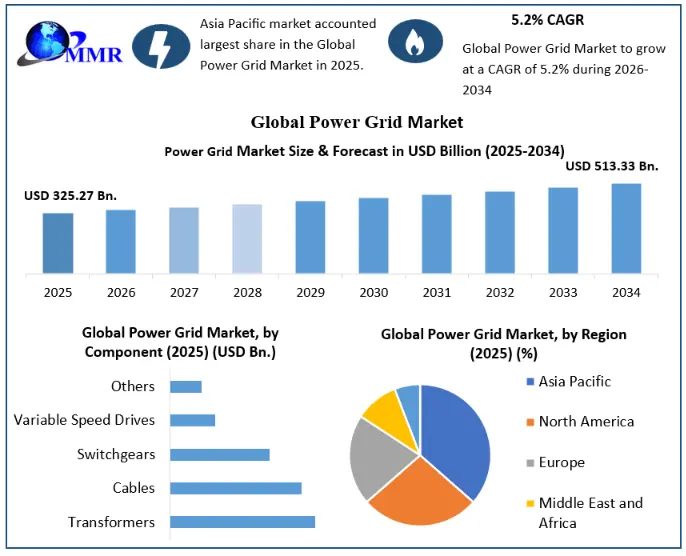
Power Grid Growth Outlook

To know about the Research Methodology :- Request Free Sample Report

Power Grid Market Dynamics

Growing Energy Requirements and Adoption of Alternative Energy Expected to Boost Power Grid Market

Increasing population and growing developments in the industrial infrastructure across the world are propelling the energy demand. The rising demand for reliable and cost-effective electricity for the population and industrial and commercial areas is expected to drive the Power Grid Market. The rising urbanization and industrialization in major developing economies across the world indicate the need for expansion and innovative power grid infrastructure. The world is shifting toward alternative energy sources and processes. Various industry verticals are already started using sustainable energy sources such as wind and solar energy and power grid systems are also adopting these sources to produce clean and green energy to fulfill requirements. These factors are expected to drive the Power Grid Market throughout the forecast period.The adoption of renewable sources improves the productivity of power grids’ and energy storage systems along with the advanced technologies to produce and supply efficient electricity.

Government Policies and Grid Modernization Initiatives to Propel the Growth of Power Grid Market

Governments across the world are initiating regulations regarding the development, modernization and expansion of power grid systems. Countries are driving this initiative through growing emphasis on reducing greenhouse gas emissions, encouraging major Power Grid Key Players to integrate sustainable energy sources in their power generation process. The government policies include tax refunds and subsidies to the Power Grid Key Companies to stimulate them to invest in Power Grid Market. These factors are expected to increase key players’Power Grid Market Share.The market growth is also driven by the increasing number of private companies with their latest technologies and they are investing and collaborating heavily with the governments to develop the power grid infrastructure along with supportive policies.

Low Penetration of Electricity and Growing Electric Vehicles Expected to Increase Power Grid Infrastructure

Major developing regions across the world are facing alack of electricity supply, these low-penetration areas are expected to create a lucrative opportunity for the development of power grid infrastructure. This is expected to drive the Power Grid Market in those regions. Also, the trend of adopting electric vehicles has become the norm in the past five years. The increasing penetration of electric vehicles is driving the demand for continuous electricity supply. As a result, the power grid market experiences growth through electrification initiatives in these regions. Also, smart grid solutions, advanced metering infrastructure, and grid analytics enable better monitoring, control and optimization of power systems. These factors are expected to modernize the power grid infrastructure and are expected to boost the Power Grid Market.

High Cost of Installation and Grid Infrastructure and Integration Challenge Impeding the Growth of the Power Grid Market

The development of power grid infrastructure requires a large investment, which has no instant returns. It is a complex and time-consuming process, due to this, the investment in this field is not that much. Also, the uncertain regulations in different regions and fewer investments are expected to limit the growth of the Power Grid Market. The present number of power grid systems across the world produces energy and electricity from traditional sources.

These sources are the largest producers of greenhouse gas emissions but the deployment of sustainable energy sources for power generation has some technical challenges and is expected to reduce the growth rate of the Power Grid Market. The construction of new transmission lines or power plants can face opposition due to potential ecological impacts, such as land disruption, habitat loss or visual pollution. These factors are expected to delay the power grid infrastructure projects and impede the growth of the Power Grid Industry.

Power Grid Market Segment Analysis

Global Power Grid Market , by Installation Type

Based on Installation Type, the Global Power Grid Market is segmented into Overhead Grid Infrastructure, Underground Grid Infrastructure, and Submarine Grid Infrastructure. The Overhead Grid Infrastructure segment holds a significant market share, supported by cost-effective electricity transmission, extensive power distribution networks, and increasing investments in high-voltage transmission infrastructure. The Underground Grid Infrastructure segment experiences growing demand due to rapid urbanization, smart city development, improved power supply reliability, and expanding underground cable networks. The Submarine Grid Infrastructure segment gains momentum through offshore wind energy projects, cross-border electricity interconnections, and rising deployment of high-voltage submarine power cables. Increasing electricity consumption, renewable energy integration, smart grid modernization, government infrastructure investments, and growing demand for reliable transmission and distribution systems support overall Global Power Grid Market growth through 2034.
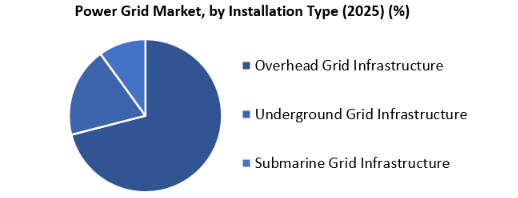
Power Grid by Installation Type

Global Power Grid Market, by End User

Based on End User, the Global Power Grid Market is segmented into Public and Regulated Electricity Utilities, Investor-Owned Electricity Utilities, Cooperative and Community-Owned Utilities, Independent Transmission and Grid Operators, and Industrial and Commercial Private Grid Owners. The Public and Regulated Electricity Utilities segment holds a significant market position, supported by government investments in electricity transmission and distribution infrastructure, grid modernization, and national electrification programs. Investor-Owned Electricity Utilities drive market growth through private infrastructure investments, smart grid deployment, and renewable energy integration. Cooperative and Community-Owned Utilities focus on rural electrification, decentralized power distribution, and reliable electricity access. Independent Transmission and Grid Operators support high-voltage transmission networks, cross-border power interconnections, and grid capacity expansion. Industrial and Commercial Private Grid Owners invest in captive power networks, microgrids, and energy-efficient electricity infrastructure. Rising electricity demand, smart grid technology adoption, renewable energy expansion, and increasing investments in power transmission and distribution networks support overall Global Power Grid Market growth through 2034.
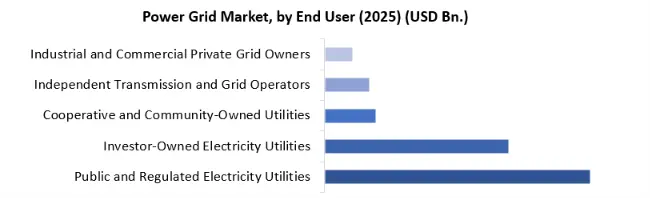
Power Grid by End User

Power Grid Market Regional Insights

Asia Pacific held the largest share of the market in 2024 and is expected to dominate the Power Grid Market during the forecast period(2025-2034).The developing economies in the region such as India, China, Japan and others are experiencing exponential growth in industrialization, technological advancements and the adoption of alternative energy sources that are useful in electricity generation. These rapid developments are driving the energy demand and are expected to drive the Asia Pacific Market. China is known as the biggest automobile industry in the world and major companies have their electric vehicles plants in the country. These factors are expected to drive the region’s market growth exponentially.

Europe is expected to hold the largest share of the market throughout the forecast period (2025-2034). Europe majorly depends on Russia for its energy requirements and recently, the region has faced a shortage due to a geological dispute between Russia and Ukraine. This highlights the region’s need to become self-sufficient in power generation. The European Union and the United Kingdom changed the regulations to attract Power Grid Key Companies for the quick development of power grid infrastructure and the adoption of sustainable energy sources to produce electricity. Also, the world Paris Agreement is also propelling the growth of alternative sources for power grid infrastructure. These factors are expected to drive the Europe Power Grid Market.

Power Grid Market: Competitive Landscape

The Global Power Grid Market features a competitive landscape comprising multinational electrical equipment manufacturers, transmission and distribution infrastructure developers, engineering service providers, and smart grid technology companies. Major players, including GE Vernova, Siemens Energy, Schneider Electric, ABB, Hitachi Energy, Eaton Corporation, and Mitsubishi Electric, strengthen their market positions through investments in grid modernization, high-voltage transmission systems, power transformers, switchgear, and digital grid technologies. Increasing electricity demand, renewable energy integration, and expansion of transmission and distribution networks drive competition across the global power grid industry. Companies focus on manufacturing capacity expansion, technological innovation, strategic partnerships, and long-term utility contracts to improve their competitive positioning.

The Power Grid Market competitive landscape is also shaped by growing investments in HVDC transmission, smart substations, grid automation, and energy-efficient electrical infrastructure. Leading manufacturers such as Prysmian Group, Nexans, TBEA, CG Power, and HD Hyundai Electric compete through product innovation, regional manufacturing capabilities, supply chain optimization, and infrastructure project participation. Rising demand for grid resilience, renewable energy connectivity, and reliable electricity distribution creates growth opportunities for established companies and emerging technology providers. Strategic acquisitions, joint ventures, research and development investments, and geographic expansion support competitive differentiation and long-term business growth through 2034.

Key Trends in Power Grid Market:

Digital Grid Transformation:
Utilities are rapidly adopting advanced digital technologies such as AI, IoT, and cloud-based SCADA systems to modernize grid operations, improve fault detection, and enable real-time decision-making.

Integration of Renewable Energy: 
The increasing share of solar, wind, and other renewables in the energy mix is driving investments in flexible grid infrastructure like battery storage, smart inverters, and HVDC systems for long-distance power transmission.

Decentralization and Microgrids:
There's a growing shift toward decentralized energy systems and microgrids, especially in remote, industrial, and urban resilience projects, enhancing energy independence and reliability during outages.

Recent Developments in Power Grid Market:

Date Company Name Description
27-Feb-26 Siemens AG (Germany) Launched Gridscale X and Electrification X platforms at DISTRIBUTECH 2024, integrating AI, DER management, and digital twin technologies.
22-Apr-26 Schneider Electric (France) Introduced EcoStruxure Grid Operation 2024, enhancing grid automation and cybersecurity for utilities integrating renewables.
25-Apr-26 Hitachi Energy (Japan) Partnered with Petrofac on major offshore wind grid connection projects in Europe, supporting renewable energy transmission.
03-May-26 Elsewedy Electric (Egypt) Commissioned a smart substation in East Africa to improve grid reliability and expand power access to rural communities.
30-Apr-26 ABB Ltd (Switzerland) Deployed new digital substation solutions with real-time condition monitoring to help reduce grid downtime across European power networks.

Power Grid Market Scope: Inquire before buying

Global Power Grid Market
Report Coverage Details
Base Year: 2025 Forecast Period: 2026-2034
Historical Data: 2019 to 2025 Market Size in 2025: US$ 325.27 Bn.
Forecast Period 2026 to 2034 CAGR: 5.2% Market Size in 2034: US$513.33 Bn.
Segments Covered: by Grid Type Transmission Grid
Distribution Grid
by Component Variable Speed Drives
Transformers
Cables
Switchgears
Others
by Voltage Level Low Voltage (Up to 1 kV)
Medium Voltage (Above 1 kV to 35 kV)
High Voltage (Above 35 kV to 230 kV)
Extra-High Voltage (Above 230 kV to 765 kV)
Ultra-High Voltage (Above 765 kV)
by Grid Technology Conventional Grid
Smart Grid
by Installation Type Overhead Grid Infrastructure
Underground Grid Infrastructure
Submarine Grid Infrastructure
by Project Type New Grid Infrastructure
Grid Expansion and Capacity Upgrades
Grid Replacement and Modernization
by End User Public and Regulated Electricity Utilities
Investor-Owned Electricity Utilities
Cooperative and Community-Owned Utilities
Independent Transmission and Grid Operators
Industrial and Commercial Private Grid Owners

Power Grid Market, by Rehion

North America (United States, Canada and Mexico)
Europe (UK, France, Germany, Italy, Spain, Sweden, Austria and Rest of Europe)
Asia Pacific (China, South Korea, Japan, India, Australia, Indonesia, Malaysia, Vietnam, Taiwan, Bangladesh, Pakistan and Rest of APAC)
Middle East and Africa (South Africa, GCC, Egypt, Nigeria and Rest of ME&A)
South America (Brazil, Argentina Rest of South America)

Power Grid Market, Key Players are:

1. GE Vernova
2. Eaton Corporation
3. Hubbell Incorporated
4. S&C Electric Company
5. G&W Electric
6. Powell Industries
7. Quanta Services
8. MYR Group
9. Black & Veatch
10. Burns & McDonnell
11. Hammond Power Solutions
12. Prolec GE
13. Siemens Energy
14. Siemens AG
15. Schneider Electric
16. ABB Ltd.
17. Hitachi Energy
18. Prysmian Group
19. Nexans
20. NKT A/S
21. Legrand
22. Ormazabal
23. Arteche Group
24. Trench Group
25. SGB-SMIT Group
26. PFISTERER
27. Socomec
28. Mitsubishi Electric Corporation
29. Toshiba Energy Systems & Solutions
30. Fuji Electric
31. Meidensha Corporation
32. HD Hyundai Electric
33. Hyosung Heavy Industries
34. LS ELECTRIC
35. TBEA Co., Ltd.
36. China XD Electric Co., Ltd.
37. CHINT Group
38. NARI Technology
39. Sieyuan Electric
40. NR Electric
41. Bharat Heavy Electricals Limited
42. CG Power and Industrial Solutions
43. Transformers and Rectifiers (India) Limited
44. APAR Industries Limited
45. NOJA Power
46. alfanar
47. Electrical Industries Company
48. Bahra Electric
49. Saudi Cable Company
50. Ducab Group
51. Elsewedy Electric
52. ACTOM
53. ZEST WEG Group
54. Voltamp Energy
55. WEG S.A.
56. TSEA Energia
57. Romagnole Produtos Elétricos
58. Comtrafo
59. Tadeo Czerweny
60. Magnetron

Frequently Asked Questions:

1. What is the Global Power Grid Market size and growth forecast for 2034?

The Global Power Grid Market is valued at USD 325.27 Billion in 2025 and is expected to reach USD 513.33 Billion by 2034, growing at a CAGR of 5.2% during 2026–2034.

2. What are the major factors driving the Power Grid Market growth?

Rising electricity demand, renewable energy integration, rapid urbanization, government infrastructure investments, and increasing adoption of smart grid technologies drive market growth.

3. Which region dominates the Global Power Grid Market?

Asia Pacific dominates the Global Power Grid Market, supported by expanding electricity transmission networks, industrialization, renewable energy investments, and grid modernization initiatives in China and India.

4. Which component plays a significant role in the Power Grid Market?

Transformers play a significant role in the Power Grid Market by supporting voltage regulation, efficient electricity transmission, power distribution, and renewable energy integration.

5. What are the key emerging trends in the Global Power Grid Market?

Major trends include smart grid digitalization, HVDC transmission expansion, AI-powered grid management, energy storage integration, automated substations, and advanced grid monitoring technologies.

Table of Contents

1. Power Grid Market: Executive Summary and Industry Overview 1.1. Power Grid Market Size and Growth Outlook (USD Million) (2025–2034) 1.2. Power Grid Industry Structure and Electricity Infrastructure Development 1.3. Global Transmission and Distribution Network Landscape 1.4. Role of Power Grid Infrastructure in Electricity Generation and Consumption 1.5. Conventional Power Grid and Smart Grid Technology Landscape 1.6. Regional Power Grid Market Development and Future Outlook 2. Power Grid Market: Dynamics 2.1. Power Grid Market Trends 2.2. Power Grid Market Dynamics 2.3. Drivers 2.4. Restraints 2.5. Opportunities 2.6. Challenges 2.7. Porter's Five Forces Analysis 2.7.1. Supplier Power 2.7.2. Buyer Power 2.7.3. Threat of Substitutes 2.7.4. Threat of New Entrants 2.7.5. Competitive Rivalry 2.8. PESTLE Analysis 3. Global Power Grid Industry Ecosystem and Value Chain Analysis 3.1. Electricity Generation Companies and Power Grid Infrastructure Developers 3.2. Transmission System Operators and Distribution Network Operators 3.3. Transformer, Switchgear, Cable, and Substation Equipment Manufacturers 3.4. Engineering, Procurement, and Construction Service Providers 3.5. Grid Automation, Monitoring, and Digital Technology Suppliers 3.6. End-to-End Power Grid Infrastructure Value Chain and Stakeholder Relationships 4. Global Electricity Generation and Power Grid Demand Analysis 4.1. Global Electricity Generation Capacity by Energy Source (GW) 4.2. Electricity Generation Volume and Consumption Trends (TWh) 4.3. Electricity Demand by Residential, Commercial, and Industrial Consumers 4.4. Renewable Energy Generation Capacity and Grid Integration Requirements 4.5. Peak Electricity Demand and Grid Load Management Analysis 4.6. Global Electricity Demand and Power Grid Capacity Requirements Through 2034 5. Global Power Transmission Infrastructure Analysis 5.1. Global Electricity Transmission Network Length (Circuit km) 5.2. High-Voltage, Extra-High-Voltage, and Ultra-High-Voltage Transmission Networks 5.3. Overhead, Underground, and Submarine Transmission Infrastructure 5.4. Transmission Line Capacity and Power Transfer Capability (MW/GW) 5.5. Transmission Network Expansion and Interregional Connectivity Projects 5.6. Global Power Transmission Infrastructure Development Outlook Through 2034 6. Global Power Distribution Infrastructure Analysis 6.1. Global Electricity Distribution Network Length (Circuit km) 6.2. Low-Voltage and Medium-Voltage Distribution Infrastructure 6.3. Distribution Substation Capacity and Network Expansion 6.4. Urban, Rural, and Industrial Electricity Distribution Networks 6.5. Distribution Network Reliability, Technical Losses, and Capacity Utilization 6.6. Global Power Distribution Infrastructure Development Outlook Through 2034 7. Power Grid Equipment Manufacturing and Production Capacity Analysis 7.1. Global Power Transformer and Distribution Transformer Manufacturing Capacity 7.2. Switchgear, Circuit Breaker, and Protection Equipment Production Capacity 7.3. Power Cable and Conductor Manufacturing Capacity 7.4. Transmission Tower, Pole, and Grid Hardware Manufacturing Landscape 7.5. Regional Power Grid Equipment Manufacturing Facilities and Capacity Utilization 7.6. Power Grid Equipment Production Capacity Expansion Outlook Through 2034 8. Global Power Transformer and Distribution Transformer Market Analysis 8.1. Power Transformer and Distribution Transformer Demand by Capacity Rating 8.2. Transformer Manufacturing Capacity and Production Volume (Units/MVA) 8.3. Transformer Demand by Transmission and Distribution Applications 8.4. Transformer Pricing, Manufacturing Costs, and Raw Material Requirements 8.5. Transformer Replacement Demand and Utility Procurement Trends 8.6. Global Transformer Demand and Manufacturing Outlook Through 2034 9. Power Grid Switchgear, Circuit Breaker, and Protection Equipment Analysis 9.1. High-Voltage and Medium-Voltage Switchgear Demand Analysis 9.2. Air-Insulated, Gas-Insulated, and Hybrid Switchgear Technology Comparison 9.3. Circuit Breaker and Electrical Protection Equipment Consumption 9.4. Grid Protection Relays, Sensors, and Monitoring Equipment Demand 9.5. Switchgear Manufacturing Capacity, Pricing, and Procurement Analysis 9.6. Power Grid Switchgear and Protection Equipment Outlook Through 2034 10. Power Transmission Cable, Conductor, and Line Infrastructure Analysis 10.1. High-Voltage Power Cable and Conductor Demand (Circuit km/Metric Tons) 10.2. Overhead Transmission Conductors and Underground Power Cable Analysis 10.3. Submarine Power Cable Demand and Interconnection Projects 10.4. Transmission Tower, Pole, Insulator, and Line Hardware Requirements 10.5. Copper, Aluminum, and Electrical Insulation Material Demand 10.6. Power Cable and Transmission Line Infrastructure Outlook Through 2034 11. Global Substation Infrastructure and Equipment Analysis 11.1. Global Transmission and Distribution Substation Infrastructure Landscape 11.2. Air-Insulated and Gas-Insulated Substation Development 11.3. Substation Transformer Capacity and Equipment Requirements (MVA) 11.4. Digital Substation and Automated Control Technology Adoption 11.5. Substation Construction Costs, Equipment Procurement, and Project Investments 11.6. Global Substation Infrastructure Expansion Outlook Through 2034 12. High-Voltage Direct Current (HVDC) and Ultra-High-Voltage Grid Analysis 12.1. Global HVDC Transmission Network Development and Installed Capacity (GW) 12.2. HVDC Converter Stations and Power Electronic Equipment Demand 12.3. Ultra-High-Voltage AC and DC Transmission Infrastructure 12.4. Cross-Border Electricity Interconnections and Long-Distance Transmission Projects 12.5. HVDC Infrastructure Investment, Project Pipeline, and Technology Comparison 12.6. HVDC and Ultra-High-Voltage Grid Development Outlook Through 2034 13. Smart Grid Technology and Grid Modernization Analysis 13.1. Global Smart Grid Infrastructure Deployment and Technology Adoption 13.2. Smart Metering and Advanced Metering Infrastructure Development 13.3. Distribution Automation and Intelligent Grid Control Systems 13.4. Smart Grid Sensors, Communication Networks, and Monitoring Technologies 13.5. Digital Grid Modernization Investments and Utility Adoption Trends 13.6. Global Smart Grid Technology Development Outlook Through 2034 14. Power Grid Software, Automation, and Digital Control Systems Analysis 14.1. Supervisory Control and Data Acquisition (SCADA) Systems 14.2. Energy Management Systems (EMS) and Distribution Management Systems (DMS) 14.3. Advanced Distribution Management Systems (ADMS) 14.4. Grid Asset Management, Predictive Maintenance, and Analytics Software 14.5. Artificial Intelligence, Digital Twin, and Grid Automation Applications 14.6. Power Grid Software and Digital Control Technology Outlook Through 2034 15. Renewable Energy Integration and Grid Flexibility Analysis 15.1. Solar and Wind Power Integration into Transmission and Distribution Networks 15.2. Renewable Energy Grid Connection Capacity and Infrastructure Requirements 15.3. Grid Flexibility, Load Balancing, and Frequency Regulation Technologies 15.4. Energy Storage Integration and Grid-Scale Battery Connection Infrastructure 15.5. Distributed Energy Resources and Virtual Power Plant Integration 15.6. Renewable Energy Grid Integration Investment Outlook Through 2034 16. Power Grid Reliability, Efficiency, and Electricity Loss Analysis 16.1. Transmission and Distribution Electricity Loss Trends (%) 16.2. Power Grid Reliability Indicators (SAIDI and SAIFI) 16.3. Grid Congestion, Capacity Constraints, and Infrastructure Bottlenecks 16.4. Power Quality, Voltage Stability, and Network Efficiency Analysis 16.5. Grid Resilience Against Extreme Weather and Infrastructure Disruptions 16.6. Electricity Grid Reliability and Efficiency Improvement Outlook Through 2034 17. Power Grid Infrastructure Investment and Capital Expenditure Analysis 17.1. Global Electricity Transmission and Distribution Infrastructure Investment (USD Billion) 17.2. Transmission Network Expansion and Modernization Capital Expenditure 17.3. Distribution Network Upgrade and Smart Grid Investment 17.4. Transformer, Substation, and High-Voltage Equipment Investment Requirements 17.5. Public and Private Sector Grid Infrastructure Financing 17.6. Global Power Grid Infrastructure Investment Outlook Through 2034 18. Power Grid Infrastructure Project Pipeline and Capacity Expansion Analysis 18.1. Major Global Transmission and Distribution Infrastructure Projects 18.2. New Transmission Corridor and Substation Development Projects 18.3. Cross-Border Power Interconnection and HVDC Project Pipeline 18.4. Grid Modernization and Distribution Network Expansion Programs 18.5. Project Investment Value, Implementation Timeline, and Capacity Addition 18.6. Power Grid Infrastructure Project Pipeline Through 2034 19. Power Grid Equipment Supply Chain and Procurement Analysis 19.1. Power Grid Equipment Supply Chain Structure and Supplier Relationships 19.2. Transformer, Switchgear, and Power Cable Procurement Models 19.3. Copper, Aluminum, Electrical Steel, and Insulation Material Sourcing 19.4. Utility Tendering, EPC Contracts, and Long-Term Supplier Agreements 19.5. Equipment Manufacturing Lead Times and Supply Chain Bottlenecks 19.6. Power Grid Supply Chain Localization and Procurement Outlook Through 2034 20. Power Grid Equipment Pricing and Infrastructure Cost Analysis 20.1. Power Transformer and Distribution Transformer Pricing Benchmarking 20.2. Switchgear, Circuit Breaker, and Substation Equipment Pricing 20.3. Power Transmission Cable and Conductor Price Analysis 20.4. Transmission Line and Distribution Network Construction Cost Benchmarking 20.5. Labor, Raw Material, Engineering, and Installation Cost Breakdown 20.6. Power Grid Equipment Pricing and Infrastructure Cost Outlook Through 2034 21. Global Power Grid Equipment Import and Export Trade Analysis 21.1. Global Transformer, Switchgear, and Electrical Equipment Export Trends 21.2. Power Cable, Conductor, and Grid Component International Trade 21.3. Major Power Grid Equipment Exporting and Importing Countries 21.4. Country-Wise Trade Value, Volume, and Product Category Analysis 21.5. Import Dependency and Domestic Equipment Manufacturing Competitiveness 21.6. Global Power Grid Equipment Trade Outlook Through 2034 22. Regional Power Grid Infrastructure Development and Manufacturing Cluster Analysis 22.1. North America Transmission and Distribution Infrastructure Landscape 22.2. Europe Power Grid Modernization and Cross-Border Interconnection Development 22.3. Asia Pacific Power Grid Expansion and Equipment Manufacturing Clusters 22.4. Middle East and Africa Grid Infrastructure Development and Electrification 22.5. South America Power Transmission Expansion and Renewable Integration 22.6. Regional Power Grid Infrastructure Investment and Development Outlook Through 2034 23. Power Grid Technology Innovation and Research & Development Analysis 23.1. Advanced Power Transmission and Distribution Equipment Technologies 23.2. Solid-State Transformers and Power Electronics Innovation 23.3. Advanced Grid Sensors, Automation, and Intelligent Protection Systems 23.4. HVDC, Superconducting Cables, and High-Efficiency Transmission Technologies 23.5. Power Grid Technology Patents, Research Investment, and Industry Collaborations 23.6. Next-Generation Power Grid Technology Roadmap Through 2034 24. Power Grid Regulatory Framework and Government Policy Analysis 24.1. Electricity Transmission and Distribution Regulatory Framework 24.2. Government Grid Modernization and Infrastructure Development Programs 24.3. Grid Connection Standards, Reliability Requirements, and Technical Regulations 24.4. Renewable Energy Grid Access and Interconnection Policies 24.5. Government Funding, Subsidies, and Public-Private Partnership Initiatives 24.6. Country-Wise Power Grid Regulatory and Policy Outlook Through 2034 25. Power Grid Sustainability and Environmental Impact Analysis 25.1. Environmental Impact of Transmission and Distribution Infrastructure 25.2. Electricity Loss Reduction and Energy Efficiency Improvement Initiatives 25.3. SF6-Free Switchgear and Alternative Insulation Technology Adoption 25.4. Sustainable Transformer Materials and Equipment Recycling 25.5. Power Grid Infrastructure Carbon Footprint and Life Cycle Assessment 25.6. Power Grid Sustainability and Environmental Compliance Outlook Through 2034 26. Global Power Grid Market Size and Forecast by Segmentation (Value in USD Million) (2025–2034) 26.1. Global Power Grid Market Size and Forecast, by Grid Type (2025–2034) 26.1.1. Transmission Grid 26.1.2. Distribution Grid 26.2. Global Power Grid Market Size and Forecast, by Component (2025–2034) 26.2.1. Variable Speed Drives 26.2.2. Transformers 26.2.3. Cables 26.2.4. Switchgears 26.3. Global Power Grid Market Size and Forecast, by Voltage Level (2025–2034) 26.3.1. Low Voltage (Up to 1 kV) 26.3.2. Medium Voltage (Above 1 kV to 35 kV) 26.3.3. High Voltage (Above 35 kV to 230 kV) 26.3.4. Extra-High Voltage (Above 230 kV to 765 kV) 26.3.5. Ultra-High Voltage (Above 765 kV) 26.4. Global Power Grid Market Size and Forecast, by Grid Technology (2025–2034) 26.4.1. Conventional Grid 26.4.2. Smart Grid 26.5. Global Power Grid Market Size and Forecast, by Installation Type (2025–2034) 26.5.1. Overhead Grid Infrastructure 26.5.2. Underground Grid Infrastructure 26.5.3. Submarine Grid Infrastructure 26.6. Global Power Grid Market Size and Forecast, by Project Type (2025–2034) 26.6.1. New Grid Infrastructure 26.6.2. Grid Expansion and Capacity Upgrades 26.6.3. Grid Replacement and Modernization 26.7. Global Power Grid Market Size and Forecast, by End User (2025–2034) 26.7.1. Public and Regulated Electricity Utilities 26.7.2. Investor-Owned Electricity Utilities 26.7.3. Cooperative and Community-Owned Utilities 26.7.4. Independent Transmission and Grid Operators 26.7.5. Industrial and Commercial Private Grid Owners 26.8. Global Power Grid Market Size and Forecast, by Region (2025–2034) 26.8.1. North America 26.8.1.1. United States 26.8.1.2. Canada 26.8.1.3. Mexico 26.8.2. Europe 26.8.2.1. United Kingdom 26.8.2.2. France 26.8.2.3. Germany 26.8.2.4. Italy 26.8.2.5. Spain 26.8.2.6. Sweden 26.8.2.7. Russia 26.8.3. Asia Pacific 26.8.3.1. China 26.8.3.2. South Korea 26.8.3.3. India 26.8.3.4. Japan 26.8.3.5. Australia 26.8.3.6. Indonesia 26.8.3.7. Philippines 26.8.3.8. Malaysia 26.8.3.9. Vietnam 26.8.3.10. Thailand 26.8.4. Middle East and Africa 26.8.4.1. South Africa 26.8.4.2. Bahrain 26.8.4.3. Kuwait 26.8.4.4. Oman 26.8.4.5. Qatar 26.8.4.6. Saudi Arabia 26.8.4.7. United Arab Emirates (UAE) 26.8.5. South America 26.8.5.1. Brazil 26.8.5.2. Argentina 26.8.5.3. Chile 26.8.5.4. Colombia 27. Company Profiles: Key Players 27.1. GE Vernova 27.1.1. Company Overview 27.1.2. Business Portfolio 27.1.3. Financial Overview 27.1.4. SWOT Analysis 27.1.5. Strategic Analysis 27.1.6. Recent Developments 27.2. Eaton Corporation 27.3. Hubbell Incorporated 27.4. S&C Electric Company 27.5. G&W Electric 27.6. Powell Industries 27.7. Quanta Services 27.8. MYR Group 27.9. Black & Veatch 27.10. Burns & McDonnell 27.11. Hammond Power Solutions 27.12. Prolec GE 27.13. Siemens Energy 27.14. Siemens AG 27.15. Schneider Electric 27.16. ABB Ltd. 27.17. Hitachi Energy 27.18. Prysmian Group 27.19. Nexans 27.20. NKT A/S 27.21. Legrand 27.22. Ormazabal 27.23. Arteche Group 27.24. Trench Group 27.25. SGB-SMIT Group 27.26. PFISTERER 27.27. Socomec 27.28. Mitsubishi Electric Corporation 27.29. Toshiba Energy Systems & Solutions 27.30. Fuji Electric 27.31. Meidensha Corporation 27.32. HD Hyundai Electric 27.33. Hyosung Heavy Industries 27.34. LS ELECTRIC 27.35. TBEA Co., Ltd. 27.36. China XD Electric Co., Ltd. 27.37. CHINT Group 27.38. NARI Technology 27.39. Sieyuan Electric 27.40. NR Electric 27.41. Bharat Heavy Electricals Limited 27.42. CG Power and Industrial Solutions 27.43. Transformers and Rectifiers (India) Limited 27.44. APAR Industries Limited 27.45. NOJA Power 27.46. alfanar 27.47. Electrical Industries Company 27.48. Bahra Electric 27.49. Saudi Cable Company 27.50. Ducab Group 27.51. Elsewedy Electric 27.52. ACTOM 27.53. ZEST WEG Group 27.54. Voltamp Energy 27.55. WEG S.A. 27.56. TSEA Energia 27.57. Romagnole Produtos Elétricos 27.58. Comtrafo 27.59. Tadeo Czerweny 27.60. Magnetron 28. Power Grid Equipment Manufacturer Benchmarking 28.1. Company Headquarters and Regional Manufacturing Presence 28.2. Power Grid Equipment and Technology Product Portfolio 28.3. Transformer, Switchgear, Cable, and Substation Equipment Manufacturing Capacity 28.4. Company Revenue, Power Grid Business Contribution, and Market Share 28.5. Technology Capabilities, Certifications, and Geographic Market Coverage 29. Power Grid Product Portfolio and Technology Benchmarking 29.1. Power Transformer and Distribution Transformer Product Comparison 29.2. High-Voltage and Medium-Voltage Switchgear Portfolio Benchmarking 29.3. Power Transmission Cable and Conductor Product Comparison 29.4. HVDC Converter, Substation, and Grid Automation Technology Benchmarking 29.5. Grid Equipment Efficiency, Reliability, and Technical Performance Comparison 29.6. Product Innovation, Technology Differentiation, and Competitive Advantages 30. Power Grid Equipment Manufacturer Financial Performance Analysis 30.1. Company Revenue and Power Grid Business Segment Contribution 30.2. Power Grid Equipment Manufacturer Revenue Growth Comparison 30.3. Operating Profit Margin and Manufacturing Cost Efficiency Analysis 30.4. Research and Development Expenditure Benchmarking 30.5. Capital Expenditure and Manufacturing Facility Investment Comparison 30.6. Company Financial Performance and Growth Outlook Through 2034 31. Power Grid Manufacturing Capacity and Global Production Footprint Analysis 31.1. Leading Transformer and Switchgear Manufacturer Production Capacity 31.2. Power Cable and Conductor Manufacturing Capacity Benchmarking 31.3. Regional Power Grid Equipment Manufacturing Facility Distribution 31.4. Manufacturing Capacity Utilization and Production Expansion Strategies 31.5. Domestic Manufacturing and Supply Chain Localization Initiatives 31.6. Global Power Grid Equipment Manufacturing Footprint Outlook Through 2034 32. Power Grid Equipment Pricing and Supplier Competitiveness Benchmarking 32.1. Power Transformer Manufacturer Pricing Comparison 32.2. Switchgear and Circuit Breaker Supplier Price Benchmarking 32.3. Power Cable and Conductor Manufacturer Cost Competitiveness 32.4. Equipment Delivery Lead Time and Procurement Performance Comparison 32.5. Product Quality, Warranty, After-Sales Support, and Service Benchmarking 32.6. Supplier Pricing Strategy and Competitive Positioning Through 2034 33. Power Grid Strategic Partnerships, Mergers, and Business Expansion Analysis 33.1. Power Grid Equipment Manufacturer and Utility Partnerships 33.2. Technology Collaborations and Grid Modernization Agreements 33.3. Joint Ventures and Manufacturing Localization Partnerships 33.4. Mergers, Acquisitions, and Strategic Investments 33.5. Power Grid Equipment Manufacturing Capacity Expansion Projects 33.6. Strategic Partnership and Business Expansion Outlook Through 2034 34. Power Grid Company Profiles and Strategic Analysis 34.1. Company Overview, Headquarters, and Business Operations 34.2. Power Grid Product Portfolio and Technology Capabilities 34.3. Manufacturing Facilities, Production Capacity, and Geographic Presence 34.4. Revenue, Profitability, and Financial Performance 34.5. Major Projects, Utility Customers, and Strategic Partnerships 34.6. Company SWOT Analysis, Competitive Positioning, and Future Strategy 35. Key Findings 36. Analyst Recommendations 37. Research Methodology

Custom Market Research Services

We Will Customise The Research For You, In Case The Report Listed Above Does Not Meet With Your Requirements