
Global Polyimide Fibers Market Size by Application, by End-Use, Region and Forecast 2034
Overview
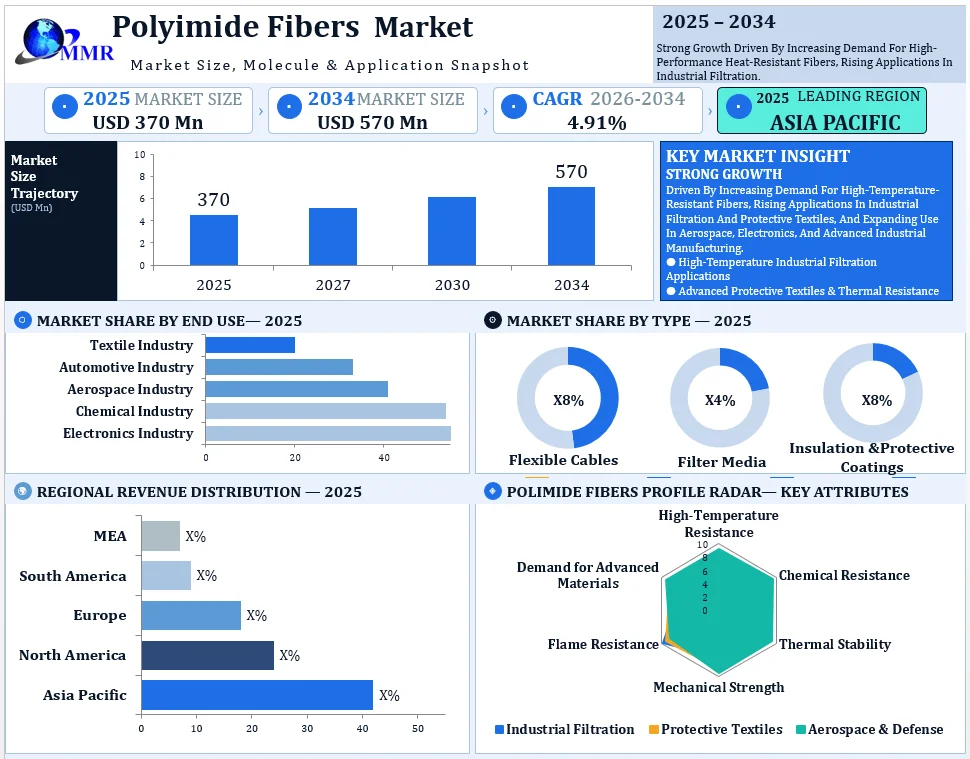
The Global Polyimide Fibers market was valued at USD 370 Mn. in 2025, and it is expected to reach USD 570 Mn. by 2034 with a CAGR of 4.91% during the forecast period.
Global Polyimide Fibers Market Overview:
Polyimide fibers (PI) are a type of heat-resistant, rather strong synthetic fiber that ranges in shade from orange to yellow. Polyimide fibers are made from aromatic diamines and aromatic tetracarboxylic dianhydrides in a two-step method. Polyimide fibers are frequently the best choice for extremely demanding applications requiring corrosion, extreme temperature, wear, and creep resistance. Continuous use of polyimide fibers at very high temperatures up to 260°C and short-term exposure at 550°C maintains excellent operating abilities.
Polyimides fibers can be made from a polyamic acid solution using a dry process. A subsequent heat treatment step transforms the precursor fibers into polyimide fibers. The production of polyimide fibers is both expensive and complicated. Polyimide fibers have a substantially higher glass transition temperature about 400°C and melting points than most conventional fibers, like acrylic and polyester. PI fibers have low flammability and great chemical resistance to most chemicals thanks to their aromatic composition. Polyimide fibers are also light in weight.
Global Polyimide Fibers Market Size, Growth and Share Analysis
To know about the Research Methodology :- Request Free Sample Report
Global Polyimide Fibers Market Dynamics:
Surging Consumption of PI Fibers in Protective Clothing:
The global demand for protective clothing is likely to rise at during the forecast period 2034. Polyimide fibers are increasingly being used in the manufacture of protective apparel thanks to their exceptional fire-resistant abilities. Polyimide fibers are widely implemented in the production of protective garments, such as the outer shell of army uniforms, industrial protection gears, firefighter jackets, and so on.
As the market for protective clothing is likely to grow so is the market for polyimide fiber during the forecast period.
Research and Development in the Space Sector:
Polyimide fibers sales have been steadily increasing as a result of an increase in the number of space research activities and launches throughout the globe. The increased number of space launches demands the production of tonnes of materials and components for rockets and space shuttles. The increased number of space launches demands the production of tonnes of materials and components for rockets and space shuttles.
According to ISRO, NASA, and other space exploration agencies, the number of space launches is likely to increase significantly during the forecast period, resulting in great demand for lightweight, high-performance materials that can endure extremely high temperatures.
Growth Opportunities for Polyimide Fibers:
Polyimide fibers were predominantly required in the production of filter bags, which are used to separate flue gases in municipal solid waste incinerators. Polyimide fibers are becoming more widely used in a variety of industries thanks to their outstanding heat resistance and flame retardant properties.
One of them, protective clothes, is gaining a lot of popularity. Similarly, over the forecast period, multiple research and development activities in the field of polyamide fibers are likely to reveal opportunities for polyimide fibers technologies.
Challenges for PI Fibers Suppliers:
Some of the key challenges or concerns to polyimide fibers suppliers include the intricate production process of polyimide fibers, high cost of polyimide fibers, and slightly fragmented market thanks to the presence of a few numbers of large companies and few middle & small business owners.
Suppliers, on the other hand, are focusing on the development of new and cost-effective manufacturing methods to meet the growing demands of consumers and vertical sectors. Also, businesses are planning to expand their manufacturing capacity.
Global Polyimide Fibers Market Segment Analysis:
Based on Application, the polyimide fibers market is segmented as, flexible cables, filter media, insulation, and protective coatings. In 2025, the filter media segment was dominant and held almost xx% of the overall market share in terms of revenue. Polyimide fibers are used to filter hot gases in coal-fired power plants, waste incinerators, and cement mills. A polyimide needle felt filters dust and particle matter from exhaust gas in this application.
Polyimide is also the most often used material for reverse osmotic films in water purification and the concentration of dilute components from water, like in maple syrup production. Detailed information about each segment is covered in the MMR’s report.
Based on End-Use, the polyimide fibers market is segmented as follows, electronics industry, chemical industry, aerospace industry, automotive industry, and textile industry. In 2025, the automotive industry segment was dominant and held almost xx% of the overall market in terms of revenue. Sintering processes can be used to make pieces and forms out of polyimide powder (direct forming, hot compression molding, and isostatic pressing).
They are useful as bushings, bearings, sockets, and constructive elements in demanding applications thanks to their great mechanical stability even at elevated temperatures. Compounds containing solid lubricants such as PTFE, graphite, or molybdenum sulphide are commonly used to improve tribological qualities. VTEC PI, P84 NT, Meldin, Vespel, and Plavis are all polyimide parts and shapes.
Global Polyimide Fibers Market Regional Insights:
Asia Pacific is the leading region in the Polyimide Fibers Market, supported by expanding industrial manufacturing, growing demand for high-temperature-resistant materials, and increasing applications in electronics, industrial filtration, and automotive components. China, Japan, South Korea, and India contribute through advanced materials production, manufacturing investments, and technological development.
North America holds a significant position in the market, driven by demand for high-performance materials in aerospace, defense, industrial filtration, and specialized protective applications. The United States contributes through advanced materials research, industrial manufacturing, and demand for fibers offering thermal stability and chemical resistance.
Europe benefits from established industrial manufacturing, stringent environmental requirements, and demand for high-performance filtration materials. Germany, France, and the United Kingdom support regional demand through applications in chemical processing, automotive manufacturing, aerospace, and industrial emission control.
South America is an emerging market for polyimide fibers, supported by industrial development and demand for advanced filtration materials. Brazil and Argentina offer opportunities through cement production, chemical processing, and other industrial applications that require heat-resistant materials.
The Middle East & Africa market is supported by demand from cement manufacturing, energy, petrochemicals, and industrial filtration. Investments in industrial infrastructure and emission-control systems create opportunities for polyimide fibers in high-temperature operating environments.
The objective of the report is to present a comprehensive analysis of the market to the stakeholders in the industry. The past and current status of the industry with the forecasted market size and trends are presented in the report with the analysis of complicated data in simple language. The report covers all the aspects of the industry with a dedicated study of key players that include market leaders, followers, and new entrants.
PORTER, PESTEL analysis with the potential impact of micro-economic factors of the market have been presented in the report. External as well as internal factors that are supposed to affect the business positively or negatively have been analyzed, which will give a clear futuristic view of the industry to the decision-makers.
The report also helps in understanding the global market dynamics, structure by analyzing the market segments and projecting the global market size. Clear representation of competitive analysis of key players by product, price, financial position, product portfolio, growth strategies, and regional presence in the global market makes the report investor's guide.
Global Polyimide Fibers Market – Competitive Landscape
The global Polyimide Fibers Market is characterized by competition among specialized fiber manufacturers, advanced materials producers, and chemical companies. Key players include Jiangsu Shino New Materials Technology Co., Ltd., Jiangsu Aoshen Hi Material Co., Changchun Hipolyking Co., Ltd., Evonik Industries AG, and Teijin Limited. These companies focus on developing high-performance fibers with excellent thermal stability, chemical resistance, and mechanical strength for demanding industrial applications.
Market participants emphasize research and development, product innovation, manufacturing efficiency, and portfolio expansion to strengthen their competitive positions. Increasing demand for heat-resistant materials in industrial filtration, protective textiles, electronics, and aerospace applications encourages manufacturers to improve fiber performance and production capabilities. Competition is also influenced by product quality, production costs, technical expertise, and the ability to meet application-specific requirements.
Global Polyimide Fibers Market Recent Developments:
| Date | Company | Development | Impact |
|---|---|---|---|
| 19 March 2026 |
Kaneka Corporation |
Kaneka Corporation announced a global price revision for its polyimide film portfolio, raising prices by 20% effective April 2026. |
The adjustment addresses rising raw material and energy costs to secure stable global supply across high-performance fiber and electronics end-use sectors. |
| 15 May 2026 |
Kermel S.A. |
Kermel S.A. expanded the commercial integration of its heat-resistant polyamide-imide and polyimide fiber blends into automotive and industrial thermal protection markets. |
The initiative drives adoption of high-temperature protective solutions in next-generation automotive component manufacturing. |
| 27 August 2026 |
Industrial Summit Technology (I.S.T.) Corporation |
I.S.T. Corporation launched White TORMED, a lightweight polyimide film and advanced fiber-compatible platform engineered for spacecraft thermal control. |
The technology simplifies satellite assembly processes by replacing multi-step surface coatings with adhesive-free co-curing prepreg integration. |
| 31 August 2026 |
DuPont de Nemours, Inc. |
DuPont presented advanced applications for its high-performance Vespel polyimide components at CSEAC 2026 in Wuxi, China. |
The demonstration highlights enhanced thermal and mechanical stability for next-generation semiconductor manufacturing tools and extreme-environment hardware. |
| 13 October 2026 |
Jayhawk Fine Chemicals |
Jayhawk Fine Chemicals published technical data on specialized dianhydride monomer selection for polyimide fiber separation membranes. |
The milestone advances industrial gas separation and hot-gas filtration bag manufacturing using highly heat-resistant polyimide structures. |
Global Polyimide Fibers Market Scope: Inquire before buying
| Polyimide Fibers Market | |||
|---|---|---|---|
| Report Coverage | Details | ||
| Base Year: | 2025 | Forecast Period: | 2026-2034 |
| Historical Data: | 2020 to 2025 | Market Size in 2025: | 370 USD Million |
| Forecast Period 2026-2034 CAGR: | 4.91% | Market Size in 2034: | 570 USD Million |
| Segments Covered: | by Application | Flexible Cables Filter Media Insulation Protective Coatings |
|
| by End-Use | Electronics Industry Chemical Industry Aerospace Industry Automotive Industry Textile Industry |
||
Global Polyimide Fibers Market Key Players
1. Evonik Industries AG
2. Jiangsu Aoshen Hi Material Co., Ltd.
3. Teijin Limited
4. BIEGLO GmbH
5. Baoding Sanyuan Textile Technology Co., Ltd.
6. Swicofil AG
7. Bannor Industrial Co., Ltd.
8. Lirsot Ltd.
9. Ningbo Yide Fine Chemical Co., Ltd.
10. Shanghai Easun Group Imp & Exp Co., Ltd.
11. Xiamen Meidasi Environmental Protection Industry Co., Ltd.
12. Jiangsu Shino New Materials & Technology Co., Ltd.
13. Changchun Gao Qi Polyimide Material Co., Ltd.
14. Changchun Hipolyking Co., Ltd.
15. Shandong Xingye Environmental Technology Corp.
16. Jiangsu Jinqiao Salt International Trade Co., Ltd.
17. PPG Industries, Inc.
18. DuPont de Nemours, Inc.
19. Toray Industries, Inc.
20. Mitsubishi Chemical Group
21. Shin-Etsu Chemical Co., Ltd.
22. Kaneka Corporation
23. UBE Corporation
24. Mitsui Chemicals, Inc.
25. Solvay S.A.
26. SABIC
27. Kuraray Co., Ltd.
28. Taimide Technology Inc.
29. PI Advanced Materials Co., Ltd.
30. Kolon Industries, Inc.
31. Yantai Tayho Advanced Materials Co., Ltd.
32. Hubei Huitian New Material Co., Ltd.
33. Saint-Gobain
34. Ensinger GmbH
35. Wacker Chemie AG
36. Huntsman Corporation
37. Arkema S.A.
38. Celanese Corporation
39. SGL Carbon SE
40. Freudenberg Performance Materials
Frequently Asked Questions:
1. Which region has the largest share in Global Polyimide Fibers Market?
Ans: Asia Pacific region held the highest share in 2025.
2. What is the growth rate of Global Polyimide Fibers Market?
Ans: The Global Polyimide Fibers Market is growing at a CAGR of 4.91% during forecasting period 2026-2034.
3. What is scope of the Global Polyimide Fibers Market report?
Ans: Global Polyimide Fibers Market report helps with the PESTEL, PORTER, COVID-19 Impact analysis, Recommendations for Investors & Leaders, and market estimation of the forecast period.
4. Who are the key players in Global Polyimide Fibers Market?
Ans: The important key players in the Global Polyimide Fibers Market are – Jiangsu Shino New Materials Technology Co., Ltd., Jiangsu Aoshen Hi Material Co., Changchun Hipolyking Co., Ltd., Ningbo Yide Fine Chemical Co., Ltd., Lirsot Ltd., Swicofil, Shandong Xingye Environmental Technology Corp., Jiangsu Jinqiao Salt International Trade Co. Ltd., Baoding Sanyuan Textile Technology Co. Ltd., Shanghai Easun Group Imp & Exp Co., Ltd., Xiamen Meidasi Environmental Protection Industry Co. Ltd., Evonik Industries AG, Bannor Industrial Co. Ltd., Bieglo GmbH, iXBlue Photonics Besancon, Others, and
5. What is the study period of this Market?
Ans: The Global Polyimide Fibers Market is studied from 2020 to 2034.