
Oil and Gas Custody Metering System Market by Component, Application and Region - Global Market Size Estimation, Industry-Wide Analysis, Competitive Landscape Assessment & Long-Term Forecast to 2034.
Overview
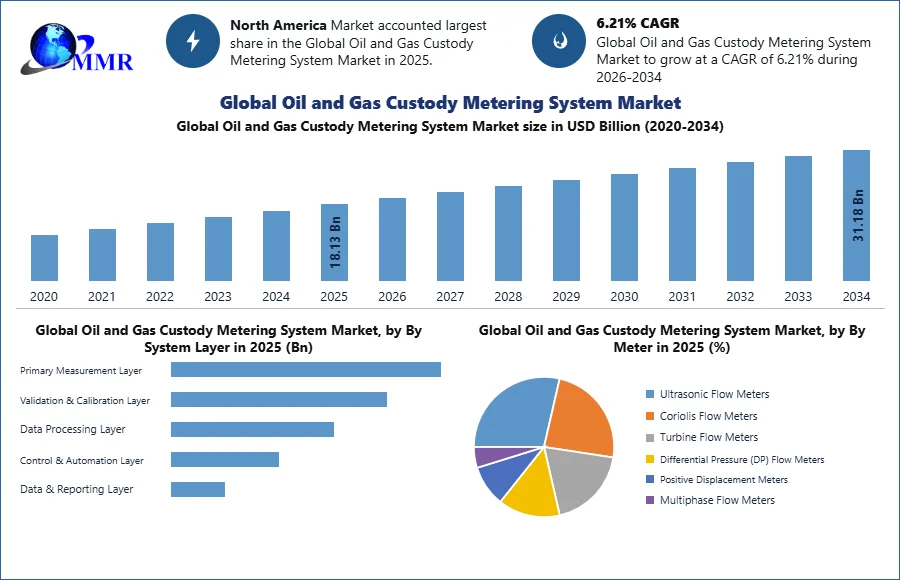
The Oil and Gas Custody Metering System Market size was valued at USD 11.89 Billion in 2025 and the total Oil and Gas Custody Metering System revenue is expected to grow at a CAGR of 6.21% from 2026 to 2034, reaching nearly USD 31.18 Billion by 2034.
Oil and Gas Custody Metering System Market Overview
Oil and Gas Custody Metering Systems (CTM) is the system that ensures accurate measurement and financial accountability during the transfer of hydrocarbons between suppliers, transporters, and buyers. These systems are engineered to offer precise volumetric and mass flow measurements that meet strict regulatory standards set by organizations such as the American Petroleum Institute (API), the American Gas Association (AGA), and the International Organization of Legal Metrology (OIML). With the increasing demand for energy security and transparency in transactions, the Oil and Gas Custody Metering System Market is witnessing significant advancements in technology, including the adoption of ultrasonic, Coriolis, and turbine flow meters, which offer enhanced accuracy, real-time data monitoring, and minimal maintenance requirements.
The integration of IoT, AI-based analytics, and cloud connectivity is transforming these systems into smart, automated solutions capable of predictive maintenance, anomaly detection, and remote monitoring. The increasing global demand for LNG and refined petroleum products, increased investments in upstream and midstream infrastructure, and the development of modular and skid-based metering systems for cost-effective deployment are the factors that drive the Oil and Gas Custody Metering System Market growth.
To know about the Research Methodology :- Request Free Sample Report
Oil and Gas Custody Metering System Market Dynamics
Increasing Energy Demand to Drive Oil and Gas Custody Metering System Market Growth
The industrial activities expand and urbanization accelerates with making the need for accurate and reliable metering solutions more critical. Custody transfer, a process where ownership of oil, gas, or refined products changes hands, requires precise measurement to ensure fair financial transactions, regulatory compliance, and operational transparency. Flow meters, such as Coriolis, ultrasonic, and positive displacement meters, are essential process, providing real-time volume or mass flow measurements. These meters are selected based on factors such as fluid properties, flow rates, and accuracy requirements, ensuring minimal processing discrepancies in transactions.
The integration of calibration systems, metering skids for controlled measurement, and advanced sampling systems for quality verification has significantly enhanced the credibility of the Oil and Gas Custody Metering System Market by ensuring accurate and reliable custody transfer processes. With global regulatory bodies such as API, OIML, and NIST enforcing stringent compliance standards, oil and gas companies are increasingly investing in modern custody metering technologies to meet legal and operational requirements. In 2024, primary energy consumption varied significantly by country, with major economies like China, the United States, and India leading global energy demand. China remained the largest consumer due to its rapid industrial growth and energy-intensive manufacturing, while the U.S. maintained high consumption driven by transportation and industrial sectors. India's increasing urbanization and economic expansion also contributed to rising energy demand.

The digital transformation and technological advancements are reshaping custody metering solutions, introducing IoT-enabled smart metering, real-time data analytics, and predictive maintenance capabilities. Oil and Gas Custody Metering System Companies are integrating cloud-based monitoring systems to enhance efficiency, detect anomalies, and optimize metering operations, reducing unaccounted losses. The transition towards alternative fuels, such as biofuels and hydrogen, is pushing the Oil and Gas Custody Metering System Market to innovate metering solutions compatible with diverse energy sources. The shift towards modular and skid-based metering units is gaining traction, as they offer flexible deployment and ease of maintenance. End-to-end metering solutions, such as those provided by Liquid Controls, Endress+Hauser, and other key players, are ensuring seamless operations from engineering and procurement to installation and calibration.
High Capital Investment and Operational Costs to Restrain Oil and Gas Custody Metering System Industry Growth
Advanced metering technologies such as Coriolis, ultrasonic, and multiphase flow meters require substantial upfront expenditure, including installation, calibration, and compliance with stringent regulatory standards. The ongoing maintenance, periodic recalibration, and requirement for specialized technical expertise contribute to higher operational expenses, significantly influencing the oil and gas custody metering system market share. The complexity of integrating these systems into existing infrastructure, particularly in offshore environments where space and weight constraints are critical, adds to the financial burden. The cost of ensuring cybersecurity for digital metering solutions and adapting to evolving industry regulations creates challenges for widespread adoption, particularly for smaller companies with limited budgets.
Oil and Gas Custody Metering System Market Regional Insights
North America dominated the Oil and Gas Custody Metering System Market in 2025 and is expected to continue its dominance over the forecast Period. The region is home to some of the largest oil and gas producers, including the United States and Canada, which require highly accurate metering systems to ensure transparency, compliance, and financial integrity in transactions. Regulatory agencies, such as the Federal Energy Regulatory Commission (FERC) in the U.S. and Measurement Canada, enforce strict metrology standards to ensure custody transfer processes maintain the highest levels of accuracy and reliability, thereby driving market Penetration. The American Petroleum Institute (API) has contributed to industry standardization through its Manual of Petroleum Measurement Standards (MPMS), which serves as a global benchmark for custody metering.
North America’s strong emphasis on technological advancements, including digital flow meters, Coriolis and ultrasonic metering systems, and real-time monitoring solutions, has positioned the region as a leader in custody transfer innovation. The integration of automation, IoT-based remote monitoring, and advanced data analytics enhances precision and efficiency in custody transfer processes, minimizing discrepancies and improving operational effectiveness, thereby driving growth in the oil and gas custody metering system market. The shale oil and gas boom in the U.S., driven by hydraulic fracturing and horizontal drilling, has boosted the demand for high-precision metering systems to manage increased production and transportation volumes. The region’s highly developed downstream infrastructure, including refineries, export terminals, and LNG facilities, requires robust custody metering solutions to ensure seamless hydrocarbon transactions between producers, refiners, and traders.
Oil and Gas Custody Metering System Market Segment Analysis
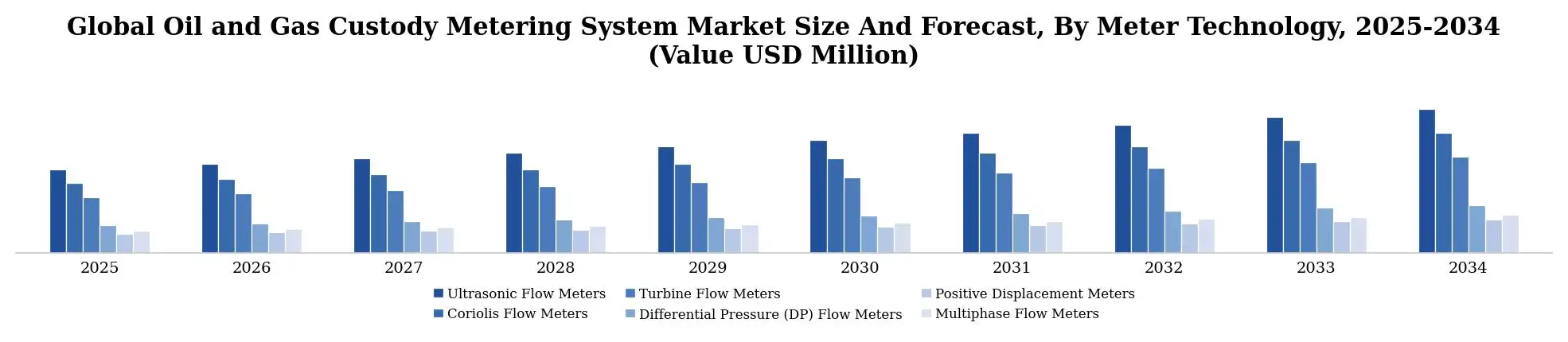
Based on the Component, the market is segmented into the Flow meters, Piping and Valving, Instrumentation and controls, Data acquisition system and others. The flow meter is expected to dominate the Oil and Gas Custody Metering System Market during the forecast period. Flow meters, such as Coriolis, ultrasonic, and turbine meters, provide real-time, high-precision measurements of mass and volumetric flow, minimizing errors and ensuring transparency in transactions.
The custody transfer involves the legal and financial exchange of hydrocarbons, any measurement discrepancy leads to significant financial losses or disputes. Regulatory bodies such as API (American Petroleum Institute) and OIML (International Organization of Legal Metrology) mandate stringent accuracy standards, driving the adoption of advanced flow meters. The technological advancements in digital and smart flow meters with remote monitoring and real-time data analytics capabilities have strengthened their dominance in market. Their reliability, accuracy, and regulatory significance make flow meters the most indispensable component in custody metering systems.

Based on Application, the market is segmented into the Offshore and Onshore. Onshore held the largest market share in Oil and Gas Custody Metering System Market in 2025. Governing onshore custody transfer operations. Onshore facilities, including refineries, storage terminals, and pipeline networks, handle the majority of global hydrocarbon transportation and distribution, requiring accurate and reliable metering systems to ensure compliance and financial transparency. The onshore operations benefit from easier installation, maintenance, and integration of advanced metering technologies compared to offshore environments, where space, weight, and harsh conditions pose significant challenges.
Regulatory bodies such as API, FERC, and Measurement Canada impose strict measurement accuracy standards on onshore custody transfers, driving the adoption of sophisticated metering solutions. The combination of higher transaction volumes, regulatory oversight, and cost-effective implementation solidifies the onshore segment as the leading application in the market.
Based on Measurement Criticality, the market is segmented into Custody Transfer / Fiscal Metering, Allocation Metering, and Operational / Process Metering. Custody Transfer / Fiscal Metering held the largest market share in the Oil and Gas Custody Metering System Market in 2025. The dominance of this segment is driven by its critical role in commercial transactions involving the transfer of crude oil, natural gas, and refined petroleum products between producers, pipeline operators, storage terminals, refiners, and end users. Fiscal metering systems are designed to deliver the highest level of measurement accuracy, ensuring precise volume and mass calculations for billing, taxation, royalties, and contractual settlements. Stringent regulatory standards issued by organizations such as the American Petroleum Institute (API), International Organization for Standardization (ISO), and the International Organization of Legal Metrology (OIML) require certified, high-accuracy metering systems for custody transfer applications. Additionally, the increasing value of hydrocarbon transactions, growing cross-border energy trade, and rising investments in pipeline and terminal infrastructure continue to accelerate the deployment of advanced fiscal metering technologies, reinforcing Custody Transfer / Fiscal Metering as the leading measurement criticality segment in the market.
Based on Transfer Point / Infrastructure, the market is segmented into Wellhead & Subsea Metering, Gathering & Processing Facilities, Pipeline Transmission Metering Stations, Storage Terminals & Tank Farms, and LNG Liquefaction & Regasification Terminals. Pipeline Transmission Metering Stations held the largest market share in the Oil and Gas Custody Metering System Market in 2025. Pipeline transmission networks serve as the primary transportation backbone for crude oil and natural gas, requiring continuous and highly accurate flow measurement across long-distance infrastructure. High transaction volumes, regulatory compliance requirements, and the need for leak detection and operational efficiency have significantly increased the deployment of advanced custody metering systems at transmission stations. Ongoing investments in cross-country pipeline expansion further strengthen the dominance of this segment.
Based on Digitalization Level, the market is segmented into Conventional Metering Systems, Automated Metering Systems, Smart Metering Systems, and AI-enabled / Predictive Metering Systems. Smart Metering Systems held the largest market share in the Oil and Gas Custody Metering System Market in 2025. The increasing digital transformation of oil and gas infrastructure has accelerated the adoption of intelligent metering platforms capable of real-time monitoring, remote diagnostics, predictive maintenance, and advanced analytics. Integration with SCADA, Industrial IoT, and cloud-based asset management platforms enhances operational visibility while reducing maintenance costs. Rising investments in digital oilfield initiatives continue to strengthen demand for smart metering solutions.
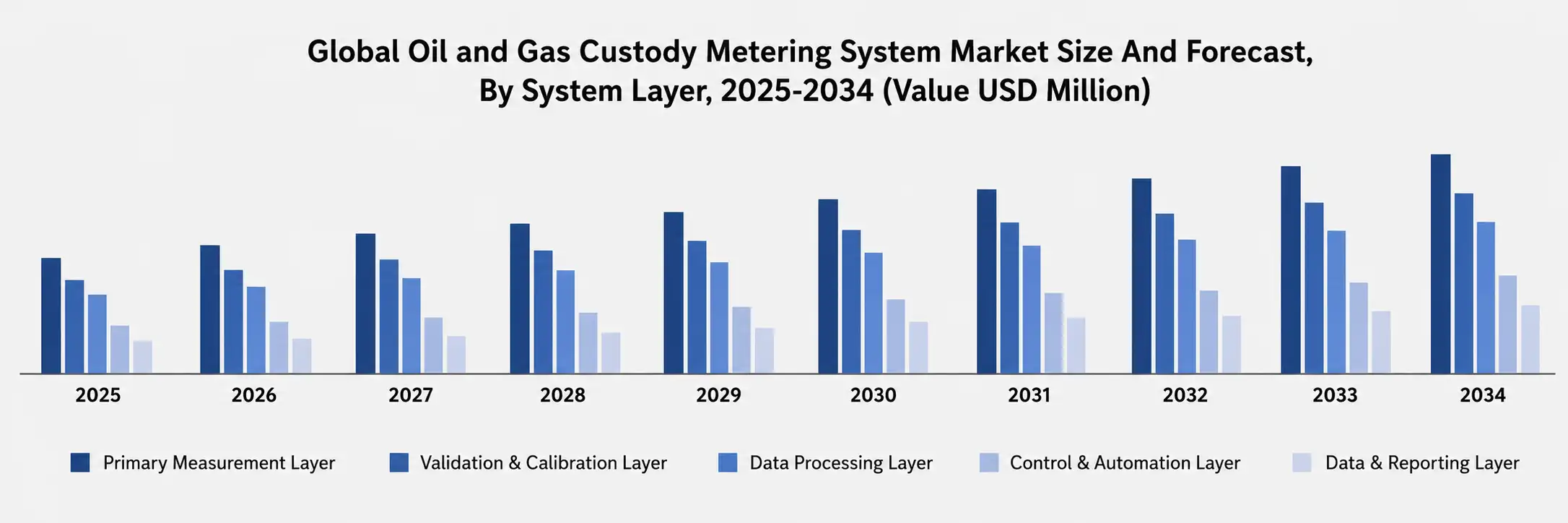
Based on System Layer, the market is segmented into Primary Measurement Layer, Validation & Calibration Layer, Data Processing Layer, Control & Automation Layer, and Data & Reporting Layer. Primary Measurement Layer held the largest market share in the Oil and Gas Custody Metering System Market in 2025. As the foundation of every custody metering system, this layer directly captures flow data using certified measurement instruments. The accuracy of all downstream calculations, reporting, and financial settlements depends on the performance of the primary measurement layer. Growing emphasis on regulatory compliance and measurement precision continues to drive investments in advanced primary sensing technologies.
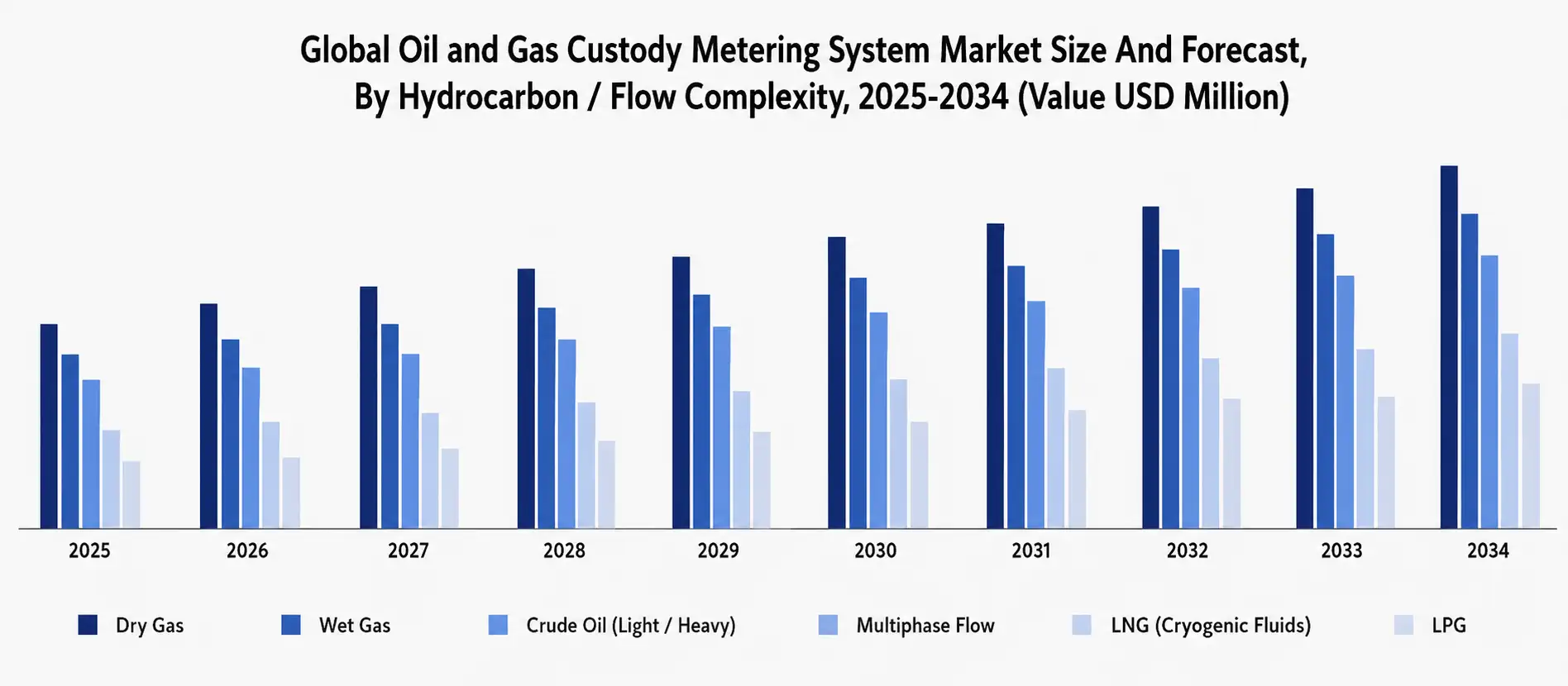
Based on Hydrocarbon / Flow Complexity, the market is segmented into Dry Gas, Wet Gas, Crude Oil (Light / Heavy), Multiphase Flow, LNG (Cryogenic Fluids), and LPG. Crude Oil (Light / Heavy) held the largest market share in the Oil and Gas Custody Metering System Market in 2025. Crude oil accounts for the highest volume of commercial hydrocarbon transactions globally, requiring highly accurate custody transfer measurement throughout production, transportation, storage, and refining operations. Increasing global crude production, expanding pipeline infrastructure, and rising export activities continue to support sustained demand for advanced custody metering systems in this segment.
Based on End-Use Sector, the market is segmented into Upstream, Midstream, Downstream, and LNG Value Chain. Midstream held the largest market share in the Oil and Gas Custody Metering System Market in 2025. Midstream operations involve extensive transportation, storage, and transfer of hydrocarbons through pipelines, terminals, and distribution networks where custody transfer occurs frequently. The need for accurate measurement, operational efficiency, and regulatory compliance has significantly increased the deployment of advanced fiscal metering systems across midstream infrastructure, making it the dominant end-use segment.
Based on Project Type, the market is segmented into Greenfield Projects, Brownfield / Retrofit Projects, and Digital Upgrade Projects. Brownfield / Retrofit Projects held the largest market share in the Oil and Gas Custody Metering System Market in 2025. Aging oil and gas infrastructure worldwide is driving operators to modernize existing custody metering installations instead of constructing entirely new facilities. Retrofitting advanced flowmeters, digital flow computers, and automation technologies enables compliance with evolving regulatory standards while minimizing capital expenditure and operational downtime, supporting the segment's market leadership.
Based on Pricing / Commercial Model, the market is segmented into CAPEX-based Systems, OPEX / Service-based Models, Digital / SaaS-based Revenue Models, and Leasing / Meter-as-a-Service Models. CAPEX-based Systems held the largest market share in the Oil and Gas Custody Metering System Market in 2025. Large-scale custody transfer installations typically require substantial upfront investments in certified metering equipment, calibration systems, automation hardware, and engineering services. National oil companies, pipeline operators, and refinery operators continue to prioritize long-term ownership of these critical assets, supporting the continued dominance of the CAPEX-based procurement model.
Based on Accuracy / Regulatory Class, the market is segmented into Custody Transfer Grade, Allocation Grade, and Operational / Monitoring Grade. Custody Transfer Grade held the largest market share in the Oil and Gas Custody Metering System Market in 2025. This segment dominates because commercial hydrocarbon transactions require the highest measurement accuracy to ensure fair financial settlements, tax calculations, and regulatory compliance. Strict international standards established by API, ISO, OIML, and regional regulatory authorities continue to drive demand for certified custody transfer-grade metering systems across global oil and gas infrastructure.
Based on Buyer Type, the market is segmented into National Oil Companies (NOCs), International Oil Companies (IOCs), Pipeline Operators, LNG Terminal Operators, and Refining & Petrochemical Companies. National Oil Companies (NOCs) held the largest market share in the Oil and Gas Custody Metering System Market in 2025. NOCs manage a substantial share of global hydrocarbon production, transportation, and export infrastructure, requiring extensive deployment of custody transfer metering systems across upstream, midstream, and downstream operations. Continuous investments in production capacity expansion, pipeline development, and export terminals, coupled with strict government compliance requirements, reinforce the leading position of this buyer segment.
Based on Lifecycle Stage, the market is segmented into New Installation Market, Replacement Market, and Upgrade / Modernization Market. Upgrade / Modernization Market held the largest market share in the Oil and Gas Custody Metering System Market in 2025. Operators are increasingly upgrading existing metering infrastructure with digital flow computers, smart flowmeters, advanced diagnostics, and automation platforms to improve measurement accuracy and operational efficiency. Rising digitalization initiatives, stricter regulatory standards, and the need to extend the operational life of aging infrastructure continue to drive modernization projects globally.
Competitive Analysis
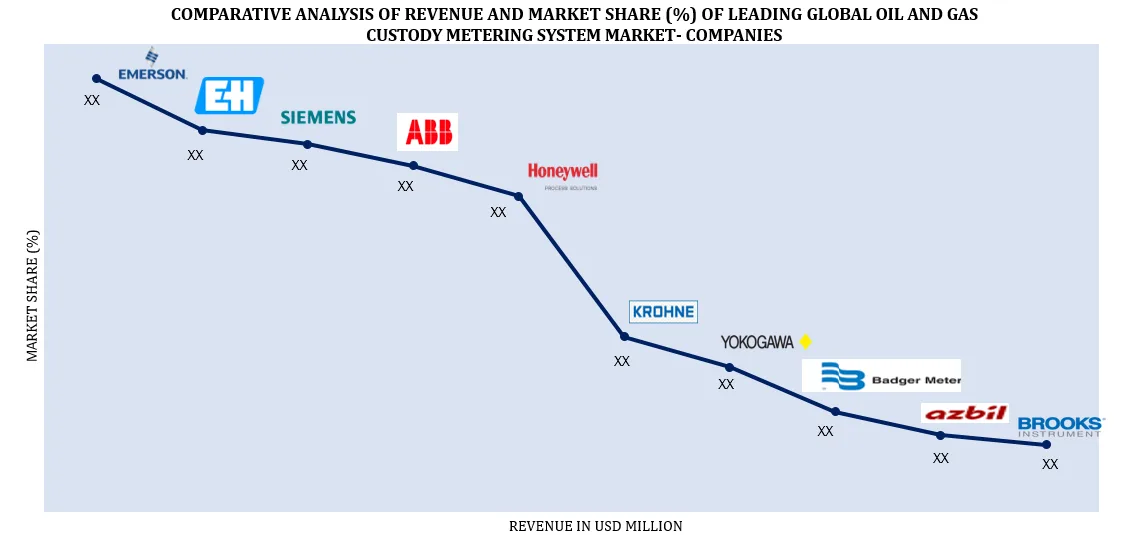
North America is led by Emerson Electric, Honeywell, Badger Meter, Itron, Rockwell Automation, McCrometer, AW-Lake, Liquid Controls, Gilbarco Veeder-Root, Tek-Trol, OMNI Flow Computers, Dynamic Flow Computers, FMC Technologies, Cameron/SLB, and Brooks Instrument. These companies compete through high-accuracy flow meters, flow computers, gas measurement, calibration, automation, and digital monitoring platforms used in upstream, midstream, pipeline, LNG, and terminal custody-transfer applications. In 2025, Emerson strengthened its position by launching the Flexim FLUXUS / PIOX 731 clamp-on ultrasonic flowmeter series for non-intrusive liquid and gas measurement, which supports demand for lower-maintenance and retrofit-friendly metering systems. Honeywell also remained active in gas and LNG automation, with a 2025 LNG technology and automation project for the Amigo LNG export terminal in Mexico, and a U.K. gas meter upgrade program supplying smart communication modules and batteries for 67,000 gas meters, showing its strength in connected gas metering and automation.
In Europe, competition is strong among Siemens, Endress+Hauser, KROHNE, LEWA, SICK, Roxar, Spirax-Sarco, Flowserve, Invensys, ABB, Schneider Electric, Yokogawa, FLEXIM, and Aquametro Oil & Marine. These companies mainly compete on ultrasonic, Coriolis, gas analysis, calibration, control systems, and integrated process instrumentation. A major 2025 development was the launch of the Endress+Hauser and SICK strategic partnership, where SICK’s gas analysis and flow measurement technology became part of Endress+Hauser’s process automation portfolio, improving its competitiveness in gas custody metering, emissions monitoring, and process efficiency. ABB also made a direct custody-transfer move in May 2025 by signing a supply frame agreement with RMG for ultrasonic gas meters in the U.S. energy market, strengthening ABB’s instrumentation and digital offering for the custody transfer and midstream segment.
In Asia Pacific and the Middle East & Africa, players such as TechnipFMC, OVAL, Azbil, GE Oil & Gas, Fuji Electric, Tokyo Keiso, Yokogawa, Cameron regional operations, Emerson MEA, TechnipFMC MEA, Petrofac, Metito, and Applus+ compete mainly through EPC-linked projects, LNG infrastructure, oilfield services, metering skids, flow computers, validation services, and after-sales support. Yokogawa remained relevant in 2025 through its focus on measurement, control, information systems, and IT/OT integration for energy and process industries, which supports digital custody-transfer and remote monitoring requirements. ABB also highlighted in 2025 that it has supported Saudi Arabia with locally made gas analyzer integration systems and has supplied customized industrial process and gas analyzer systems to major oil and gas projects, reinforcing the importance of localized manufacturing and service support in MEA. Overall, 2025 competition is moving toward ultrasonic gas measurement, digital flow monitoring, gas analysis, LNG automation, smart communication modules, and integrated validation/calibration solutions rather than only standalone meters.
Oil and Gas Custody Metering System Market Recent Developments:
| Date | Company | Development | Impact |
|---|---|---|---|
| 07 April 2026 | TechnipFMC plc | TechnipFMC confirmed its 2026 full-year financial guidance following a record subsea backlog of $16.6 billion reported in early 2026. | The massive backlog ensures sustained demand for integrated subsea production and metering systems, driving growth in the offshore custody transfer segment through the end of the decade. |
| 17 February 2026 | Badger Meter, Inc. | The company reported record 2025 financial results with $916.7 million in revenue and detailed the full integration of its SmartCover acquisition. | The strategic expansion into AI-driven remote monitoring and digital connectivity strengthens their competitive position in high-precision flow measurement and resource management. |
| 10 November 2025 | SICK AG | SICK AG launched its 2025/2026 Innovations portfolio, focusing on the integration of sensor intelligence with cloud-based edge computing. | This development enables real-time diagnostic insights and improved measurement transparency across complex oil and gas distribution networks. |
| 26 June 2025 | Emerson Electric Co. | Emerson introduced updated capabilities for the Roxar™ 2600 Multiphase Flow Meter to enhance accuracy in challenging extraction environments. | The updated system reduces measurement uncertainty in complex fluid streams, directly improving fiscal reporting and reservoir management for upstream operators. |
| 01 May 2025 | PNGRB (India) | The Petroleum and Natural Gas Regulatory Board issued the Updated LNG Terminal Regulations, formalizing strict operating and registration compliance. | These regulations mandate standardized metering and monitoring systems, creating a significant replacement and retrofit cycle for terminal automation providers in the Asia-Pacific region. |
| 23 January 2025 | Badger Meter, Inc. | Badger Meter completed the acquisition of SmartCover for $184 million to enhance its real-time visibility and analytics portfolio. | The move integrates predictive maintenance and leak detection into their core metering platforms, catering to the industry's shift toward smart infrastructure and sustainability. |
Oil and Gas Custody Metering System Market Scope: Inquire before buying
| Oil and Gas Custody Metering System Market | |||
|---|---|---|---|
| Report Coverage | Details | ||
| Base Year: | 2025 | Forecast Period: | 2026-2034 |
| Historical Data: | 2020 to 2025 | Market Size in 2025: | 11.89 USD Billion |
| Forecast Period 2026-203 CAGR: | 6.21% | Market Size in 2032: | 31.18 USD Billion |
| Segments Covered: | by Meter Type | Ultrasonic Coriolis Turbine Differential Pressure Others |
|
| by Component | Flow meters Piping and Valving Instrumentation and controls Data acquisition system Others |
||
| by Application | Pipeline Monitoring Fiscal Metering |
||
| by Location | Offshore Onshore |
||
| By Measurement Criticality | Custody Transfer / Fiscal Metering Allocation Metering Operational / Process Metering |
||
| By Transfer Point / Infrastructure | Wellhead & Subsea Metering Gathering & Processing Facilities Pipeline Transmission Metering Stations Storage Terminals & Tank Farms LNG Liquefaction & Regasification Terminals |
||
| By Metering Architecture | Single-Phase Metering Systems Multiphase Metering Systems Hybrid Metering Systems (Gas + Liquid integrated) Virtual Metering Systems (AI / Digital Twin-based) |
||
| By Digitalization Level | Conventional Metering Systems Automated Metering Systems Smart Metering Systems AI-enabled / Predictive Metering Systems |
||
| By System Layer | Primary Measurement Layer Validation & Calibration Layer Data Processing Layer Control & Automation Layer Data & Reporting Layer |
||
| By Hydrocarbon / Flow Complexity | Dry Gas Wet Gas Crude Oil (Light / Heavy) Multiphase Flow LNG (Cryogenic Fluids) LPG |
||
| By End-Use Sector | Upstream Midstream Downstream LNG Value Chain |
||
| By Project Type | Greenfield Projects/ (New installations) Brownfield / Retrofit Projects Digital Upgrade Projects (Automation & analytics upgrades) |
||
| By Pricing / Commercial Model | CAPEX-based Systems (Full system installation) OPEX / Service-based Models (Maintenance & calibration contracts) Digital / SaaS-based Revenue (Monitoring, analytics platforms) Leasing / Meter-as-a-Service Models |
||
| By Lifecycle Stage | New Installation Market (Project-driven demand) Replacement Market (Aging infrastructure) Upgrade / Modernization Market (Digitalization-driven) |
||
Oil and Gas Custody Metering System Market, by Region
North America (United States, Canada and Mexico)
Europe (UK, France, Germany, Italy, Spain, Sweden, Austria and Rest of Europe)
Asia Pacific (China, South Korea, Japan, India, Australia, Indonesia, Malaysia, Vietnam, Taiwan, Bangladesh, Pakistan and Rest of APAC)
Middle East and Africa (South Africa, GCC, Egypt, Nigeria and Rest of ME&A)
South America (Brazil, Argentina Rest of South America
Oil and Gas Custody Metering System Key Players:
North America
1. Emerson Electric Co.
2. FMC Technologies, Inc.
3. Cameron International Corporation (SLB)
4. Itron Inc.
5. Badger Meter, Inc.
6. Brooks Instrument
7. Rockwell Automation, Inc.
8. McCrometer, Inc.
9. AW-Lake Company
10. Liquid Controls
11. Gilbarco Veeder-Root
12. Tek-Trol LLC
13. Honeywell International Inc.
14. Schlumberger Limited (SLB)
15. OMNI Flow Computers, Inc.
16. Dynamic Flow Computers, Inc.
Europe
17. Siemens AG
18. Endress+Hauser Group
19. KROHNE Group
20. LEWA GmbH
21. SICK AG
22. Roxar
23. Spirax-Sarco Engineering plc
24. Flowserve Corporation
25. Invensys
26. ABB Ltd.
27. Schneider Electric
28. Yokogawa Electric Corporation
29. FLEXIM GmbH
30. Aquametro Oil & Marine AG
Asia Pacific
31. TechnipFMC plc
32. OVAL Corporation
33. Azbil Corporation
34. GE Oil & Gas
35. Fuji Electric Co., Ltd.
36. Tokyo Keiso Co., Ltd.
37. Yokogawa Electric Corporation
Middle East & Africa
38. Cameron Regional Operations
39. Emerson MEA Operations
40. TechnipFMC MEA Projects
41. Petrofac Limited
42. Metito Group
43. Applus+
Frequently Asked Questions:
1. Which region dominated the Global Oil and Gas Custody Metering System Market?
Ans: North America dominated the market in 2025.
2. What is the growth rate of the Global Oil and Gas Custody Metering System Market?
Ans: The Global market is growing at a CAGR of 6.21% during the forecasting period 2026-2034.
3. What is the scope of the Global Oil and Gas Custody Metering System Market report?
Ans: Global market report helps with the PESTEL, PORTER, Recommendations for Investors & Leaders, and market estimation of the forecast period.
4. Who are the key players in the Global Oil and Gas Custody Metering System Market?
Ans: The key players in the Global market are Siemens AG, Endress+Hauser Group, KROHNE Group, FMC Technologies, Inc., Cameron International Corporation, TechnipFMC plc and others.
5. What is the study period of this Market?
Ans: The Global market is studied from 2025 to 2034.