
3D Printing Powder Market Size by Type, Application, Region – Segment-Level Market Assessment, Growth Opportunity Analysis, Competitive Mapping & Forecast to 2032
Overview
The 3D Printing Powder Market size was valued at USD 2.43 Billion in 2025 and the total 3D Printing Powder revenue is expected to grow at a CAGR of 19.2% from 2026 to 2032, reaching USD 8.31 Billion by 2032.
3D Printing Powder Market Overview
3D printing powder is a raw material used in the 3D printing process, made out of numerous ingredients like ceramics, metals, biochemical and thermoplastics used in the 3D printing process to produce anticipated products. It is a dynamic and transformative segment within the additive manufacturing realm, employing finely-tuned powders, encompassing metals, ceramics, polymers, and composites, to revolutionize the creation of intricate three-dimensional objects, layer by layer. Its unparalleled adaptability and precision make it indispensable across diverse industries such as aerospace, healthcare, and automotive. Constant material innovation, coupled with evolving printing techniques like laser sintering and binder jetting, augments its capabilities, ensuring its continued growth and potential to reshape traditional manufacturing paradigms with efficient, customizable, and sustainable solutions for the 3D Printing Powder Market.
The 3D Printing Powder key players involved in the production of 3D printing powder material such as Carpenter, Sandvik, Erasteel and LPW Technology, are involved in the supply of 3D printing powders to the demand of the market.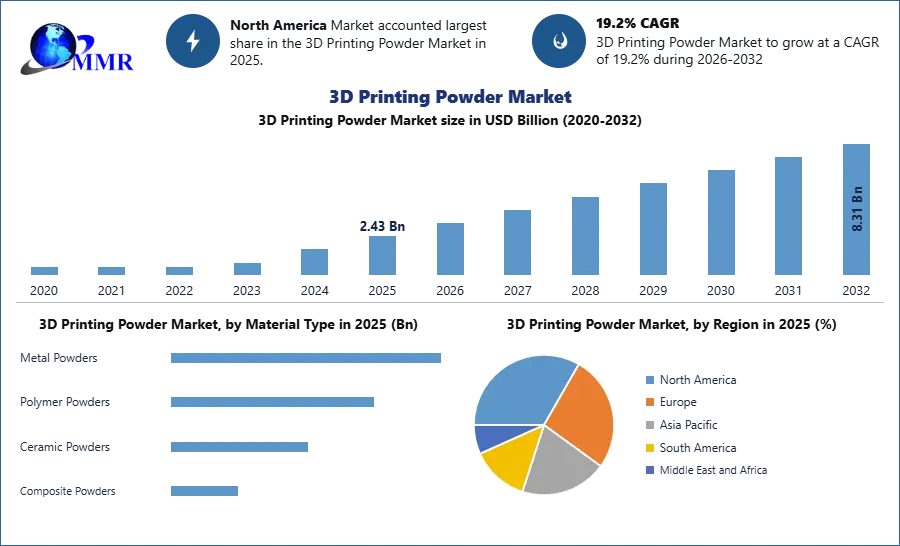 To know about the Research Methodology :- Request Free Sample Report
3D Printing Powder Market Dynamics:
Drivers and Restraints for Market Growth
The key growth driver of the 3D Printing Powder Market is the advancement in material development which has led to powders with enhanced performance characteristics. For example, 3D printing powders increase and improve the strength, durability, thermal resistance, and electrical conductivity, which make 3D-printed parts and products more reliable and functional, thus opening up new opportunities across industries.
This dynamic facet fuels the industry's expansion by continually diversifying material options, enhancing their performance characteristics, enabling tailored solutions for specific applications, promoting sustainability through eco-friendly materials, reducing costs, and fostering innovation in composite materials. Composite materials, which combine different elements to achieve superior properties, are gaining traction. For example, metal matrix composites and carbon fiber-reinforced polymers are becoming increasingly popular for high-stress applications. These innovative materials provide a balance between strength, weight, and performance.
The growing demand for 3D printing powder finds its primary driver in the medical sector, particularly in the realm of orthopedic implants, where customization to meet individual patient needs is paramount. Additionally, the cost-effective nature of 3D implant production using this technology has enticed vendors to invest, promising significant market growth in the near future. Concurrently, the expansive research and development efforts in additive manufacturing, spanning software, material development, manufacturing processes, and applications, are expected to influence the demand for 3D materials.
In the automotive industry, 3D printing powders are elevating the mechanical strength and overall performance of machinery components compared to traditional materials. These powders encompass a spectrum of pure metals, including gold, palladium, platinum, and silver, further diversifying their applications. Aerospace and automobile sectors are increasingly turning to aluminum and titanium to enhance component durability, while nickel remains a popular choice in the electronics industry, all contributing to the unstoppable growth of the 3D printing powder market. Moreover, 3D printing powder's versatility extends to consumer goods such as cosmetics, jewelry, watches, footwear, and belts. Nonetheless, market growth could face impediments from substitutes and a shortage of skilled personnel in the coming years.
The aerospace industry is also spending large budgets on developing manufacturing processes that try to make the building of titanium components more cost-effective. ADDere’s additive manufacturing streamlines the development and production process of large-scale components made from titanium.3D printing has made remarkable strides, and the availability of high-quality, reliable powders across all material types remains a concern. Inconsistent powder composition or impurities lead to defects in printed objects, compromising their integrity. Ensuring stringent quality control throughout the production process is a complex task, especially as the demand for a wider range of materials continues to grow. Material development is inherently time-consuming and costly, and as the industry races to meet diverse application needs, maintaining consistent powder quality becomes a significant challenge. These limitations are expected to slow down the market's expansion.
Opportunity for the Market
The 3D printing powder is used in healthcare and medical applications to transform the field of personalized medicine. This transformative technology holds the potential to customize nutritional products, pharmaceuticals, and even organs and drugs. It is expected to find widespread applications in pharmacy settings, where databases of medication formulations are emailed to pharmacies for on-demand drug printing, drastically altering traditional drug manufacturing and distribution methods to become more cost-effective.
As a result, patients benefit from simplified medication regimens, improving adherence. Also, the most advanced application on the horizon is the bioprinting of complex organs, with estimates suggesting that fully printable hearts could become a reality within two decades. While challenges remain, progress in printing vascular networks is promising. This advancement led to the fabrication of heterogeneous tissues such as liver and kidney tissues, enabling viable live implants, tissue models for drug discovery, and even personalized medication testing. This is expected to create a lucrative opportunity for the market growth.
3D Printing Powder Market Segment Analysis
Based on material type, the 3D Printing Powder Market is segmented into metal powders, polymer powders, ceramic powders, and others. In 2025, the metal powder segment holds the largest market share due to its extensive use in high-performance industrial applications. Metal powders such as titanium, aluminum, stainless steel, and nickel-based alloys are widely used for manufacturing complex and lightweight components with high strength and durability. The ability of metal powders to produce intricate geometries with minimal material wastage and improved mechanical properties is significantly driving their adoption across industries.
Based on technology, the market is categorized into selective laser sintering (SLS), direct metal laser sintering (DMLS), electron beam melting (EBM), binder jetting, and others. In 2025, the direct metal laser sintering (DMLS) and selective laser sintering (SLS) technologies account for a major share of the market, as these technologies enable the production of highly precise and complex components. Their capability to manufacture strong and lightweight parts with high accuracy makes them widely used in aerospace, automotive, and industrial manufacturing applications.
Based on application, the market is segmented into aerospace & defense, automotive, healthcare, industrial manufacturing, and others. In 2025, the aerospace and defense segment dominates the market due to the increasing adoption of 3D printing powders for manufacturing aircraft components, engine parts, structural parts, and defense equipment. These materials offer excellent toughness, durability, and weight reduction, which are critical factors in aerospace manufacturing. Additionally, the use of 3D printing enables faster production cycles and efficient design customization, further supporting the growth of this segment.
3D Printing Powder Market Regional Analysis:
Regionally, North America dominated the 3D Printing Powder Market in 2025, supported by the strong presence of advanced manufacturing infrastructure and early adoption of additive manufacturing technologies. Countries such as the United States and Canada are major contributors to the regional market, driven by increasing demand from industries including aerospace & defense, healthcare, and automotive. The presence of major additive manufacturing companies and continuous investments in research and development further strengthen the market growth in the region.
Asia Pacific held a significant share of the market in 2025 and is expected to witness strong growth during the forecast period. The growth is driven by the increasing adoption of 3D printing technologies across industries such as medical and dental, automotive, aerospace, and defense. Rapid industrialization and expanding manufacturing activities in countries such as China and India are further contributing to market expansion. China, being one of the largest global manufacturing hubs, plays a key role in driving the demand for 3D printing powders in the Asia Pacific region.
The objective of the report is to present a comprehensive analysis of the Global 3D Printing Powder Market including all the stakeholders of the industry. The past and current status of the industry with forecasted market size and trends are presented in the report with the analysis of complicated data in simple language. The report covers all the aspects of the industry with a dedicated study of key players that includes market leaders, followers and new entrants. PORTER, SWOT, and PESTEL analysis with the potential impact of micro-economic factors of the market have been presented in the report. External as well as internal factors that are supposed to affect the business positively or negatively have been analyzed, which will give a clear futuristic view of the industry to the decision-makers.
The report also helps in understanding the Global 3D Printing Powder Market dynamics, and structure by analysing the market segments and expected the Global 3D Printing Powder Market size. Clear representation of competitive analysis of key players by Application, price, financial position, Product portfolio, growth strategies, and regional presence in the Global 3D Printing Powder Market make the report an investor’s guide.
3D Printing Powder Market Recent Developments (2025-2026):
| Exact Date | Company | Development | Impact |
|---|---|---|---|
| 18 February 2026 | Stratasys | Launched the P3 Silicone 25A material, a high-performance biocompatible silicone powder substitute for DLP platforms. | The development enables the production of industrial-grade flexible parts with 100% silicone, reducing the need for traditional molding in healthcare and consumer goods. |
| 18 November 2025 | HP Inc. | Announced the general availability of HP 3D HR PA 11 Gen2, a bio-based polymer powder for its Multi Jet Fusion (MJF) systems. | The new material improves sustainability with 80% powder reusability and reduces variable part costs by up to 40% for industrial users. |
| 13 August 2025 | Sandvik AB | Introduced Osprey® MAR 55, a versatile tool steel powder designed to bridge the gap between maraging steels and carbon-bearing steels. | This alloy offers exceptional weldability and mechanical strength, simplifying the manufacturing of high-performance components in the aerospace and tooling sectors. |
3D Printing Powder Market Scope: Inquire before buying
| 3D Printing Powder Market | |||
|---|---|---|---|
| Report Coverage | Details | ||
| Base Year: | 2025 | Forecast Period: | 2026-2032 |
| Historical Data: | 2020 to 2025 | Market Size in 2025: | 2.43 USD Billion |
| Forecast Period 2026-2032 CAGR: | 19.2% | Market Size in 2032: | 8.31 USD Billion |
| Segments Covered: | by Material Type | Metal Powders Polymer Powders Ceramic Powders Composite Powders |
|
| by Technology | Selective Laser Sintering (SLS) Direct Metal Laser Sintering (DMLS) Electron Beam Melting (EBM) Binder Jetting Laser Metal Deposition (LMD) Others |
||
| by Application | Aerospace & Defense Automotive Healthcare & Medical Industrial Manufacturing Consumer Goods Others |
||
3D Printing Powder Market, by Region
North America (United States, Canada and Mexico)
Europe (UK, France, Germany, Italy, Spain, Sweden, Austria and Rest of Europe)
Asia Pacific (China, South Korea, Japan, India, Australia, Indonesia, Malaysia, Vietnam, Taiwan, Bangladesh, Pakistan and Rest of APAC)
South America (Brazil, Argentina Rest of South America)
Middle East and Africa (South Africa, GCC, Egypt, Nigeria and Rest of ME&A)
Global 3D Printing Powder Market Key Players
1. EOS GmbH
2. GE Additive
3. 3D Systems
4. Stratasys
5. HP Inc.
6. Oceania International LLC
7. Carpenter Technology Corporation
8. LPW Technology Ltd
9. Exone GmbH
10. Hoganas AB
11. Sandvik AB
12. Carpenter
13. Hoganas AB
14. Optomec
15. Arcam AB
16. Arkema
17. Erasteel
18. Metalysis
19. GKN PLC
20. Puris
21. Advanced Powders and Coatings Inc.