
Microneedle Drug Delivery Systems Market – Global Market Size, Strategic Growth Drivers, Risk Assessment Framework, Regulatory Landscape Review, Competitive Intensity Mapping & Long-Term Industry Outlook to 2032
Overview
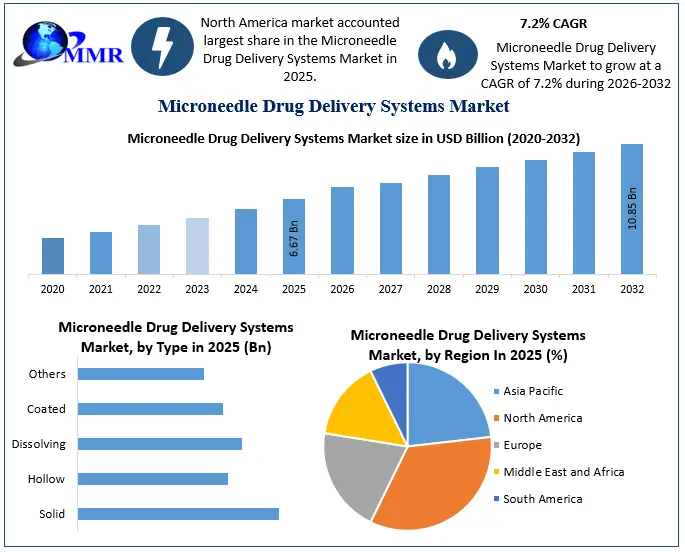
The Microneedle Drug Delivery Systems Market size was valued at USD 6.67 billion in 2025, and the total Microneedle Drug Delivery Systems revenue is expected to grow at a CAGR of 7.2% from 2026 to 2032, reaching nearly USD 10.85 billion.
Microneedle drug delivery systems Market Overview:
The Global Microneedle Drug Delivery Systems Market is gaining momentum as pharmaceutical and biotechnology companies are discovering minimally invasive alternatives for conventional injections and more convenient approaches to drug administration. Microneedle platforms. Microneedle platforms can deliver therapeutic compounds through the skin, potentially reducing injection-related discomfort. reducing injection-related discomfort and improve patient acceptance. The technology is being explored across drug delivery, vaccine delivery, dermatology, pain management, cancer therapy, and other applications, as the interest in chronic disease management and self-administered therapies is growing. In 2024, the drug delivery application accounted for 34.3% of the market; this highlights its leading role and the increasing use of microneedle platforms for chronic disease management and therapeutic applications. Advancements are taking place in dissolving, hollow, coated, and solid microneedles, along with polymer engineering and wearable patch technologies. This are expanding the range of therapeutic applications and supporting the development of next-generation transdermal delivery systems.
The market is also getting benefit from increasing pharmaceutical R&D activity focusing on improving drug bioavailability, controlled release, and patient adherence. Dissolving microneedles are attracting particular attention because they can potentially eliminate the need for needle removal after administration, while wearable and smart microneedle systems are opening opportunities for continuous monitoring and personalized drug delivery. Vaccine delivery represents another promising application, as microneedle patches may simplify administration and improve accessibility in mass immunization settings. North America remains a key innovation hub due to its advanced pharmaceutical ecosystem and strong R&D capabilities, while Asia-Pacific is emerging as an attractive growth market supported by expanding healthcare infrastructure, biotechnology investment, and increasing adoption of advanced drug delivery technologies. These developments are expected to strengthen the role of microneedle platforms in the future of patient-centric and minimally invasive healthcare.
 To know about the Research Methodology: Request Free Sample Report
Microneedle Drug Delivery Systems Market Dynamics:
Rising Demand for Minimally Invasive and Patient-Friendly Drug Administration
The preference for painless and minimally invasive drug administration is increasing, thus growing interest in microneedle-based delivery systems. Unlike conventional hypodermic injections, microneedles can potentially reduce discomfort and improve patient acceptance, supporting their adoption for chronic disease management, self-administration, and home-based therapies. The growing focus on patient-centric healthcare is encouraging pharmaceutical companies to explore microneedle platforms for controlled and targeted drug delivery.
Advancements in Microneedle Technology and Materials
The innovation in dissolving, hollow, solid, and coated microneedles is increasing the capabilities of transdermal drug delivery. Advancement in biodegradable polymers, microfabrication, and controlled-release technologies are enabling more efficient delivery of complex therapeutic compounds. The development of wearable and smart microneedle systems is further creating opportunities for integrated drug delivery and real-time monitoring.
Growing Pharmaceutical R&D and Biologics Development
Increasing pharmaceutical R&D activities focusing on biologics, vaccines, peptides, and other complex therapeutics is creating opportunities for advanced delivery technologies. Microneedle systems can substantially improve drug stability, bioavailability, and administration convenience, encouraging collaboration between pharmaceutical companies, biotechnology firms, and technology developers.
High Development Costs and Regulatory Complexity
The market faces challenges related to high R&D and manufacturing costs, complex microfabrication processes, and regulatory requirements for combination drug-device products. Demonstrating consistent dose delivery, product stability, safety, and manufacturing quality can increase development timelines and commercialization costs, particularly for emerging microneedle technologies.
Expansion of Vaccine Delivery and Self-Administration Applications
The focus is shifting on accessible vaccination and decentralized healthcare is creating opportunities for microneedle patches that can simplify administration and potentially reduce dependence on trained healthcare professionals. Similarly, growing demand for self-administered therapies is encouraging research into wearable and patch-based systems, supporting broader commercialization opportunities across vaccines, chronic disease therapies, and other applications.
Microneedle Drug Delivery Systems Market Trends:
- Dissolving and Biodegradable Microneedles Gaining Adoption: Increasing development of dissolving and biodegradable microneedles is supporting painless drug administration while reducing sharps waste and simplifying disposal. These systems are gaining attention for vaccines, biologics, and other sensitive therapeutics.
- Growing Shift Toward Self-Administration and Patient-Centric Drug Delivery: The market is moving toward microneedle patches that enable convenient self-administration at home, reducing dependence on healthcare professionals and improving treatment adherence for chronic and recurring therapies.
- Expansion Into Biologics and Advanced Therapeutics: Microneedle platforms are increasingly being developed for peptides, proteins, vaccines, hormones, and other complex therapeutics that face limitations with conventional oral or injectable delivery routes.
- Wearable and Smart Microneedle Systems Enabling Controlled Drug Release: Integration with wearable sensors, microelectronics, responsive materials, and digital health technologies is creating smart microneedle systems capable of controlled, programmable, and potentially personalized drug delivery.
- Increasing Use of Microneedles for Vaccine Delivery: Microneedle patches are gaining interest as an alternative to conventional needle-based vaccination because of their potential to reduce administration discomfort, simplify logistics, and support broader access to immunization.
Global Microneedle Drug Delivery Systems Market Segment Analysis:
The By System Type segment is divided into Solid, Hollow, Dissolving, Coated, and Others. Hollow microneedles accounted for the largest revenue share in 2024, supported by their suitability for delivering liquid formulations and applications such as vaccines and hormonal therapies. Their ability to enable controlled delivery of drug formulations directly into the skin is supporting their continued use across pharmaceutical applications. Dissolving microneedles, meanwhile, are projected to register the fastest CAGR during the forecast period, driven by their biodegradable nature and the ability to dissolve after insertion, eliminating the need for removal and reducing sharps waste. Solid microneedles remain relevant for skin pretreatment and enhancing transdermal permeability, while coated microneedles are being explored for rapid delivery of vaccines and other therapeutics. The By Application segment is divided into Dermatology, Drug Delivery, Pain Management, Cancer Therapy, Vaccine Delivery, and Others. Drug delivery accounted for 34.3% of the global market in 2024, making it the leading application segment. This dominance is attributed to the increasing use of microneedle systems for chronic disease management and the delivery of therapeutics such as insulin and other complex drugs, supported by the technology's potential to improve bioavailability, reduce administration-related discomfort, and enhance patient compliance. Vaccine delivery is projected to register the fastest CAGR of 8.7% during the forecast period, reflecting growing interest in painless and targeted immunization, self-administration, simplified vaccination logistics, and the potential for improved vaccine stability. Dermatology remains an important application area, while pain management and cancer therapy represent emerging opportunities for localized and minimally invasive therapeutic delivery.
Microneedle Drug Delivery Systems Market Regional Insights:
North America holds the leading position in the global microneedle drug delivery systems market, representing around 43.1% of global revenue and a market value of around USD 2.87 billion in 2025. The region's dominance is supported by its well-established pharmaceutical and biotechnology ecosystem, high healthcare expenditure, and strong focus on innovative drug delivery technologies. The U.S. is the primary contributor, supported by extensive R&D in transdermal delivery, biologics, vaccines, and minimally invasive therapeutic technologies. The presence of advanced clinical research infrastructure and increasing demand for patient-centric drug administration is further strengthening the regional market.
Europe represents the second-largest regional market, with an estimated 25.9% share and a market value of approximately USD 1.73 billion in 2025. The market is supported by strong pharmaceutical research capabilities, growing interest in non-invasive drug administration, and increasing development of advanced transdermal delivery technologies. Countries such as Germany, the U.K., France, and Switzerland are contributing to regional innovation through pharmaceutical R&D and clinical research. The region's emphasis on improving patient adherence and reducing the burden associated with conventional injections is also creating opportunities for dissolving, hollow, and coated microneedle systems.
Asia Pacific is emerging as a high-potential market, accounting for around 18.9% of global revenue and representing around USD 1.26 billion in 2025. The region's growth is supported by expanding pharmaceutical manufacturing, rising healthcare expenditure, large patient populations, and increasing investment in advanced drug delivery technologies. China, Japan, and India are at the forefront of regional development, with growing research activity in microneedle-based vaccines, biologics, and transdermal therapies. The region's large population base and increasing need for convenient and minimally invasive treatment options are expected to make it an increasingly important market for next-generation microneedle platforms.
Latin America represents an emerging opportunity for microneedle drug delivery technologies as healthcare systems modernize and demand increases for convenient and minimally invasive treatment options. Adoption is expected to be concentrated in countries with relatively advanced pharmaceutical and healthcare infrastructure, particularly Brazil and Mexico. The development of vaccine delivery technologies and growing interest in patient-friendly drug administration could support future market penetration, although limited access to advanced manufacturing capabilities and specialized healthcare technologies may constrain near-term adoption.
Middle East & Africa remains a developing market, with opportunities linked to healthcare infrastructure expansion and increasing investment in advanced medical technologies. Saudi Arabia, the UAE, and South Africa are among the markets with potential for adoption as healthcare systems increasingly emphasize modern therapeutic approaches. Microneedle platforms could find particular opportunities in vaccine delivery and other applications where simplified administration and improved patient convenience are important. However, limited awareness, uneven healthcare infrastructure, and restricted access to advanced drug delivery technologies remain key factors influencing regional adoption.
Microneedle Drug Delivery Systems Market Recent Developments:
| Month & Year | Recent Developments |
| Feb 2025 | Becton, Dickinson and Company (BD) announced plans to separate its Biosciences and Diagnostic Solutions business, allowing the company to sharpen its strategic focus and investment priorities across its healthcare technology portfolio. |
| Oct 2024 | Ya-Man introduced a skincare series featuring 24K gold-coated microneedles, highlighting the expanding use of microneedle technology beyond pharmaceutical delivery into advanced dermatological and aesthetic applications. |
| 2025–2026 | Research activity is increasingly moving toward smart and stimulus-responsive microneedle systems. Researchers at McGill University developed a light-activated microneedle patch for controlled delivery of the IVF hormone leuprolide in early preclinical studies, illustrating the potential integration of microneedles with programmable drug-release technologies. |
| May 2026 | New research demonstrated an AI-assisted, closed-loop approach to cryomicroneedle formulation discovery, combining machine learning, Bayesian optimization, and laboratory validation to improve formulation development for cryomicroneedle systems. The work signals growing integration of AI into next-generation microneedle R&D. |
Global Microneedle Drug Delivery Systems Market Competitive Landscape:
Microneedle Drug Delivery Systems Market Scope: Inquire before buying
| Microneedle Drug Delivery Systems Market | |||
|---|---|---|---|
| Report Coverage | Details | ||
| Base Year: | 2025 | Forecast Period: | 2026-2032 |
| Historical Data: | 2020 to 2025 | Market Size in 2025: | USD 6.67 Bn. |
| Forecast Period 2026 to 2032 CAGR: | 7.2% | Market Size in 2032: | USD 10.85 Bn. |
| Segments Covered: | By System Type | Solid Hollow Dissolving Coated Others |
|
| By Material | Silicon Metal Polymer Others |
||
| By Application | Dermatology Drug Delivery Pain Management Cancer Therapy Vaccine Delivery Others |
||
| By End-User | Hospitals Ambulatory Surgical Centers Specialty Clinics Academic Institutions Research Institutes |
||
Microneedle Drug Delivery Systems Market, by Region
North America (United States, Canada and Mexico)
Europe (UK, France, Germany, Italy, Spain, Sweden, Austria and Rest of Europe)
Asia Pacific (China, South Korea, Japan, India, Australia, Indonesia, Malaysia, Vietnam, Taiwan, Bangladesh, Pakistan and Rest of APAC)
Middle East and Africa (South Africa, GCC, Egypt, Nigeria and Rest of ME&A)
South America (Brazil, Argetina and Rest of South America)
Microneedle Drug Delivery Systems Key Players:
North America
- Becton, Dickinson and Company (BD) – United States
- 3M Company – United States
- Zosano Pharma Corporation – United States
- Corium, Inc. – United States
- Valeritas, Inc. – United States
- Micron Biomedical, Inc. – United States
- Vaxess Technologies, Inc. – United States
- Kindeva Drug Delivery – United States
- TheraJect, Inc. – United States
- Microdermics, Inc. – Canada
Europe
- LTS Lohmann Therapie-Systeme AG – Germany
- Debiotech SA – Switzerland
- Innoture Medical Technology Limited – United Kingdom
- Cutanos GmbH – Switzerland
Asia Pacific
- Raphas Co., Ltd. – South Korea
- Nitto Denko Corporation – Japan
- NanoPass Technologies Ltd. – Israel
- CosMED Pharmaceutical Co., Ltd. – Japan
- SNvia Co., Ltd. – South Korea
- QuadMedicine Inc. – South Korea
- Endoderma Ltd. – South Korea
- Terumo Corporation – Japan
- Hisamitsu Pharmaceutical Co., Inc. – Japan
- Vaxxas Pty Ltd. – Australia
Others
Frequently Asked Questions:
1. How does microneedle drug delivery differ from traditional injection methods?
Ans: Microneedle drug delivery involves the use of tiny needles that penetrate the skin to deliver medications or vaccines, while traditional injections typically use larger needles. Microneedles offer the advantage of being minimally invasive and potentially painless.
2. What are the advantages of using microneedle drug delivery systems?
Ans: According to the research, microneedle drug delivery systems can improve medication absorption, target skin layers, allow self-administration and prevent needlestick injuries. Product may aid regulated drug administration and patient adherence.
3. How are microneedle drug delivery systems manufactured?
Ans: Microneedle drug delivery systems are manufactured using various techniques, including micro moulding, lithography, or laser ablation. These processes allow for the precise fabrication of microneedles with specific dimensions and properties.
4. What types of drugs can be delivered using microneedle systems?
Ans: Microneedles can deliver various drugs including small molecules, biologics, vaccines and gene-based therapies. High adaptability makes these systems suitable for medical use cases.
5. What was the Global Microneedle Drug Delivery Systems Market size in 2025?
Ans: The Global Microneedle Drug Delivery Systems Market size was USD 6.67 Billion in 2025.