
Merchant Hydrogen Market Size by Application, Type, Storage, Region – Revenue Pool Analysis, Margin Structure Assessment, Capital Flow Trends, Competitive Benchmarking & Forecast to 2034
Overview
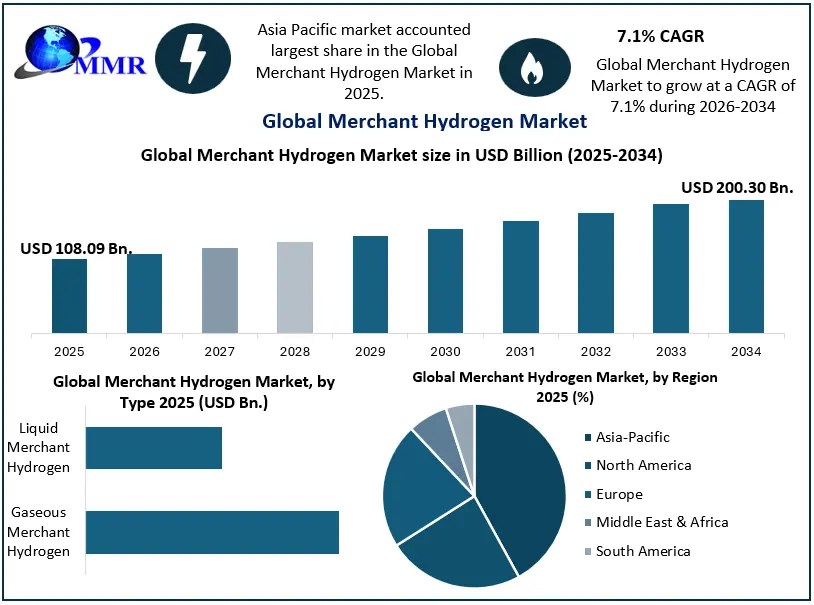
The Merchant Hydrogen Market size was valued at USD 108.09 Billion in 2025 and the total Merchant Hydrogen revenue is expected to grow at a CAGR of 7.1% from 2026 to 2034, surged to USD 200.30 Billion.
The Merchant Hydrogen Market is growing due to increasing demand from petroleum refining, chemical manufacturing, fertilizer production, electronics, and clean energy applications. Merchant hydrogen is produced by specialized suppliers and sold to external customers through pipelines, gas cylinders, tube trailers, and liquid hydrogen delivery systems. Asia-Pacific leads the Merchant Hydrogen Market, supported by strong industrial demand and expanding hydrogen infrastructure. Key market drivers include rising hydrogen consumption and investments in low-carbon hydrogen technologies, while high production costs, storage requirements, and transportation infrastructure remain major challenges. Leading companies include Air Liquide, Linde, Air Products, Messer, and Nippon Sanso Holdings.
Merchant Hydrogen Market Growth and Share Analysis
To know about the Research Methodology :- Request Free Sample Report
Merchant Hydrogen Market Dynamics:
Market Drivers
Growing Industrial Demand for Merchant Hydrogen: Merchant hydrogen plays an important role in industries that require a reliable external hydrogen supply, including petroleum refining, chemical manufacturing, food processing, electronics, and metal production. According to the International Energy Agency (IEA), global hydrogen demand surpasses 100 million tonnes in 2025, driven mainly by traditional industrial applications and refining. This growing demand creates opportunities for merchant hydrogen suppliers that serve multiple industrial customers without requiring each customer to operate its own hydrogen production facility.
Expansion of Merchant Hydrogen Supply Networks: Industrial gas companies expand hydrogen production and distribution networks to supply customers that lack dedicated hydrogen manufacturing facilities. Merchant hydrogen reaches end users through pipelines, high-pressure gas cylinders, tube trailers, and liquid hydrogen tankers, depending on their consumption levels and location. This supply model allows customers to access hydrogen without investing in their own production plants. The IEA reports that global hydrogen demand exceeds 100 million tonnes in 2025, with established industrial uses accounting for almost all consumption. This demand base creates opportunities for merchant suppliers to expand their customer networks and improve supply reliability.
Market Restraints
High Production and Distribution Costs: High production costs limit the competitiveness of merchant hydrogen, particularly when suppliers use renewable-powered electrolysis. According to the International Energy Agency (IEA), renewable hydrogen production remains more expensive than conventional fossil-based production in many regions, with the cost gap influenced by electricity prices, electrolyser investment, and local fuel costs. In 2025, the IEA also highlights that higher electrolyser costs and slower-than-expected technology deployment continue to challenge cost reductions. Merchant suppliers additionally face expenses related to compression, liquefaction, storage, packaging, and delivery. These costs increase the final price for customers located far from production facilities, making conventional hydrogen more attractive in price-sensitive industries.
Limited Distribution Infrastructure and Safety Requirements: The merchant hydrogen market depends on reliable storage facilities, distribution networks, and specialized transport equipment. Hydrogen requires careful handling because it can leak through unsuitable materials and is highly flammable. Establishing pipelines, refuelling stations, high-pressure storage systems, and liquid hydrogen facilities requires substantial capital investment. These requirements make it difficult for suppliers to serve remote industrial customers economically and can delay expansion into new regions.
Market Opportunities
Growing Demand for Low-Emission Hydrogen: The shift toward cleaner industrial production creates opportunities for merchant suppliers to offer low-emission hydrogen to refineries, chemical manufacturers, and other industrial customers. The IEA reports that low-emissions hydrogen production grows by 20% in 2025, reaching nearly 1 million tonnes globally. Although this represents a small share of total production, the increase creates opportunities for suppliers that invest in renewable-powered electrolysis and other low-emission production technologies.
Industrial Partnerships and Long-Term Supply Agreements: Partnerships between hydrogen producers, industrial gas suppliers, and end users create opportunities to secure reliable demand and support investment in production facilities. Long-term supply agreements help customers maintain a consistent hydrogen supply while giving producers greater visibility into future sales. The IEA reports that newly signed offtake agreements for low-emissions hydrogen total approximately 1.7 million tonnes per year in 2025, although only around 20% of the newly signed volumes have firm contractual commitments. Expanding firm agreements can help merchant suppliers reduce demand uncertainty and move projects toward commercial operation.
Market Challenges
Balancing Production Capacity with Customer Demand: Merchant hydrogen suppliers need to match production capacity with customer requirements while managing operating costs and delivery schedules. Building facilities before securing reliable customers can create financial risks, while insufficient capacity can disrupt supply to industrial users. The IEA identifies high costs, uncertain demand, regulatory uncertainty, and slow infrastructure development as major barriers to faster growth in low-emission hydrogen. Suppliers therefore depend on credible offtake agreements, supportive policies, and coordinated infrastructure planning to expand sustainably.
Maintaining Reliable and Safe Hydrogen Delivery: Hydrogen suppliers must maintain product quality, pressure, purity, and delivery reliability to meet the requirements of different industries. Transportation over long distances adds logistical complexity, particularly when suppliers use compressed or liquefied hydrogen. Companies also need suitable equipment, leak detection systems, trained personnel, and strict operating procedures to manage safety risks. These requirements increase operating complexity and make investment in specialized distribution infrastructure essential for the long-term development of the merchant hydrogen market.
Merchant Hydrogen Market Segment Analysis
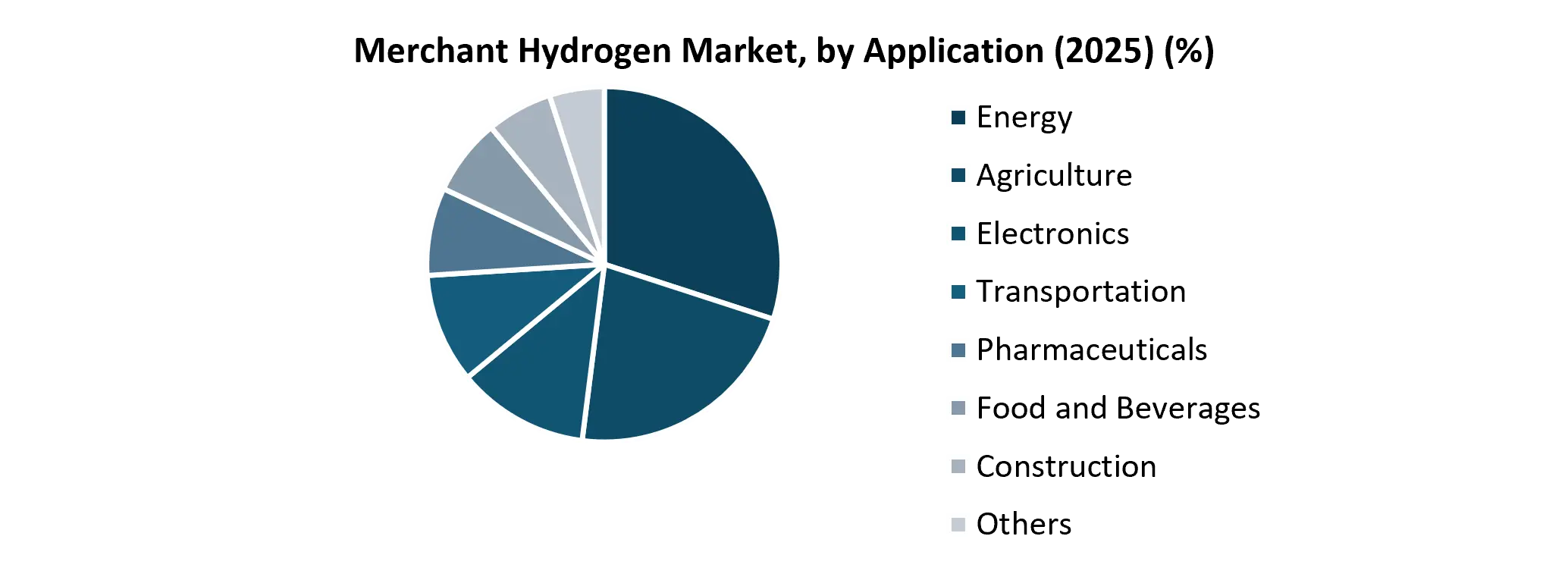
Based on Application, the Merchant Hydrogen Market is segmented into agriculture, construction, energy, electronics, food and beverages, transportation, pharmaceuticals, and others. Agriculture drives hydrogen demand mainly through ammonia production, which supports the manufacturing of nitrogen-based fertilizers. The energy sector uses merchant hydrogen in petroleum refining, fuel processing, and emerging clean energy applications. Electronics manufacturers rely on high-purity hydrogen for semiconductor production and other specialized processes. In the food and beverages industry, hydrogen supports edible oil hydrogenation and selected food processing activities. The transportation sector uses hydrogen in fuel-cell vehicles, while pharmaceutical companies depend on it for specific chemical synthesis and hydrogenation processes. Construction-related demand comes primarily from metalworking and industrial operations. Overall, Merchant Hydrogen Market growth across these applications depends on hydrogen purity, consistent supply, industrial demand, and efficient distribution networks.
 Based on Type, the Merchant Hydrogen Market is divided into gaseous merchant hydrogen and liquid merchant hydrogen. Gaseous merchant hydrogen is distributed through pipelines, compressed gas cylinders, and tube trailers, making it suitable for industrial facilities that require a steady and reliable supply. It supports applications in chemical manufacturing, petroleum refining, electronics, and metal processing. Liquid merchant hydrogen is produced by cooling hydrogen to extremely low temperatures, reducing its volume and making bulk transportation more practical for certain applications. It serves industries that require high-purity hydrogen, including aerospace, electronics, and specialized manufacturing. The selection of gaseous or liquid merchant hydrogen depends on consumption volume, transportation distance, storage capacity, and delivery costs. These factors influence Merchant Hydrogen Market trends and the development of efficient hydrogen supply solutions.
Based on Storage, the Merchant Hydrogen Market is segmented into high-pressure gas cylinders, cryogenic tanks, and others. High-pressure gas cylinders store compressed hydrogen and serve customers with low or intermittent consumption, including laboratories, electronics manufacturers, and small industrial facilities. Cryogenic tanks store liquid hydrogen at extremely low temperatures and support bulk storage and transportation requirements for applications that consume larger quantities of hydrogen. Other storage solutions include tube trailers, bulk storage systems, and specialized stationary facilities that support hydrogen distribution networks. Storage selection depends on the physical form of hydrogen, required capacity, delivery frequency, safety requirements, and end-user needs. As industrial demand for merchant hydrogen increases, reliable storage infrastructure and safe handling systems remain important factors supporting Merchant Hydrogen Market growth and the industry's long-term outlook.
Merchant Hydrogen Market Regional Insights
Asia-Pacific dominates the Merchant Hydrogen Market, driven by strong demand from chemical manufacturing, petroleum refining, fertilizer production, and metal processing. China, India, Japan, and South Korea support regional growth through expanding industrial activities and investments in hydrogen infrastructure. Government initiatives promoting clean energy and green hydrogen further strengthen the Asia-Pacific Merchant Hydrogen Market growth.
North America holds a significant share of the Merchant Hydrogen Market, supported by established refining, petrochemical, and chemical industries. The United States and Canada drive demand through industrial hydrogen consumption and investments in low-carbon hydrogen production. Expanding distribution infrastructure and clean energy initiatives support the North America Merchant Hydrogen Market outlook.
Europe remains an important region in the Merchant Hydrogen Market, driven by industrial demand and carbon reduction targets. Germany, France, the United Kingdom, and the Netherlands support hydrogen consumption across refining and chemical manufacturing. Investments in renewable hydrogen and distribution networks strengthen Europe Merchant Hydrogen Market trends.
The Middle East and Africa Merchant Hydrogen Market benefits from established oil and gas industries, fertilizer production, and emerging clean hydrogen projects. Saudi Arabia, the UAE, and Egypt invest in hydrogen production and export infrastructure, creating opportunities for market expansion and industrial diversification.
South America offers growing opportunities in the Merchant Hydrogen Market, supported by industrial demand and renewable energy resources. Brazil and Chile advance hydrogen-related initiatives, while strong solar, wind, and hydropower potential supports green hydrogen development. Investments in production and distribution infrastructure contribute to the region's Merchant Hydrogen Market growth potential.
Merchant Hydrogen Market Recent Developments:
| Date | Company | Development | Impact |
| August 2026 | BHEL and Hystar | Establish a strategic partnership to support local manufacturing of PEM electrolyzer systems in India. | Strengthens domestic hydrogen technology manufacturing and supply capabilities. |
| July 2026 | Plug Power and Orica | Advance a 50 MW renewable hydrogen project in Australia's Hunter Valley following a final investment decision. | Supports renewable hydrogen supply for industrial ammonia production. |
| June 2026 | H-Power and Protium | Sign an agreement for the sale of 5,000 kg of green hydrogen produced from cracked ammonia. | Expands commercial hydrogen supply and distribution opportunities. |
| March 2026 | NeuEN Green Energy and Numaligarh Refinery | Secure a 10,000-tonne-per-year green hydrogen supply contract under a 25-year agreement. | Supports long-term merchant hydrogen supply to the refining industry. |
| January 2026 | Kawasaki Heavy Industries and Japan Suiso Energy | Sign a contract to build a 40,000-cubic-metre liquefied hydrogen carrier. | Supports the development of large-scale hydrogen transportation and international supply chains. |
Merchant Hydrogen Market Key Development:
The research study includes the profiles of leading companies operating in the global merchant hydrogen market. In Feb 2019, Hydrogenics Corp. bagged a new order from Air Liquide to construct, design and installs an electrolyze system for the production of hydrogen in the latter’s new facility in Canada.
The objective of the report is to present a comprehensive analysis of the Global Merchant Hydrogen Market including all the stakeholders of the industry. The past and current status of the industry with forecasted market size and trends are presented in the report with the analysis of complicated data in simple language. The report covers all the aspects of the industry with a dedicated study of key players that includes market leaders, followers, and new entrants. PORTER, SVOR, PESTEL analysis with the potential impact of micro-economic factors of the market has been presented in the report.
External as well as internal factors that are supposed to affect the business positively or negatively have been analyzed, which will give a clear futuristic view of the industry to the decision-makers.
The report also helps in understanding Global Market dynamics, structure by analyzing the market segments and projects the Global Market size. Clear representation of competitive analysis of key players by Application, price, financial position, Product portfolio, growth strategies, and regional presence in the Global Merchant Hydrogen Market make the report investor’s guide.
Merchant Hydrogen Market Scope: Inquire before buying
| Merchant Hydrogen Market | |||
|---|---|---|---|
| Report Coverage | Details | ||
| Base Year: | 2025 | Forecast Period: | 2026-2034 |
| Historical Data: | 2020 to 2025 | Market Size in 2025: | USD 108.09 Bn. |
| Forecast Period 2026 to 2034 CAGR: | 7.1% | Market Size in 2034: | USD 200.30 Bn. |
| Segments Covered: | by Application | Agriculture Construction Energy Electronics Food and Beverages Transportation Pharmaceuticals Others |
|
| by Type | Gaseous Merchant Hydrogen Liquid Merchant Hydrogen |
||
| by Storage | High Pressure Gas Cylinders Cryogenic Tanks Others |
||
Merchant Hydrogen Market, by Region
North America (United States, Canada and Mexico)
Europe (UK, France, Germany, Italy, Spain, Sweden, Austria and Rest of Europe)
Asia Pacific (China, South Korea, Japan, India, Australia, Indonesia, Malaysia, Vietnam, Taiwan, Bangladesh, Pakistan and Rest of APAC)
Middle East and Africa (South Africa, GCC, Egypt, Nigeria and Rest of ME&A)
South America (Brazil, Argentina Rest of South America)
Merchant Hydrogen Market Key Players
1. Air Liquide
2. Linde plc
3. Air Products and Chemicals, Inc.
4. Airgas
5. Messer SE & Co. KGaA
6. Nippon Sanso Holdings Corporation
7. INOX Air Products
8. Coregas
9. Matheson Tri-Gas
10. Air Water Inc.
11. SOL Group
12. Gulf Cryo
13. Iwatani Corporation
14. Taiyo Nippon Sanso
15. Praxair India
16. Ellenbarrie Industrial Gases
17. Bhuruka Gases
18. Goyal MG Gases
19. Samator Indo Gas
20. Southern Industrial Gas
21. Yingde Gases Group
22. Hangzhou Hangyang
23. Axpo Group
24. Uniper
25. TotalEnergies
26. Cummins
27. Plug Power
28. Nel ASA
29. thyssenkrupp nucera
30. Siemens Energy
31. John Cockerill
32. McPhy Energy
33. ITM Power
34. Enapter
35. Ohmium International
36. Hygreen Energy
37. Hysata
38. Sunfire
39. Topsoe
40. Johnson Matthey
41. Technip Energies
42. BayoTech
43. HyGear
44. Nuvera Fuel Cells
45. Teledyne Energy Systems
46. Ballard Power Systems
47. FuelCell Energy
48. Resonac Holdings Corporation
49. Merck KGaA
50. Entegris
Frequently Asked Questions:
1. What is the Merchant Hydrogen Market?
Ans. The Merchant Hydrogen Market involves the production, distribution, and sale of hydrogen to industrial and commercial customers through pipelines, cylinders, tube trailers, and liquid hydrogen deliveries.
2. What drives Merchant Hydrogen Market growth?
Ans. Market growth is driven by increasing demand from petroleum refining, chemical manufacturing, fertilizer production, electronics, and emerging clean energy applications.
3. Which region dominates the Merchant Hydrogen Market?
Ans. Asia-Pacific is considered a leading region due to strong industrial hydrogen demand, expanding manufacturing activities, and investments in hydrogen infrastructure.
4. What are the major segments of the Merchant Hydrogen Market?
Ans. The market is segmented by application, including agriculture, construction, energy, electronics, food and beverages, transportation, pharmaceuticals, and others; by type, into gaseous and liquid hydrogen; and by storage, including high-pressure gas cylinders and cryogenic tanks.
5. Who are the key players in the Merchant Hydrogen Market?
Ans. Major industry participants include Air Liquide, Linde, Air Products, Messer, Nippon Sanso Holdings, and INOX Air Products.
6. What are the key trends in the Merchant Hydrogen Market?
Ans. Key trends include growing interest in low-carbon hydrogen, investments in hydrogen production and distribution infrastructure, improved storage technologies, and long-term industrial supply agreements.