
Global Industrial Palletizing Robots Market by Type, by Cell Configuration, by Application, by End Use Industry, by Region and Forecast 2034
Overview
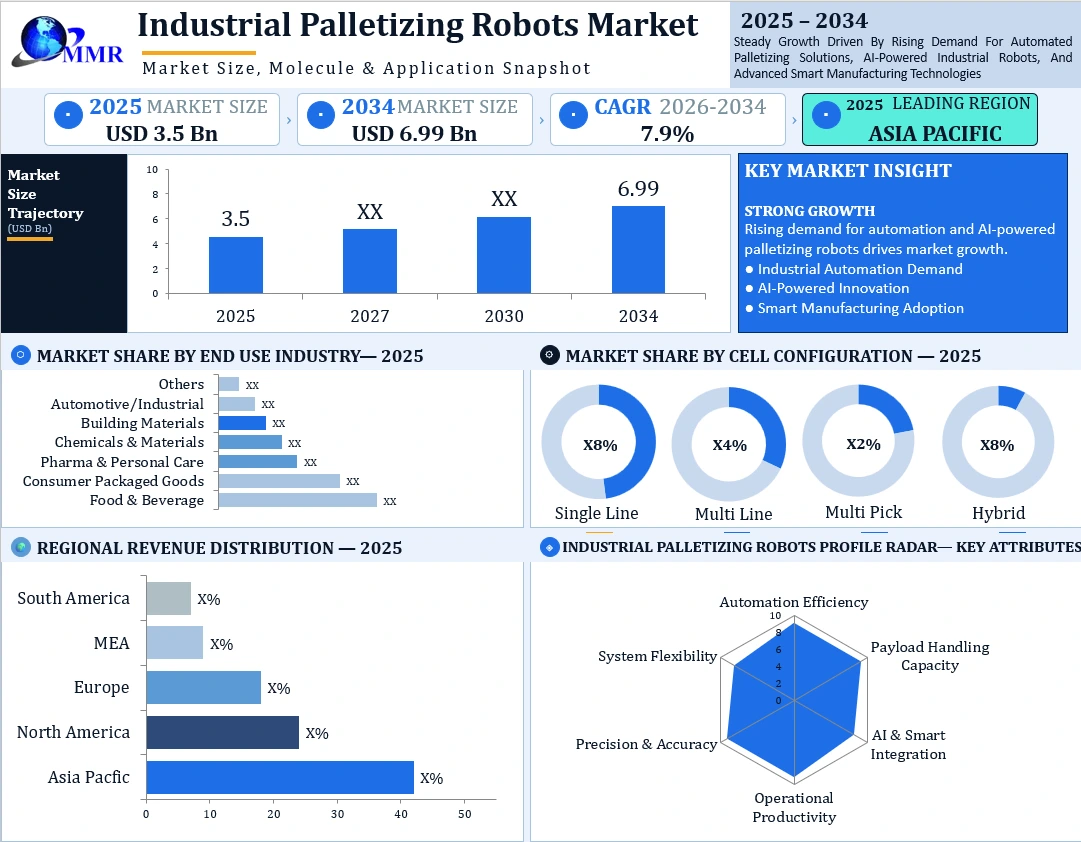
Global Industrial Palletizing Robots Market size was valued at USD 3.5 Bn. in 2025, and the total Industrial Palletizing Robots Market revenue is expected to grow by 7.9% from 2025 to 2034, reaching USD 6.99 Bn. by 2034
Industrial Palletizing Robots Market Overview:
The Global Industrial Palletizing Robots Market refers to the industry focused on the development, manufacturing, and deployment of robotic systems that automatically stack, arrange, and handle products on pallets for storage, transportation, and distribution.Industrial Palletizing Robots are automated robotic systems designed to handle, stack, and organize products efficiently in manufacturing and logistics operations. Widely used in industries such as food and beverages, pharmaceuticals, and consumer goods, these robots enhance productivity, reduce labor costs, and improve workplace safety. Equipped with advanced technologies such as artificial intelligence (AI), vision systems, and collaborative robotics (cobots), they manage diverse product sizes and weights with precision. Integration with Industry 4.0 systems enables real-time monitoring, predictive maintenance, and data-driven optimization, boosting the industrial palletizing robots Market growth.
Asia Pacific dominated the market, accounting for a revenue share of 35.4% in 2025. The robotic palletizers and de-palletizers market is driven by the increasing adoption of warehouse and end-of-line automation, the growing deployment of industrial robots to address labor shortages and improve operational efficiency, and the rising demand for high-speed, accurate pallet handling across manufacturing, logistics, and distribution facilities.
Industrial Palletizing Robots Market Key Highlights
• Market Size: The global market reaches USD 3.5 billion in 2025 and is projected to reach USD 6.99 billion by 2034.
• Market Growth: The market grows at a CAGR of 7.9% during 2025–2034.
• Regional Leadership: Asia Pacific dominates the market with a 35.4% revenue share in 2025, driven by manufacturing expansion and industrial automation.
• Dominant Robot Type: Articulated robots lead due to their flexibility, range of motion, and suitability for high-speed palletizing.
• Leading Application: End-of-line palletizing drives adoption by improving packaging efficiency, stacking accuracy, and production throughput.
• Emerging Trend: AI-powered robotics, collaborative robots, Industry 4.0 connectivity, and predictive maintenance enhance automation capabilities.
Global Industrial Palletizing Robots Market Growth Outlook
To know about the Research Methodology :- Request Free Sample Report
These robots are designed to handle, stack, and organize products efficiently, reducing labor costs, improving workplace safety, and increasing operational productivity. The surge in e-commerce, growing demand for faster delivery cycles, and the need for precise, high-speed material handling in industries such as food and beverages, pharmaceuticals, consumer goods, and logistics drive the Industrial Palletizing Robots Market growth. Artificial intelligence (AI), machine learning, advanced vision systems, and collaborative robots (cobots) are enabling palletizing robots to handle diverse product sizes, shapes, and weights with high accuracy and flexibility. Integration with Industry 4.0 technologies allows real-time monitoring, predictive maintenance, and data-driven process optimization, enhancing efficiency and reducing downtime.
Industrial Palletizing Robots Market Dynamics
Industrial Palletizing Robots Market Drivers
• Rising Industrial Automation and Demand for Efficient Material Handling: The growing adoption of industrial automation across manufacturing plants, warehouses, and distribution centers drives the Industrial Palletizing Robots Market. Manufacturers increasingly deploy robotic palletizing systems to automate end-of-line packaging, improve stacking accuracy, increase production throughput, and reduce dependence on manual labor. The expansion of e-commerce, third-party logistics, and high-volume distribution operations further increases demand for automated pallet handling solutions. Industrial palletizing robots also support continuous operations, consistent load placement, and improved workplace safety, making them valuable for food and beverages, pharmaceuticals, consumer goods, and other manufacturing industries.
• Advancements in AI, Machine Vision, and Robotic Technologies: Advancements in artificial intelligence (AI), machine vision, sensors, and intelligent grippers strengthen demand for industrial palletizing robots. AI-enabled robotic systems identify products, recognize package orientations, and adjust handling movements according to different product dimensions and packaging requirements. These capabilities improve palletizing accuracy and enable flexible handling of mixed stock-keeping units (SKUs). Integration with conveyor systems, programmable logic controllers, and warehouse management systems further enhances production coordination and operational efficiency. As manufacturers prioritize smart manufacturing and automated material handling, advanced robotic palletizers become increasingly important to modern production facilities.
Industrial Palletizing Robots Market Restraints
• High Initial Investment and Total Cost of Ownership: High upfront investment remains a major restraint in the Industrial Palletizing Robots Market. Businesses must finance robotic arms, grippers, machine vision systems, safety equipment, software, installation, and commissioning. Additional costs associated with maintenance, spare parts, workforce training, and facility modifications increase the total cost of ownership. These expenses can delay adoption among SMEs and manufacturers with low production volumes, particularly when the expected return on investment depends on long-term productivity improvements.
• Complex Integration with Existing Production Lines: Integrating robotic palletizing systems with existing conveyors, packaging machinery, production controls, and warehouse infrastructure can require substantial technical modifications. Variations in carton dimensions, package weights, pallet configurations, and production speeds complicate system configuration. Compatibility issues between legacy equipment and modern automation software can extend installation timelines and increase commissioning costs. These challenges restrict adoption among businesses operating older production facilities or frequently changing packaging formats.
Industrial Palletizing Robots Market Opportunity
• Growing Demand for AI-Enabled Mixed-Case Palletizing: The growing need to handle mixed product sizes, irregular cartons, and customized orders creates significant opportunities for AI-enabled industrial palletizing robots. Machine vision and intelligent robotic guidance enable systems to recognize package dimensions, determine suitable gripping positions, and optimize pallet stacking patterns without extensive manual reprogramming. This flexibility supports e-commerce fulfillment centers, food and beverage distributors, and third-party logistics providers that manage high product variety.
Recent industry developments reinforce this opportunity. In March 2026, Prime Robotics announced the commercial availability of its Advanced Tall Pallet Station, which combines AI-enabled 3D computer vision with robotic automation for mixed-case palletizing. The company reports a rated capacity exceeding 350 cases per hour.
• Expansion of Collaborative Robots and Robotics-as-a-Service: Collaborative palletizing robots and Robotics-as-a-Service (RaaS) models create opportunities among small and medium-sized enterprises (SMEs) that face budget constraints and changing production requirements. Compact robotic palletizers, modular automation cells, and subscription-based deployment models can reduce initial capital requirements and simplify implementation. Manufacturers can scale robotic palletizing capacity according to production demand while improving workforce productivity and workplace ergonomics.
Industrial Palletizing Robots Market Challenges
• Handling Diverse Products and Maintaining Pallet Stability: Industrial palletizing robots face challenges when handling products with varying shapes, dimensions, weights, and packaging materials. Fragile cartons, flexible bags, unstable packages, and mixed-SKU orders require accurate gripping, dynamic motion planning, and optimized stacking patterns. Improper load distribution can compromise pallet stability during storage and transportation. Manufacturers therefore need reliable machine vision, adaptable end-of-arm tooling, and advanced control software to maintain consistent pallet quality across different production conditions.
• Technical Skills Shortages and System Reliability: The deployment of industrial palletizing robots requires skilled personnel for programming, commissioning, troubleshooting, maintenance, and system optimization. A shortage of qualified robotics technicians can increase operating costs and delay implementation. Equipment failures, sensor errors, software compatibility issues, and unexpected production changes can also interrupt automated material handling. Businesses need effective maintenance strategies, operator training, remote diagnostics, and technical support to maintain system reliability and minimize production downtime.
Industrial Palletizing Robots Market Trends
• AI-Powered Robotic Palletizing and 3D Machine Vision: AI-powered palletizing, deep-learning algorithms, and 3D machine vision are emerging as important trends in the Industrial Palletizing Robots Market. These technologies allow robots to recognize packages, calculate gripping positions, and automatically adjust stacking patterns for different product formats. The shift from fixed-program robotic systems toward intelligent, flexible automation supports mixed-case palletizing and reduces manual programming requirements.
A recent example is Doosan Robotics' June 2026 announcement of its PalletizHD+ solution. The system integrates AI-based motion optimization and automated stacking-pattern generation, and it supports processing up to 11 boxes per minute. This development illustrates the industry's focus on improving palletizing speed, usability, and adaptability.
• Industry 4.0 and Connected Warehouse Automation: Industry 4.0 initiatives are encouraging manufacturers to connect robotic palletizers with IoT sensors, cloud analytics, production control systems, and warehouse management platforms. Connected systems provide real-time visibility into throughput, equipment performance, and maintenance requirements. Predictive maintenance and data-driven workflow optimization help reduce unplanned downtime and improve production planning
Industrial Palletizing Robots Market Segment Analysis
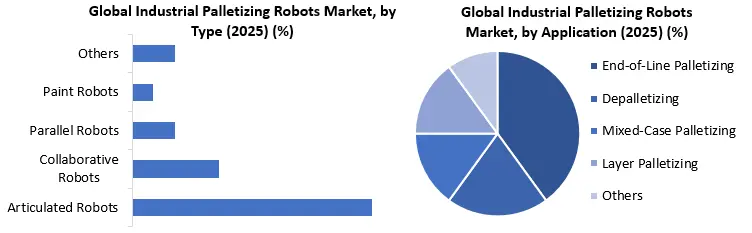
Based on Type, Industrial Palletizing Robots Industry is segmented into Articulated robot, Collaborative Robots, Parallel Robots, Paint Robots and Others. Articulated robots are expected to dominate the Industrial Palletizing Robots Market over the forecast period. Articulated robots have emerged as a dominant technology in the industrial palletizing robots market due to their superior flexibility, adaptability, and range of motion. These robots also excel in versatility, performing multiple applications including pick-and-place, material handling, packaging, assembly, and machine loading, which consolidates operational efficiency and reduces the need for multiple specialized machines.
Leading Industrial Palletizing Robots Manufacturers such as FANUC, ABB, KUKA, and Yaskawa Motoman have focused heavily on articulated robots, further reinforcing their dominance in the market. FANUC’s R-2000iA series, ABB’s IRB 2600, and Motoman’s HP20 are examples of six-axis robots designed for high-speed, high-precision palletizing and other industrial applications. These robots are built to integrate seamlessly into automated production environments, delivering consistent performance while reducing labor costs and minimizing human error.
Based on Cell Configuration, the Industrial Palletizing Robots Market is segmented into Single-Line / Single-Pick Cells, Multi-Line / Shared-Robot Cells, Multi-Pick / Row or Layer-Forming Cells, Hybrid / Integrated Cells, and Others. Single-line cells handle products from one production line, while multi-line cells serve multiple lines using a shared robot. Multi-pick cells improve throughput by handling multiple products simultaneously. Hybrid cells integrate palletizing with conveyors and packaging equipment, while other configurations include mobile and track-mounted systems. Growing demand for industrial automation, space optimization, and efficient material handling supports adoption across manufacturing and logistics industries.
Based on Application, End-of-Line Palletizing, Depalletizing, Mixed-Case Palletizing, Layer Palletizing and Others. End-of-line palletizing robots are expected to dominate Industrial Palletizing Robots Market over the forecast period. End-of-line palletizing robots enhance operational efficiency by reducing manual labor, minimizing errors, and enabling faster throughput, which is particularly valuable in high-volume industries such as food and beverages, pharmaceuticals, consumer goods, and logistics. These robots are capable of handling a variety of workpieces, including cartons, bags, bottles, and crates, and can adapt to different sizes and weights, making them highly versatile. The adoption of end-of-line palletizing is further supported by advancements in robotic technology, such as articulated six-axis robots, collaborative robots (cobots), and intelligent vision systems, which allow for precise placement and optimized stacking patterns.
Regional Insights for Industrial Palletizing Robots Market
North America represents an important market for industrial palletizing robots, driven by warehouse automation, labor shortages, and investments in advanced manufacturing. The United States leads regional demand as manufacturers, distribution centers, and third-party logistics providers increasingly adopt robotic palletizing systems to improve throughput and reduce manual handling. Canada supports market expansion through investments in food processing, manufacturing, and logistics infrastructure. The growing use of AI-powered vision systems, collaborative robots, and automated end-of-line packaging solutions strengthens adoption across food and beverage, pharmaceuticals, consumer goods, and e-commerce fulfillment operations.
Europe is the fastest-growing region for the Industrial Palletizing Robots Industry. The region's emphasis on efficiency improvements, resource optimization, and stringent safety regulations is driving the adoption of robotic solutions. Countries with strong manufacturing traditions are increasingly integrating palletizing robots to streamline operations and meet regulatory standards. This trend is particularly evident in industries such as food and beverages, pharmaceuticals, and logistics, where automation is enhancing productivity and reducing operational costs
Asia Pacific dominated the Industrial Palletizing Robots Market in 2025. Countries such as China, Japan, and South Korea are central to this growth, driven by rapid industrialization, a strong manufacturing base, and a surge in e-commerce activities. The region's focus on enhancing productivity through automation has led to increased adoption of palletizing robots across various industries, including food and beverage, pharmaceuticals, and logistics. Additionally, labor shortages and the need for efficient material handling solutions are propelling the demand for robotic automation in the Asia Pacific.
The Middle East and Africa region presents emerging opportunities for industrial palletizing robots as governments and businesses invest in manufacturing diversification, logistics infrastructure, and industrial modernization. The United Arab Emirates and Saudi Arabia support demand through warehouse development, food processing, and investments in automated distribution facilities. South Africa contributes through its food and beverage, consumer goods, and manufacturing sectors. Increasing investment in smart logistics, industrial facilities, and modern packaging operations encourages the adoption of robotic palletizing systems. However, high initial investment, limited access to specialized technical expertise, and integration costs continue to influence adoption rates.
South America represents a developing market for industrial palletizing robots, supported by demand from food and beverage processing, agriculture-related industries, consumer goods manufacturing, and logistics. Brazil leads regional opportunities because of its extensive manufacturing base and large food processing industry. Argentina also contributes through agricultural processing, packaged goods, and industrial production. Manufacturers increasingly consider robotic palletizing to improve packaging consistency, reduce repetitive manual handling, and enhance warehouse productivity. However, economic uncertainty, capital expenditure constraints, and uneven automation infrastructure can slow implementation, particularly among small and medium-sized enterprises.
Industrial Palletizing Robots Market Competitive Landscape
The global Industrial Palletizing Robots Market is experiencing significant growth, driven by increasing automation in manufacturing and logistics. Key players such as ABB Ltd., FANUC Corporation, KUKA AG, and Yaskawa Electric Corporation dominate the market, offering a range of robotic solutions tailored to various industries, including food and beverages, pharmaceuticals, and logistics. These companies leverage their extensive service networks and established customer bases to maintain a competitive edge. Strategic initiatives like product innovation, technological advancements, and strategic partnerships are central to their Industrial Palletizing Robots Market strategies. For instance, the adoption of articulated palletizing robots is on the rise, attributed to their versatility and effectiveness across diverse applications.
| Company | Country | Key competitive strategy |
| FANUC Corporation | Japan | Focuses on high-speed palletizing robots, advanced motion control, operational reliability, and global customer support. |
| ABB Ltd. | Switzerland | Emphasizes AI-enabled palletizing, flexible automation, digital solutions, and energy-efficient robotics. |
| KUKA AG | Germany | Develops high-payload robotic systems, integrated automation solutions, and software-driven palletizing technologies. |
| Yaskawa Electric Corporation | Japan | Focuses on high-speed handling, motion control, and integrated robotic automation. |
| Kawasaki Heavy Industries | Japan | Develops high-speed palletizing robots, compact robot designs, and energy-efficient material handling systems. |
| Mitsubishi Electric Corporation | Japan | Combines industrial robots, factory automation, and advanced control technologies. |
| Universal Robots | Denmark | Focuses on collaborative robots and flexible palletizing applications for manufacturers of different sizes. |
| Fuji Yusoki Kogyo | Japan | Specializes in robotic palletizing systems for packaging and industrial material handling. |
| Premier Tech | Canada | Provides integrated palletizing, packaging, and end-of-line automation solutions. |
| Columbia/Okura | United States | Develops robotic palletizing systems and customized end-of-line automation solutions. |
Key developments in the Industrial Palletizing Robots Market
| Date | Company | Development | Key details | Market impact |
| January 2026 | Universal Robots, Robotiq, and Siemens | Connected palletizing technology demonstration | Demonstrates a UR20 robot, PAL Ready palletizing cell, and digital twin technology for improved automation planning and visualization. | Supports digital integration and smarter palletizing operations. |
| February 2026 | Kawasaki Heavy Industries | CP110L palletizing robot launch | Introduces a compact, high-speed robot with a 110 kg payload capacity and regenerative power technology. | Improves palletizing throughput and energy efficiency. |
| April 2026 | ABB Robotics and Jacobi Robotics | Strategic AI collaboration | Integrates OmniPalletizer AI software into ABB's robotics ecosystem for mixed-case palletizing with reduced custom engineering. | Expands flexible automation and AI-driven stacking capabilities. |
| June 2026 | Doosan Robotics | PalletizHD+ introduction | Unveils an AI-powered solution that automatically generates stacking patterns and optimizes robot motion. | Simplifies deployment and supports high-mix production environments. |
| August 2026 | FlexLink | RC20 collaborative palletizer launch | Introduces a compact collaborative palletizing cell designed for heavier cases and higher-throughput applications. | Expands collaborative palletizing opportunities in space-constrained facilities. |
Industrial Palletizing Robots Market Key Trends:
| Trend | Description | Examples | Market Impact |
| Technological Upgrades in Legacy Models | Modernization of proven robot series with better cycle times, load capacities, and energy efficiency. | FANUC (new R-2000i series), KUKA (KR QUANTEC upgrades). | Extends lifecycle of installed base, reduces replacement hesitation, drives incremental adoption. |
| Integration of Collaborative & Autonomous Solutions | Rise of cobots and autonomous palletizing solutions with enhanced safety and flexibility. | Omron cobot palletizer; Rockwell Automation’s acquisition of Clearpath Robotics. | Expands adoption in SMEs and mixed-SKU warehouses; enables human-robot collaboration. |
| Focus on End-to-End Production Logistics | Vendors are shifting toward offering complete automation ecosystems, linking robots with conveyors, AGVs/AMRs, and software. | ABB is integrating logistics software; acquisitions in robotics mobility and AI. | Drives market consolidation; creates bundled solutions for full line and warehouse automation. |
Scope of Industrial Palletizing Robots Market: Inquire before buying
| Industrial Palletizing Robots Market | |||
|---|---|---|---|
| Report Coverage | Details | ||
| Base Year: | 2025 | Forecast Period: | 2026-2034 |
| Historical Data: | 2020 to 2025 | Market Size in 2025: | 3.5 USD Billion |
| Forecast Period 2026-2034 CAGR: | 7.9% | Market Size in 2034: | 6.99 USD Billion |
| Segments Covered: | by Type | Articulated Robot Collaborative Robots Parallel Robots Paint Robots Others |
|
| by Cell Configuration | Single-Line / Single-Pick Cells Multi-Line / Shared-Robot Cells Multi-Pick / Row or Layer-Forming Cells Hybrid / Integrated Cells Others |
||
| by Application | End-of-Line Palletizing Depalletizing Mixed-Case Palletizing Layer Palletizing Others |
||
| by End Use Industry | Food & Beverage Consumer Packaged Goods Pharma & Personal Care Chemicals & Materials Building Materials Automotive/Industrial Others |
||
Industrial Palletizing Robots Market, by Region
North America (United States, Canada and Mexico)
Europe (UK, France, Germany, Italy, Spain, Sweden, Austria, Turkey, Russia and Rest of Europe)
Asia Pacific (China, India, Japan, South Korea, Australia, ASEAN and Rest of APAC)
Middle East and Africa (South Africa, GCC, Egypt, Nigeria and Rest of ME&A)
South America (Brazil, Argentina, Columbia and Rest of South America)
Key Players/Competitors profiles covered in the Industrial Palletizing Robots Market report in strategic perspective
1. Industrial Robot & Robotic Palletizing System Manufacturers
These companies manufacture industrial robots, robotic arms, and complete palletizing solutions for automated material handling applications.
North America
1. FANUC America Corporation – United States
2. ABB Robotics – United States Operations (ABB Ltd. – Switzerland)
3. KUKA Robotics Corporation – United States
4. Yaskawa Motoman Robotics – United States
5. Omron Adept Technologies, Inc. – United States
Europe
1. ABB Ltd. – Switzerland
2. KUKA AG – Germany
3. Comau S.p.A. – Italy
4. Stäubli Robotics – Switzerland
5. Universal Robots A/S – Denmark
Asia Pacific
1. FANUC Corporation – Japan
2. Yaskawa Electric Corporation – Japan
3. Mitsubishi Electric Corporation – Japan
4. Kawasaki Heavy Industries, Ltd. – Japan
5. Epson Robots (Seiko Epson Corporation) – Japan
6. Nachi-Fujikoshi Corporation – Japan
7. Omron Corporation – Japan
8. DENSO Corporation – Japan
9. Hyundai Robotics – South Korea
2. Robotic Palletizing Cell, Automation & Material Handling Solution Providers
These companies provide integrated palletizing systems, conveyors, warehouse automation, and robotic material handling solutions.
North America
1. Rockwell Automation, Inc. – United States
2. Honeywell Intelligrated – United States
3. Dematic Corporation – United States
4. Seegrid Corporation – United States
Europe
1. Fives Group – France
2. Bosch Rexroth AG – Germany
3. Siemens AG – Germany
Asia Pacific
1. Mitsubishi Electric Corporation – Japan
2. Omron Corporation – Japan
3. Robotic Vision, Sensors & Intelligent Automation Providers
These companies provide machine vision, sensors, AI-based inspection, and intelligent automation technologies that enhance robotic palletizing systems.
North America
1. Cognex Corporation – United States
2. Rockwell Automation, Inc. – United States
Europe
1. Bosch Rexroth AG – Germany
2. Siemens AG – Germany
Asia Pacific
1. Omron Corporation – Japan
4. Collaborative Robots (Cobots) & Flexible Palletizing Solution Providers
These companies provide collaborative robots and flexible robotic systems for low-volume and high-mix palletizing applications.
Europe
1. Universal Robots A/S – Denmark
2. ABB Ltd. – Switzerland
3. KUKA AG – Germany
4. Stäubli Robotics – Switzerland
Asia Pacific
1. FANUC Corporation – Japan
2. Omron Corporation – Japan
Frequently Asked Questions:
Q1. What is the size of the Industrial Palletizing Robots Market?
Ans: The Industrial Palletizing Robots market was valued at USD 3.5 billion in 2025 and is projected to reach USD 6.99 billion by 2034, driven by AI advancements, automation demand, and global labor shortages.
Q2. What is the CAGR of Industrial Palletizing Robots Market?
The Industrial Palletizing Robots market is expected to grow at a CAGR of 7.9% during 2025–2034 due to increasing adoption across manufacturing, logistics, healthcare, and personal assistance applications.
Q3. Which region dominates Industrial Palletizing Robots Market?
Asia Pacific is a leading region in the Industrial Palletizing Robots Market, driven by rapid industrialization, strong manufacturing capacity, and increasing automation adoption in China, Japan, South Korea, and India.
Q4. Who are key players in Industrial Palletizing Robots Market?
The key players include FANUC Corporation, ABB Ltd., KUKA AG, Yaskawa Electric Corporation, Kawasaki Heavy Industries, Mitsubishi Electric Corporation, Fuji Yusoki Kogyo, Okura Yusoki, Universal Robots, Columbia/Okura, Premier Tech, Krones AG, and Sidel.