
India Water Purifier Market - Industry Structure Evaluation, Demand Drivers Analysis, Geographicall Growth Analysis and Identification, Competitive Positioning Review & Market Size Forecast to 2032
Overview
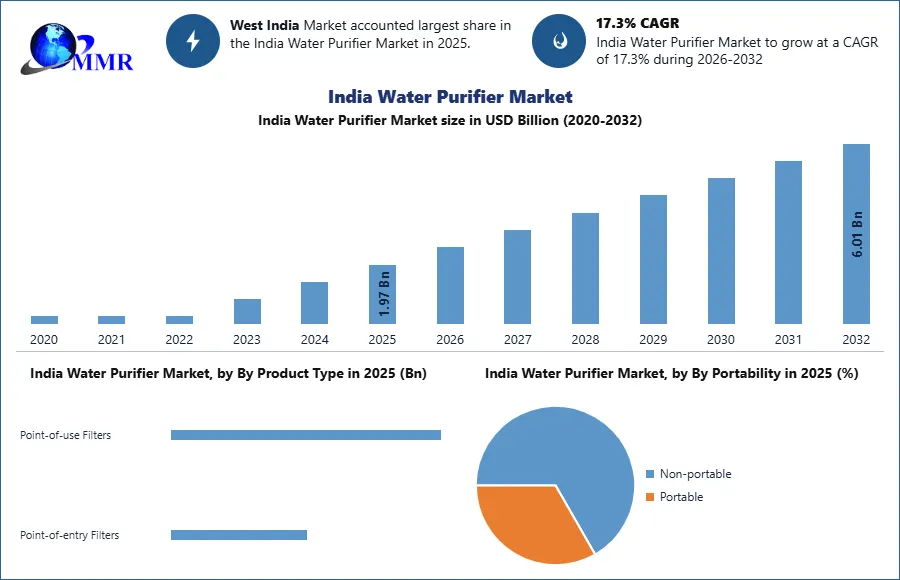
India Water Purifier Market size was valued at USD 1.97 Bn in 2025 and is expected to reach USD 6.01 Bn by 2032, at a CAGR of 17.3 %.
India Water Purifier Market Overview
Water purification is the process of removing unwanted chemicals, biological contaminants, suspended solids, and gases from contaminated water to make it preferable for its intended use. While the primary aim is to produce safe drinking water, purification also serves various other purposes such as meeting the standards required for medical and industrial applications. The methods utilized in water purification are diverse and include physical processes such as filtration, sedimentation, and distillation, which drives India Water Purifier Market growth. The biological methods such as slow sand filters and biologically active carbon; chemical techniques including flocculation and chlorination. Each method contributes to ensuring that the water meets the specific quality requirements for its designated use.
As urbanization and industrial activities increase, the demand for reliable water purification solutions has also increased. Water purifiers have become beneficial for households and businesses, boosted by the need to ensure access to clean and safe drinking water. Technological advancements have resulted in the innovations of several purification methods, including ultraviolet (UV) purification, reverse osmosis (RO) and activated carbon filters. This provides for several needs and water quality issues. The India Water Purifier Market has a diverse range of products, from reasonable, basic models to high-end systems providing advanced filtration and purification features. India Water Purifier Key players are increasingly innovating, announcing smart water purifiers with features such as real-time water quality monitoring, and automatic filter cleaning. The growing awareness of waterborne diseases and contamination issues has increased the demand for effective water purification solutions.
 To know about the Research Methodology:-Request Free Sample Report
India Water Purifier Market Dynamics
Driver: Government policies and programs to Boost Market Growth
The India Water Purifier Market is substantially driven by the government's inclusive policies and programs aimed at enhancing water quality and availability across the nation. Central to these efforts is the government's rural e-governance initiative, Common Service Centres (CSCs), which is launching a pilot project to offer clean and safe drinking water in 50 villages. This initiative follows Prime Minister Narendra Modi’s announcement to ensure clean drinking water for all by 2024. CSC collaborating with village-level entrepreneurs (VLEs) to establish water filtration plants in up to 1 lakh villages. This ambitious project initially focused on deploying advanced water filtration technologies developed by the Bhabha Atomic Research Centre (BARC), involving techniques for brackish water desalination and fluoride detection. By leveraging ethnic technologies and engaging local entrepreneurs, the program aims to provide water purification solutions at economical prices, satisfying the government’s social responsibilities while increasing rural business opportunities.
National Water Mission (NWM), established as part of the National Action Plan on Climate Change, boosts the India Water Purifier Market. The NWM’s objectives involve conserving water, minimizing wastage, and ensuring equitable distribution through integrated water resources management. It underscores increasing water use efficiency to promote citizen and state actions for water conservation and meeting in vulnerable areas. Several strategies outlined by the NWM include developing comprehensive water databases, encouraging integrated basin-level management, and enhancing water conservation efforts. These goals are supported by a range of initiatives, from community-level water security models to collaborative research programs.
1.For instance, the Department of Science & Technology (DST) in India supports R&D activities to provide safe drinking water at an affordable cost. This uses innovative technologies such as nano-material filtration and real-time water quality monitoring systems. Collaborative efforts with international organizations, such as the Indo-UK program on water quality research, strengthen these initiatives by exploring advanced water treatment technologies and sensor-based monitoring. The DST’s efforts also include developing low-cost electrode technologies and mobile water purification units for drought-affected regions, demonstrating the government's commitment to addressing water challenges through diverse and sustainable solutions.
Programs such as Arsenic & Metal Removal by Indian Technology (AMRIT) provide affordable and effective solutions for areas affected by arsenic contamination, showcasing the application of advanced materials developed by institutions such as IIT Madras. These government policies and programs are pivotal in driving the growth of the India Water Purifier Market by promoting innovative technologies, enhancing accessibility, and ensuring that safe drinking water reaches even the most underserved communities.
High cost associated with advanced water purification technologies to hamper Market
Advanced purification systems including reverse osmosis (RO) units, ultraviolet (UV) filters, and advanced membrane technologies, come with significant upfront costs. This is a significant burden for many consumers, particularly in low-income and rural areas. The expense does not end with the early purchase; maintenance and operational costs such as regular replacement of filters and membranes, strain household budgets. For lower-income households, this financial commitment is prohibitive, restraining their ability to invest in high-quality water purification solutions. Many people are forced to rely on less effective and potentially unsafe alternatives, thereby cooperating with their access to clean drinking water. This economic barrier affects individual households and impacts the broader goal of enhancing public health and water quality across the country. The high costs remain a significant obstacle, hindering India Water Purifier Market growth and restraining the availability of advanced technologies to a broader population.
India Water Purifier Market Segment Analysis
In 2025, the Point-of-Use (PoU) Filters segment dominates the India water purifier market due to its affordability, ease of installation, and suitability for household usage. Within this category, Under the Counter Filters and Countertop Filters are widely preferred in urban households for their convenience and space efficiency. Pitcher Filters and Faucet-mounted Filters are gaining traction among price-sensitive consumers and renters due to their portability and low cost.
Meanwhile, Point-of-Entry (PoE) Filters are witnessing increasing adoption in premium residential complexes and commercial establishments, as they provide whole-house filtration. However, their higher installation cost limits widespread adoption compared to PoU systems.
Based on portability, the Non-portable segment holds the largest market share in 2025, driven by strong demand for fixed RO and UV purification systems in households and commercial spaces. These systems offer higher purification capacity and durability, making them the preferred choice for long-term usage.
The Portable segment is growing steadily, particularly in rural areas and among travelers or temporary users, due to its affordability and ease of use without complex installation.
In 2025, RO (Reverse Osmosis) Filters represent the most dominant and in-demand technology segment due to their ability to remove dissolved salts, heavy metals, and impurities, making them ideal for Indian water conditions.
UV Filters are commonly used in combination with RO systems to eliminate bacteria and viruses, enhancing purification efficiency. Gravity Filters are growing in rural and low-income markets due to affordability and no electricity requirement. Other technologies hold a smaller share but cater to specialized needs.
| India Water Purifier Market | |||
|---|---|---|---|
| Report Coverage | Details | ||
| Base Year: | 2025 | Forecast Period: | 2026-2032 |
| Historical Data: | 2020 to 2025 | Market Size in 2025: | 1.97 USD Billion |
| Forecast Period 2026-2032 CAGR: | 17.3% | Market Size in 2032: | 6.01 USD Billion |
| Segments Covered: | By Product Type | Point-of-use Filters Under The Counter Filters Counter Top Filters Pitcher Filters Faucet-mounted Filters Others Point-of-entry Filters |
|
| By Portability | Non-portable Portable |
||
| By Category | Electrical Non-electrical |
||
| By Installation | Faucet Mount Under Sink Counter Top Others |
||
| By Technology | RO Filters UV Filters Gravity Filters Others |
||
| By Capacity | Small (Below 5L) Medium (5L to 10L) High (Above 10L) |
||
| By Distribution Channel | B2B B2C Online E-commerce Websites Company-owned Websites Offline Supermarkets/Hypermarkets Specialty Stores Convenient Stores Others |
||
| By End Users | Residential Commercial Hotels and Restaurants Corporate Offices Educational Institutes Others Industrial |
||
India Water Purifier Market Regional Insights
Based on region, North India leads the India water purifier market in 2025 due to severe water contamination issues, including high TDS levels and groundwater pollution, particularly in states like Delhi, Uttar Pradesh, and Haryana.
South India follows closely, driven by strong urbanization, higher consumer awareness, and demand for advanced purification technologies in cities such as Bengaluru, Chennai, and Hyderabad.
West India shows significant growth, supported by industrialization and increasing adoption in urban centers like Mumbai and Pune.
East India is witnessing moderate growth due to improving infrastructure and rising awareness, although lower income levels in some areas limit adoption. Overall, regional growth is influenced by water quality concerns, urbanization, and economic development.
Government initiatives and infrastructure projects aimed at improving water quality also play a pivotal role. Several state and national programs focus on improving water purification infrastructure, which boosts the adoption of water purifiers in urban as well as rural areas. The mixture of these factors severe water contamination issues, economic development, and supportive government policies create a strong India Water Purifier Market environment in North India.
1. For Instance, The Har Ghar Jal Programme, launched by the Ministry of Jal Shakti under the Jal Jeevan Mission (JJM), represents one of the world's largest drinking water initiatives. Its primary objective is to ensure that every rural household has affordable and consistent access to safe drinking water through tap connections. As of February 23, 2024, 74.58% of the targeted 19.27 crore households have received functional household tap connections. The budgetary allocation for JJM has increased significantly, with a compound annual growth rate (CAGR) of 48% from FY2020 to FY2025 BE, reaching ₹70,162.9 crore in FY2025 BE. The Centre released ₹60,713 crore in FY2024 to 29 states/UTs, a substantial increase from the previous year’s ₹54,744 crore. Notably, ten states/UTs have achieved 100% tap water coverage, highlighting the program’s progress and impact.
India Water Purifier Industry Ecosystem
India Water Purifier Market Scope: Inquire before buying
India Water Purifier Market, key players
1. Eureka Forbes Ltd.
2. Kent RO Systems Limited
3. Hindustan Unilever Limited
4. Tata Chemicals Limited
5. Livpure Pvt. Ltd.
6. Panasonic India Pvt. Ltd.
7. LG Electronics India Pvt. Ltd.
8. Blue Star Limited
9. Ion Exchange India Ltd.
10. Okaya Power Pvt Ltd.
11. Arow Technologies
12. Aquapot
13. MGR Technologies
14. Tata Chemicals Limited
15. Hi-Tech Sweet Water Technologies Private Limited
16. LG Electronics India Private Limited
17. Pureit
18. AO Smith
19. Ion Exchange (India) Limited
20. Havells India Limited
21. Usha International Limited