
Immunology Drug Market – Global Market Size, Strategic Growth Drivers, Risk Assessment Framework, Regulatory Landscape Review, Competitive Intensity Mapping & Long-Term Industry Outlook to 2034
Overview
The Global Immunology Drug Market was valued at USD 126.54 Billion in 2025 and is projected to reach USD 255.07 Billion by 2034, growing at a CAGR of 8.1% during 2026–2034.
Immunology Drug Market Overview:
The Immunology Drug Market covers drugs that suppress or modulate the activity of the immune system, as well as boosters of its function, used in the treatment and management of autoimmune, inflammatory, immune-deficiency, and associated conditions. The segment encompasses monoclonal antibodies, immunosuppressants, fusion proteins, JAK inhibitors, and other targeted therapies. These drugs act on specific immune pathways, suppress pro-inflammatory processes, and restore the function of the immune system. The growing use of targeted and biologic therapies and the research into the role of the immune system in disease and its modulation mechanisms are the key factors driving the growth of the market. The constant research efforts and the increasing understanding of the diseases of the immune system will also contribute to the growth of the market.
The North America region is the largest Immunology Drug Market shareholder, with a significant share provided by the presence of biologics and targeted therapies, developed and adopted in the countries of the region, advanced healthcare, and pharmaceutical research, and high rates of treatment of autoimmune and inflammatory conditions. The European market is also substantial, while the Asia Pacific region is a growing market due to the increasing access to pharmaceutical products and treatments, as well as the recognition of autoimmune and inflammatory diseases and targeted therapies’ role in managing them. Thus, the factors mentioned above result in varying but significant shares in different regions and the opportunity to address the needs of the market gap.
The key companies in the segment are AbbVie, Johnson & Johnson, Novartis, Sanofi, Pfizer, Bristol Myers Squibb, Eli Lilly and Company, and others. The company’s focus on biologics, biosimilars, monoclonal antibodies, and targeted therapies, and the development of new treatment options, as well as the expansion into new therapeutic areas and indications. The continuous development and introduction of new products and treatments will drive the growth of the market, allow addressing the market needs and opportunities, and increase the market shares of the companies involved.
Immunology Drug Market Size, Growth and Share Analysis

To know about the Research Methodology :- Request Free Sample Report
Global Immunology Drug Market Dynamics
Rising Demand for Targeted and Advanced Immune Therapies Drives Market Growth
The rising use of targeted medicines for autoimmune and inflammatory diseases is supporting the Immunology Drug Market Size. Increasing treatment options for rheumatoid arthritis, psoriasis, inflammatory bowel disease, lupus, and other immune-related conditions are encouraging the use of biologics, monoclonal antibodies, targeted small molecules, and other advanced therapies. Continued research into new immune pathways and treatment methods is also expanding the treatment options available to patients. The development of new mechanisms of action and expanded drug indications is supporting market growth and helping pharmaceutical companies increase their market share.
High Treatment Costs and Biosimilar Competition Create Market Challenges
The high cost of biologic and specialty immunology medicines can limit access, particularly for patients and healthcare systems with restricted treatment budgets. Complex manufacturing, clinical development, and regulatory requirements can also increase the cost of advanced therapies. At the same time, growing biosimilar competition is putting price pressure on established biologic products as patents expire. This changing environment can reduce revenue for some originator products and create a market gap between advanced treatment availability and affordable access. These factors may influence the market forecast and future revenue growth across mature immunology drug segments.
New Drug Targets and Underserved Patient Groups Create Market Opportunities
The development of medicines targeting new immune pathways is creating important market opportunities for pharmaceutical companies. Research is increasingly focusing on patients who do not respond well to existing treatments, underserved disease areas, oral therapies, combination treatments, and newer drug technologies. Recent development activity also includes expanded uses of established immunology medicines and new biologic therapies for inflammatory conditions. Focusing on unmet medical needs can increase market potential and help companies develop differentiated products in areas where current treatment choices remain limited.
Crowded Treatment Landscape and Complex Drug Development Challenge Market Expansion
The increasing number of therapies within major immunology indications is making the market more competitive. Several autoimmune and inflammatory diseases now have multiple treatment classes and mechanisms, giving physicians and payers more choices. This creates pressure on companies to show clear differences in effectiveness, safety, convenience, and patient outcomes. Clinical development can also require strong comparative evidence because newer products compete with both established medicines and biosimilars. The crowded treatment environment may make market entry more difficult and influence future market share, market opportunities, market potential, and market forecast.
Immunology Drug Market Segment Analysis
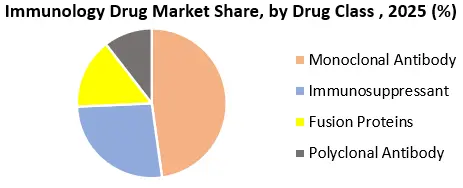
By Drug Class, The Monoclonal Antibody segment holds a major position in the Immunology Drug Market due to the widespread application of targeted biologic therapies for autoimmune and inflammatory diseases. Fusion Proteins are also employed to regulate specific immune pathways and facilitate treatment in conditions necessitating targeted immune modulation. Immunosuppressants play an essential role in diminishing aberrant immune responses and are extensively utilized in the management of autoimmune disorders and organ transplantation. Polyclonal Antibodies are involved in selected immune-related therapeutic interventions, including the prevention and management of organ rejection. The augmentation of targeted therapeutic approaches, the advancement of biologic pharmaceuticals, and the demand for more specifically tailored therapeutic regimes are driving the segment growth and generating further market opportunities.
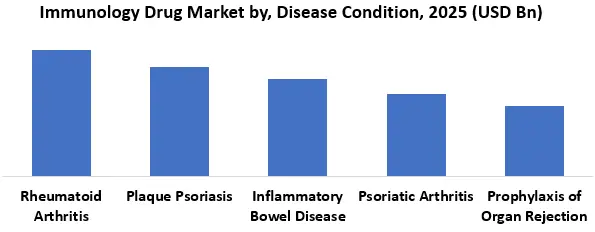
By Disease Condition, Rheumatoid Arthritis represents a major disease segment due to the perennial demand for medicinal interventions that regulate joint inflammation and mitigate disease progression. Plaque Psoriasis and Psoriatic Arthritis are also significant segments, driven by the increased utilization of biologic and targeted therapeutic approaches for managing moderate-to-severe disease manifestations. Inflammatory Bowel Disease is gaining increased recognition as treatment options are expanded for ailments such as Crohn’s disease and ulcerative colitis. Prophylaxis of Organ Rejection remains an essential application as immunosuppressive pharmaceuticals are requisite in preventing graft rejection subsequent to organ transplantation. Enhanced disease awareness, optimized diagnostic capabilities, improved accessibility to advanced therapeutic interventions, and continued pharmaceutical development efforts are propelling the demand for these disease conditions.
Immunology Drug Market Regional Insights:
North America dominated the Immunology Drug Market with the largest market share of 41.3% in 2025. The presence of well-established healthcare infrastructure, higher prevalence of chronic conditions and comparatively higher diagnosis and treatment rates among the patient population in the U.s are the factors responsible for the dominance of the region in the global market.
Europe is anticipated to register a significant CAGR during the forecasting period. Rising prevalence of autoimmune conditions and increase drug approval in the region, For example in 2019 estimated 40,000 people in the UK were suffering from Rheumatoid Arthritis and 4 Mn people were suffering from autoimmune disease.
Asia Pacific region is expected to hold the highest CAGR of around 2.3% during the forecast period. Rising obesity in people and increasing geriatric population especially in developing countries such as China and India are increasing the demand for the Immunology Drug Market. Europe Immunology Drug Market is expected to at steady rate during the forecast period.
The objective of the report is to present a comprehensive analysis of the Immunology Drug Market to the stakeholders in the industry. The past and current status of the industry with the forecasted market size and trends are presented in the report with the analysis of complicated data in simple language. The report covers all the aspects of the industry with a dedicated study of key players that include market leaders, followers, and new entrants.
PORTER, PESTEL analysis with the potential impact of micro-economic factors of the market have been presented in the report. External as well as internal factors that are supposed to affect the business positively or negatively have been analyzed, which will give a clear futuristic view of the industry to the decision-makers.
The reports also helps in understanding the Immunology Drug Market dynamic, structure by analyzing the market segments and project the Immunology Drug Market size. Clear representation of competitive analysis of key players by product, price, financial position, product portfolio, growth strategies, and regional presence in the Immunology Drug Market make the report investor’s guide.
Immunology Drug Market Recent Development
| Date | Company | Development | Impact |
|---|---|---|---|
| 15 April 2025 | AbbVie Inc. | AbbVie received U.S. FDA approval for RINVOQ (upadacitinib) for the treatment of giant cell arteritis after Phase 3 trials demonstrated a 46.4% sustained remission rate versus 29.0% on placebo. | This approval marks RINVOQ's ninth U.S. label expansion in immunology, strengthening AbbVie's market position in targeted oral autoimmune therapeutics. |
| 18 December 2025 | Amgen Inc. | Amgen secured U.S. FDA approval for UPLIZNA (inebilizumab-cdon) for adult patients with generalized myasthenia gravis. | The regulatory milestone significantly broadens Amgen's targeted B-cell targeted autoimmune portfolio into rare neurological immunology conditions. |
| 15 March 2026 | Johnson & Johnson | Johnson & Johnson announced a major strategic investment exceeding USD 1 billion to construct a new cell therapy manufacturing facility in Montgomery County, Pennsylvania. | The dedicated commercial facility dramatically enhances supply chain scale and production capacity for the company's expanding oncology and immunology pipeline. |
| 12 April 2026 | Johnson & Johnson | Johnson & Johnson achieved U.S. FDA label expansion for STELARA (ustekinumab) to treat pediatric Crohn's disease in patients aged 2 years and older. | The approval expands therapeutic options for early-onset pediatric inflammatory bowel disease while extending the clinical reach of the IL-12/23 inhibitor class. |
| 28 April 2026 | Sanofi and Regeneron Pharmaceuticals | Sanofi and Regeneron obtained U.S. FDA approval for DUPIXENT (dupilumab) in pediatric patients aged 2 to 11 years with chronic spontaneous urticaria. | This decision introduces a targeted biologic option for young pediatric patients with uncontrolled skin inflammation, broadening DUPIXENT's dominant market footprint in type 2 inflammation. |
| 14 May 2026 | Formycon / Teva Pharmaceutical | The U.S. FDA granted regulatory approval for IMMGOLIS and IMMGOLIS INTRI, marking the approval of the first biosimilars to Simponi and Simponi Aria (golimumab). | The approval introduces cost-effective anti-TNF biologic choices for rheumatoid arthritis and psoriatic disease, accelerating biosimilar competition in mature immunology markets. |
Immunology Drug Market Scope: Inquire before buying
| Immunology Drug Market | |||
|---|---|---|---|
| Report Coverage | Details | ||
| Base Year: | 2025 | Forecast Period: | 2026-2034 |
| Historical Data: | 2020 to 2025 | Market Size in 2025: | USD 126.54 Bn. |
| Forecast Period 2026 to 2034 CAGR: | 8.1% | Market Size in 2034: | USD 255.07 Bn. |
| Segments Covered: | by Drug Class Type | Monoclonal Antibody Fusion Proteins Immunosuppressant Polyclonal Antibody |
|
| by Disease Condition | Rheumatoid Arthritis Psoriatic Arthritis Plaque Psoriasis Inflammatory Bowel Disease Prophylaxis of Organ Rejection |
||
| by Distribution Channel |
Hospital Pharmacies Retail Pharmacies Online Pharmacies |
||
Immunology Drug Market, by Region
North America (United States, Canada and Mexico)
Europe (UK, France, Germany, Italy, Spain, Sweden, Austria and Rest of Europe)
Asia Pacific (China, South Korea, Japan, India, Australia, Indonesia, Malaysia, Vietnam, Taiwan, Bangladesh, Pakistan and Rest of APAC)
Middle East and Africa (South Africa, GCC, Egypt, Nigeria and Rest of ME&A)
South America (Brazil, Argentina Rest of South America)
Immunology Drug Market, Key Players:
The Immunology Drug refers to the global economic sector involving the research, development, manufacturing, and sale of pharmaceutical products that modify or regulate the human immune system. These therapeutics including monoclonal antibodies, immunosuppressants, and fusion proteins are used to treat autoimmune diseases, chronic inflammatory conditions, allergies, and organ transplant rejections.
| Company Name | Headquarters | Core Competencies |
| Pfizer Inc. | New York, New York, USA | Immunology, inflammation, autoimmune diseases, biologics, specialty medicines |
| F. Hoffmann-La Roche Ltd. | Basel, Switzerland | Immunology, biologics, monoclonal antibodies, precision medicine |
| AbbVie Inc. | North Chicago, Illinois, USA | Immunology biologics, autoimmune disease therapies, inflammatory disorders |
| Bristol Myers Squibb | Princeton, New Jersey, USA | Immunology, oncology, cardiovascular, autoimmune therapies |
| Merck & Co., Inc. | Rahway, New Jersey, USA | Immunology, vaccines, biologics, specialty pharmaceuticals |
| Novartis AG | Basel, Switzerland | Immunology, dermatology, rheumatology, biologics |
| Johnson & Johnson Innovative Medicine | Raritan, New Jersey, USA | Immunology, inflammatory bowel disease, psoriasis, autoimmune disorders |
| Amgen Inc. | Thousand Oaks, California, USA | Immunology, inflammation, biologics, biosimilars |
| UCB SA | Brussels, Belgium | Immunology, autoimmune diseases, neurology, biologics |
| Eli Lilly and Company | Indianapolis, Indiana, USA | Immunology, dermatology, autoimmune disease therapies |
| Sanofi | Paris, France | Immunology, rare diseases, biologics, inflammatory disorders |
| AstraZeneca | Cambridge, England, United Kingdom | Immunology, respiratory diseases, biologics, inflammation |
| Regeneron Pharmaceuticals | Tarrytown, New York, USA | Monoclonal antibodies, immunology, inflammatory diseases |
| GSK plc | London, England, United Kingdom | Immunology, respiratory medicine, biologics, specialty pharmaceuticals |
| Biogen Inc. | Cambridge, Massachusetts, USA | Neuroimmunology, autoimmune diseases, biologic therapies |
| Boehringer Ingelheim | Ingelheim am Rhein, Germany | Immunology, respiratory diseases, inflammatory disorders |
| CSL Limited | Melbourne, Australia | Immunoglobulin therapies, immune deficiencies, plasma-derived medicines |
| Takeda Pharmaceutical Company Limited | Tokyo, Japan | Gastroenterology, immunology, rare diseases, biologics |
| LEO Pharma | Ballerup, Denmark | Medical dermatology, inflammatory skin diseases, immunology |
| Zydus Lifesciences Limited | Ahmedabad, India | Biosimilars, immunology therapeutics, specialty pharmaceuticals |
Frequently Asked Questions:
1] Which segments are covered in Immunology Drug Market report?
Ans. The segments covered in Immunology Drug Market report are based on Disease By Drug Class and By Disease Condition.
2] Which region is expected to hold the highest share in the Immunology Drug Market?
Ans. North America is expected to hold the highest share in the Vision Screeners Market.
3] What is the market size of Immunology Drug Market by 2034?
Ans. The market size of Immunology Drug Market by 2034 is USD 255.07 Bn.
4] Who are the top key players in the Immunology Drug Market?
Ans. Active Biotech, Eli Lilly and Company, Autoimmune Inc, Pfizer, GlaxoSmithKline plc, Seattle Genetics, Genentech, F. Hoffmann-La Roche Ltd., Eisai Co., Bayer AG, Sanofi Aventis LLC.
5] What was the Global Immunology Drug Market size in 2025?
Ans: The Global Immunology Drug Market size was USD 126.54 Billion in 2025.