
Imaging Services Market - Industry Structure Evaluation, Demand Drivers Analysis, Regional Growth Analysis and Identification, Competitive Positioning Review & Global Market Size Forecast to 2032
Overview
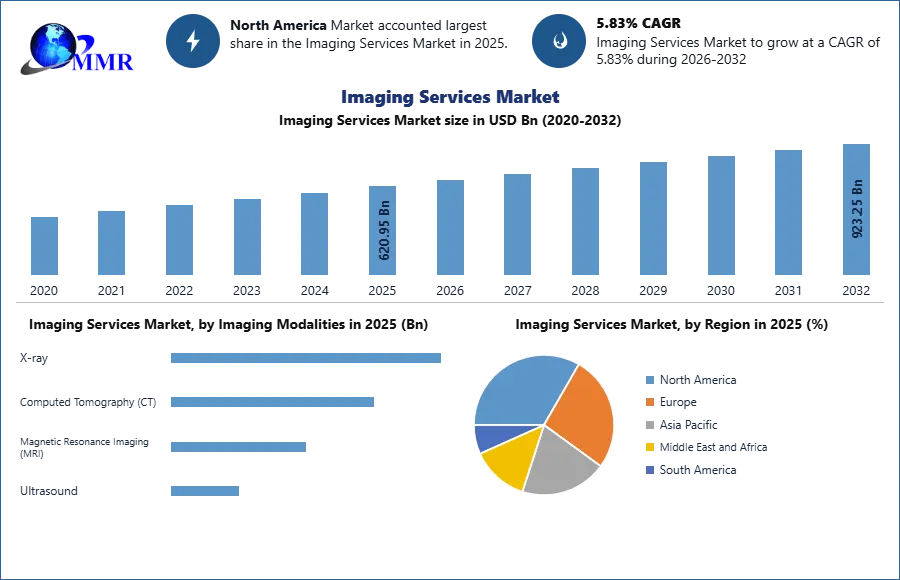
The Imaging Services Market size was valued at USD 620.95 Bn. in 2025 and the total Imaging Services Market revenue is expected to grow by 5.83% from 2025 to 2032, reaching nearly USD 923.25 Bn.
Imaging Services Market Overview:
The medical Imaging Services Market is growing at a steady pace as both demand and supply are well backed by the need and investment. Spending patterns show a positive outlook for medical imaging as more and more companies have started to make future R&D investments in hindsight of optimistic technological results. As technology continues to advance, allowing medical imaging to provide better care to patients. There are six important areas, which greatly improve the performance, workflow, accuracy, accessibility, remote maintenance, and diagnostic support of medical imaging, especially during challenging times like the COVID-19 pandemic. It is important to recognize that medical imaging is causing significant changes in the Imaging Services Market.
Many people across the globe take benefit from these basic diagnostic imaging services. The World Health Organization (WHO) estimates that more than 50% of the world's population access imaging services. According to the MMR study a basic imaging department has one-X-ray machine, one operator, one darkroom or digital processor, and one ultrasound unit. This equipment serve a population of 10,000-50,000 people. It becomes a practical investment if it provides four or more examinations per day, although such a department with one operator make up to 15-20 examinations per day. With additional staff, the same equipment make at least 40 examinations per day.
To know about the Research Methodology :- Request Free Sample Report
Imaging Services Market Dynamics:
Drivers
Technological Advancements Boost Market Growth
Technological advancements drive the demand for imaging services. Advances in imaging modalities improved the accuracy and resolution of diagnostic images. For example, the development of high-field strength magnets and advanced pulse sequences has enhanced the quality of MRI scans, allowing for better visualization of anatomical structures and pathological conditions. Similarly, improvements in CT scanner technology, such as multidetector row CT and dual-energy CT, have enabled faster and more detailed imaging with reduced radiation exposure. These advancements have increased the demand for imaging services as healthcare providers seek to leverage the benefits of these cutting-edge technologies.
AI and machine learning algorithms have made significant contributions to the imaging services market. These technologies have the potential to assist radiologists in image interpretation, workflow optimization, and decision support. AI algorithms analyze large datasets, detect abnormalities, and provide quantitative measurements, thereby improving the efficiency and accuracy of diagnosis. AI-based tools have the potential to automate certain routine tasks, allowing radiologists to focus on complex cases and providing faster turnaround times for imaging reports. Therefore technological advancement accelerates market growth.
Growing Investments in Healthcare Infrastructure Drive the Market Growth
Governments investing in the development of healthcare infrastructure. This investment leads to the establishment of new imaging facilities and the upgrading of existing ones. This factor contributes to the growth of the imaging services market. Investments in healthcare infrastructure involve the modernization and upgrading of existing healthcare facilities. This includes replacing outdated imaging equipment with new one, more advanced technology.
Upgrading imaging equipment helps healthcare providers offer better diagnostic capabilities and improve patient outcomes. The need for equipment replacement and upgrades contributes to the demand for imaging services. Additionally, Investments in healthcare infrastructure often focus on expanding healthcare services to underserved areas. This involves the establishment of healthcare facilities in rural regions that previously lacked access to advanced imaging services. By bringing imaging services closer to these communities, investments in healthcare infrastructure improve accessibility and ensure that a wider population benefits from diagnostic imaging. Growing investments in healthcare infrastructure contribute to the expansion, and modernization, of imaging services within the healthcare system. This leads to increased demand for imaging equipment and service provision, driving the growth of the imaging services market.
Restrain
High Costs of Imaging Services Hamper the Market Growth.
Imaging services are expensive, both for healthcare providers as well as patients. The high costs associated with imaging equipment, and maintenance. Also, the need for skilled personas limits the accessibility and affordability of imaging services. This factor limits the market growth. The initial investment required to purchase and install imaging equipment, such as MRI machines, CT scanners, and ultrasound systems, can be substantial. These high costs create financial barriers for healthcare providers, particularly smaller clinics or facilities with limited budgets.
The capital investment needed to establish or upgrade imaging facilities delay the availability of imaging services in certain areas or limits the expansion of existing services. Also, it includes maintenance and service contracts for the imaging equipment, costs associated with the procurement of contrast agents and other consumables, as well as expenses related to staffing and training qualified personnel. Therefore, the high cost of imaging services is a burden for patients, especially those without adequate insurance coverage. This results in delayed diagnoses compromised patient care, and potentially poorer health outcomes. Those all factors hinder the Imaging Market Growth.
Opportunity
Rising Demand for Advanced Imaging Modalities creates Lucrative Growth Opportunities for the Market.
The demand for advanced imaging modalities, such as MRI, CT, and PET, is growing due to their ability to provide detailed and accurate diagnostic information. These advanced techniques provide clearer and more detailed images of the body structures and functions compared to traditional methods. Healthcare providers use these images to make more precise diagnoses. Medical conditions become complicated and varied. So, higher demand for advanced imaging services to ensure accurate and thorough diagnoses. Chronic diseases like heart disease, cancer, and neurological disorders are becoming more common worldwide, which adds to the need for advanced imaging.
Advanced imaging modalities provide valuable insights into the progression and management of these conditions. They facilitate the monitoring of disease response to treatment, aid in the evaluation of disease recurrence, and assist in therapy planning. The rising prevalence of chronic diseases contributes to the growing demand for advanced imaging services.
Competitive Landscape:
The imaging services market is highly competitive. There are various competitors are driving the global Imaging Services Market. The report provides a comprehensive study of the key players such as RadNet Inc., Sonic Healthcare Limited, Quest Diagnostics Incorporated, LabCorp, Siemens Healthineers AG, GE Healthcare, Koninklijke Philips N.V., Fujifilm Holdings Corporation, Canon Medical Systems Corporation, and Hitachi, Ltd., Carestream Health, Inc., Agfa-Gevaert Group, Hologic, Inc., Esaote S.p.A., Varian Medical Systems, Inc., Mindray Medical International Limited.
RadNet Inc.: Through Artificial intelligence and advanced technology the company provides the very best in patient care from 35 years of expertise, RadNet is Leading Radiology Forward. The company is a national leader in providing high-quality, cost-effective, fixed-site outpatient diagnostic imaging services.
The key players of the Global Imaging Services Market ARE major focuses on product advancement and company expansion. Also through partnerships and acquisitions, the key players try to expand their market shares in the healthcare industry.
Imaging Services Market Segment Analysis:
Based on Imaging Modalities, the X-ray segment dominates the Imaging Services Market in the year 2025. X-ray imaging remains a widely used modality due to its accessibility, cost-effectiveness, and ability to provide quick results. It is commonly employed for diagnosing bone fractures, lung conditions, and dental examinations. X-ray systems are available in various settings, ranging from hospitals to smaller clinics, and even portable devices for field use. Nowadays AI and ML-based X-ray machines demand is increasing. For example, recent years have been showing a promising trend in the approval of AI/ML both in the EU & USA. The number of AI/ML medical devices that are approved each year is increasing and in 2025 the biggest portion of it is coming from radiology devices.
Ultrasound Imaging is the fastest-growing segment of the global Imaging Services Market. With high-frequency sound waves to produce real-time images of organs the adoption of ultrasound imaging is increasing. It is largely used in cardiology and other medical specialties. Ultrasound systems are relatively portable and cost-effective compared to other modalities. Therefore, the adoption of Ultrasound Imaging is rising.
Regional Insight:
North America region dominates the global Imaging Services Market in the year 2025. North America is one of the leading regions in the imaging services market. The United States has a well-established healthcare infrastructure and high adoption rates of advanced imaging technologies. The large patient population, favorable reimbursement policies, and continuous technological advancements boost the market growth in this region. The market is growing due to a strong healthcare system, increasing awareness about early disease detection, and a growing elderly population there are several notable trends shaping the North America Imaging Services Market. These include a shift towards outpatient imaging centers, increased adoption of teleimaging and teleradiology, growing demand for personalized medicine, and the integration of artificial intelligence (AI) and machine learning in imaging analysis.
Recent Industry Developments (2025–2026)
| Exact Date | Company | Development | Impact |
|---|---|---|---|
| 17 January 2025 | GE HealthCare | Announced a seven-year strategic Care Alliance with Sutter Health to enhance diagnostic imaging services using AI-powered technology across California. | The partnership is expected to increase patient capacity and ensure consistent, high-caliber precision care across community-based access points. |
| 23 January 2025 | Siemens Healthineers | Unveiled the helium-free Magnetom Flow 1.5T MRI and the Somatom Pro.Pulse CT scanner at the AOCR 2025 congress in Chennai. | These innovations advance sustainable imaging operations by removing helium dependence and lowering total cost of ownership for healthcare providers. |
| 25 February 2025 | Stratasys Ltd. | Collaborated with Siemens Healthineers to launch patient-specific 3D-printed phantoms designed to improve CT scan algorithms and diagnostic precision. | This development enhances R&D efficiency by providing realistic anatomical models for imaging software validation and physician training. |
| 18 March 2025 | NVIDIA | Announced an expanded collaboration with GE HealthCare to focus on pioneering autonomous X-ray and ultrasound applications. | The shift toward physical AI in imaging aims to alleviate the global radiologist shortage by automating complex image acquisition and interpretation. |
| 12 May 2025 | Koninklijke Philips N.V. | Partnered with NVIDIA to integrate advanced AI computing platforms specifically designed to optimize MRI image quality and diagnostic speed. | Integration is set to reduce scan times significantly, improving the economic throughput of high-cost MRI services in clinical settings. |
| 27 January 2026 | Soma Tech Intl | Reported that 39% of refurbished diagnostic systems now incorporate AI diagnostic tools, facilitating modern care for smaller hospital networks. | The trend drives market accessibility by providing cost-effective alternatives to new premium imaging equipment for underserved regions. |
Imaging Services Market Scope: Inquire before buying
| Imaging Services Market | |||
|---|---|---|---|
| Report Coverage | Details | ||
| Base Year: | 2025 | Forecast Period: | 2026-2032 |
| Historical Data: | 2020 to 2025 | Market Size in 2025: | 620.95 USD Bn |
| Forecast Period 2026-2032 CAGR: | 5.83% | Market Size in 2032: | 923.25 USD Bn |
| Segments Covered: | by Imaging Modalities | X-ray Computed Tomography (CT) Magnetic Resonance Imaging (MRI) Ultrasound |
|
| by Application | Oncology Cardiology Neurology Orthopaedics Gastroenterology Others |
||
| by End User | Hospitals and Clinics Diagnostic Imaging Centers Research and Academic Institutes Others |
||
Imaging Services Market, by Region
North America (United States, Canada and Mexico)
Europe (UK, France, Germany, Italy, Spain, Sweden, Austria and Rest of Europe)
Asia Pacific (China, South Korea, Japan, India, Australia, Indonesia, Malaysia, Vietnam, Taiwan, Bangladesh, Pakistan and Rest of APAC)
Middle East and Africa (South Africa, GCC, Egypt, Nigeria and Rest of ME&A)
South America (Brazil, Argentina Rest of South America)
Key players/ competitors profile covered in brief in Imaging Services Market in strategic perspective
- RadNet, Inc.
- Sonic Healthcare Limited
- Quest Diagnostics Incorporated
- LabCorp
- Siemens Healthineers AG
- GE HealthCare
- Koninklijke Philips N.V.
- Fujifilm Holdings Corporation
- Canon Medical Systems Corporation
- Hitachi, Ltd.
- Carestream Health, Inc.
- Hologic, Inc.
- Shimadzu Corporation
- Dignity Health (CommonSpirit Health)
- Novant Health
- Alliance Medical
- InHealth Group
- Medica Group
- Akumin Inc.
- Mindray Bio-Medical Electronics Co., Ltd.
- Esaote S.p.A.
- United Imaging Healthcare
- Samsung Medison
- Agfa-Gevaert N.V.
- Proscan Imaging