Heat Sink Market by Type, Material, Application and Region - Global Market Size Estimation, Industry-Wide Analysis, Competitive Landscape Assessment & Long-Term Forecast to 2032

7.5%
CAGR (2026-2032)
8.2 USD Bn.
Market Size
302
Report Pages
132
Market Tables

Overview

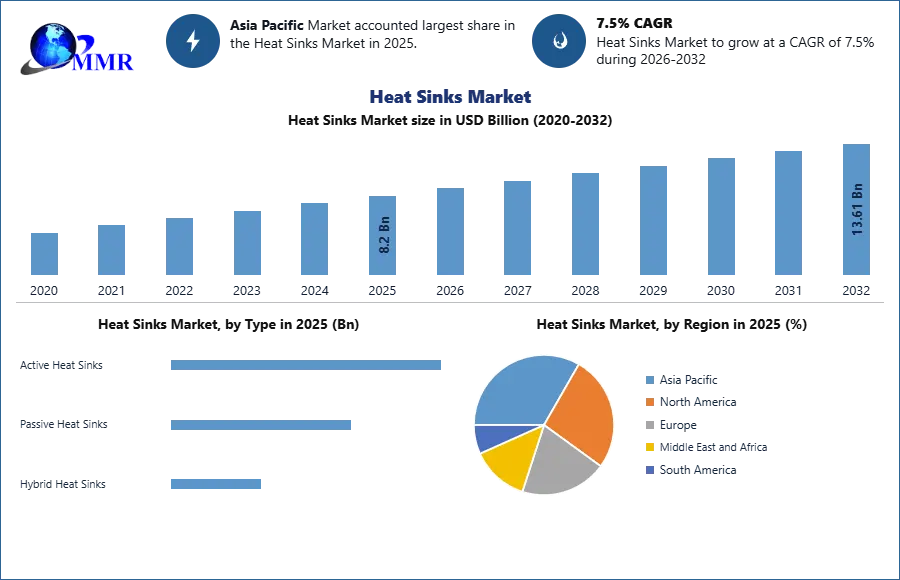
The Heat Sink Market size was valued at USD 8.2 Billion in 2025 and the total Heat Sink revenue is expected to grow at a CAGR of 7.5% from 2026 to 2032, reaching nearly USD 13.61 Billion.

Heat Sink Market Overview:

A heat sink is a component designed or installed in circuits to drain excess heat created by electronic components or chips during operation. It is generally used for thermal control in order to prevent a device from unexpected failure, hence increasing its efficiency and reliability. The heat sink follows Fourier's law of heat transmission. When the temperature across the device rises, it works to dissipate it by dispersing it through lower temperature zones around it. The heat sink functions as a heat exchanger, using the conduction and convection concepts. The most efficient heat sinks are made of metals with high thermal conductivity such as copper and aluminum. However, owing to its cheaper cost aluminum is more typically used for the manufacturing of Heat sinks.
Heat Sinks Market

To know about the Research Methodology :- Request Free Sample Report

In this report, the Heat Sink market's growth reasons, as well as the market's many segments (Type, Application, and Region), are discussed. Data has been given by market players, regions, and specific requirements. This market report includes a comprehensive overview of all the significant improvements that are presently prevailing in all market segments. Key data analysis is presented in the form of statistics, infographics, and presentations. The study discusses the Heat Sink market's Drivers, Restraints, Opportunities, and Challenges. The report helps to assess the market growth drivers and determines how to use these drivers as a tool. The report also helps to rectify and resolve issues related to the global Heat Sink market situation.

This report investigates how the Middle East conflict reshapes revenue for market leaders and disruptors. Geopolitical instability across maritime chokepoints has triggered diverse regional consequences notably in aluminum smelting and copper supply chain integrity. We examine short-term and long-term market shifts, specifically record-high raw material costs and industrial energy shocks, equipping decision-makers with strategic regional frameworks to navigate this high-pressure and rapidly evolving landscape.

Global Heat Sink Market Dynamics:

Heat sinks are used in computers to cool central processing units or graphics processors. Heat sinks are utilized with high-power semiconductor devices such as power transistors and optoelectronics such as lasers and light-emitting diodes (LEDs) when the component's own heat dissipation capability is insufficient to keep the temperature under control. The Heat Sinks are expected to be in high demand in North America, Europe, and Asia in the next years. The latest trend in designing electronics systems is to increase the functionality into smaller form factors.

Demand for electronics and power devices is growing across a variety of end industries; for example, the upcoming 5G implementation is expected to support a large influx of data and connectivity requirements for industries such as autonomous vehicles, smart cities, robotics, augmented reality, virtual reality, and manufacturing automation. Because of the increased use of artificial intelligence and the Internet of Things (IoT), which integrate smart functionality and connectivity across most industries, the number of cloud data center deployments is rapidly expanding. As a result, the power dissipation of most Integrated Circuit devices continues to rise, fueling the demand for more effective heat sinks and optimized designs.

The drawback associated with the Heat sinks is expected to hamper the growth of the market. A large heatsink will take up a lot of room within a computer case. This can make installing additional elements more challenging, especially if the motherboard is compact. Based on the scale and design of the board, the heatsink may potentially render access to certain of the motherboard's ports and connections difficult. A large heatsink may also be exceedingly noisy, resulting in a computer that sounds blaring when in use. While this may not bother some computer users, it may be rather annoying when utilized in a setting where others watch television or prefer silence.

Heat Sink Market Segment Analysis:

By Material, the Aluminum heat sink segment is the most often used heat sink. Extruded aluminum heat sinks, in particular, meet the requirements of the majority of projects. The metal is light in weight and has a high thermal conductivity.

Copper has become even more thermal conductivity than aluminum. The disadvantages include its weight and cost. The metal is occasionally used when thermal conductivity is more important than weight savings.

A combination of Copper and Aluminium Heat Sinks is often used in applications that need the use of large heat sinks. One of the advantages of this is that the base and fin materials can be different. In addition, instead of using only one fin material, a mix of aluminum and copper fins can be used. This enables users to boost thermal performance while adding very little weight. Bonded-fin heat sinks usually provide moderate performance at a high cost.

By Application, the Automobile Industry segment is expected to grow at the highest rate during the forecast period. Heat sinks are extensively used in the automotive industry, based on the requirement of thermal performance and price point. For example, an EV's thermal management covers the battery, transmission system, engine cooling, and waste heat recovery. For electric vehicles, the battery is one of the primary heat sources, and technologies such as friction stir welding and cold plate are ideal for addressing heat concerns.

Heat Sink Market Regional Insights:

In the Asia Pacific, Heat Sink Market is expected to have a significant share throughout the forecast period owing to the rise of the consumer electronics sector in the area. The region's increased car production increases the need for heat sinks. The expansion of semiconductor manufacturing businesses in China and South Korea is boosting the Asia Pacific thermal management market.

In North America and Europe, the market is also expected to grow at a rapid rate. For the last few years, there has been a huge increase in demand for servers and data centers. These include a variety of devices that require a greater number of heat sinks to regulate thermal activities in order for devices to operate smoothly and continuously.

Recent Industry Developments (2025–2026)

Exact Date Company Development Impact
23 February 2026 Asetek Commercialized next-generation AI-optimized liquid cooling heat sinks for high-density server racks. Strengthens market position in the hyperscale data center segment, addressing extreme heat from AI workloads.
14 February 2026 Delta Electronics Launched a new series of active-passive hybrid heat sinks specifically designed for 5G base station reliability. Optimizes thermal efficiency in outdoor environments, reducing maintenance costs for telecom operators.
15 January 2026 Momentive Technologies Introduced ultra-thin ceramic heat sinks for advanced 3D semiconductor packaging applications. Enables higher power density in compact consumer electronics and medical wearable devices.
12 December 2025 Boyd Corp Expanded production of friction stir welded cold plates for electric vehicle (EV) battery thermal management. Directly addresses the surging demand for lightweight, high-performance cooling in the automotive sector.
18 November 2025 Phononic Announced a strategic partnership to integrate thermoelectric cooling modules into LiDAR sensors for autonomous vehicles. Improves sensor accuracy and lifespan, setting a new benchmark for thermal control in self-driving tech.


The objective of the report is to present a comprehensive analysis of the Heat Sink market to the stakeholders in the industry. The past and current status of the industry with the forecasted market size and trends are presented in the report with the analysis of complicated data in simple language. The report covers all the aspects of the industry with a dedicated study of key players that include market leaders, followers, and new entrants.

PORTER, PESTEL analysis with the potential impact of micro-economic factors of the market have been presented in the report. External as well as internal factors that are supposed to affect the business positively or negatively have been analyzed, which will give a clear futuristic view of the industry to the decision-makers.

The report also helps in understanding the Heat Sink market dynamics, and structure by analyzing the market segments and projecting the Heat Sink market size. Clear representation of competitive analysis of key players by product, price, financial position, product portfolio, growth strategies, and regional presence in the Heat Sink market make the report investor’s guide.

Heat Sink Market Scope: Inquiry Before Buying  

Heat Sinks Market
Report Coverage Details
Base Year: 2025 Forecast Period: 2026-2032
Historical Data: 2020 to 2025 Market Size in 2025: 8.2 USD Billion
Forecast Period 2026-2032 CAGR: 7.5% Market Size in 2032: 13.61 USD Billion
Segments Covered: by Type Active Heat Sinks
Passive Heat Sinks
Hybrid Heat Sinks
by Material Aluminium Heat Sink
Copper Heat Sink
Others
by Application Automobile Industry
Electronic Industry
Aerospace And Defense
It And Telecommunication
Healthcare
Others

Heat Sink Market, by Region :

North America (United States, Canada and Mexico)
Europe (UK, France, Germany, Italy, Spain, Sweden, Austria and Rest of Europe)
Asia Pacific (China, South Korea, Japan, India, Australia, Indonesia, Malaysia, Vietnam, Taiwan, Bangladesh, Pakistan and Rest of APAC)
Middle East and Africa (South Africa, GCC, Egypt, Nigeria and Rest of ME&A)
South America (Brazil, Argentina Rest of South America)

Key Players / Competitors Profiles Covered in Brief in Global Heat Sink Market Report in Strategic Perspective:

  1. Alpha
  2. Molex
  3. Mecc.Al
  4. Ohmite
  5. Aavid Thermalloy
  6. Advanced Thermal Solutions
  7. Apex Microtechnology
  8. T-Global Technology
  9. Hoso Metal Co., Ltd.
  10. Dhruti Electricals & Electronics
  11. Saral Industries
  12. Himalay Engineering Co.
  13. Verdict Electronic Pvt. Ltd.
  14. Aavid Thermalloy India Pvt. Ltd.
  15. Delta Electronics
  16. TE Connectivity
  17. Fujikura Ltd.
  18. Laird Thermal Systems
  19. Advanced Cooling Technologies
  20. CUI Devices
  21. Wakefield Thermal
  22. Comair Rotron
  23. Alpha Novatech
  24. CTS Corporation
  25. Mersen

Frequently Asked Questions

1] What is the projected Heat Sink Market size and growth rate?
Ans. The market valuation was USD 8.2 Billion in 2025. It targets USD 13.61 Billion by 2032, maintaining a 7.5% CAGR driven by global infrastructure expansion.

2] Which region leads the Heat Sink Market share analysis for 2026?
Ans. Asia Pacific dominates due to surging semiconductor manufacturing in China and South Korea, coupled with rising consumer electronics demand and localized automotive production across the region.

3] How does 5G technology influence the Heat Sink Market outlook?
Ans. The 5G rollout mandates robust thermal control for base stations. Active-passive hybrid designs are emerging to ensure telecom equipment remains functional in diverse outdoor environmental conditions.

4] What are the sustainability trends in heat sink material selection?
Ans. Aluminum remains the preferred cost-effective, recyclable choice. However, high-performance copper and ceramic materials are gaining traction for applications requiring superior thermal conductivity and compact sizing.

5] What supply chain challenges currently affect the Heat Sink Market?
Ans. Space constraints in miniaturized electronics and potential noise issues from large active coolers represent significant design hurdles that manufacturers must address to maintain competitive positioning.

6] How does miniaturization impact the Heat Sink Market Trends 2026?
Ans. The trend toward smaller form factors requires higher power density. Innovative ultra-thin ceramic and hybrid heat sinks are essential for cooling compact 3D semiconductor packaging.

7] What role does the IoT sector play in industry growth drivers?
Ans. IoT integration across smart cities and robotics increases integrated circuit power dissipation. This necessitates optimized, high-performance heat sink designs to prevent critical hardware thermal failure.

Table of Contents

1. Heat Sinks Market Introduction
1.1. Study Assumption and Market Definition
1.2. Scope of the Study
1.3. Executive Summary
2. Global Heat Sinks Market: Competitive Landscape
2.1. MMR Competition Matrix
2.2. Competitive Landscape
2.3. Key Players Benchmarking
2.3.1. Company Name
2.3.2. Business Segment
2.3.3. End-user Segment
2.3.4. Revenue (2025)
2.3.5. Company Locations
2.4. Leading Heat Sinks Market Companies, by market capitalization
2.5. Market Structure
2.5.1. Market Leaders
2.5.2. Market Followers
2.5.3. Emerging Players
2.6. Mergers and Acquisitions Details
3. Heat Sinks Market: Dynamics
3.1. Heat Sinks Market Trends by Region
3.1.1. North America Heat Sinks Market Trends
3.1.2. Europe Heat Sinks Market Trends
3.1.3. Asia Pacific Heat Sinks Market Trends
3.1.4. Middle East and Africa Heat Sinks Market Trends
3.1.5. South America Heat Sinks Market Trends
3.2. Heat Sinks Market Dynamics by Region
3.2.1. North America
3.2.1.1. North America Heat Sinks Market Drivers
3.2.1.2. North America Heat Sinks Market Restraints
3.2.1.3. North America Heat Sinks Market Opportunities
3.2.1.4. North America Heat Sinks Market Challenges
3.2.2. Europe
3.2.2.1. Europe Heat Sinks Market Drivers
3.2.2.2. Europe Heat Sinks Market Restraints
3.2.2.3. Europe Heat Sinks Market Opportunities
3.2.2.4. Europe Heat Sinks Market Challenges
3.2.3. Asia Pacific
3.2.3.1. Asia Pacific Heat Sinks Market Drivers
3.2.3.2. Asia Pacific Heat Sinks Market Restraints
3.2.3.3. Asia Pacific Heat Sinks Market Opportunities
3.2.3.4. Asia Pacific Heat Sinks Market Challenges
3.2.4. Middle East and Africa
3.2.4.1. Middle East and Africa Heat Sinks Market Drivers
3.2.4.2. Middle East and Africa Heat Sinks Market Restraints
3.2.4.3. Middle East and Africa Heat Sinks Market Opportunities
3.2.4.4. Middle East and Africa Heat Sinks Market Challenges
3.2.5. South America
3.2.5.1. South America Heat Sinks Market Drivers
3.2.5.2. South America Heat Sinks Market Restraints
3.2.5.3. South America Heat Sinks Market Opportunities
3.2.5.4. South America Heat Sinks Market Challenges
3.3. PORTER's Five Forces Analysis
3.4. PESTLE Analysis
3.5. Technology Roadmap
3.6. Regulatory Landscape by Region
3.6.1. North America
3.6.2. Europe
3.6.3. Asia Pacific
3.6.4. Middle East and Africa
3.6.5. South America
3.7. Key Opinion Leader Analysis For Heat Sinks Industry
3.8. Analysis of Government Schemes and Initiatives For Heat Sinks Industry
3.9. Heat Sinks Market Trade Analysis
3.10. The Global Pandemic Impact on Heat Sinks Market
4. Heat Sinks Market: Global Market Size and Forecast by Segmentation (in USD Billion) 2025-2032
4.1. Heat Sinks Market Size and Forecast, by Type (2025-2032)
4.1.1. Active Heat Sinks
4.1.2. Passive Heat Sinks
4.1.3. Hybrid Heat Sinks
4.2. Heat Sinks Market Size and Forecast, by Material (2025-2032)
4.2.1. Aluminium Heat Sink
4.2.2. Copper Heat Sink
4.2.3. Others
4.3. Heat Sinks Market Size and Forecast, by Application (2025-2032)
4.3.1. Automobile Industry
4.3.2. Electronic Industry
4.3.3. Aerospace And Defense
4.3.4. It And Telecommunication
4.3.5. Healthcare
4.3.6. Others
4.4. Heat Sinks Market Size and Forecast, by Region (2025-2032)
4.4.1. North America
4.4.2. Europe
4.4.3. Asia Pacific
4.4.4. Middle East and Africa
4.4.5. South America
5. North America Heat Sinks Market Size and Forecast by Segmentation (in USD Billion) 2025-2032
5.1. North America Heat Sinks Market Size and Forecast, by Type (2025-2032)
5.1.1. Active Heat Sinks
5.1.2. Passive Heat Sinks
5.1.3. Hybrid Heat Sinks
5.2. North America Heat Sinks Market Size and Forecast, by Material (2025-2032)
5.2.1. Aluminium Heat Sink
5.2.2. Copper Heat Sink
5.2.3. Others
5.3. North America Heat Sinks Market Size and Forecast, by Application (2025-2032)
5.3.1. Automobile Industry
5.3.2. Electronic Industry
5.3.3. Aerospace And Defense
5.3.4. It And Telecommunication
5.3.5. Healthcare
5.3.6. Others
5.4. North America Heat Sinks Market Size and Forecast, by Country (2025-2032)
5.4.1. United States
5.4.1.1. United States Heat Sinks Market Size and Forecast, by Type (2025-2032)
5.4.1.1.1. Active Heat Sinks
5.4.1.1.2. Passive Heat Sinks
5.4.1.1.3. Hybrid Heat Sinks
5.4.1.2. United States Heat Sinks Market Size and Forecast, by Material (2025-2032)
5.4.1.2.1. Aluminium Heat Sink
5.4.1.2.2. Copper Heat Sink
5.4.1.2.3. Others
5.4.1.3. United States Heat Sinks Market Size and Forecast, by Application (2025-2032)
5.4.1.3.1. Automobile Industry
5.4.1.3.2. Electronic Industry
5.4.1.3.3. Aerospace And Defense
5.4.1.3.4. It And Telecommunication
5.4.1.3.5. Healthcare
5.4.1.3.6. Others
5.4.2. Canada
5.4.2.1. Canada Heat Sinks Market Size and Forecast, by Type (2025-2032)
5.4.2.1.1. Active Heat Sinks
5.4.2.1.2. Passive Heat Sinks
5.4.2.1.3. Hybrid Heat Sinks
5.4.2.2. Canada Heat Sinks Market Size and Forecast, by Material (2025-2032)
5.4.2.2.1. Aluminium Heat Sink
5.4.2.2.2. Copper Heat Sink
5.4.2.2.3. Others
5.4.2.3. Canada Heat Sinks Market Size and Forecast, by Application (2025-2032)
5.4.2.3.1. Automobile Industry
5.4.2.3.2. Electronic Industry
5.4.2.3.3. Aerospace And Defense
5.4.2.3.4. It And Telecommunication
5.4.2.3.5. Healthcare
5.4.2.3.6. Others
5.4.3. Mexico
5.4.3.1. Mexico Heat Sinks Market Size and Forecast, by Type (2025-2032)
5.4.3.1.1. Active Heat Sinks
5.4.3.1.2. Passive Heat Sinks
5.4.3.1.3. Hybrid Heat Sinks
5.4.3.2. Mexico Heat Sinks Market Size and Forecast, by Material (2025-2032)
5.4.3.2.1. Aluminium Heat Sink
5.4.3.2.2. Copper Heat Sink
5.4.3.2.3. Others
5.4.3.3. Mexico Heat Sinks Market Size and Forecast, by Application (2025-2032)
5.4.3.3.1. Automobile Industry
5.4.3.3.2. Electronic Industry
5.4.3.3.3. Aerospace And Defense
5.4.3.3.4. It And Telecommunication
5.4.3.3.5. Healthcare
5.4.3.3.6. Others
6. Europe Heat Sinks Market Size and Forecast by Segmentation (in USD Billion) 2025-2032
6.1. Europe Heat Sinks Market Size and Forecast, by Type (2025-2032)
6.2. Europe Heat Sinks Market Size and Forecast, by Material (2025-2032)
6.3. Europe Heat Sinks Market Size and Forecast, by Application (2025-2032)
6.4. Europe Heat Sinks Market Size and Forecast, by Country (2025-2032)
6.4.1. United Kingdom
6.4.1.1. United Kingdom Heat Sinks Market Size and Forecast, by Type (2025-2032)
6.4.1.2. United Kingdom Heat Sinks Market Size and Forecast, by Material (2025-2032)
6.4.1.3. United Kingdom Heat Sinks Market Size and Forecast, by Application (2025-2032)
6.4.2. France
6.4.2.1. France Heat Sinks Market Size and Forecast, by Type (2025-2032)
6.4.2.2. France Heat Sinks Market Size and Forecast, by Material (2025-2032)
6.4.2.3. France Heat Sinks Market Size and Forecast, by Application (2025-2032)
6.4.3. Germany
6.4.3.1. Germany Heat Sinks Market Size and Forecast, by Type (2025-2032)
6.4.3.2. Germany Heat Sinks Market Size and Forecast, by Material (2025-2032)
6.4.3.3. Germany Heat Sinks Market Size and Forecast, by Application (2025-2032)
6.4.4. Italy
6.4.4.1. Italy Heat Sinks Market Size and Forecast, by Type (2025-2032)
6.4.4.2. Italy Heat Sinks Market Size and Forecast, by Material (2025-2032)
6.4.4.3. Italy Heat Sinks Market Size and Forecast, by Application (2025-2032)
6.4.5. Spain
6.4.5.1. Spain Heat Sinks Market Size and Forecast, by Type (2025-2032)
6.4.5.2. Spain Heat Sinks Market Size and Forecast, by Material (2025-2032)
6.4.5.3. Spain Heat Sinks Market Size and Forecast, by Application (2025-2032)
6.4.6. Sweden
6.4.6.1. Sweden Heat Sinks Market Size and Forecast, by Type (2025-2032)
6.4.6.2. Sweden Heat Sinks Market Size and Forecast, by Material (2025-2032)
6.4.6.3. Sweden Heat Sinks Market Size and Forecast, by Application (2025-2032)
6.4.7. Austria
6.4.7.1. Austria Heat Sinks Market Size and Forecast, by Type (2025-2032)
6.4.7.2. Austria Heat Sinks Market Size and Forecast, by Material (2025-2032)
6.4.7.3. Austria Heat Sinks Market Size and Forecast, by Application (2025-2032)
6.4.8. Rest of Europe
6.4.8.1. Rest of Europe Heat Sinks Market Size and Forecast, by Type (2025-2032)
6.4.8.2. Rest of Europe Heat Sinks Market Size and Forecast, by Material (2025-2032)
6.4.8.3. Rest of Europe Heat Sinks Market Size and Forecast, by Application (2025-2032)
7. Asia Pacific Heat Sinks Market Size and Forecast by Segmentation (in USD Billion) 2025-2032
7.1. Asia Pacific Heat Sinks Market Size and Forecast, by Type (2025-2032)
7.2. Asia Pacific Heat Sinks Market Size and Forecast, by Material (2025-2032)
7.3. Asia Pacific Heat Sinks Market Size and Forecast, by Application (2025-2032)
7.4. Asia Pacific Heat Sinks Market Size and Forecast, by Country (2025-2032)
7.4.1. China
7.4.1.1. China Heat Sinks Market Size and Forecast, by Type (2025-2032)
7.4.1.2. China Heat Sinks Market Size and Forecast, by Material (2025-2032)
7.4.1.3. China Heat Sinks Market Size and Forecast, by Application (2025-2032)
7.4.2. S Korea
7.4.2.1. S Korea Heat Sinks Market Size and Forecast, by Type (2025-2032)
7.4.2.2. S Korea Heat Sinks Market Size and Forecast, by Material (2025-2032)
7.4.2.3. S Korea Heat Sinks Market Size and Forecast, by Application (2025-2032)
7.4.3. Japan
7.4.3.1. Japan Heat Sinks Market Size and Forecast, by Type (2025-2032)
7.4.3.2. Japan Heat Sinks Market Size and Forecast, by Material (2025-2032)
7.4.3.3. Japan Heat Sinks Market Size and Forecast, by Application (2025-2032)
7.4.4. India
7.4.4.1. India Heat Sinks Market Size and Forecast, by Type (2025-2032)
7.4.4.2. India Heat Sinks Market Size and Forecast, by Material (2025-2032)
7.4.4.3. India Heat Sinks Market Size and Forecast, by Application (2025-2032)
7.4.5. Australia
7.4.5.1. Australia Heat Sinks Market Size and Forecast, by Type (2025-2032)
7.4.5.2. Australia Heat Sinks Market Size and Forecast, by Material (2025-2032)
7.4.5.3. Australia Heat Sinks Market Size and Forecast, by Application (2025-2032)
7.4.6. Indonesia
7.4.6.1. Indonesia Heat Sinks Market Size and Forecast, by Type (2025-2032)
7.4.6.2. Indonesia Heat Sinks Market Size and Forecast, by Material (2025-2032)
7.4.6.3. Indonesia Heat Sinks Market Size and Forecast, by Application (2025-2032)
7.4.7. Malaysia
7.4.7.1. Malaysia Heat Sinks Market Size and Forecast, by Type (2025-2032)
7.4.7.2. Malaysia Heat Sinks Market Size and Forecast, by Material (2025-2032)
7.4.7.3. Malaysia Heat Sinks Market Size and Forecast, by Application (2025-2032)
7.4.8. Vietnam
7.4.8.1. Vietnam Heat Sinks Market Size and Forecast, by Type (2025-2032)
7.4.8.2. Vietnam Heat Sinks Market Size and Forecast, by Material (2025-2032)
7.4.8.3. Vietnam Heat Sinks Market Size and Forecast, by Application (2025-2032)
7.4.9. Taiwan
7.4.9.1. Taiwan Heat Sinks Market Size and Forecast, by Type (2025-2032)
7.4.9.2. Taiwan Heat Sinks Market Size and Forecast, by Material (2025-2032)
7.4.9.3. Taiwan Heat Sinks Market Size and Forecast, by Application (2025-2032)
7.4.10. Rest of Asia Pacific
7.4.10.1. Rest of Asia Pacific Heat Sinks Market Size and Forecast, by Type (2025-2032)
7.4.10.2. Rest of Asia Pacific Heat Sinks Market Size and Forecast, by Material (2025-2032)
7.4.10.3. Rest of Asia Pacific Heat Sinks Market Size and Forecast, by Application (2025-2032)
8. Middle East and Africa Heat Sinks Market Size and Forecast by Segmentation (in USD Billion) 2025-2032
8.1. Middle East and Africa Heat Sinks Market Size and Forecast, by Type (2025-2032)
8.2. Middle East and Africa Heat Sinks Market Size and Forecast, by Material (2025-2032)
8.3. Middle East and Africa Heat Sinks Market Size and Forecast, by Application (2025-2032)
8.4. Middle East and Africa Heat Sinks Market Size and Forecast, by Country (2025-2032)
8.4.1. South Africa
8.4.1.1. South Africa Heat Sinks Market Size and Forecast, by Type (2025-2032)
8.4.1.2. South Africa Heat Sinks Market Size and Forecast, by Material (2025-2032)
8.4.1.3. South Africa Heat Sinks Market Size and Forecast, by Application (2025-2032)
8.4.2. GCC
8.4.2.1. GCC Heat Sinks Market Size and Forecast, by Type (2025-2032)
8.4.2.2. GCC Heat Sinks Market Size and Forecast, by Material (2025-2032)
8.4.2.3. GCC Heat Sinks Market Size and Forecast, by Application (2025-2032)
8.4.3. Nigeria
8.4.3.1. Nigeria Heat Sinks Market Size and Forecast, by Type (2025-2032)
8.4.3.2. Nigeria Heat Sinks Market Size and Forecast, by Material (2025-2032)
8.4.3.3. Nigeria Heat Sinks Market Size and Forecast, by Application (2025-2032)
8.4.4. Rest of ME&A
8.4.4.1. Rest of ME&A Heat Sinks Market Size and Forecast, by Type (2025-2032)
8.4.4.2. Rest of ME&A Heat Sinks Market Size and Forecast, by Material (2025-2032)
8.4.4.3. Rest of ME&A Heat Sinks Market Size and Forecast, by Application (2025-2032)
9. South America Heat Sinks Market Size and Forecast by Segmentation (in USD Billion) 2025-2032
9.1. South America Heat Sinks Market Size and Forecast, by Type (2025-2032)
9.2. South America Heat Sinks Market Size and Forecast, by Material (2025-2032)
9.3. South America Heat Sinks Market Size and Forecast, by Application (2025-2032)
9.4. South America Heat Sinks Market Size and Forecast, by Country (2025-2032)
9.4.1. Brazil
9.4.1.1. Brazil Heat Sinks Market Size and Forecast, by Type (2025-2032)
9.4.1.2. Brazil Heat Sinks Market Size and Forecast, by Material (2025-2032)
9.4.1.3. Brazil Heat Sinks Market Size and Forecast, by Application (2025-2032)
9.4.2. Argentina
9.4.2.1. Argentina Heat Sinks Market Size and Forecast, by Type (2025-2032)
9.4.2.2. Argentina Heat Sinks Market Size and Forecast, by Material (2025-2032)
9.4.2.3. Argentina Heat Sinks Market Size and Forecast, by Application (2025-2032)
9.4.3. Rest Of South America
9.4.3.1. Rest Of South America Heat Sinks Market Size and Forecast, by Type (2025-2032)
9.4.3.2. Rest Of South America Heat Sinks Market Size and Forecast, by Material (2025-2032)
9.4.3.3. Rest Of South America Heat Sinks Market Size and Forecast, by Application (2025-2032)
10. Company Profile: Key Players
10.1. Alpha
10.1.1. Company Overview
10.1.2. Business Portfolio
10.1.3. Financial Overview
10.1.4. SWOT Analysis
10.1.5. Strategic Analysis
10.1.6. Scale of Operation (small, medium, and large)
10.1.7. Details on Partnership
10.1.8. Regulatory Accreditations and Certifications Received by Them
10.1.9. Awards Received by the Firm
10.1.10. Recent Developments
10.2. Molex
10.3. Mecc.Al
10.4. Ohmite
10.5. Aavid Thermalloy
10.6. Advanced Thermal Solutions
10.7. Apex Microtechnology
10.8. T-Global Technology
10.9. Hoso Metal Co. Ltd.
10.10. Dhruti Electricals & Electronics
10.11. Saral Industries
10.12. Himalay Engineering Co.
10.13. Verdict Electronic Pvt. Ltd.
10.14. Aavid Thermalloy India Pvt. Ltd.
10.15. Delta Electronics
10.16. TE Connectivity
10.17. Fujikura Ltd.
10.18. Laird Thermal Systems
10.19. Advanced Cooling Technologies
10.20. CUI Devices
10.21. Wakefield Thermal
10.22. Comair Rotron
10.23. Alpha Novatech
10.24. CTS Corporation
10.25. Mersen
11. Key Findings
12. Industry Recommendations
13. Heat Sinks Market: Research Methodology
14. Terms and Glossary

Custom Market Research Services

We Will Customise The Research For You, In Case The Report Listed Above Does Not Meet With Your Requirements