
Global Handbag Market - Industry Structure Evaluation, Demand Drivers Analysis, Regional Growth Analysis and Identification, Competitive Positioning / Landscape Review & Global Market Size Forecast to 2032
Overview
The Handbag Market size was valued at USD 57.60 Billion in 2024 and the total Handbag revenue is expected to grow at a CAGR of 6.9% from 2025 to 2032, reaching nearly USD 98.24 Billion.
Overview
A handbag is a type of fashion accessory that is typically used by women to carry vital personal utility items. Handbags are often made by sewing many pieces of cloth or leather together in a range of sizes, designs, and colors. The most prevalent varieties of handbags on the market include shoulder, satchel, handled, and sling bags. Gender-neutral bags are becoming increasingly popular among customers of all ages. People are becoming increasingly fascinated by the product's fashionable appeal, material quality, and attractive design, which drive Handbag Market growth. It is commonly utilized to enhance the user's appearance while also serving as a helpful storage device. The product's demand is forecast to be driven by the booming travel and tourism, which is driving up demand for the goods. To know about the Research Methodology :- Request Free Sample Report
Handbag Market Dynamics
E-commerce Expansion to Drive Market Growth: The handbag market is experiencing significant growth due to the expansion of e-commerce platforms. Online retailing offers consumers convenience, variety, and accessibility, driving up demand for handbags globally. E-commerce allows customers to browse through a vast array of products from the comfort of their homes, enabling retailers to reach a broader audience and penetrate new markets. With the proliferation of smartphones and internet connectivity, online shopping has become increasingly popular, further fuelling the growth of the handbag Industry.
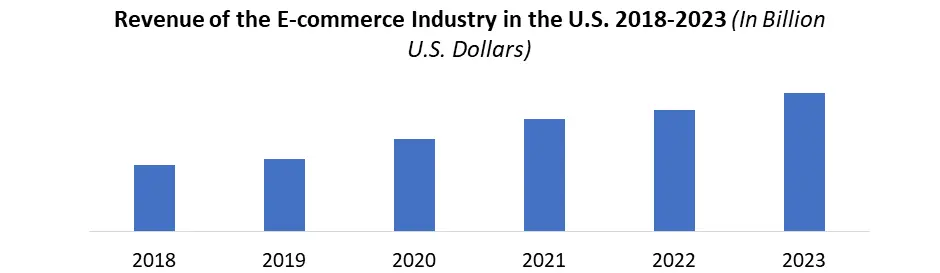
The e-commerce platforms offer personalized recommendations and targeted marketing strategies, enhancing the overall shopping experience and encouraging repeat purchases. As online retail continues to evolve and innovate, it is expected to remain a primary driver of growth in the handbag industry, capturing market share from traditional brick-and-mortar stores.
For Instance, the Wholesale Leather Bags offers a comprehensive exploration of sales and distribution channels tailored for businesses seeking to market leather goods in volume. From direct-to-consumer avenues through websites and retail outlets to wholesale distribution facilitated by agents and distributors, the industry is rich with options. Additionally, private label and custom manufacturing partnerships present opportunities for brand enhancement and product customization. Online marketplaces and e-commerce platforms offer global reach, while export and international sales expand revenue potential. Key considerations include navigating language, cultural differences, and regulatory landscapes. With a focus on quality control, branding, and packaging, Wholesale Leather Bags provides invaluable insights for businesses aiming to excel in the competitive wholesale leather goods Handbag Market.
Rising Disposable Income to Propel Market Growth
The handbag market is witnessing robust growth driven by increasing disposable income levels worldwide. As economies grow and consumers' purchasing power rises, there is a greater propensity to spend on luxury and fashion items like handbags. Rising disposable income enables consumers to indulge in premium and designer handbag brands, driving sales and revenue for manufacturers and retailers. The growing middle class in emerging markets such as China, India, and Brazil presents significant opportunities for the handbag market, as these consumers seek to showcase their status and style through luxury accessories. Luxury handbag brands are capitalizing on this trend by expanding their presence in emerging economies and offering products tailored to local preferences. As disposable incomes continue to rise globally, the demand for handbags is expected to remain buoyant, sustaining the market's growth trajectory.
The global consumer appetite for luxury bags, wallets, or cases varies significantly across different regions, with Asia and the Middle East exhibiting higher levels of interest compared to Europe and North America.
According to recent data, India stands out as the country with the highest percentage of consumers interested in purchasing luxury bags, wallets, or cases, with a notable 36% expressing intent to enter the market. Following closely behind is the UAE, with nearly a third of consumers (29%) showing interest. Other Asian countries surveyed also display considerable interest, with Indonesia (28%), Hong Kong (24%), China (18%), and Singapore (16%) all surpassing the global average.
In the Americas, urban Mexico outpaces the global average, with 16% of consumers expressing plans to purchase luxury bags. However, this enthusiasm is not mirrored in neighboring countries, with only 8% of Canadians and 7% of Americans indicating similar intentions.
European countries, despite being home to many prestigious luxury brands, generally exhibit lower interest in luxury bags compared to other regions. Italy, for instance, registers only 11% of consumers planning to buy luxury bags or wallets, while Denmark and Germany each record 7%. The UK demonstrates the least interest among European markets, with just around 6% of consumers intending to make such purchases.
Innovation and Product Differentiation to Create Lucrative Opportunity for Market Growth:
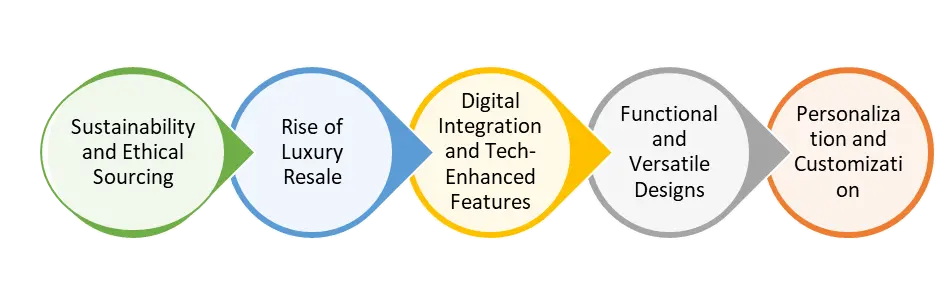
Innovation and product differentiation are key drivers of growth in the handbag market, as brands strive to capture consumers' attention in a competitive landscape. Innovation in handbags is driven by unique materials, creative designs, functional features, customization options, technology integration, sustainable practices, collaborations, storytelling, and omnichannel experiences. Strategic pricing complements differentiation, ensuring premium value for consumers.
Manufacturers are investing in research and development to create innovative designs, materials, and functionalities that resonate with evolving consumer preferences and lifestyle trends. From smart handbags equipped with technology features to sustainable materials and customizable options, brands are continuously innovating to offer unique and compelling products and boost the Handbag Industry. Product differentiation through limited editions, collaborations with designers, and customization services allows brands to create exclusivity and cater to diverse consumer segments. Social media and influencer marketing play a crucial role in promoting new handbag designs and driving consumer engagement. By staying ahead of trends and embracing innovation, handbag brands maintain relevance in the market and sustain growth amidst changing consumer demands.
Globally, younger women aged 18 to 24 show the highest interest in purchasing luxury bags or wallets, with 23% expressing intent, compared to 9% of women aged 55 and above and 12% of men across all age groups. However, in countries like the US and the UK, it is women aged 25 to 34 who exhibit the greatest propensity to invest in expensive bags, with 13% expressing interest. Additionally, in these countries, women aged 18 to 24 are equally likely as those over 55 to consider purchasing luxury bags, each group representing 6% of the population surveyed.
Evolutionary Trends Reshaping the Handbag Market: A Closer Look at 5 Key Developments.
Changing Fashion Trends and Counterfeit Products to Restrain the Market Growth
The handbag market is heavily influenced by rapidly evolving fashion trends. Shifts in consumer preferences towards minimalist designs, sustainable materials, or alternative forms of carrying belongings can quickly disrupt traditional handbag sales. Brands must adapt to these changing trends to remain relevant and maintain consumer interest. Failure to anticipate or respond to evolving fashion preferences can lead to decreased demand and excess inventory.
Counterfeit handbags pose a significant threat to the Handbag Market, diluting brand value and eroding consumer trust. Counterfeits not only compete directly with authentic products but also undermine the exclusivity and perceived quality associated with genuine luxury handbags. The presence of counterfeit goods diminishes brand reputation and impacts the consumers from purchasing legitimate products, impacting sales and profitability for genuine handbag manufacturers. Counterfeit prevention efforts require significant investment in anti-counterfeiting technologies and rigorous enforcement measures to protect brands and consumers alike.
Bag-packs, briefcases, drawstring bags, and other alternatives to handbags are progressively acquiring market share throughout the world and are expected to have a negative influence on handbag market growth. Similarly, the fact that many men prefer these alternative items to handbags has had a detrimental influence on the market. The leather items, including these types of bags, are seeing a drop in exports in several places throughout the world, which hinders the growing consumption. According to statistics published by Leather India.
Handbag Market Segment Analysis
By Product Type
In 2024, the Tote bag segment held the largest Handbag Market share. Tote bags are versatile accessories appreciated for their functionality and durability. They boast a larger size compared to other handbags, catering to various needs of consumers, whether for work, school, or leisure. The surge in popularity of Korean fashion trends, particularly among younger demographics, has further propelled the demand for tote bags. Their chic appeal also enables users to make a fashion statement, particularly in formal settings. One of the key factors driving the preference for tote bags is their eco-friendly nature. With the ability to be reused multiple times, they significantly reduce reliance on single-use plastic bags, thus aligning with sustainability objectives aimed at curbing plastic pollution. The initiatives such as the collaboration between renowned fashion designer Anya Hindmarch and major UK supermarket chains, Sainsbury's and Waitrose commitment to repurpose tote bags for sustainable practices.
By Distribution Channel
The online distribution channel segment is expected to grow at a significant CAGR over the forecast period. This surge is attributed to the increasing popularity of e-commerce platforms and social media channels. Particularly among younger demographics, there's a notable preference for online shopping due to the widespread digitalization of services. To adapt to this trend, companies within the market are enhancing their customer databases and digital storefronts to effectively cater to a broader audience. Leveraging social media platforms such as WeChat, Pinterest, Instagram, Twitter, and Sina Weibo have become integral for companies to engage with customers and drive traffic to both online and offline distribution channels.
For instance, Capri Holdings, which owns renowned brands Such as Michael Kors, Versace, and Jimmy Choo, has been strategically expanding its global retail presence by prioritizing omnichannel and e-commerce development. Similarly, companies like Coach and Kate Spade have established informative websites tailored for consumers in key markets like China, Malaysia, Singapore, Taiwan, and Hong Kong, demonstrating a concerted effort to reach audiences across the Asia Pacific region.
Handbag Market Regional Insight
Europe held the largest handbag market with a share in 2024. The region's high per capita income, exemplified by countries such as Germany, Italy, France, and the United Kingdom has propelled the consumption of fashion products, particularly handbags. Local brands such as Louis Vuitton, Chanel, and Gucci enjoy strong presence and popularity among consumers, further driving the market growth.
In the Asia Pacific region, steady Handbag Market gains are anticipated due to increasing employment rates, leading to greater consumption of consumer goods. Despite a slight decline from the previous year, with an employment-population ratio of 33.1%. The region is witnessing a surge in consumption, especially among its large youth population. Central and Southern Asia, with approximately 361 million young people according to the United Nations Economic and Social Affairs, are contributing significantly to this trend. The frequency of purchasing luxury handbags among high-income consumers in China as of January 2024 is used in once a month is 12% and every two months it is 24 5 %. Also, consumers are looking for a handbag per season up to 46 %.
Handbag Market Scope: Inquiry Before Buying
| Global Handbag Market | |||
|---|---|---|---|
| Report Coverage | Details | ||
| Base Year: | 2024 | Forecast Period: | 2025-2032 |
| Historical Data: | 2019 to 2024 | Market Size in 2024: | USD 57.60 Bn. |
| Forecast Period 2025 to 2032 CAGR: | 6.9% | Market Size in 2032: | USD 98.24 Bn. |
| Segments Covered: | by Product Type | Tote Clutch Satchel Others |
|
| by Raw Material | Leather Fabric Others |
||
| by Distribution Channel | Online Offline |
||
| by End-User | Men Women |
||
Handbag Market, by Region
North America (United States, Canada and Mexico)
Europe (UK, France, Germany, Italy, Spain, Sweden, Austria and Rest of Europe)
Asia Pacific (China, South Korea, Japan, India, Australia, Indonesia, Malaysia, Vietnam, Taiwan, Bangladesh, Pakistan and Rest of APAC)
Middle East and Africa (South Africa, GCC, Egypt, Nigeria and Rest of ME&A)
South America (Brazil, Argentina Rest of South America)
Handbag Key players
North America
1. Coach IP Holdings LLC (USA)
2. Kate Spade (USA)
3. Calvin Klein Inc. (USA)
4. Michael Kors (USA)
5. Fossil Group Inc. (USA)
6. Others
Europe
7. Ted Baker (United Kingdom)
8. Chanel Ltd. (France)
9. Louis Vuitton Speedy (France)
10. Prada Group (Italy)
11. Fendi (Italy)
12. Burberry (United Kingdom)
13. Hermès International S.A (France)
14. Others
Frequently Asked Questions:
1] What is the growth rate of the Global Handbag Market?
Ans. The Global Handbag Market is growing at a significant rate of 6.9 % during the forecast period.
2] Which region is expected to dominate the Global Handbag Market?
Ans. Europe is expected to dominate the Handbag Market during the forecast period.
3] What is the expected Global Handbag Market size by 2032?
Ans. The Handbag Market size is expected to reach USD 98.24 Bn by 2032.
4] Which are the top players in the Global Handbag Market?
Ans. The major top players in the Global Handbag Market are Coach IP Holdings LLC, Kate Spade and others.
5] What are the factors driving the Global Handbag Market growth?
Ans. The growth fashion industry and the millinery population's attraction towards these fashion trends and accessories are expected to drive the Handbag Market growth.
6] What was the Global Handbag Market size in 2024?
Ans: The Global Handbag Market size was USD 57.60 Billion in 2024.