Doors Market Size by Product type, Material, Mechanism, End User, Region, Industry-Wide Analysis, Competitive Landscape Assessment & Long-Term Forecast to 2032

5.2%
CAGR (2025-2032)
11.48 USD Bn.
Market Size
328
Report Pages
155
Market Tables

Overview

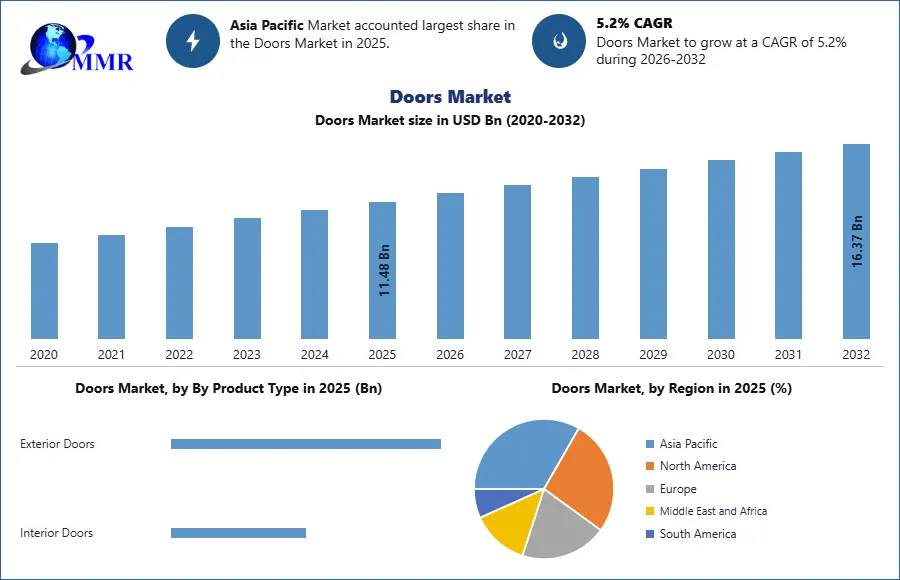
The Doors Market size was valued at USD 11.48 Billion in 2025 and the total Doors Market size is expected to grow at a CAGR of 5.2% from 2025 to 2032, reaching nearly USD 16.37 Billion by 2032.

Doors Market Overview:

Doors are the most commonly used structures in the construction sector. It controls the atmosphere of a place by circling the air drafts as well as growing the visual appeal of the architecture.Doors MarketTo know about the Research Methodology :- Request Free Sample Report
Doors Market Dynamics:

Growing housing infrastructure in urban and rural areas and rising populations are expected to drive the demand for door products. Increasing demand for impact-resistant housing structures will boost the growth of the global door market. Consumer demand is gradually shifting towards premium green products in the doors market. High investment & installation costs for eco-friendly doors are major factors restraining the growth of the market.

The construction and processing of doors are strongly reliant on raw materials. The growth of the doors market is hampered by variations in the prices of raw materials like plastic, wood, metal, and glass. The manufacture of plastic and metal products is heavily reliant on the oil and gas industry. Volatility in oil and gas prices has an impact on the pricing of plastic, metal, and glass, raising the cost of raw materials and affecting the doors market. Customers ultimately bear the brunt of these exorbitant expenditures. As a result, demand for the products declines, reducing manufacturers' profit margins. As a result, despite shifting raw material prices, the key issue for door manufacturers is to provide cheap solutions.

Doors Market Segment Analysis:

In 2025, the Exterior Doors segment holds the highest demand in the global doors market. Exterior doors are critical for security, insulation, and aesthetic appeal, making them a priority in both residential and non-residential construction. Increasing investments in housing infrastructure and renovation projects are further driving demand for durable and weather-resistant exterior doors. Meanwhile, Interior Doors are witnessing steady growth due to rising urbanization and the growing emphasis on interior design and space optimization, particularly in residential applications.

Based on Material, Wood (especially Engineered Wood) remains the most widely used segment in 2025 due to its cost-effectiveness, aesthetic versatility, and improved durability compared to solid wood. Engineered wood is increasingly preferred for its resistance to warping and environmental factors. However, Metal Doors (Steel and Aluminum) are gaining strong traction, particularly in commercial and industrial applications, due to their superior strength, security, and fire resistance. Glass and Composite materials are also experiencing growing demand in modern architectural designs, driven by trends toward energy efficiency and contemporary aesthetics.

Based on Mode of Application, New Construction accounts for the largest market share in 2025, driven by rapid urbanization, infrastructure development, and government initiatives supporting housing and commercial construction projects globally. At the same time, the Aftermarket segment is growing steadily, supported by rising renovation and remodeling activities, particularly in developed regions where upgrading building aesthetics and energy efficiency is a priority.

Based on Application, the Residential segment dominates the doors market in 2025, fueled by increasing housing demand, population growth, and rising consumer spending on home improvement. The demand for aesthetically appealing and secure doors is particularly high in this segment. Meanwhile, the Non-Residential segment (including commercial, industrial, and institutional buildings) is witnessing significant growth due to expanding infrastructure, office spaces, hospitality, and retail sectors, where durability and compliance with safety standards are key considerations.

Doors Market
Report Coverage Details
Base Year: 2025 Forecast Period: 2026-2032
Historical Data: 2020 to 2025 Market Size in 2025: 11.48 USD Bn
Forecast Period 2026-2032 CAGR: 5.2% Market Size in 2032: 16.37 USD Bn
Segments Covered: By Product Type Exterior Doors
Interior Doors
By Material Wood
    Solid
    Engineered Wood
Metal
    Steel
    Aluminum
    Stainless Steel
Glass
    Tempered
    Laminated
    Frosted
Composite
    Fiberglass
    Polymer
Plastic
    PVC
    Polycarbonate
    Acrylic
Others
By Mechanism Swinging
Sliding
Overhead
Folding
Others
By Mode of Application New Construction
Aftermarket
By Application Residential
Non-Residential

Doors Market Regional Insights:

Based on Region, Asia Pacific leads the global doors market in 2025, driven by rapid urbanization, population growth, and large-scale residential and commercial construction activities in countries such as China and India. The region benefits from strong demand for both affordable and premium door solutions. North America and Western Europe show stable growth, supported by renovation activities, advanced construction standards, and increasing adoption of energy-efficient and smart doors. Meanwhile, regions such as Eastern Europe, Middle East & Africa, and South America are experiencing moderate growth, primarily influenced by infrastructure development and improving economic conditions.

The objective of the report is to present a comprehensive analysis of the Global Washing Machine Market to the stakeholders in the industry. The past and current status of the industry with the forecasted market size and trends are presented in the report with the analysis of complicated data in simple language. The report covers all the aspects of the industry with a dedicated study of key players that include market leaders, followers, and new entrants.

PORTER, PESTEL analysis with the potential impact of micro-economic factors of the market have been presented in the report. External as well as internal factors that are supposed to affect the business positively or negatively have been analyzed, which will give a clear futuristic view of the industry to the decision-makers.

The reports also helps in understanding the Global Washing Machine Market dynamic, structure by analyzing the market segments and project the Global Washing Machine Market size. Clear representation of competitive analysis of key players by product, price, financial position, product portfolio, growth strategies, and regional presence in the Global Washing Machine Market make the report investor’s guide.

Global Doors Market Scope: Inquire before buying

Global Doors Market, by Region

Asia Pacific (China, South Korea, Japan, India, Australia, Indonesia, Malaysia, Vietnam, Taiwan, Bangladesh, Pakistan and Rest of APAC)
Europe (UK, France, Germany, Italy, Spain, Sweden, Austria and Rest of Europe)
North America (United States, Canada and Mexico)
Middle East and Africa (South Africa, GCC, Egypt, Nigeria and Rest of ME&A)
South America (Brazil, Argentina Rest of South America)

Global Doors Market Key Players

  1. Masonite
  2. Andersen Corporation
  3. JELD-WEN, Inc.
  4. Pella Corporation
  5. Cornerstone Building Brands
  6. Boon Edam
  7. Atrium Windows & Doors
  8. Fenesta Building Systems
  9. Simpson Door Company
  10. Hörmann Group
  11. Novoferm
  12. Corinthian Doors
  13. Marvin Windows & Doors
  14. ViWinTech Windows & Doors
  15. Therma-Tru Corp.
  16. OCM Industrial Doors
  17. ASSA ABLOY AB
  18. Fortune Brands Innovations
  19. LaCantina Doors
  20. Rytec Doors
  21. Efaflex
  22. Angel Mir
  23. Magna International (Doors Division)
  24. dormakaba Group
  25. GEZE GmbH
  26. Gilgen Door Systems AG
  27. Sapa Building Systems
  28. Hörmann India
  29. Kalco Alu-Systems Pvt. Ltd.

Table of Contents

1. Doors Market : Market Introduction 1.1. Executive Summary 1.2. Market Size (2025) & Forecast (2026-2032) 1.3. Market Size (USD Million and 000'Units) and Market Share (%) - By Segments, Regions and Country 2. Competitive Landscape 2.1. MMR Competition Matrix 2.2. Competitive Analysis of key players 2.3. Key Players Benchmarking 2.3.1 Company Name 2.3.2 Headquarter 2.3.3 Product Portfolio 2.3.4 Revenue 2025 2.3.5 Market Share (%) 2.3.6 Growth Rate (%) 2.3.7 Profit Margin (%) 2.3.8 R&D Investments 2.3.9 Warranty Durations 2.3.10 Technological Innovation 2.3.11 Certifications 2.3.12 ESG / sustainability policies 2.3.13 Geographical Presence 2.4. Market Structure 2.4.1 Market Leaders 2.4.2 Market Followers 2.4.3 Emerging Players 2.5. Mergers and Acquisitions Details 2.6. Research and Development 3. Doors Market Dynamics 3.1. Doors Market Trends 3.2. Doors Market Dynamics 3.2.1 Drivers 3.2.2 Restraints 3.2.3 Opportunities 3.2.4 Challenges 3.3. PORTER’s Five Forces Analysis 3.4. PESTLE Analysis 4. Consumer & Buyer Decision-Making Analysis 4.1 Key Purchase Criteria Across Residential and Non-Residential Buyers 4.2 Role of Aesthetics, Durability, Safety, and Price in Decision Hierarchy 4.3 Influence of Architects, Contractors, and Interior Designers on Selection 4.4 Brand Perception vs Functional Performance Trade-offs 4.5 Buyer Sensitivity to Warranties, Certifications, and Compliance Labels 4.6 Replacement Cycle Behavior and Upgrade Triggers 4.7 Regional and Cultural Preferences Shaping Buying Behavior 5. Customization, Design Trends & Aesthetic Evolution 5.1 Shift Toward Customized and Made-To-Order Door Solutions 5.2 Influence of Architectural Styles and Interior Design Trends 5.3 Demand for Minimalistic, Frameless, and Concealed Door Designs 5.4 Color, Texture, and Finish Innovation Impact on Premiumization 5.5 Modularity and Flexibility in Door Design 5.6 Design-Led Differentiation in High-End Applications 5.7 Speed-to-Market Challenges in Customized Offerings 6. Application-Based Demand & Usage Pattern Analysis 6.1 Residential Demand Patterns Across Housing Types, Income Segments, and Lifestyle Preferences 6.2 Non-Residential Demand Driven by Commercial, Institutional, and Industrial Facilities 6.3 Performance and Safety Requirements by Application Type 6.4 Renovation vs New-Build Adoption Trends Across Residential and Non-Residential Projects 6.5 Material and Design Preferences by Application Category 6.6 Installation and Maintenance Patterns Across Residential and Non-Residential Sectors 6.7 Application-Specific Demand Stability and Resilience Across Economic Cycles 7. Pricing, Cost Structure & Profitability Analysis (2025 7.1 Cost Composition Across Materials, Labor, and Manufacturing Processes 7.2 Impact of Material Price Fluctuations on Margins 7.3 Pricing Differentiation by Performance and Customization Level 7.4 Value-Added Features and Their Effect on Price Realization 7.5 Profitability Variation Across Application Categories 7.6 Economies of Scale and Operational Efficiency Levers 7.7 Margin Sensitivity to Demand Cycles and Input Costs 8. Performance, Safety & Functional Requirement Analysis 8.1 Fire Resistance and Smoke Control Performance Standards 8.2 Acoustic Insulation and Soundproofing Requirements 8.3 Moisture Resistance and Suitability for Wet Environments 8.4 Security, Burglary Resistance, and Access Control Integration 8.5 Radiation Shielding Requirements in Specialized Applications 8.6 Durability, Wear Resistance, and Lifecycle Performance 8.7 Trade-offs Between Performance Enhancement and Cost 9. Installation, Maintenance & After-Sales Service Analysis 9.1 Installation Complexity and Skill Requirements 9.2 Impact of Improper Installation on Performance and Warranties 9.3 Maintenance Frequency and Lifecycle Cost Considerations 9.4 Service Contracts and Aftermarket Revenue Opportunities 9.5 Role of Installers and Service Partners in Brand Reputation 9.6 Retrofit and Replacement-Driven Service Demand 9.7 Digital Tools for Installation Guidance and Service Management 10. Technology & Product Innovation Analysis 10.1 Adoption of Smart, Connected, and Sensor-Enabled Doors 10.2 Advances in Fire-Rated, Acoustic, and Security Door Technologies 10.3 Material Innovation Trends Improving Durability and Lifecycle Performance 10.4 Role of Automation and Precision Manufacturing in Quality Enhancement 10.5 Integration of Sustainability and Eco-Design Principles 10.6 Customization Capabilities Driven by Digital Fabrication 10.7 Technology-Led Differentiation and Product Lifecycle Evolution 11. Procurement, Specification & Tendering Dynamics 11.1 Specification-Driven Procurement in Large Construction Projects 11.2 Tendering Processes and Vendor Qualification Criteria 11.3 Cost vs Compliance Trade-offs in Public and Private Projects 11.4 Influence of Bulk Purchasing and Long-Term Contracts 11.5 Role of Certifications and Test Reports in Procurement Decisions 11.6 Procurement Risks and Vendor Dependency Issues 11.7 Shift Toward Performance-Based Procurement Models 12. Trade Flow Analysis (2025) 12.1 Global and Regional Import–Export Flows of Doors and Door Components 12.2 Key Exporting and Importing Regions and Trade Concentration 12.3 Impact of Trade Policies, Tariffs, and Duties on Door Pricing 12.4 Cross-Border Logistics, Freight Costs, and Lead Time Implications 12.5 Localization vs International Sourcing Trade-offs 12.6 Regional Supply–Demand Gaps Influencing Trade Flows 12.7 Geopolitical and Macroeconomic Risks Affecting Door Trade Dynamics 13. Supply Chain, Manufacturing & Capacity Analysis 13.1 Global and Regional Sourcing Dependencies for Key Inputs 13.2 Manufacturing Footprint Optimization and Capacity Utilization 13.3 Automation and Lean Manufacturing Adoption Levels 13.4 Logistics, Warehousing, and Distribution Cost Pressures 13.5 Supply Chain Resilience and Risk Mitigation Strategies 13.6 Role of OEMs, Contract Manufacturers, and Integrators 13.7 Lead-Time Management and Delivery Performance Benchmarks 14. Sustainability, Energy Efficiency & Regulatory Impact 14.1 Influence of Green Building Standards on Door Specifications 14.2 Demand for Energy-Efficient and Insulated Door Solutions 14.3 Lifecycle Assessment and Carbon Footprint Considerations 14.4 Recycling, Reuse, and Circular Material Adoption Trends 14.5 Regulatory Enforcement of Fire, Smoke, and Safety Norms 14.6 Compliance Cost Implications for Manufacturers 14.7 Sustainability as a Procurement and Branding Differentiator 15. Regulatory Landscape Analysis by Region 15.1 Overview of Regional Building Codes and Standards 15.2 Fire Safety, Smoke Protection, and Emergency Compliance Requirements 15.3 Energy Efficiency and Thermal Insulation Regulations 15.4 Security, Burglary Resistance, and Access Control Standards 15.5 Material-Specific Compliance (Wood, Metal, Glass, Composite, Plastic) 15.6 Certification and Testing Requirements Across Key Markets 15.7 Regional Enforcement Practices, Penalties, and Impact on Manufacturers 16. Global Doors Market : Market size and Forecast by Segmentation (by Value USD Million and 000'Units) (2025-2032) 16.1. Global Doors Market Size and Forecast, By Product Type 16.1.1 Interior Doors 16.1.2 Exterior Doors 16.2. Global Doors Market Size and Forecast, By Material 16.2.1 Wood 16.2.2 Solid 16.2.3 Engineered Wood 16.2.4 Metal 16.2.5 Steel 16.2.6 Aluminum 16.2.7 Stainless Steel 16.2.8 Glass 16.2.9 Tempered 16.2.10 Laminated 16.2.11 Frosted 16.2.12 Composite 16.2.13 Fiberglass 16.2.14 Polymer 16.2.15 Plastic 16.2.16 PVC 16.2.17 Polycarbonate 16.2.18 Acrylic 16.2.19 Others 16.3. Global Doors Market Size and Forecast, By Mechanism 16.3.1 Swinging 16.3.2 Sliding 16.3.3 Overhead 16.3.4 Folding 16.3.5 Others 16.4. Global Doors Market Size and Forecast, By Mode of Application 16.4.1 New Construction 16.4.2 Aftermarket 16.5. Global Doors Market Size and Forecast, By Application 16.5.1 Residential 16.5.2 Non-Residential 16.6. Global Doors Market Size and Forecast, by Region 16.6.1 North America 16.6.2 Europe 16.6.3 Asia Pacific 16.6.4 Middle East and Africa 16.6.5 South America 17. North America Doors Market Size and Forecast by Segmentation (by Value USD Million and 000'Units) (2025-2032) 17.1. North America Market Size and Forecast, By Product Type 17.2. North America Market Size and Forecast, By Material 17.3. North America Market Size and Forecast, By Mechanism 17.4. North America Market Size and Forecast, By Mode of Application 17.5. North America Market Size and Forecast, By Application 17.6. North America Market Size and Forecast, by Country 17.6.1 United States 17.6.2 United States Market Size and Forecast, By Product Type 17.6.3 United States Market Size and Forecast, By Material 17.6.4 United States Market Size and Forecast, By Mechanism 17.6.5 United States Market Size and Forecast, By Mode of Application 17.6.6 United States Market Size and Forecast, By Application 17.6.7 Canada 17.6.8 Mexico 18. Europe Doors Market Size and Forecast by Segmentation (by Value USD Million and 000'Units) (2025-2032) 18.1. Europe Market Size and Forecast, By Product Type 18.2. Europe Market Size and Forecast, By Material 18.3. Europe Market Size and Forecast, By Mechanism 18.4. Europe Market Size and Forecast, By Mode of Application 18.5. Europe Market Size and Forecast, By Application 18.6. Europe Market Size and Forecast, by Country 18.6.1 United Kingdom 18.6.2 France 18.6.3 Germany 18.6.4 Italy 18.6.5 Spain 18.6.6 Sweden 18.6.7 Russia 18.6.8 Rest of Europe 19. Asia Pacific Doors Market Size and Forecast by Segmentation (by Value USD Million and 000'Units) (2025-2032) 19.1. Asia Pacific Market Size and Forecast, By Product Type 19.2. Asia Pacific Market Size and Forecast, By Material 19.3. Asia Pacific Market Size and Forecast, By Mechanism 19.4. Asia Pacific Market Size and Forecast, By Mode of Application 19.5. Asia Pacific Market Size and Forecast, By Application 19.6. Asia Pacific Market Size and Forecast, by Country 19.6.1 China 19.6.2 Japan 19.6.3 South Korea 19.6.4 India 19.6.5 Australia 19.6.6 Malaysia 19.6.7 Thailand 19.6.8 Vietnam 19.6.9 Indonesia 19.6.10 Philippines 19.6.11 Rest of Asia Pacific 20. Middle East and Africa Doors Market Size and Forecast by Segmentation (by Value USD Million and 000'Units) (2025-2032) 20.1. Middle East and Africa Market Size and Forecast, By Product Type 20.2. Middle East and Africa Market Size and Forecast, By Material 20.3 Middle East and Africa Market Size and Forecast, By Mechanism 20.4 Middle East and Africa Market Size and Forecast, By Mode of Application 20.5 Middle East and Africa Market Size and Forecast, By Application 20.6. Middle East and Africa Market Size and Forecast, by Country 20.6.1 South Africa 20.6.2 GCC 20.6.3 Nigeria 20.6.4 Egypt 20.6.5 Turkey 20.6.6 Rest of ME&A 21. South America Doors Market Size and Forecast by Segmentation (by Value USD Million and 000'Units) (2025 -2032) 21.1. South America Market Size and Forecast, By Product Type 21.2. South America Market Size and Forecast, By Material 21.3. South America Market Size and Forecast, By Mechanism 21.4 South America Market Size and Forecast, By Mode of Application 21.4 South America Market Size and Forecast, By Mode of Application 21.5 South America Market Size and Forecast, By Application 21.6. South America Market Size and Forecast, by Country 21.6.1 Brazil 21.6.2 Argentina 21.6.3 Colombia 21.6.4 Chile 21.6.5 Peru 21.6.6 Rest Of South America 22. Company Profile: Key Players 22.01.Masonite 22.01.1 Overview 22.01.2 Business Portfolio 22.01.3 Financial Overview 22.01.4 SWOT Analysis 22.01.5 Strategic Analysis 22.01.6 Recent Developments 22.02.Andersen Corporation 22.03.JELD-WEN, Inc. 22.04.Pella Corporation 22.05.Cornerstone Building Brands 22.06.Boon Edam 22.07.Atrium Windows & Doors 22.08.Fenesta Building Systems 22.09.Simpson Door Company 22.10.Hormann / Hörmann Group 22.11.Novoferm 22.12.Corinthian Doors 22.13.Marvin Windows & Doors 22.14.ViWinTech Windows & Doors 22.15.Therma-Tru Corp. 22.16.OCM Industrial Doors 22.17.ASSA ABLOY AB / Assa Abloy Group 22.18.Fortune Brands Innovations 22.19.Lacantina Doors 22.20.Rytec Doors 22.21.Efaflex 22.22.Angel Mir 22.23.Magna International (Doors Division) 22.24.Dorma / Dormakaba Group 22.25.Geze GmbH 22.26.Gilgen Door Systems AG 22.27.Sapa Building Systems 22.28.Hörmann India 22.29.Kalco Alu-Systems Pvt. Ltd. 22.29.1 Others 23. Key Findings 24. Strategic Moves & Industry Outlook 25. Global Doors Market : Research Methodology

Custom Market Research Services

We Will Customise The Research For You, In Case The Report Listed Above Does Not Meet With Your Requirements