
Luxury Handbag Market by Product Type, by Material, by End user, by Distribution Channel and Regional Insights 2034
Overview
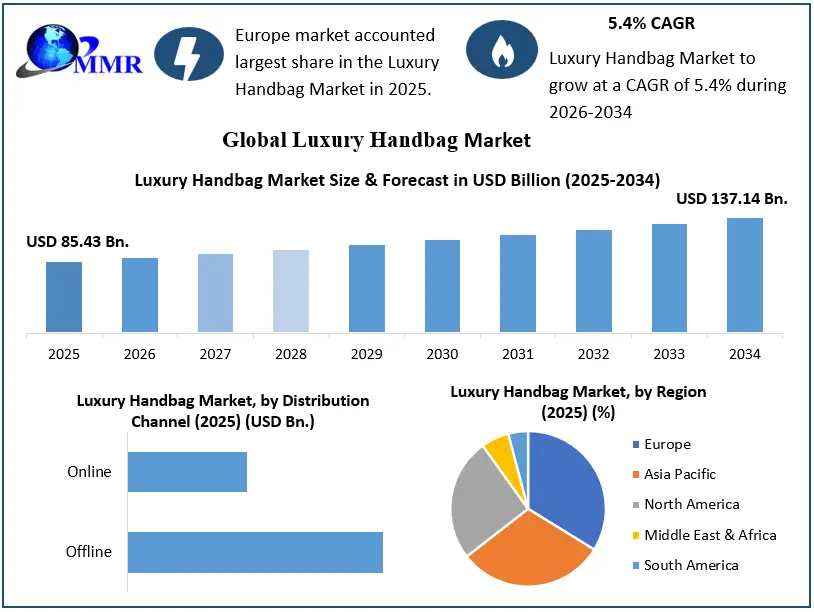
The Global Luxury Handbag Market was valued at USD 85.43 Billion in 2025 and is projected to reach USD 137.14 Billion by 2034, growing at a CAGR of 5.4% during the forecast period 2026–2034.
Global Luxury Handbag Market Overview
A luxury handbag is a high-end product that combines quality, craftsmanship, brand recognition, and unique design. The Luxury Handbag Market entails designer handbags, totes, shoulder bags, clutches, satchels, crossbody bags, and other high-end bags offered by luxury retailers and department stores. The market’s importance is driven by the demand for luxury products, the role of handbags as a status symbol, and their prominence as a fashion statement. Luxury bag brands are critical to their manufacturers as they offer significant revenue and brand value. The Luxury Handbag Market continues to grow due to its value, brand image, and appeal to customers’ luxury segments. Moreover, handbags have become an essential purchase for many, and the market attracts various groups of buyers.
The Luxury Handbag Market is changing due to style preferences, customer behaviors, and the rising influence of fashion-conscious millennials and collectibles. Limited collections, customization, bags’ desirability, and sustainability have become more important to brands and customers. In addition, handbag shopping involves high-income customers, limited production runs, and the impact of social media. Prominent Luxury Handbag Market bags are recognized by their brand value, image, and product design, which create desirable exclusivity. However, a market gap analysis indicates that the market for luxury handbags is highly divided between luxury brands and customers’ purchasing power.
Europe is a leading region of Luxury Handbag Market due to its significant contribution to the luxury fashion sector, brand presence, and tourism. Asia Pacific is a growing market for luxury handbags due to an increase in wealthy individuals and middle-class customers who purchase luxury items and fashion bags. The market competition is intense as top manufacturers compete to provide high-quality luxury handbags based on brand value, quality, and experience. Thus, MMR’s research on the Luxury Handbag Market provides a list of prominent players, including Louis Vuitton, Gucci, Hermès, Chanel, Prada, Dior, Burberry, Coach, Michael Kors, and Bottega Veneta. According to MMR, the market will continue to grow due to the brands’ value and product placement. However, the most significant opportunity for growth in the Luxury Handbag Market will come from closing the luxury market gap between existing players and new market entrants while creating brand value and desirable collections.
Luxury Handbag Market Growth Outlook
To know about the Research Methodology:- Request Free Sample Report
Global Luxury Handbag Market Dynamics
Rising Premium Expenditure and Demand for Status-Driven Fashion to Drive Luxury Handbag Market Growth
An increase in disposable income among affluent consumers and the rising need for premium lifestyle accessories fuels the demand for luxury handbags. In most cases, discerning buyers tend to purchase high-end handbags as a means of satisfying their desire for prestige, luxury, uniqueness, and self-expression, all of which contribute to the market growth. Moreover, the growth of tourism and the need for branded accessories among travelers boosts the market demand for designer handbags. Younger generations are also entering the market through smaller handbags, affordable luxury accessories, and digital channels, thus, supporting the manufacturers’ ability to expand their presence in non-wealthy demographics. Overall, the rising need for brand storytelling and the scarcity of products also impact the growth of the luxury handbag market size. Thus, the market growth potential for established luxury brands with significant market shares is enormous.
Premium Pricing and Economic Instability to Restraint Global Luxury Handbag Market Growth
On the other hand, the luxury handbag market growth rate might decelerate due to the significant purchasing power needed to acquire luxury handbags. For instance, during inflationary periods, economic downturns, and times of low consumer confidence, most buyers tend to hold off on their premium handbag purchases. At the same time, many luxury handbag manufacturers tend to increase their prices due to rising production costs, thus, lowering the purchasing power of middle-market consumers. In addition, counterfeit products can damage the brand image of high-end handbag manufacturers, thereby, influencing the overall market share of genuine luxury handbags. Some luxury handbag manufacturers might struggle to maximize their profits due to the significant investment required in showrooms, bag production, brand development, and marketing. Therefore, the overall market potential for luxury handbags is moderate, despite the projected market growth.
Luxury Handbag Market Opportunities to Come from Emerging Consumers and Rising Resale Market
The rising middle-class wealth, together with an increase in disposable income, will boost the demand for premium handbags among emerging consumers in developed and emerging markets. Companies can benefit from targeting these consumers through smaller handbags, personalized accessories, online luxury collections, and entry-level luxury handbags. However, manufacturers must also ensure they do not dilute the brand’s image due to the target market’s lower purchasing power. The secondary market is also a significant source of market supply, which has helped most luxury handbag brands’ growth in the past decade. The demand for certified pre-owned handbags will continue to fuel the market growth while supporting more sustainable and circular fashion consumption. Most luxury handbag manufacturers target the upper-middle-class and high-net-worth consumers to maximize their profit margins. However, the middle-class luxury handbag segment has significant growth potential, especially with the use of digital channels and online retail marketing. Another significant opportunity for handbag manufacturers is the ability to produce entry-level luxury handbags, thus, maximizing their profits by providing unique products to a more significant number of affluent consumers.
Scarcity and Rising Demand for Premium Handbags to Challenge Manufacturers
Luxury handbag manufacturers can benefit from the overall market potential. However, a considerable amount of brand dilution might occur, thus, lowering the overall market valuation significantly. On the other hand, a company can generate substantial profits with high margin percentages by investing heavily in brand development, quality production, brand maintenance, and supply chain management. While most handbag manufacturers seek to increase their market share by targeting new customers and expanding their retail presence, they might encounter significant challenges. The significant gap between ultra-luxury, luxury, and commercial bag providers continues to dictate most industry players’ market positioning and valuation. The rising need for higher production volumes, together with the need for product authenticity and higher quality, will limit the ability of manufacturers to boost their revenues. Moreover, the rising cost of labor and raw materials, higher profit expectations from stakeholders, as well as the need for continuous innovation, will motivate some manufacturers to switch to more affordable luxury bag production. Therefore, the long-term luxury handbag market outlook is stable due to the need for brand prestige and the rising demand for affordable luxury handbags.
Global Luxury Handbag Market Trend
| Trend | Short Description |
| Resale Value Matters More | Buyers consider resale value, rarity, and future demand before making a purchase, therefore, contributing to the market potential of bags. |
| Heritage Designs Return | Luxury fashion houses’ reuse of past styles in innovative approaches to materials and details helps the market size and younger generations interested. |
| Limited Editions Gain Demand | Supplies are rare, so colors, sizes, and constructions are worth attention to increase their share and new market opportunities. |
| Craftsmanship Gains Importance | Consumers are now more likely to consider leather, quality, and handcrafted bags, thus supporting the forecast for the market. |
| Bold Materials and Textures Grow | Chains, suede, woven effect, and statement details are presented in different collections for 2026, offering many opportunities. |
| Digital and Resale Channels Connect | Boutiques, social networks, e-commerce, and pawnshops provide customers with a wide range of choices; however, authentication remains a challenge. |
Global Luxury Handbag Market Segment Analysis
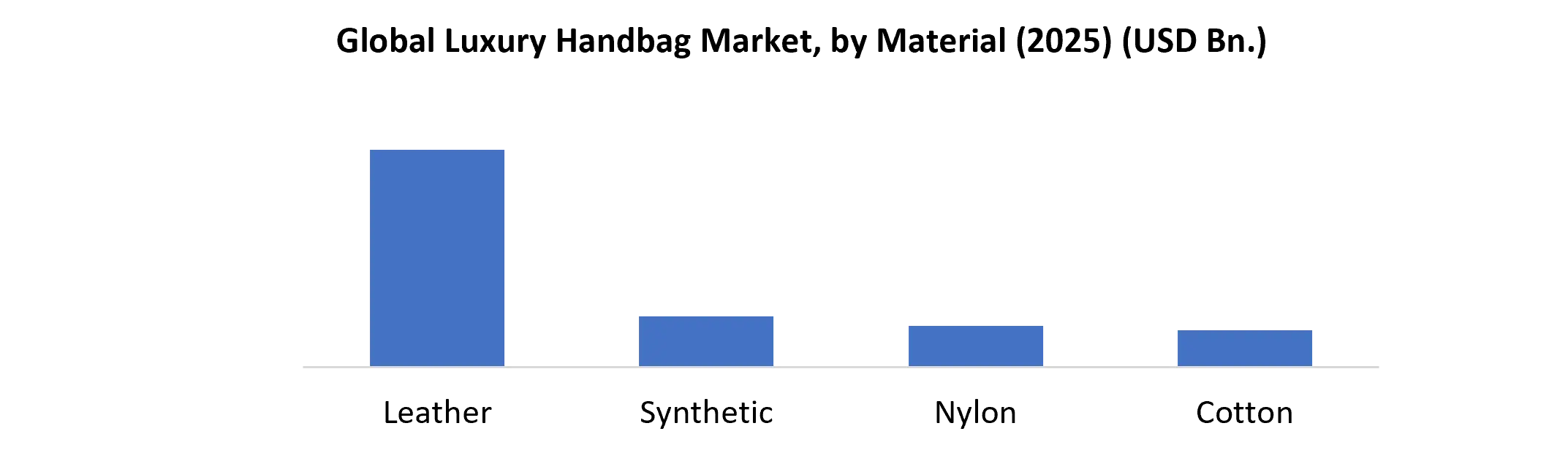
By Material, The Luxury Handbag Market is divided into Cotton, Leather, Nylon, and Synthetic. The Leather segment has the maximum share due to its association with high-end luxury, quality, and brand value, while the Synthetic material is demanded by budget-conscious and vegan buyers. Nylon is used for light, travel-friendly luxury handbags, and Cotton is a minor segment for casual and seasonal bags. The luxury handbag market growth is driven by the increase in product variety offered in different materials. However, there is a market gap for sustainable, lightweight, and affordable luxury handbags. The market potential is great for brands that manage to offer innovative material solutions without compromising the product’s luxury feel and image.
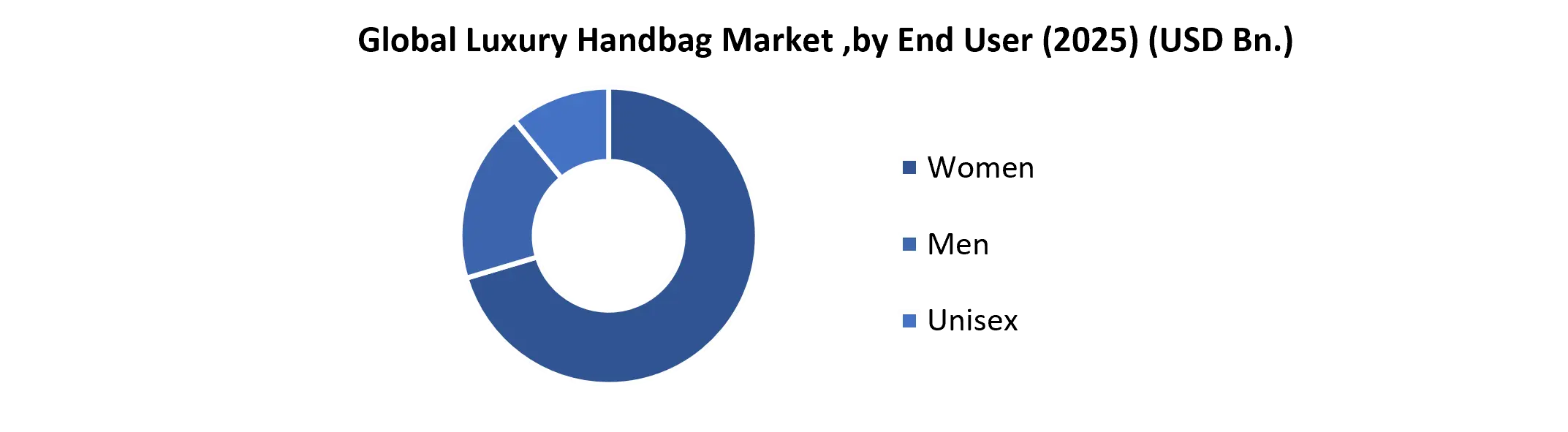
By End User, The Luxury Handbag Market is segmented into Men, Women, and Unisex. The largest segment is women’s luxury handbags, as they are the most common type of luxury bags among female customers in terms of office bags, travel bags, casual bags, and everyday use. The men’s segment is growing as brands are launching more products in this category. There is also a market gap for unisex luxury handbags. The overall market size for luxury handbags is expanding due to the increased variety of products and the growing popularity of luxury bags among men and women. However, the market gap for men’s luxury handbags and unisex bags remains, as well as opportunity for brand development through the use of innovative materials and designs.
 Global Luxury Handbag Market Regional Insights
Europe: Europe holds a leading position in the Luxury Handbag Market because of its high-end fashion brands. It also has a developed luxury retail sector and considerable tourism, which directly impacts the market. The market gap is present in emerging fashion capitals beyond traditional ones, such as London and Paris. The market potential is considerable as the demand for luxury handbags remains consistent due to the overall appeal of the products.
North America: North America is a region where many luxury brands have their headquarters, including many bags and luxury handbag manufacturers. It also has a dense network of department stores and luxury retailers, as well as a base of high-end and middle-market consumers. It has a considerable market share due to the wealth of the average consumer and the tendency to shop for luxury items. The market potential is great due to the overall market development and the presence of a considerable audience of luxury bag buyers.
Asia Pacific: Asia Pacific is a region with a significant population of luxury consumers and an increasing number of young people with disposable income. It has several leading luxury fashion capitals in terms of brand presence and production capabilities, as well as a considerable market gap in smaller cities. The market potential is significant due to the overall growth of the luxury market in the region and the increasing presence of young consumers interested in luxury items.
Middle East & Africa: Middle East & Africa is a region with considerable wealth and tourism, which creates demand for luxury goods and luxury retail experiences. The market share is impacted by the overall market development, as well as the presence of many high-end retail chains and malls. The market potential is impacted by the tendency for young luxury consumers to seek more diverse luxury handbag collections and the increasing popularity of the regional luxury fashion scene.
South America: South America is a region with a growing luxury market and an increasing number of both local and international luxury brand buyers. It also has a considerable market gap due to the overall lower level of development of the luxury retail market, as well as the potential for a larger audience of middle-class consumers.
Key Highlights:
Global Luxury Handbag Market analysis and forecast, in terms of value.
Comprehensive study and analysis of market drivers, restraints and opportunities influencing the growth of the Global Luxury Handbag Market
The Luxury Handbag Market segmentation on the basis of type, source, end-user, and region (country-wise) has been provided.
Luxury Handbag Market strategic analysis with respect to individual growth trends, future prospects along with the contribution of various sub-market stakeholders have been considered under the scope of study.
This Luxury Handbag Market analysis and forecast for five major regions namely North America, Europe, Asia Pacific, the Middle East & Africa (MEA) and Latin America along with country-wise segmentation.
Profiles of key industry players, their strategic perspective, market positioning and analysis of core competencies are further profiled.
Competitive developments, investments, strategic expansion and competitive landscape of the key players operating in the Global Luxury Handbag Market are also profiled.
Luxury Handbag Market Recent Development
| Published Date | Recent Development |
| Septermber-2026 | Hermès opened a new boutique in Williamsburg, Brooklyn, on 19 September 2026. The new store will contribute to expanding the brand’s U.S. market presence and will display the company’s entire product line, including leather goods and luxury handbags. The fashion label’s U.S. boutiques specialize in top-tier leather goods and accessories with exquisite detailing and elegant feminine designs. |
| June-2026 | Prada announced the opening of Prada Galleria – a significant investment in one of the brand’s most iconic locations in Milan, Italy. As part of the project, Prada expanded its women’s and men’s boutiques, creating a private client salon, contributing to the luxury fashion house’s prestige in the field of high-end retail. |
| June-2026 | Burberry unveiled the first hotel in its global luxury hotel partnership for Summer 2026 in Hôtel Belles Rives in the French Riviera. The company also plans to expand its luxury lifestyle collections of accessories and apparel, offering guests unique luxury experiences in several high-end hotels in the region. |
| June-2026 | Coach announced the launch of its Summer 2026 handbag collection. Fresh designs for summer have been created, using colorful canvas, handwoven wooden beads, and straw braids. The collection includes new interpretations of the Tabby and Brooklyn bags, as well as innovations in fabric and color. |
| March-2026 | Dior unveiled the Dior Cigale bag for Spring–Summer 2026, with a design by creative director Jonathan Anderson. This collection is part of Dior’s tribute to Christian Dior’s legendary La Cigale dress of 1952. The new bag combines a signature architectural silhouette and contemporary luxury leather goods in a modern interpretation. |
Global Luxury Handbag Market Competitive landscape
The Luxury Handbag Market competitive landscape is characterized by the high level of competitiveness between the major fashion companies and luxury brands. Such brands as Louis Vuitton, Hermès, Chanel, Gucci, Prada, Dior, Saint Laurent, Bottega Veneta, Fendi, and Coach, among others, provide the conditions for the competitive environment due to their unique selling points. In addition, these competitors impact the market structure by introducing new handbag collections, offering limited pieces, creating flagship stores, collaborating with celebrities, providing personalization, and developing digital luxury goods.
Moreover, the luxury handbags market size will continue to grow due to the demand for collectible items and bags as an investment. The market gap can be seen in the need for high-end luxury goods and the target customer’s perception that entry-level luxury products are a more reasonable choice. In addition, small luxury bag size, the importance of image, and the value of secondhand bags contribute to the market gap. It allows the market to grow, and it is possible to build a sustainable luxury brand in the short term.
There is a gap between the high-end market and emerging markets. It can be filled by introducing a product at an accessible price point. Regional market potential growth can be seen in the Asia Pacific region and the Middle East as these locations are popular among tourists and luxury jewelry retail chains. It is possible to build a sustainable luxury brand in the short term while providing unique products and a high level of quality. However, brands should be differentiated by exclusivity, sustainability, digital strategy, and high quality.
Luxury Handbag Market Scope: Inquire before buying
| Luxury Handbag Market | |||
|---|---|---|---|
| Report Coverage | Details | ||
| Base Year: | 2025 | Forecast Period: | 2026-2034 |
| Historical Data: | 2020 to 2025 | Market Size in 2025: | 85.43 USD Billion |
| Forecast Period 2026-2034 CAGR: | 5.4% | Market Size in 2034: | 137.14 USD Billion |
| Segments Covered: | by Product Type | Tote Bags Shoulder Bags Crossbody Bags Satchel Bags Clutch Bags Hobo Bags Bucket Bags Others |
|
| by Material | Cotton Leather Nylon Synthetic |
||
| by End user | Men Women Unisex |
||
| by Distribution channel | Online Offline |
||
Luxury Handbag Market, by Region:
North America (United States, Canada and Mexico)
Europe (UK, France, Germany, Italy, Spain, Sweden, Austria and Rest of Europe)
Asia Pacific (China, South Korea, Japan, India, Australia, Indonesia, Malaysia, Vietnam, Taiwan, Bangladesh, Pakistan and Rest of APAC)
Middle East and Africa (South Africa, GCC, Egypt, Nigeria and Rest of ME&A)
South America (Brazil, Argentina Rest of South America)
Luxury Handbag Market, Key Players are
1. Louis Vuitton
2. Hermès
3. Chanel
4. Gucci
5. Prada
6. Dior
7. Saint Laurent
8. Bottega Veneta
9. Fendi
10. Celine
11. Burberry
12. Coach
13. Michael Kors
14. Balenciaga
15. Valentino
16. Loewe
17. Longchamp
18. Mulberry
19. MCM
20. Tory Burch
21. Ferragamo
22. Givenchy
23. Chloé
24. Dolce & Gabbana
25. Bulgari
26. Jimmy Choo
27. Stella McCartney
28. Tod’s
29. The Row
30. Goyard
31. Delvaux
32. Alaïa
33. Loro Piana
34. Ralph Lauren
35. Miu Miu
36. Tom Ford
37. Versace
38. Jacquemus
39. Mansur Gavriel
40. Polène
41. DeMellier
42. Strathberry
43. GANNI
44. Coperni
45. Cuyana
46. Savette
47. Wandler
48. Khaite
49. Loeffler Randall
50. Staud
Frequently Asked Questions:
1. Which region has the largest share in Global Luxury Handbag Market?
Ans: North America region holds the highest share in 2025.
2. What is the growth rate of Global Luxury Handbag Market?
Ans: The Global Market is growing at a CAGR of 5.4% during forecasting period 2026-2034.
3. What is scope of the Global Luxury Handbag market report?
Ans: Global Market report helps with the PESTEL, PORTER, COVID-19 Impact analysis, Recommendations for Investors & Leaders, and market estimation of the forecast period.
4. Who are the key players in Global Luxury Handbag market?
Ans: The important key players in the Global Market are – Wanlima, Phillip Lim, The Chanel, Givenchy, LV, Proenza, Alexander, Stella, Céline’s Phantom, Charlotte Olympia, Valentino, Mulberry, Longchamp, Hermès Kelly, Gucci, Burberry Group Plc., Compagnie Financière Richemont SA., Dolce & Gabbana Srl., Hermès International., Kering SA., LVMH Moet Hennessy - Louis Vuitton., PRADA Group., Ralph Lauren Corp.
5. What is the study period of this market?
Ans: The Global Luxury Handbag Market is studied from 2020 to 2034.