
Thermally Conductive Adhesives Market Size by Type, Application, Region – Revenue Pool Analysis, Margin Structure Assessment, Capital Flow Trends, Competitive Benchmarking & Forecast to 2034
Overview
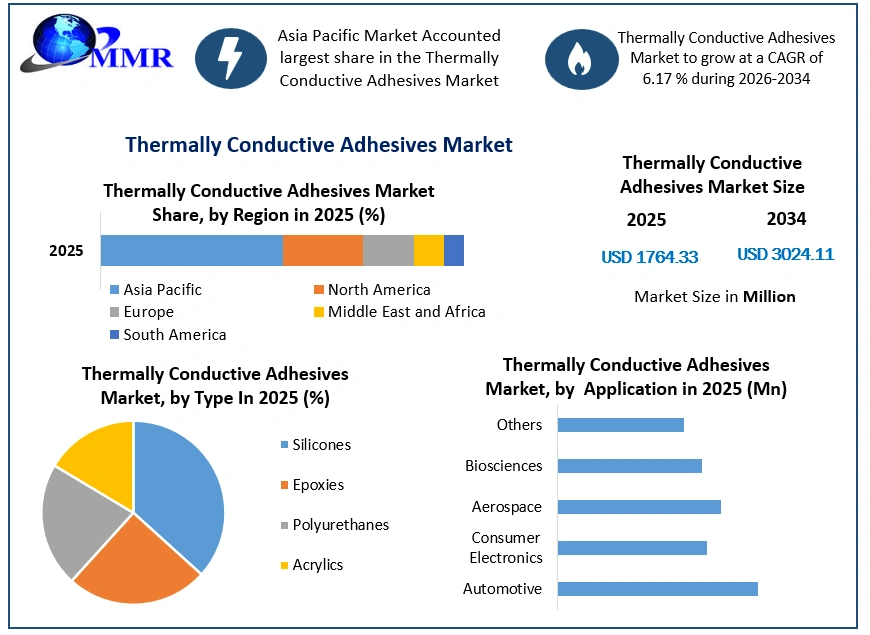
Global Thermally Conductive Adhesives Market size is expected to reach nearly USD 1764.33 Mn. by 2034 with the CAGR of 6.17% during the forecast period.
The report includes an analysis of the impact of COVID-19 lockdown on the revenue of market leaders, followers, and disruptors. Since the lockdown was implemented differently in various regions and countries; the impact of the same is also seen differently by regions and segments. The report has covered the current short-term and long-term impact on the market, and it would help the decision-makers to prepare the outline and strategies for companies by region.
Thermally Conductive Adhesives Market Dynamics:
Thermally conductive adhesives are frequently used to dissipate heat from power electronics. It is used to bond heat sinks, for example, their heat conductivity reduces thermal strain to prevent performance loss or failure of electronic components. Thermally conductive adhesives are also used as encapsulation compounds for temperature sensors for enclosures or reactors.
When used as a joining technique, thermally conductive adhesives fasten components to create a durable mechanical connection, while enabling heat to transfer from the warmer component to the colder component. Thus, in many cases, thermally conductive bonding is an alternative to conventional connection processes such as soldering, welding, or screwing.
Thermally Conductive Adhesives Market Size, Growth & Share Analysis
To know about the Research Methodology:-Request Free Sample Report
Thermally Conductive Adhesives Market Segment Analysis:
Based on the type, the epoxies-based adhesives segment has been witnessing significant demand in recent years because of the several advantages that these adhesives offer. Epoxy-based adhesives required short processing time and less handling of assemblies required as a result it provides quicker production. The Thermally conductive epoxy adhesive has high adhesive strength, good surface wet-out, low viscosity for potting applications, and good gap filling in electronic appliances. Thermally conductive epoxy adhesives are majorly used for bonding, potting, and encapsulation applications in a wide variety of industries. Some specific applications include heat sinking bonding, potting, encapsulating sensors, etc.
These silicone adhesives help in providing the solution for the most sensitive circuits and components. Thermally conductive silicone adhesives make sure that the components remain functional even when the appliances get hot. Further, thermally conductive silicone adhesives transfer the device’s heat to the heat sink.
Thermally conductive polyurethane adhesive is used for advanced electronic assembly. It is a self-leveling, injectable compound that is especially suitable for electronic bonding and potting.
Based on the application, Automotive is the most profitable application segment in the global thermally conductive adhesives market followed by Consumer Electronics & others. Thermally conductive adhesives are widely used in automotive for anti-lock braking systems, engine control units, and transmission control units. Although, in the consumer electronics segment, they are used for flexible connections in various electronic devices.
Thermally conductive adhesives have superior properties due to which they can be used extensively in PV solar panels, touch panel screens, LED/OLEDs, and various other electronic devices. Thermally conductive adhesives are also accomplished by blocking the electromagnetic radiations emitted by electronic devices. Thus, these adhesives are used for electromagnetic shielding.
New applications in energy and electrical engineering require ever-higher levels of thermal conductivity. This was the reason, a new generation of thermally conductive adhesives with thermal conductivity of 1-4 W/mK or more has been developed.
Geographically, The Asia-Pacific region is a large market for thermally conductive adhesives owing to the presence of a large number of electronics companies in countries such as Japan, China, South Korea, and Taiwan.
The North America Thermally conductive adhesives market is projected to expand significantly in the near future, led by the rising demand for these adhesives in the electronics and automotive industries.
Thermally Conductive Adhesives Market, Key Highlights:
1. Global Thermally Conductive Adhesives Market analysis and forecast, in terms of value.
2. Comprehensive study and analysis of market drivers, restraints and opportunities influencing the growth of the Global Thermally Conductive Adhesives Market
3. Global Thermally Conductive Adhesives Market segmentation on the basis of type, source, end-user, and region (country-wise) has been provided.
4. Global Thermally Conductive Adhesives Market strategic analysis with respect to individual growth trends, future prospects along with the contribution of various sub-market stakeholders have been considered under the scope of study.
5. Global Thermally Conductive Adhesives Market analysis and forecast for five major regions namely North America, Europe, Asia Pacific, the Middle East & Africa (MEA) and Latin America along with country-wise segmentation.
6. Profiles of key industry players, their strategic perspective, market positioning and analysis of core competencies are further profiled.
7. Competitive developments, investments, strategic expansion and competitive landscape of the key players operating in the Global Thermally Conductive Adhesives Market are also profiled.
The report has considered the base year of 2023 and past four years trend. 2023 figures are at actuals, however due to different dynamics of year 2023, market forecast is not only dependent upon 2023, but on the basis of 2018-2023.
Thermally Conductive Adhesives Market Recent Development
| Date | Company | Development | Impact |
|---|---|---|---|
| 12 May 2026 | Henkel | Launched Bergquist TGF 2030APS and Loctite TLB 9270APS to improve EV battery thermal management. | Supports high-volume production and enables efficient heat dissipation in cell-to-pack battery architectures. |
| 14 January 2026 | Master Bond | Introduced EP54TC, a high-performance two-component thermal epoxy for heat sink bonding. | Achieves thermal conductivity exceeding 6 W/m·K while maintaining electrical insulation for sensitive electronics. |
| 28 October 2025 | Henkel | Commercialized Loctite TCF 14001, a liquid thermal interface material for AI data center transceivers. | Delivers 14.5 W/m·K conductivity to manage heat density in 800G and 1.6T optical modules. |
| 05 February 2025 | 3M Company | Deployed Battery Enhancement Material (BEM) 1807S to fill gaps in EV battery packs. | Reduces energy draw for thermal management by up to 33% and extends vehicle range. |
Thermally Conductive Adhesives Market Scope: Inquire before buying
| Global Thermally Conductive Adhesives Market | |||
|---|---|---|---|
| Report Coverage | Details | ||
| Base Year: | 2025 | Forecast Period: | 2026-2034 |
| Historical Data: | 2020 to 2025 | Market Size in 2025: | USD 1764.33 Mn. |
| Forecast Period 2026 to 2034 CAGR: | 6.17% | Market Size in 2034: | USD 3024.11 Mn. |
| Segments Covered: | by Type | Silicones Epoxies Polyurethanes Acrylics |
|
| by Application | Automotive Consumer Electronics Aerospace Biosciences Others |
||
Thermally Conductive Adhesives Market,by Region
North America (United States, Canada and Mexico)
Europe (UK, France, Germany, Italy, Spain, Sweden, Austria and Rest of Europe)
Asia Pacific (China, South Korea, Japan, India, Australia, Indonesia, Malaysia, Vietnam, Taiwan, Bangladesh, Pakistan and Rest of APAC)
Middle East and Africa (South Africa, GCC, Egypt, Nigeria and Rest of ME&A)
South America (Brazil, Argentina Rest of South America)
Thermally Conductive Adhesives Market, Key Players
1. Henkel
2. H.B. Fuller
3. 3M Company
4. Panacol-Elosol
5. Dow Corning
6. Polytec-PT
7. Permabond Engineering Adhesives
8. Masterbond
9. Creative Materials
10. Resin Lab
11. Lord Corporation
12. MG Chemicals
13. Protavic America
14. Aremco
15. Cast-Coat
16. Nagase America
17. AI Technology
Frequently Asked Questions:
1. Which region has the largest share in Global market?
Ans: Asia Pacific region held the highest share in 2025.
2. What is the growth rate of Global market?
Ans: The Global market is growing at a CAGR of 6.17% during forecasting period 2026-2034.
3. What is scope of the Global market report?
Ans: Global market report helps with the PESTEL, PORTER, COVID-19 Impact analysis, Recommendations for Investors & Leaders, and market estimation of the forecast period.
4. Who are the key players in Global market?
Ans: The important key players in the Global market are – Henkel, H.B. Fuller, 3M Company, Panacol- Elosol, Dow Corning, Polytec-PT, Permabond Engineering Adhesives, Masterbond, Creative Materials, Resin Lab, Lord Corporation, MG Chemicals, Protavic America, Aremco, Cast-Coat, Nagase America, AI Technology.
5. What is the study period of this Market?
Ans: The Global market is studied from 2020 to 2034.