
Telepresence Robot Market Size by Type, Component, End User, Region – Revenue Pool Analysis, Margin Structure Assessment, Capital Flow Trends, Competitive Benchmarking & Forecast to 2030
Overview
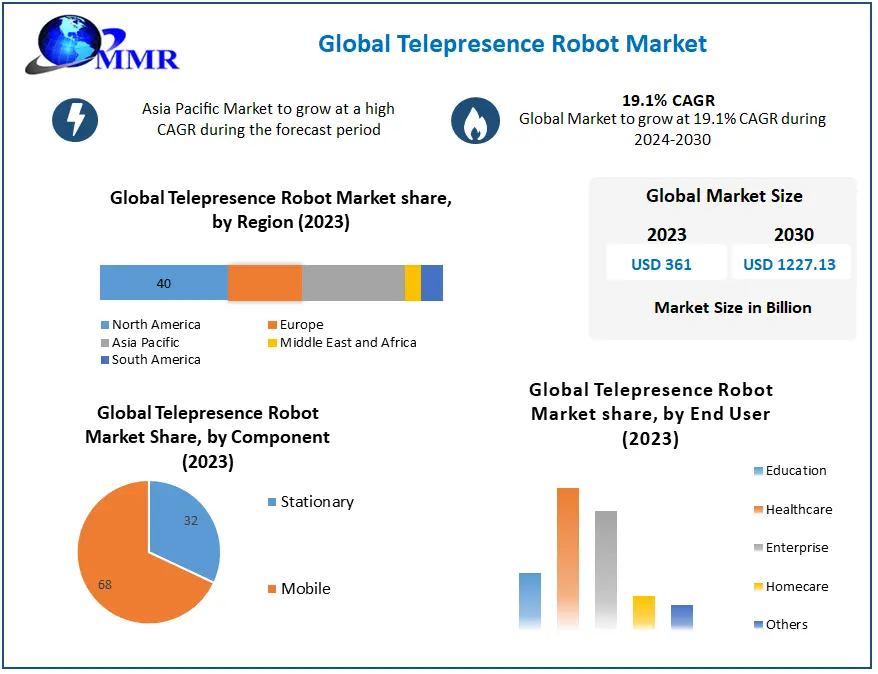
The Global Telepresence Robot Market is forecasted at a CAGR of 19.1% during 2024-2030. A detailed description of the factors and market trends pertaining to different regions is given in detail in the report.
Telepresence Robot Market Overview:
The market research report on the Telepresence Robot Market provides a comprehensive overview of the industry, including internal and external analysis, drivers, restraints, trends, and competitor analysis.
Telepresence robotics refers to the use of robots equipped with audio and visual capabilities to enable remote communication and interaction between individuals in different locations. The market for telepresence robotics is expected to experience significant growth in the coming years, driven by the increasing need for remote communication and collaboration in various industries, including healthcare, education, retail, hospitality, and manufacturing.
 To know about the Research Methodology :- Request Free Sample Report
The report includes both internal and external analysis of the Telepresence Robot Market. The internal analysis covers factors such as market size, growth rate, and market share, while the external analysis includes factors such as economic, political, and social trends that may impact the market. Furthermore, the report identifies and analyses the key drivers and restraints affecting the Telepresence Robot Market.
Drivers include factors such as the increasing need for remote communication and collaboration, advancements in technology, and the growing adoption of telepresence robots in healthcare and education. Restraints include factors such as high costs and the complexity of integrating telepresence robots into existing systems.
In addition, the report highlights key trends in the Telepresence Robot Market, such as the increasing demand for mobile telepresence robots, the integration of artificial intelligence and machine learning technologies, and the emergence of cloud-based telepresence solutions.
Telepresence Robot Market Research Methodology
The research conducted utilized both primary and secondary data sources to ensure that all possible factors affecting the market were thoroughly examined and validated. The Telepresence Robot market size for top-level markets and sub-segments is normalized and the impact of inflation, economic downturns, regulatory & policy changes, and other variables is factored into the market forecast.
The bottom-up approach and multiple data triangulation methodologies are used to estimate the market size and forecasts. The percentage splits, market shares, and breakdowns of the segments are derived based on weights assigned to each of the segments on their utilization rate and average sale price. The country-wise analysis of the overall market and its sub-segments are based on the percentage adoption or utilization of the given Telepresence Robot market Size in the respective region or country. Major players in the market are identified through secondary research based on indicators that include market revenue, price, services offered, advancements, mergers and acquisitions, and joint.
Extensive primary research was conducted to acquire information and verify and confirm the crucial numbers arrived at after comprehensive market engineering and calculations for market statistics, market size estimations, market forecasts, market breakdown, and data triangulation.
Telepresence Robot Market Dynamics
The report on the market dynamics of telepresence robotics covers the market drivers, restraints, and trends in detail. It identifies the drivers such as the increasing demand for telepresence robots in remote work environments, improved customer service in hospitality, and the development of advanced features. The report also discusses restraints such as high investment costs, technical complexities, and concerns about data privacy. In addition, it highlights trends such as the adoption of telepresence robots in healthcare, education, retail, and manufacturing sectors, and partnerships between manufacturers and other companies. Some of the drivers, restraints and trends are been briefly described below
Telepresence Robot Market Drivers:
One of the major drivers is the increasing demand for remote healthcare services and telemedicine. Telepresence robots are being used to remotely monitor patients and provide healthcare services, especially in rural or remote areas where access to medical care is limited. This is expected to drive the growth of the Telepresence Robot Market in the healthcare sector.
Another driver is the growing adoption of telepresence robots in education, as they enable remote learning and virtual field trips. The COVID-19 pandemic has accelerated the adoption of these robots, as many schools and universities have had to switch to remote learning.
In addition, the report highlights the use of telepresence robots in the retail sector for customer service and inventory management, which is expected to drive the demand for these robots. Moreover, the increasing use of telepresence robots in manufacturing for quality control and equipment inspection is also expected to drive market growth.
Overall, the market drivers identified in the report suggest that the telepresence robotics industry is poised for significant growth in the coming years, driven by the increasing adoption of these robots in various industries and applications.
Telepresence Robot Market Restraints
One of the main restraints is the high cost associated with telepresence robots, which makes them unaffordable for many small and medium-sized enterprises. This is expected to limit market growth, particularly in price-sensitive regions.
Another restraint is the lack of awareness about the benefits and applications of telepresence robots, particularly in emerging economies. This could limit the demand for these robots, as potential customers may not understand the value proposition of telepresence robots. Furthermore, technical issues such as connectivity problems and data security concerns are likely to act as restraints in the Telepresence Robot Market. These issues could limit the adoption of these robots, particularly in industries such as healthcare where security and privacy are critical.
In summary, the market restraints identified in the report suggest that while the telepresence robotics industry has significant potential for growth, there are several challenges that need to be addressed in order to fully realize this potential. These challenges include cost, awareness, and technical issues, which may limit market growth in the short to medium term.
Telepresence Robot Market Trend
One trend is the increasing use of telepresence robots in remote work environments. The COVID-19 pandemic has led to a surge in remote work, and telepresence robots are being used to facilitate remote collaboration and communication between employees. This trend is expected to continue in the post-pandemic era, driving the growth of the Telepresence Robot Market.
Another trend is the development of advanced features and capabilities in telepresence robots, such as improved sensors, artificial intelligence, and machine learning algorithms. These advanced features are expected to enhance the functionality and performance of telepresence robots, making them more attractive to potential customers.
The report also highlights the growing adoption of telepresence robots in the hospitality industry for tasks such as room service and concierge services. This trend is expected to continue as hotels and other hospitality businesses seek to enhance their customer service capabilities.
Additionally, the report identifies the growing trend of partnerships and collaborations between telepresence robot manufacturers and other companies in order to expand their reach and capabilities. This trend is expected to drive innovation and growth in the Telepresence Robot Market.
Overall, the report suggests that the Telepresence Robot Market is characterized by several key trends that are likely to shape the industry in the coming years. These trends include the increasing use of telepresence robots in remote work environments, the development of advanced features and capabilities, the growing adoption in the hospitality industry, and the trend of partnerships and collaborations.
Telepresence Robot Market Segment Analysis:
Based on End User: The market is segmented into Education, Healthcare, Enterprise, Homecare and Others. The Healthcare segment held the largest Telepresence Robot Market share in 2023 and is expected to retain this dominance during the forecast period. The advancements owe their success to remote-controlled telepresence robots. These robots enable doctors to engage with patients for consultations and training. Additionally, the research team has been crafting telepresence robots capable of facilitating remote surgeries, potentially saving lives under the guidance of remote surgeons.
Telepresence Robot Market Regional Insights:
The report includes a comprehensive analysis of the various regions where the market is present.
The report has done an in-depth analysis of regions such as North America, Europe, Asia-Pacific, Latin America, and the Middle East & Africa. It identifies the key trends, drivers, and challenges that are specific to each region.
For example, the report highlights the high adoption rate of telepresence robots in North America, driven by the presence of major market players and the growing trend of remote work. In Europe, the report discusses the increasing use of telepresence robots in the healthcare industry. The report also analyses the growth potential of the market in the Asia-Pacific region, driven by the rising demand for telepresence robots in the manufacturing sector.
Furthermore, the report includes a competitive analysis of the major Telepresence Robot Market players operating in each region, along with their market share, product portfolio, and strategic initiatives.
Overall, the report provides a detailed analysis of the regional insights of the telepresence robotics industry, including the drivers, restraints, and trends specific to each region.
Telepresence Robot Market Competitive Landscape:
The report includes an in-depth analysis of the Telepresence Robot Market key players operating in the market, along with their market share, product portfolio, and strategic initiatives.
The report highlights the presence of several major players in the market, including Double Robotics, InTouch Technologies Inc., VGo Communications, and Anybots Inc., among others. These companies are focusing on developing advanced features such as artificial intelligence (AI), augmented reality (AR), and virtual reality (VR) to enhance the capabilities of their telepresence robots.
According to the report, Double Robotics holds a significant market share in the Telepresence Robot Market, owing to its strong product portfolio and continuous product development initiatives. InTouch Technologies Inc. is also a key player in the market, with a focus on providing telepresence solutions for the healthcare industry.
In addition, the report includes a detailed analysis of the competitive landscape of the Telepresence Robot Market based on various parameters such as revenue, product offerings, and strategic partnerships. The report also highlights the growth strategies adopted by these companies, such as mergers and acquisitions, partnerships, and collaborations.
The report provides numerical data such as market share percentages and revenue figures to support the analysis of the competitive landscape. For example, Double Robotics holds a market share of around 20%, followed by InTouch Technologies Inc. with a market share of approximately 15%.
Overall, the report provides valuable insights into the competitive landscape of the Telepresence Robot Market, including the market share, product portfolio, and strategic initiatives of the major players operating in the market.
Telepresence Robot Market Scope: Inquire before buying
| Global Telepresence Robot Market | |||
|---|---|---|---|
| Report Coverage | Details | ||
| Base Year: | 2023 | Forecast Period: | 2024-2030 |
| Historical Data: | 2018 to 2023 | Market Size in 2023: | US $ 361 Bn. |
| Forecast Period 2024 to 2030 CAGR: | 19.1% | Market Size in 2030: | US $ 1227.13 Bn. |
| Segments Covered: | by Type | Head Camera Display Speaker Microphone Body Power Source Sensors & Control System Others |
|
| by Component | Stationary Mobile |
||
| by End User | Education Healthcare Enterprise Homecare Others |
||
Telepresence Robot Market, by Region
North America (United States, Canada and Mexico)
Europe (UK, France, Germany, Italy, Spain, Sweden, Austria and Rest of Europe)
Asia Pacific (China, South Korea, Japan, India, Australia, Indonesia, Malaysia, Vietnam, Taiwan, Bangladesh, Pakistan and Rest of APAC)
Middle East and Africa (South Africa, GCC, Egypt, Nigeria and Rest of ME&A)
South America (Brazil, Argentina Rest of South America)
Telepresence Robot Key Players
1. Qihan Technology Co. Ltd. (China)
2. Pilot AI Labs (USA)
3. Rethink Robotics (USA)
4. H-Bots Robotics Pvt Ltd (Bengaluru, India)
5. GreyOrange (Gurgaon, India)
6. Suitable Technologies, Inc. (USA)
7. KUKA AG (Germany)
8. PFF Group (Italy)
9. Yaskawa Electric Corporation (Japan)
10. ASIMOV Robotics Pvt Ltd (Gurugram, India)
11. SoftBank Robotics Group (Japan)
12. Orbis Robotics (USA)
13. Ekso Bionics (USA)
14. Locus Robotics (USA)
15. Emotix (Mumbai, India)
16. Anybots Inc. (USA)
17. Fetch Robotics (USA)
18. Telepresence Robotics Corporation (USA)
19. Gostai (France)
20. Awabot (France)
21. Omron Corporation (Japan)
22. Xenex Disinfection Services LLC (USA)
23. Robolab Technologies (Pune, India)
24. Vecna Technologies Inc. (USA)
25. HEBI Robotics (USA)
26. Planys Technologies (Chennai, India)
27. Mira Robotics (Japan)
28. Systemantics (Bengaluru, India)
29. VGo Communications, Inc. (USA)
30. Gridbots Technologies (Ahmedabad, India)
31. Robotnik (Spain)
32. Blue Ocean Robotics (Denmark)
33. Tend.ai (USA)
FAQs:
1. What are the growth drivers for the Telepresence Robot Market?
Ans: The growth of the Telepresence Robot Market is forecasted at a CAGR of 19.1% during 2024-2030
2. What is the major restraint for the Telepresence Robot Market growth?
Ans: The major restraint for the Telepresence Robot Market growth is high cost.
3. Which region is expected to lead the global Telepresence Robot Market during the forecast period?
Ans: North America is expected to lead the global Telepresence Robot Market during the forecast period.
4. What is the projected market size & growth rate of the Telepresence Robot Market?
Ans: The projected market size of the Telepresence Robot Market is expected to reach USD 1227.13 million by 2030, with a CAGR of 19.1% during the forecast period.
5. What segments are covered in the Telepresence Robot Market report?
Ans: The specific segments covered in a Telepresence Robot Market report may vary, but typical segments include type, component, end-user, and geography.