
Underwater Robotics Market Size – Industry Structure Evaluation, Demand Drivers Analysis, Regional Growth Analysis and Identification, Competitive Positioning Review & Global Market Size Forecast to 2032
Overview
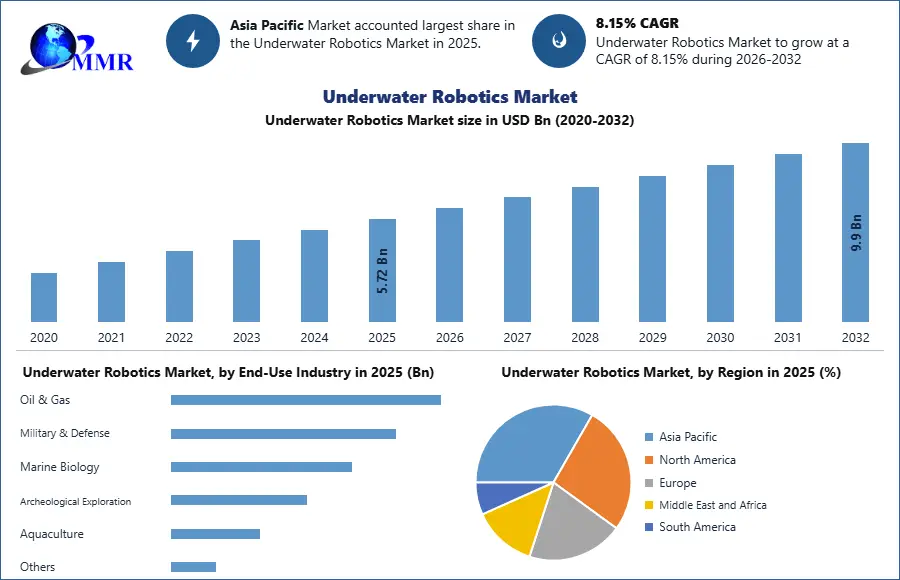
Global Underwater Robotics Market size was valued at USD 5.72 Bn. in 2025 , and the total Global Underwater Robotics Market revenue is expected to grow by 8.15% from 2026 to 2032, reaching nearly USD 9.9 Bn.
Underwater Robotics Market Overview:
The industry focused on robotic systems such as ROVs, AUVs, and hybrid vehicles designed for underwater inspection, exploration, data collection, defence, research, and offshore operations. The report provides a thorough examination of the availability of advanced underwater robotics technologies available globally, and the investigation of demand and supply: with demand growing primarily from expansion into offshore oil and gas exploration, through to deep-sea mining, environmental monitoring, and naval modernization programs, and supply chain analysis identifying key component suppliers, technological enablers and manufacturing locations that are important to the ecosystem.
In a thoroughly executed regional dominance analysis, the Asia Pacific market emerges as the primary region of interest, largely due to industrialization development, increased offshore exploration and production activities, and substantial naval modernization investments by China, India, Japan, and Australia, among others. The sheer size of infrastructure development, coupled with continually expanding environmental monitoring activities, truly makes this region remarkable, especially when compared against the previous regions that had two representatives, North America and Europe.
To know about the Research Methodology:-Request Free Sample Report
The report identifies significant key players including, but not limited to, Oceaneering International (USA), Fugro N.V. (Netherlands), ECA Group (France), Forum Energy Technologies (USA), Atlas Elektronik (Germany), Mitsui E&S, (Japan), and Deep Ocean Engineering (USA), along with their product offerings, revenue and market strategy. Lastly, the report provided an assessment of their respective end user contributions, which further emphasizes significant contributions from the commercial market sector, defense agencies, and scientific investigations, and ultimately clarifies the segmentation and drivers for the growth of the market. Overall, a detailed and comprehensive overview of the marine and underwater robotics market should provide stakeholders with relevant facts to support their strategic decision-making activities surrounding underwater robotics.
Underwater Robotics Market Dynamics
Growing Industrial and Defence Demand to drive Underwater Robotics Market Expansion
The underwater robotics market is largely being propelled by multiple factors; mainly, the demand for safe and effective underwater operations across sectors such as oil and gas, Defence, scientific research, and environmental monitoring. Specifically, offshore oil exploration is expanding and there is a need for subsea infrastructure inspection which has meant industries are embracing the use of remotely operated vehicles (ROVs) and autonomous underwater vehicles (AUVs) to keep costs low and to reduce risk. Further, as nations increase focuses on maritime security, nations all over the world are investing in naval modernization programs, fueling the demand for underwater drones and robots - for surveillance or mine detection. An focus on protecting the environment and marine research is also related to growth, as underwater robots allow for detailed, non-invasive exploration of marine ecosystems.
Technological Innovation and New Applications to Create Lucrative Opportunities in Market
The underwater robotics does have considerable opportunities ahead, especially with the growth of offshore renewable energy projects such as wind farms and tidal energy systems that require continual underwater maintenance and inspection. The emerging field of deep-sea mining focused on rare-earth elements and minerals found on the seafloor will also be an area for underwater robotics to take hold and grow. The developments in artificial intelligence, efficient propulsion systems, underwater communications systems, and integration of different sensors are producing new use cases for underwater robots while enhancing capabilities of existing underwater robotics systems. The increasing interest in ocean exploration missions by both government and private companies also opens more possibilities for new advanced AUVs and hybrid systems. The worldwide focus on sustainable blue economy initiatives will create a need for effective and efficient underwater monitoring devices, resulting in further innovation and growth in this market.
High Costs and Technical Limitations to Challenge Widespread Adoption in Market
The underwater robotics market has great potential to grow, but it faces several important challenges. First, the operational and maintenance costs associated with deploying and managing underwater robotic systems are typically high, especially in deep-sea or extreme environments. These systems are likely to typically involve specialized support vessels, trained personnel, and often require constant monitoring in a way that can be resource-intensive. In addition, technical limitations, including limited battery life, challenges for long-range underwater communications, and a propensity to be affected by underwater currents and pressure challenges, can affect performance. Developers also must learn how to integrated with existing systems and provide real-time processing of data during remote underwater missions. These continued technical challenges must be addressed to motivate some level of widespread adoption.
Regulatory Hurdles and Skill Gaps to Restrain the Underwater Robotics Market Growth
There are a variety of external and systemic issues currently restraining the growth of the underwater robotics market. Regulations around subsea operations in international waters complicate potential legal liabilities and operational requirements for deployment. Environmental considerations and restrictions in regards to deep-sea mining and other industrialized underwater activities impact the level of approval received for projects, and can sometimes prolong decision-making. The lack of prescribed protocols for underwater robotic platforms contributes to incompatibilities between platforms and technologies inducing interoperability problems. A key restraint is the access of skilled personnel capable of managing sophisticated robotics systems; this is especially impactful in developing regions. It is hoped that these issues, in total, can slow the process of taking up and slow the scale of expansion into emerging markets.
Underwater Robotics Market Segment Analysis
Based on Type, the remotely operated vehicle segment dominated the Underwater Robotics Market in 2025, Growth of remotely operated vehicle segment is attributed to rising offshore deep-sea oil and drilling industry owing to its capability to perform undersea operations such as drilling, equipment assembling, underwater repair, and maintenance.
The autonomous underwater vehicles segment is expected to witness significant growth during the forecast period due to increasing demand and adoption in defence applications such as surveillance, mine counter measurement, anti-warfare application, and others. Moreover, potential use in ocean floor mapping, testing water samples, polar ice research, and pipeline inspection is expected to further drive expansion over the forecast period.
Based on Application, the Global Underwater Robotics Market includes defence & security, commercial exploration, scientific research, and others. Among these, defence & security dominated the Underwater Robotics Market in 2025. This dominance is driven by increasing investments in naval modernization, surveillance, and mine countermeasure operations. Governments across the globe are deploying underwater robots for tasks such as reconnaissance, inspection, and threat detection in deep-sea environments. Their ability to operate in hazardous conditions without risking human lives makes them highly valuable for defence and maritime security missions.
Regional Analysis in Underwater Robotics Market
The Asia Pacific region is estimated to expand at the highest CAGR over the forecast period due to high adoption of underwater robots in emerging economies and growing investments in autonomous marine vehicles in the countries such as China, South Korea, Japan, India, and Australia are expected to drive the region’s growth.
China dominates the regional market with approximately 33% share of the Asia-Pacific AUV and ROV industry in 2025, supported by strong offshore oil & gas operations, maritime defense programs, and advanced underwater engineering capabilities. India is projected to record growth above 13% through the forecast period because of increasing investments in deep ocean missions, naval surveillance systems, and indigenous underwater robotics development programs. Offshore projects in the South China Sea, Indian Ocean, and Southeast Asia are significantly increasing demand for Autonomous Underwater Vehicles (AUVs) and Remotely Operated Vehicles (ROVs) for subsea inspection, pipeline monitoring, and underwater construction activities.
The region is also witnessing rising deployment of underwater robots for offshore wind farms, marine biodiversity monitoring, and deep-sea mineral exploration. ROV systems currently account for more than 50% of underwater robotic deployments due to their reliability in underwater maintenance and industrial inspection operations. Countries such as Japan, South Korea, Australia, and Singapore are increasing investments in AI-enabled underwater robotics, advanced sonar systems, and autonomous navigation technologies to strengthen maritime security and scientific ocean exploration.
Competitive landscape for the Underwater Robotics Market
The Underwater Robotics Market competitive landscape provides a comprehensive analysis, focusing on the key players and the new or innovative technologies they're employing in the market. Companies are profiled with details including their headquarters, industrial portfolio, annual revenue, share of their respective market, regions the company has an active presence in and the actual till that each company is focused on, for example, fishing (commercial), defence, and scientific. The report includes a Key Players Benchmarking Matrix that benchmarks competitors on a number of financial performance metrics, R&D spend, technology advancement, product portfolio, and global market coverage. The matrix categorization is based on market leaders, market followers, and market-disruptors and provides insight into the strengths of competitors and areas that can be improved.
Competing industry players like Oceaneering International, Forum Energy Technologies, Fugro N.V., ECA Group (Exail), Atlas Elektronik (Thyssenkrupp Marine Systems), Mitsui E&S and Deep Ocean Engineering are assessed on key activities that impact the Underwater Robotics Market patterns, including mergers and acquisitions, partnerships, pipelines of innovation, etc. These activities represent the volatile nature of the market and ongoing advancement of autonomous vehicle technologies, as well as advanced sensors and the development of AI, and other remote operating capabilities.
The exploration has tracked historical information from 2020 to 2025 which identified market trends such as a rising demand for Autonomous Underwater Vehicles (AUVs), increasing subsea oil and gas exploration, defense modernization programs, and a push for sustainable and remote underwater inspection solutions. Technological development and competitive maneuvers influencing the sector landscape have been reviewed in detail. This reviews of competitiveness can generate actionable insights for stakeholders and allow investors, manufacturers, and service providers to factually understand the complex, fast moving underwater robotics market space, leverage emerging opportunities, and healthily prepare for future complications.
Recent Developments
14 April 2026 – Oceaneering International, Inc. (USA)
Oceaneering International expanded its autonomous underwater robotics capabilities by deploying advanced remotely operated vehicles (ROVs) and AI-enabled subsea inspection systems for offshore oil & gas and renewable energy projects. The company enhanced real-time subsea monitoring, predictive maintenance analytics, and autonomous navigation technologies to improve deepwater operational efficiency. Oceaneering also strengthened offshore inspection contracts across Asia Pacific and the Middle East to support subsea infrastructure monitoring and underwater maintenance activities. Increasing offshore energy investments, underwater pipeline inspection demand, and expansion of offshore wind projects are significantly driving adoption of Oceaneering’s robotic subsea technologies within the global Underwater Robotics Market.
27 March 2026 – Kongsberg Maritime (Norway)
Kongsberg Maritime introduced upgraded autonomous underwater vehicle (AUV) systems integrated with AI-based navigation, advanced sonar imaging, and real-time ocean mapping technologies. The company focused on improving subsea inspection accuracy, marine research efficiency, and offshore infrastructure monitoring capabilities for defense and commercial applications. Kongsberg also expanded underwater robotics deployment across Asia Pacific maritime projects and offshore renewable energy operations. The development reflects increasing demand for intelligent underwater robotics solutions capable of supporting autonomous seabed mapping, underwater surveillance, and deep-sea exploration activities, strengthening Kongsberg’s position in the global Underwater Robotics Market.
Key trends in the Underwater Robotics Market:
1. Growing Military and Defence Investments in Autonomous Underwater Systems
Major contracts such as Oceaneering's multi-million dollar contract for the development of the Freedom™ AUV and the evidence of large submarine orders for Thyssenkrupp Marine Systems demonstrate the defence sector's growing reliance on advanced underwater robotics for surveillance, mine countermeasures, and strategic underwater applications.
2. Strategic Partnerships and Regional Expansion to Solidify Market Position
Companies are like Forum Energy Technologies are developing partnerships with local players (OGEQUIP and UnderOcean in Brazil) to enhance service capabilities with local support, in conjunction with a trend toward increasingly localized operations and commitment to customer engagement in emerging subsea markets.
3. Emphasis on Autonomous and Uncrewed Technologies for Mrs-Tor2
Fugro's work with Damen to utilize uncrewed vessels for the Royal Netherlands Navy highlights the increasing emphasis on developing autonomous surface and underwater vehicles to maintain maritime security, surveillance and environmental monitoring capabilities.
4. Increasing Market Recognition and Expected Growth from Innovation
Recognition of Deep Ocean Engineering as a leader in underwater robotics innovation and expectations that the market will reach almost $12 billion by 2033 suggest growing confidence in the technology improvements that affect future growth drivers such as artificial intelligence, remote control and autonomy.
Underwater Robotics Market Scope : Inquire before buying
| Underwater Robotics Market | |||
|---|---|---|---|
| Report Coverage | Details | ||
| Base Year: | 2025 | Forecast Period: | 2026-2032 |
| Historical Data: | 2020 to 2025 | Market Size in 2025: | 5.72 USD Bn |
| Forecast Period 2026-2032 CAGR: | 8.15% | Market Size in 2032: | 9.9 USD Bn |
| Segments Covered: | by Type | Remotely Operated Vehicle Autonomous Underwater Vehicles |
|
| by Component | Hardware Software Services |
||
| by Application | Defense & Security Commercial Exploration Scientific Research Others |
||
| by End-Use Industry | Oil & Gas Military & Defense Marine Biology Archeological Exploration Aquaculture Others |
||
Underwater Robotics Market, by Region:
North America (United States, Canada, and Mexico)
Europe (UK, France, Germany, Italy, Spain, Sweden, Austria, and the Rest of Europe)
Asia Pacific (China, South Korea, Japan, India, Australia, ASEAN, Indonesia, Philippines, Malaysia, Vietnam, Thailand, ASEAN, Rest of Asia Pacific)
Middle East & Africa (South Africa, GCC, Nigeria, Rest of ME&A)
South America (Brazil, Argentina, Rest of South America)
Key players/Competitors profiles covered in the Underwater Robotics Market report in strategic perspective
North America
1. Oceaneering International, Inc. – Texas, USA
2. Bluefin Robotics (General Dynamics Mission Systems) – Massachusetts, USA
3. Deep Ocean Engineering, Inc. – California, USA
4. International Submarine Engineering Ltd. (ISE) – British Columbia, Canada
5. VideoRay LLC – Pennsylvania, USA
Europe
1. Kongsberg Maritime (Kongsberg Gruppen) – Viken County, Norway
2. Saab Seaeye (Saab AB) – Västra Götaland County, Sweden
3. Fugro N.V. – South Holland, Netherlands
4. ECA Group – Var, France
5. Soil Machine Dynamics Ltd. (SMD) – Tyne and Wear, United Kingdom
Asia-Pacific
1. Mitsui E&S Co., Ltd. – Tokyo, Japan
2. Atlas Elektronik (Thyssenkrupp Marine Systems) – Bremen, Germany (strong APAC operations)
3. Teledyne Marine (Teledyne Technologies) – California, USA (major APAC presence)
4. Ocean Infinity – Oxfordshire, United Kingdom (global ops incl. APAC)
5. TechnipFMC – London, UK / Houston, Texas (dual HQ; active in APAC)
South America / Middle East / Africa
1. Forum Energy Technologies, Inc. – Texas, USA
2. Subsea 7 S.A. – London, United Kingdom (operates in Brazil, Angola, ME)
3. Eddyfi Technologies – Quebec, Canada
4. Phoenix International Holdings, Inc. – Maryland, USA
5. Deep Trekker Inc. – Ontario, Canada