
Solar Chimney Market Size – Industry Structure Evaluation, Demand Drivers Analysis, Regional Growth Analysis and Identification, Competitive Positioning Review & Global Market Size Forecast to 2032
Overview
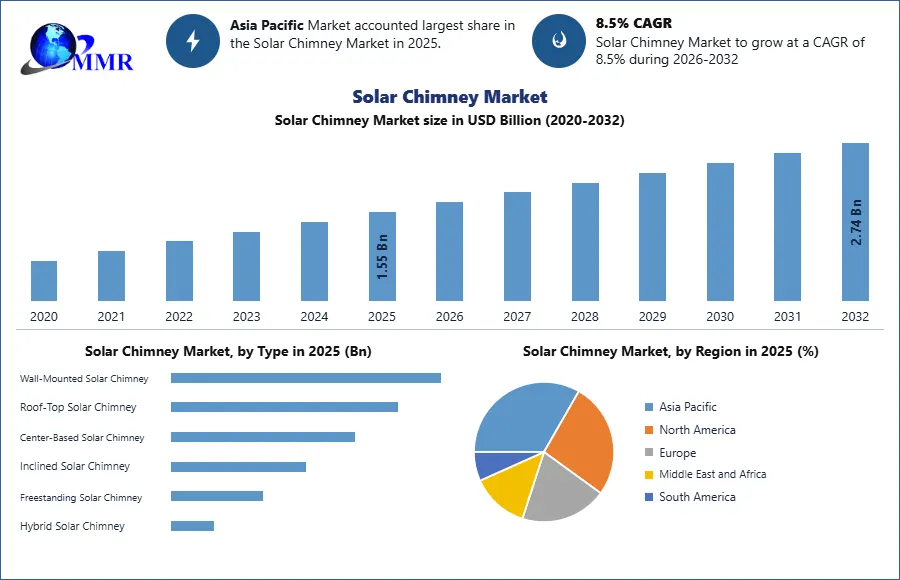
The Solar Chimney Market was valued at USD 1.55 Billion in 2025 and is estimated to grow at a CAGR of 8.5% over the forecast period, reaching USD 2.75 Billion by 2032.
The global Solar Chimney Market report is a comprehensive analysis of the industry, market, and key players. The report has covered the market by demand and supply-side by segments. The global Solar Chimney Market report also provides trends by market segments, technology, and investment with a competitive landscape.
Solar Chimney Market Overview
The Solar Chimney Market refers to systems that use solar radiation to create buoyancy-driven airflow for ventilation, passive cooling, thermal regulation, and in some broader configurations, supplemental power generation. In the built-environment context, a solar chimney is integrated into the building envelope or architectural layout so that heated air rises through a shaft, drawing fresh air through occupied spaces without relying fully on conventional mechanical ventilation. Technical literature and industry sources consistently describe the technology as part of the wider family of passive cooling systems, natural ventilation solutions, energy-efficient buildings, green building technologies, and sustainable construction strategies.
The growth outlook for the Solar Chimney Market strengthened because buildings remain one of the world’s largest energy and carbon pressure points. UNEP states that the buildings and construction sector consumed 32% of global energy and contributed 34% of global CO2 emissions in the latest global status review, which materially increased interest in low-energy ventilation and cooling pathways. At the same time, the IEA continues to position buildings as a core efficiency battleground, while U.S. DOE guidance has long emphasized that passive solar design reduces cooling loads and supports whole-building low-energy performance. Together, these factors expanded the strategic relevance of solar chimneys from an architectural niche to a credible decarbonization tool in selected climates and building types.
Technology development also improved the market’s commercial viability. Recent technical reviews show that solar chimneys are no longer limited to simple wall-mounted shafts; the market now includes wall-mounted, roof-top, center-based, inclined, and hybrid configurations integrated with photovoltaic panels, earth-to-air heat exchangers, atria, double-skin façades, Trombe walls, and phase change materials. This widening design toolkit improved airflow control, thermal performance, and integration into both new construction and retrofit projects. As a result, the Solar Chimney Market forecast increasingly depends not only on solar resource availability, but also on architectural design quality, material selection, smart controls, and hybridization with broader building performance systems.
Demand remained strongest where cooling loads, urban heat, and energy-efficiency compliance converged. The IEA notes that space cooling is the fastest-growing use of energy in buildings globally and in Southeast Asia, and that cooling demand still has significant room to rise as incomes and electrification expand. That dynamic supports demand for natural and mixed-mode alternatives that can reduce mechanical HVAC runtime. In parallel, the EU’s recast Energy Performance of Buildings Directive reinforced the policy case for lower-energy building operation, explicitly covering heating, cooling, ventilation, and technical building systems within building energy performance frameworks. This policy-and-physics combination is why the Solar Chimney Market growth story is increasingly tied to hot-climate urbanization, net-zero building pathways, and the economics of resilient ventilation.
Solar Chimney Market Growth Catalysts
Net-Zero Building Regulations Expanded Passive Design Adoption
The strongest catalyst for the Solar Chimney Market was the tightening of building energy-performance regulation. The EU’s 2024 recast EPBD elevated building performance obligations across heating, cooling, and ventilation, while UNEP and WorldGBC continued to frame buildings as a central lever in climate mitigation and market transformation. As developers moved toward net-zero and low-operational-carbon assets, solar chimneys gained relevance as a non-fuel, low-operating-cost ventilation strategy that could improve compliance without fully scaling mechanical systems.
Cooling Demand Inflation Improved the Value Proposition
The commercial logic of the Solar Chimney Market improved because cooling demand kept rising faster than many other building end uses. The IEA highlighted cooling as the fastest-growing use of energy in buildings in Southeast Asia, and Singapore’s 2025 Go 25 initiative showed how governments are actively promoting sustainable cooling practices to reduce air-conditioning loads. In climates where HVAC is a major operating expense, solar chimneys became more attractive as a way to moderate peak cooling demand, improve airflow, and support mixed-mode ventilation strategies.
Hybrid Solar Chimney Designs Increased Performance Flexibility
The market benefited from a broader innovation pipeline. Recent review literature shows that solar chimneys can now be combined with PV, phase change materials, earth-air tunnels, wind catchers, Trombe walls, and double-skin façades. This mattered commercially because standalone passive systems can be climate-sensitive, but hybrid systems improve controllability, extend operating hours, and make the technology more applicable to schools, commercial buildings, institutional projects, and tall-building ventilation concepts.
Solar Chimney Market Limitations
High Upfront Design Customization Restricted Standardization
The Solar Chimney Market remained constrained by project-specific engineering. Academic and technical sources repeatedly note the absence of a unified design strategy, with performance highly dependent on local climate, geometry, height, material properties, inlet-outlet ratios, and orientation. That meant the market did not scale like commoditized HVAC hardware; instead, it relied on customized design, simulation, and architectural coordination, which raised pre-construction cost and lengthened approval cycles.
Performance Varied by Climate and Building Typology
Solar chimneys did not perform equally across all geographies. Their effectiveness depends on solar radiation, temperature gradients, and airflow behavior, which makes them materially stronger in hot, sunny regions than in colder or heavily shaded urban environments. This climate dependence limited uniform adoption and often required hybrid backup systems, especially in dense urban zones or mixed seasonal climates.
Solar Chimney Market Opportunities
Retrofit Demand in Education, Public Buildings, and Commercial Assets
A major future opportunity in the Solar Chimney Market lies in retrofitting buildings that need lower operating energy without full HVAC replacement. DOE’s whole-building approach and the commercial focus of ventilation specialists both support the idea that passive and mixed-mode strategies can be inserted into schools, public-sector buildings, and large commercial facilities to improve air quality and reduce cooling loads. As building owners face energy-price volatility, retrofit-grade passive ventilation becomes more investable.
Tropical and Hot-Arid Cities Created Untapped Demand Pools
Untapped growth remained strongest in hot-climate urban regions where cooling demand is rising fastest. The IEA’s Southeast Asia work and WorldGBC’s Asia-Pacific activity both point to strong structural demand for sustainable building systems in rapidly urbanizing markets. This makes Asia-Pacific, the Middle East, and selected parts of Africa attractive long-term demand zones for solar chimney deployment in residential blocks, institutions, logistics assets, and public buildings.
Smart Controls and Hybrid Cooling Improved Commercial Bankability
The market also has a meaningful opportunity in digitally assisted passive systems. As building owners increasingly adopt smart building controls, a solar chimney can be paired with sensors, BMS logic, operable façade elements, and secondary air movement systems to create better measured performance. This is strategically important because buyers increasingly want quantified comfort outcomes, energy reporting, and ESG-aligned operating data rather than passive design claims alone.
Solar Chimney Market Operational and Strategic Barriers
Fragmented Supplier Ecosystem Reduced Scale Efficiency
The Solar Chimney Market remained fragmented across specialist façade firms, natural ventilation providers, engineering consultants, and a small number of dedicated solar-chimney players. That fragmentation limited manufacturing scale, reduced pricing transparency, and made procurement more complex than in mainstream HVAC categories. market references explicitly describe the competitive base as fragmented and project-led.
Buyer Education and Proof-of-Performance Slowed Adoption
A second barrier was buyer confidence. Many building owners still require proof that solar chimneys can deliver measurable comfort, compliance, and payback under local climatic conditions. Because performance is design-sensitive, sales cycles often depend on modelling, case studies, and architect-engineer collaboration rather than direct catalog purchasing. That slowed adoption even where the long-term energy logic was favorable.
Solar Chimney Market Trends
Building-Integrated Solar Chimneys Outpaced Standalone Concepts
The market trend was clearly moving toward building-integrated systems rather than isolated experimental towers. segmentation references increasingly separate integrated solar chimney systems from standalone ones, and technical literature emphasizes envelope integration, tall-building applications, and hybrid architectural strategies. That trend supports higher-value project work in commercial and institutional construction.
Mixed-Mode and Sustainable Cooling Strategies Became More Mainstream
Singapore’s Go 25 movement and related mixed-mode ventilation discussions show that the market is shifting from “air conditioning only” toward smarter cooling hierarchies. Solar chimneys fit this transition well because they can reduce baseline loads and complement fans or moderated air-conditioning setpoints. This aligns the Solar Chimney Market with broader industry trends in adaptive comfort, building resilience, and low-energy ventilation.
Research Shifted Toward Hybrid Performance Optimization
Recent literature shows growing attention to PCM-enhanced, PV-assisted, and wind-assisted chimney systems, along with geometry optimization and CFD-led design refinement. This indicates that the innovation frontier is no longer basic concept validation; it is performance optimization for real projects, longer operating windows, and better economics. That shift is positive for the Solar Chimney Market forecast because it gradually reduces one of the category’s biggest constraints: unpredictable real-world performance.
Solar Chimney Market Segmentation, by Type
Type
- Wall-Mounted Solar Chimney
- Roof-Top Solar Chimney
- Center-Based Solar Chimney
- Inclined Solar Chimney
- Freestanding Solar Chimney
- Hybrid Solar Chimney
In 2025, the Wall-Mounted Solar Chimney segment was the largest in the Solar Chimney Market because it matched the economics and architectural realities of mainstream building projects better than other formats. Wall-mounted systems were easier to integrate into façades, retrofits, and medium-rise structures without requiring major structural redesign. Their adoption was supported by strong demand for passive ventilation in schools, offices, and residential buildings where developers preferred lower installation complexity and simpler maintenance. The latest technical review showed that wall-mounted systems remained one of the most studied and commercially relevant forms of solo solar chimney deployment, particularly in building ventilation applications. Their dominance also reflected the fact that the broader market still leaned more toward ventilation and passive cooling than toward large-scale utility power generation. In practical terms, buyers adopted wall-mounted systems because they were easier to specify, easier to simulate in early design, and easier to justify within green building budgets than large freestanding towers or experimental high-capacity chimney concepts.
Solar Chimney Market Segmentation, by Application
Application
- Ventilation
- Cooling
- Heating
- Electricity Generation
- Drying
- Desalination and Multi-Use Thermal Applications
In 2025, Ventilation was the largest application segment in the Solar Chimney Market when the market was defined from the building-systems perspective. That dominance came from the immediate and measurable value of natural airflow, indoor comfort improvement, and partial HVAC displacement in occupied buildings. The strongest commercial use cases were in residential, commercial, and institutional assets that needed lower operating energy and better indoor environmental quality. Technical reviews repeatedly positioned solar chimneys as building ventilation systems first, with heating, cooling, and hybrid functions adding incremental value. While some broader market definitions place power generation ahead, real-world building adoption still concentrated around ventilation because it required lower capital intensity, fewer permitting hurdles, and clearer integration with sustainable construction specifications. For this reason, the ventilation-led definition is the most credible basis for near-term commercial market analysis.
Solar Chimney Market Segmentation, by Material
Material
- Glass
- Metal
- Concrete
- Composite Materials
- Polycarbonate and Other Transparent Covers
In 2025, Glass was the dominant material segment in the Solar Chimney Market because transparent collector and façade elements are central to capturing solar heat and generating buoyancy-driven airflow. Glass-enabled systems were widely preferred in commercial and institutional projects because they supported both performance and architectural integration. Although metal and concrete remained important for structure and durability, glass carried the core functional role in solar gain and was therefore more directly tied to airflow effectiveness and system efficiency.
Solar Chimney Market Segmentation, by Installation Type
Installation Type
- New Construction
- Retrofit
In 2025, New Construction was the largest installation segment in the Solar Chimney Market because architects and engineers could optimize orientation, shaft dimensions, façade placement, and air-path design from the beginning of the project. Retrofit demand was meaningful and rising, but new construction dominated because the technology performed best when integrated into the initial building form rather than appended later. Early-stage design control improved airflow performance, reduced structural compromise, and made it easier to align solar chimneys with broader green building technologies and low-energy building goals.
Solar Chimney Market Segmentation, by End Use
End Use
- Residential Buildings
- Commercial Buildings
- Industrial Buildings
- Institutional Buildings
- Public Infrastructure
In 2025, the Commercial Buildings segment was the largest in the Solar Chimney Market because commercial assets faced the strongest combination of energy-cost pressure, ESG reporting, occupant comfort expectations, and design-budget flexibility. Offices, educational buildings, hospitality assets, and mixed-use developments were more likely than small residences to adopt integrated passive ventilation solutions during either new construction or deep retrofit cycles. Commercial buyers also had stronger incentives to pursue certification-linked design improvements and operational carbon reductions, which favored solar chimney adoption as part of a broader natural ventilation strategy. Residential demand was growing, especially in warm climates, but it remained more price-sensitive and less standardized. Industrial use existed in selected airflow-intensive facilities, yet building-integrated solar chimney systems found their best fit in commercial projects where architectural value, sustainability positioning, and lifecycle energy performance could all be monetized simultaneously.
Solar Chimney Market Regional Analysis
In 2025, Asia Pacific was the leading region in the ventilation-oriented Solar Chimney Market because it combined strong urban construction growth, rising cooling demand, supportive green-building activity, and climate conditions well suited to passive ventilation. The market segmentation sources identified Asia Pacific as the largest and fastest-growing region for solar chimney ventilation systems. That position was reinforced by IEA evidence that cooling is the fastest-growing use of energy in buildings in Southeast Asia, as well as WorldGBC’s strong Asia-Pacific network activity in accelerating sustainable building adoption. The region also benefited from a large pipeline of new commercial and institutional construction where solar chimneys could be designed into the building envelope from the outset. Policy support for energy-efficient buildings, increasing sensitivity to electricity costs, and the need for lower-carbon cooling infrastructure further strengthened Asia-Pacific’s lead. In practical terms, the region dominated because industrial growth, policy direction, technology adaptation, and infrastructure expansion were all moving in the same direction.
The objective of the report is to present a comprehensive analysis of the global Solar Chimney Market to the stakeholders in the industry. The past and current status of the industry with the forecasted market size and trends are presented in the report with the analysis of complicated data in simple language. The report covers all the aspects of the industry with a dedicated study of key players that include market leaders, followers, and new entrants.
PORTER, SVOR, PESTEL analysis with the potential impact of micro-economic factors of the market have been presented in the report. External as well as internal factors that are supposed to affect the business positively or negatively have been analyzed, which will give a clear futuristic view of the industry to the decision-makers.
The report also helps in understanding the global Solar Chimney Market dynamics, structure by analyzing the market segments and project the global Solar Chimney Market size. Clear representation of competitive analysis of key players by Grade, price, financial position, Grade portfolio, growth strategies, and regional presence in the global Solar Chimney Market make the report investor’s guide.
Global Solar Chimney Market Scope: Inquire before buying
| Solar Chimney Market | |||
|---|---|---|---|
| Report Coverage | Details | ||
| Base Year: | 2025 | Forecast Period: | 2026-2032 |
| Historical Data: | 2020 to 2025 | Market Size in 2025: | USD 1.55 Billion |
| Forecast Period 2026-2032 CAGR: | 8.5% | Market Size in 2032: | USD 2.74 Billion |
| Segments Covered: | by Type | Wall-Mounted Solar Chimney Roof-Top Solar Chimney Center-Based Solar Chimney Inclined Solar Chimney Freestanding Solar Chimney Hybrid Solar Chimney |
|
| by Material | Glass Metal Concrete Composite Materials Polycarbonate and Other Transparent Covers |
||
| by Installation Type | New Construction Retrofit |
||
| by Application | Ventilation Cooling Heating Electricity Generation Drying Desalination and Multi-Use Thermal Applications |
||
| by End Use | Residential Buildings Commercial Buildings Industrial Buildings Institutional Buildings Public Infrastructure |
||
Recent Development
May 2025: Singapore’s Ministry of Sustainability and the Environment, together with SGBC and support from NEA and BCA, launched the Go 25 national movement to encourage sustainable cooling by setting indoor air-conditioning at or above 25°C. The programme is not a direct solar chimney product launch, but it is highly relevant to the Solar Chimney Market because it strengthens the commercial logic for mixed-mode ventilation, passive cooling, and airflow-focused building design. The official release states that buildings account for more than 20% of Singapore’s carbon emissions and highlights research showing energy savings of up to 12% for each degree increase from 23°C to 25°C in office setpoints. For the solar chimney ecosystem, this is strategically important because it shifts procurement conversations from “replace HVAC” to “reduce cooling intensity through passive and hybrid measures.” That framing directly benefits technologies such as solar chimneys that work best as part of a broader low-energy ventilation architecture rather than as standalone replacements for all cooling equipment.
September 2025: Genuit Group announced the acquisition of Monodraught for £55.6 million, describing Monodraught as a specialist ventilation manufacturer and strengthening Genuit’s position in sustainable water, climate, and ventilation solutions for the built environment. While the transaction was not limited to solar chimney products, it matters for the Solar Chimney Market because Monodraught has long been associated with low-energy and natural-ventilation solutions in commercial and public buildings. The deal signaled that larger building-products groups see strategic value in climate-responsive ventilation platforms, controls, and retrofit-ready sustainability offerings. From a market perspective, acquisitions of this kind usually improve route-to-market strength, engineering support, after-sales capability, and specification reach. That can accelerate adoption of passive and hybrid airflow solutions in schools, offices, and public-sector estates. The transaction therefore points to a gradual institutionalization of the fragmented natural-ventilation supplier base that supports solar chimney commercialization.
November 2025: The University of Waterloo highlighted the solar chimney incorporated into its Mathematics 4 building, describing it as a passive design feature that uses architecture and materials to regulate temperature and airflow without relying on mechanical systems. This was not framed as a mass-market product launch, yet it is one of the clearest recent public examples of a contemporary solar chimney being showcased in a high-visibility institutional project. The relevance to the Solar Chimney Market is significant because flagship educational and institutional buildings often serve as proof-of-concept assets for consultants, policymakers, and project developers. Public demonstrations help move solar chimneys from theoretical sustainability language into visible built-environment practice. The Waterloo example also reinforced the trend toward integrating solar chimneys into a wider package of passive design measures aimed at reducing energy use and enhancing occupant comfort. For a market still constrained by proof-of-performance concerns, that kind of visible project communication matters commercially
Global Solar Chimney Market, by Region
• North America (United States, Canada and Mexico)
• Europe (UK, France, Germany, Italy, Spain, Sweden, Austria and Rest of Europe)
• Asia Pacific (China, South Korea, Japan, India, Australia, Indonesia, Malaysia, Vietnam, Taiwan, Bangladesh, Pakistan and Rest of APAC)
• Middle East and Africa (South Africa, GCC, Egypt, Nigeria and Rest of ME&A)
• South America (Brazil, Argentina Rest of South America)
Key Players/Competitors Profiles Covered in the Solar Chimney Market Report in Strategic Perspective
- Solar Innovations, Inc.
- EnviroMission Limited
- Helioakmi S.A.
- Specflue Ltd.
- Monodraught Ltd.
- Colt International Ltd.
- Kingspan Light + Air
- WindowMaster International A S
- Systemair AB
- Lindab AB
- TROX GmbH
- Halton Group
- VELUX Commercial
- Schlaich Bergermann Partner
- Solar Tower Technologies
- Conserval Engineering, Inc.
- Solatube International
- Broan-NuTone
- Stiebel Eltron
- Siemens Smart Infrastructure
- Gensler
- HOK
- Atelier Ten
- Arup Group
- WSP Global