
Smartphone Display Market Size by Screen Size, Technology Type, Resolution, Distribution Channel and Region – Segment-Level Market Assessment, Growth Opportunity Analysis, Competitive Mapping & Forecast to 2032
Overview
Global Smartphone Display Market size was valued at USD 6.78 Bn in 2024 and is expected to reach USD 12.65 Bn by 2032, at a CAGR of 8.1 %.
Smartphone Display Market Overview
A smartphone display is a screen on a mobile device that visually presents information, enabling users to interact with applications and content. It serves as the primary interface, allowing users to view messages, browse the internet, play games, and access various apps. The display's key applications include showcasing vibrant visuals, facilitating touch interactions, and providing a dynamic platform for diverse tasks. End users rely on smartphone displays for an immersive experience, from reading messages and watching videos to navigating apps. The display is integral to the overall functionality of a smartphone, enhancing user engagement and accessibility.
In recent years, mobile displays have undergone remarkable advancements to meet the escalating demands of richer applications. From early monochrome screens with limited pixels, today's mobile handsets boast displays exceeding 105 pixels and up to 12 bits of color depth. To know about the Research Methodology :- Request Free Sample Report
The Growth Smartphone Display Market is driven by technological progress in wireless networks and mobile handsets have propelled smartphone phone displays to rival desktop monitors in brightness, contrast, and color saturation. The evolution includes various display types such as LCD, IPS-LCD, OLED, and AMOLED. Choosing the best display often confuses consumers, with options such as IPS LCD, TFT LCD, OLED, and Super AMOLED. The screen, coupled with touch functionality, plays a pivotal role in the user interface, prompting comprehensive testing for factors like contrast ratio, color calibration, brightness, and sunlight legibility during reviews. This dynamic landscape reflects a commitment to delivering an exceptional communication experience for consumers.
The growing demand for smartphones and tablets is the major driving factor behind the growth of the smartphone display market. The rise in the adoption of smartphones by consumers of all ages and increasing smartphone sales are driving the growth of the market. Also, growing concerns regarding features of smartphones such as display, size, camera quality, etc. are key factors that influence the Smartphone Display Industry.
Smartphone Display Market Dynamics
Technological Advancements in Display Technology to Drive the Market Growth
The continuous evolution of display technologies is a primary driver propelling the growth of the Smartphone Display Market. Manufacturers are consistently investing in research and development to enhance screen quality, resolution, and functionality. The transition from traditional LCD (Liquid Crystal Display) to advanced technologies such as OLED (Organic Light-Emitting Diode) and AMOLED (Active Matrix Organic Light-Emitting Diode) has significantly improved the visual experience for smartphone users. These advancements not only contribute to sharper and more vibrant displays but also enable the creation of innovative form factors, such as foldable and flexible screens. As consumers increasingly prioritize superior display quality in their smartphones, manufacturers delivering cutting-edge display technologies are positioned for significant Smartphone Display Market growth.
Smartphone Display Technology Innovation Trends Impact the Market Growth
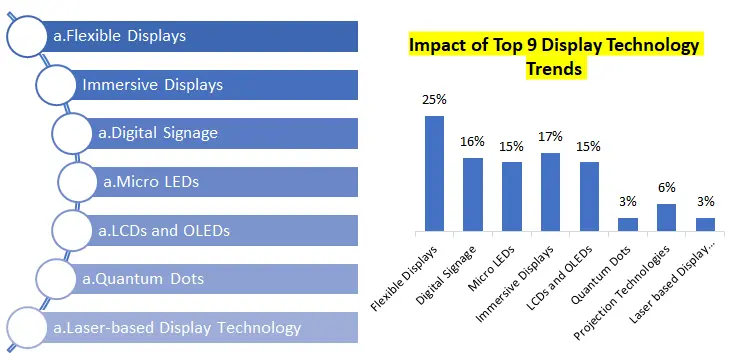
The growth of online gaming and entertainment is extending screen time on TVs, tablets, and smartphones, compelling consumers to seek enhanced visual experiences. This demand is expected to drive continuous innovation in display technologies, where LED advancements, particularly organic LED (OLED) and micro-LED, are supplanting LCDs for superior performance. Smartphone display emerging key players are pivotal players, delving into next-gen technologies such as quantum dot (QD) displays.
Rising Adoption of 5G Technology to Boost the Market Growth
The global rollout of 5G networks is driving demand for smartphones with displays capable of harnessing the potential of high-speed connectivity. 5G technology enables faster data transfer rates and lower latency, unlocking new possibilities for multimedia content consumption, augmented reality (AR), and virtual reality (VR) applications. The Smartphone Display Market is experiencing robust growth, propelled by key drivers such as continuous advancements in display technology, a growing demand for edge-to-edge displays, and the widespread adoption of 5G technology. To fully leverage the benefits of 5G, smartphone manufacturers are incorporating high-refresh-rate displays and optimizing screen technologies to deliver seamless and responsive user experiences. The transition to 5G is, therefore, influencing the design and functionality of smartphone displays, acting as a key growth driver of the Smartphone Display Market.
Today 99% of displays and other spare parts for smartphones, tablets, laptops, etc. are made in China. The PRC has succeeded in creating all necessary conditions for technological advance on an unthinkable scale. Logical enough, all the most popular manufacturers of smartphones, as well as other consumer electronics & and portable equipment have built factories in this country. Smartphone display manufacturers are investing in OLED and AMOLED displays to enhance visual experiences.
The trend towards bezel-less designs and foldable displays is driving consumer demand. For instance, in response to India's 5G launch, Apple and Samsung committed to software upgrades for their 5G-enabled phones by December, aligning with government initiatives. Apple plans updates for iPhone 14, 13, 12, and SE models, ensuring optimal 5G experiences. This move reflects the industry's adaptation to emerging technologies, emphasizing the crucial role of compatible displays in delivering enhanced connectivity. As major players align with network advancements, the demand for cutting-edge smartphone displays is poised to surge, driving growth in the smartphone display market.
Also, the 5G networks drive the need for high-refresh-rate displays, optimizing user experiences. As 5G transforms connectivity, companies like Microsoft, Google, and Verizon are at the forefront, capitalizing on the 5G revolution. This Smartphone Display Market evolution is reshaping industries globally, from healthcare to automotive, promising a significant economic boost.
Increase in Demand for Larger Screens to Create Lucrative Opportunity for Market Growth
The growing consumer preference for larger smartphone screens is a key factor driving the expansion of the Smartphone Display Market. As mobile devices increasingly serve as primary platforms for multimedia consumption, gaming, and productivity, there is a rising demand for larger, more immersive displays. Consumers seek smartphones that offer an optimal balance between portability and screen real estate. The trend toward bezel-less designs and higher screen-to-body ratios further underscores this preference for expansive displays. Smartphone Display Market Manufacturers responding to this demand by developing smartphones with larger and visually engaging screens are such to experience heightened market traction, driving overall industry growth.
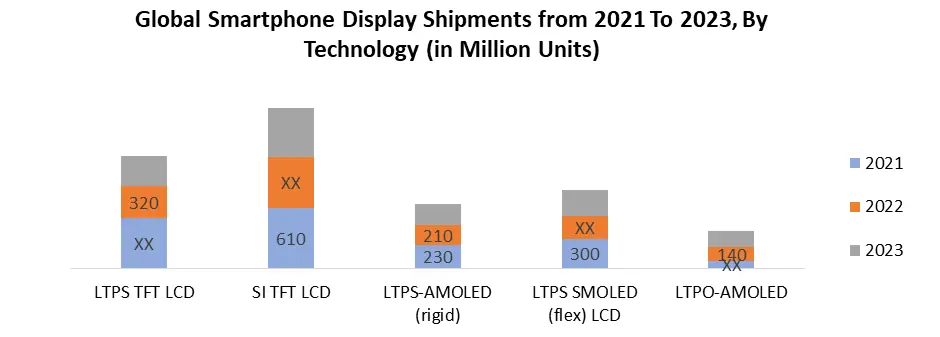
Supply Chain Disruptions:
Smartphone displays are intricate components that require specialized materials and manufacturing processes. One significant restraint factor for the Smartphone Display Market is the vulnerability to disruptions in the global supply chain. The supply chain involves multiple stages, from raw material extraction to component assembly, and any disruption in this complex network can impact the availability of displays. For instance, events like natural disasters, geopolitical tensions, or global health crises can disrupt the production and transportation of essential materials, leading to shortages and delays in manufacturing. This, in turn, affects the overall supply of smartphone displays, leading to increased costs and potential Smartphone Display Market instability.
Smartphone Display Market Segment Analysis
By technology type, the TFT-LCD (Thin-Film Transistor Liquid-Crystal Display) segment dominated the smartphone display market in 2024. TFT-LCD is most commonly used in the manufacturing of smartphone displays. TFT technology improves image quality such as addressability and contrast. These are cheaper in manufacturing cost and found on budget phones, feature phones, and lower-end smartphones. Furthermore, the AMOLED (Active-Matrix Organic Light Emitting Diode) segment is expected to dominate the market at CAGR of xx% during the forecast period. The rise in demand for high-end smartphones with large displays is driving the growth of the Smartphone Display Market. Nowadays, AMOLED displays are preferred over LCDs owing to their color reproduction capability, lightweight design, fast response time and high brightness. Thin-film transistor liquid crystal display technology uses "field-effect" transistors, which are built by layering thin films on a glass substrate, hence the name. This technique is commonly used for creating microprocessors. The TFT in the LCD controls individual pixels in the display by setting the level of the electric field across the three liquid crystal capacitors (one for each sub-pixel of red, green, and blue) in the pixel to control the polarization of the crystal material. The amount of polarization in the crystal determines the amount of light that reaches the color filter from the backlight. Because of this ability to directly and quickly control each pixel, TFT is also called active-matrix LCD technology.
Based on screen size, above 6 inches segments held the largest Smartphone Display Market share in 2023 and are expected to keep their dominance over the forecast period. This smartphone display provides a versatile user experience, ideal for immersive gaming, crisp multimedia viewing, and efficient multitasking. Its expansive screen size enhances productivity, making it suitable for professionals who rely on their devices for work. Additionally, the larger display provides a comfortable platform for creative tasks, such as photo and video editing. As a result, such a factor is expected to drive the segment growth in the market. The rising demand for large user-friendly smartphones is driving the growth of the market. A larger display gives users the best viewing experience.
For instance, Samsung launches the Galaxy M31 in India with an AMOLED display and size above 6 inches. In China, Huawei is the top smartphone brand. In Feb 2021, Huawei launches HUAWEI Mate Xs with a powerful dual-screen smartphone display of 6.6-inch main screen and a 6.38-inch secondary screen. Apples the latest iPhone 11 pro have a display with rounded corners, these corners are within a standard rectangle with a 6.46-inch screen size.
Smartphone Display Market Regional Insight
Asia Pacific held the largest Smartphone Display Market share in 2024 and is expected to grow at a CAGR of xx% during the forecast period. Economies such as China, India, Japan and South Korea are dominating the Smartphone Display Market owing to the presence of smartphone manufacturers like Samsung, Oppo, Vivo, LG and others. The rise in the adoption of new technologies related to mobile phones by many manufacturing industries across the region is also driving the growth of the market.
In large population countries such as India and China, the number of smartphone users is high which leads to the growth of the smartphone display market in the region. Samsung Electronics a South Korean-based company holds 1St ranking in mobile phone manufacturing and selling business with 31.38% Global Smartphone Display Market Share as of 2023-2024. Huawei and Xiaomi (MI) are the Chinese multinational companies and manufacturers that hold 3rd and 4th ranking with 8.57% and 7.52% global market share in 2024.
India emerges as the fastest-growing smartphone market in the Asia Pacific region, signaling robust future growth. Asia Pacific is poised to host the three largest smartphone markets globally, representing over 40% of global connections. The regional growth is evident, with China leading at 1,493 million connections, followed by India at 1,041 million and Indonesia at 351 million. Smartphone penetration is on the rise, with an average of 83% of connections in the region by 2030, reflecting the tech-savvy nature of consumers. The population trends in Asia and the Pacific, housing approximately 3.5 billion people, underscore the immense Smartphone Display Market potential.
In North America, the smartphone display market is shaped by a tech-forward consumer culture. High demand for premium smartphones fuels competition among manufacturers, emphasizing cutting-edge display technologies such as OLED and high refresh rates. User experience, including gaming and media consumption, remains a priority. The market is dynamic, with a focus on collaborations between tech companies and display manufacturers to meet the evolving preferences of discerning North American consumers.
Europe Smartphone Display Market reflects a diverse landscape of tech-savvy consumers with a penchant for premium devices. Demand centers on advanced features such as high resolutions and vibrant colors. European consumers prioritize sleek design and cutting-edge technology, driving manufacturers to innovate in areas like OLED displays. The market is competitive, fostering collaborations between European and global display technology leaders.
The objective of the report is to present a comprehensive analysis of the Global Smartphone Display Market including all the stakeholders of the industry. The past and current status of the industry with forecasted market size and trends are presented in the report with the analysis of complicated data in simple language.
The report covers all the aspects of the industry with a dedicated study of key players that includes market leaders, followers and new entrants. PORTER, SWOT, and PESTEL analysis with the potential impact of micro-economic factors of the market have been presented in the report. External as well as internal factors that are supposed to affect the business positively or negatively have been analyzed, which will give a clear futuristic view of the industry to the decision-makers.
The report also helps in understanding the Global Smartphone Display Market dynamics, and structure by analyzing the market segments and projecting the Global Smartphone Display industry. Clear representation of competitive analysis of key players by Application, price, financial position, Product portfolio, growth strategies, and regional presence in the Global Smartphone Display Market make the report an investor’s guide.
The smartphone display industry's competitive landscape is shaped by the ongoing rivalry between OLED and LCD technologies, with Samsung Display and LG Display leading the market. Innovation in foldable and flexible displays, advancements in HDR support, and strategic OEM partnerships contribute to the dynamic nature of the industry. Additionally, companies focus on supply chain efficiency, geographical presence, and cost competitiveness to gain an edge. The emergence of environmentally sustainable practices further influences the evolving competitive dynamics in the global smartphone display market. For the latest insights, consulting up-to-date industry reports and market analyses is recommended.
LG Electronics introduces the groundbreaking LG WING™ 5G smartphone, featuring a unique swivel design that enhances creativity, productivity, and entertainment. Boasting a Qualcomm Snapdragon™ 765G 5G processor, it enables seamless multitasking and takes advantage of 5G speeds. With a high-capacity 4,000mAh battery, dual OLED screens (6.8" FullVision and 3.9" secondary display), and triple rear cameras, including a 64 MP lens and a 13 MP ultra-wide lens, the LG WING™ delivers a superior user experience. Offering ample storage with 256GB memory, LG WING™ 5G is a powerful device for capturing, creating, and multitasking. Explore LG's latest 5G smartphones and accessories for an all-encompassing mobile experience.
Smartphone Display Market Scope : Inquire before buying
| Smartphone Display Market | |||
|---|---|---|---|
| Report Coverage | Details | ||
| Base Year: | 2024 | Forecast Period: | 2025-2032 |
| Historical Data: | 2019 to 2024 | Market Size in 2024: | US $ 6.78 Bn. |
| Forecast Period 2025 to 2032 CAGR: | 8.1% | Market Size in 2032: | US $ 12.65 Bn. |
| Segments Covered: | by Screen Size | Above 6 inches 5.5 inches-5.9 inches 5 inches-5.4 inches Below 5 inches |
|
| by Technology Type | TFT-LCD IPS-LCD OLED AMOLED Others ( micro LED, etc) |
||
| by Resolution | 4K (4096 x 2160) 2K (2560 x 1440) 1080p (1920 x 1080) 720p (1280 x 720) |
||
| by Distribution Channel | OEMs Aftermarket |
||
Smartphone Display Market, by Region
Asia Pacific (China, South Korea, Japan, India, Australia, Indonesia, Malaysia, Vietnam, Taiwan, Bangladesh, Pakistan and Rest of APAC)
Europe (UK, France, Germany, Italy, Spain, Sweden, Austria and Rest of Europe)
North America (United States, Canada and Mexico)
Middle East and Africa (South Africa, GCC, Egypt, Nigeria and Rest of ME&A)
South America (Brazil, Argentina Rest of South America)
Smartphone Display Key Players are:
The Smartphone Display market is dominated by key players such as Samsung, LG, NEC, Tianma, and BOE, each leading the way with innovative Smartphone display solutions. Samsung is a key competitor, focusing on innovative AMOLED, OLED, and LCD technologies, and aims to advance flexible and frameless screens. The analysis highlights trends in display technology and the strategic positioning of major stakeholders. These Smartphone display companies prioritize advancements in sustainability, performance, and efficiency through robust R&D efforts. Their strategic alliances and comprehensive product ranges enable them to address varied industrial needs.
Asia Pacific
1. Samsung - Seoul, South Korea
2. LG - Seoul, South Korea
3. NEC - Tokyo, Japan
4. Tianma Microelectronics (China)
5. BOE Technologies Group - Beijing, China
6. Chi Mei Corporation - Tainan, Taiwan
7. Visionox - Beijing, China
8. Japan Display Inc. - Tokyo, Japan
9. AU Optronics - Hsinchu, Taiwan
10. Ever Display - Shanghai, China
11. Hannstar Display - Taipei, Taiwan
12. Toshiba Corporation - Tokyo, Japan
13. InfoVision Optoelectronics - Hsinchu, Taiwan
14. Panasonic Corporation - Osaka, Japan
15. Sony Corporation - Tokyo, Japan
16. Heyuan Zhongtou Communication Technology - Heyuan, China
Europe
17. NEC Display Solutions (Germany)
18. Barco (Belgium)
19. Others
Asia Pacific
20. Apple - Cupertino, California, USA
21. Corning Incorporated (United States)
22. Universal Display Corporation (United States)
23. Others
Frequently Asked Questions:
1] What is the growth rate of the Global Smartphone Display Market?
Ans. The Global Smartphone Display Market is growing at a significant rate of 8.1 % during the forecast period.
2] Which region is expected to dominate the Global Smartphone Display Market?
Ans. APAC is expected to dominate the Smartphone Display Market during the forecast period.
3] What is the expected Global Smartphone Display Market size by 2032?
Ans. The Smartphone Display Market size is expected to reach USD 12.65 Bn by 2032.
4] Which are the top players in the Global Smartphone Display Market?
Ans. The major top players in the Global Smartphone Display Market are Samsung, LG, Apple and others.
5] What are the factors driving the Global Smartphone Display Market growth?
Ans. The growth of 5G penetration and high demand for smartphones are expected to drive the Smartphone Display Market growth.
6] Which country held the largest Global Smartphone Display Market share in 2024?
Ans. The Chian held the largest Smartphone Display Market share in 2024.