
Robot Cars and Trucks Market – Global Market Size, Strategic Growth Drivers, Risk Assessment Framework, Regulatory Landscape Review, Competitive Intensity Mapping & Long-Term Industry Outlook to 2032
Overview
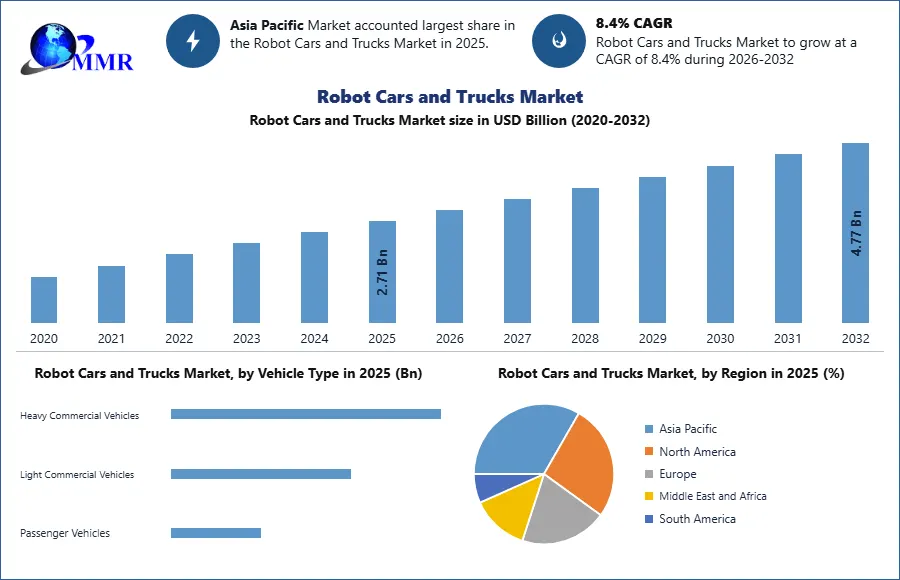
Robot Cars and Trucks Market size was valued at USD 2.71 Billion in 2025 and the total Global Robot Cars and Trucks Market revenue is expected to grow at a CAGR of 8.4% from 2025 to 2032, reaching nearly USD 4.77 Billion.
Robot Cars and Trucks Market Overview
The Robot Cars and Trucks Market is evolving with the growing adoption of autonomous mobility technologies across passenger transportation, logistics, and commercial delivery operations. Robot cars and trucks are self-driving vehicles equipped with artificial intelligence, machine learning, advanced sensors, LiDAR, radar systems, cameras, and real-time navigation software that enable autonomous driving without human intervention. The market is gaining momentum due to increasing demand for safer transportation systems, operational efficiency, reduced labor dependency, and smart mobility infrastructure. Autonomous trucks are increasingly used in freight transportation, warehouse logistics, mining operations, and middle-mile delivery, while robot cars are expanding within urban transportation and mobility services. The integration of connected vehicle technologies, cloud-based fleet management, and vehicle-to-everything communication is improving driving accuracy and traffic coordination. Governments across developed and emerging economies are supporting intelligent transportation initiatives, autonomous vehicle testing zones, and smart city development projects.
To know about the Research Methodology :- Request Free Sample Report
Global Robot Cars and Trucks Market Dynamics:
Market Trend
The increasing commercialization of autonomous mobility ecosystems and smart transportation networks. Companies operating in autonomous driving are shifting from pilot testing toward large-scale deployment of robotaxis, autonomous delivery fleets, and self-driving freight vehicles. Artificial intelligence and deep learning technologies are improving vehicle perception, object detection, lane navigation, and predictive decision-making capabilities, enabling safer and more reliable autonomous operations. Another important trend is the growing integration of electric vehicles with autonomous driving systems, creating sustainable and intelligent transportation solutions. The market is also witnessing rising deployment of autonomous trucks for long-haul logistics, warehouse transportation, and middle-mile delivery applications to improve efficiency and reduce transportation costs. Smart cities are increasingly implementing connected infrastructure such as 5G communication networks, intelligent traffic systems, and vehicle-to-everything connectivity to support autonomous vehicle operations.
Market Driver
Human driving errors such as fatigue, distraction, overspeeding, and impaired driving remain major causes of traffic accidents worldwide. Autonomous vehicles utilize advanced artificial intelligence systems, real-time sensors, automated braking, adaptive cruise control, and predictive analytics to minimize accidents and enhance driving precision. Growing demand for efficient freight transportation and logistics automation is also accelerating market growth. The logistics industry is facing driver shortages, rising fuel costs, and increasing pressure to improve supply chain efficiency, encouraging the adoption of autonomous trucks and smart delivery systems. Governments are investing heavily in intelligent transportation infrastructure, connected roads, and smart traffic management systems to support autonomous mobility deployment. In addition, the rapid expansion of e-commerce and demand for faster delivery services are increasing the adoption of self-driving commercial vehicles in logistics operations.
Market Restraint
A significant restraint affecting the Robot Cars and Trucks Market is the high development cost and technological complexity associated with autonomous driving systems. Autonomous vehicles require expensive technologies including LiDAR sensors, radar modules, AI processors, HD mapping systems, high-performance computing platforms, and real-time communication infrastructure, increasing overall production and operational costs. Many transportation companies and fleet operators face challenges in adopting autonomous mobility solutions due to substantial capital investment requirements. Regulatory uncertainty also remains a major challenge, as different countries have varying rules and safety standards regarding autonomous vehicle testing, deployment, and liability management. Public concerns regarding vehicle safety, cybersecurity threats, software reliability, and accident risks continue to slow consumer acceptance in several regions.
Robot Cars and Trucks Market Segment Analysis
By Vehicle Type the market is segmented into Heavy Commercial Vehicles, Light Commercial Vehicles, Passenger Vehicles. The Passenger Vehicles segment dominated the market in 2025 & is expected to hold the largest market share during the forecast period, due to the rapid commercialization of autonomous cars and robotaxis. Tech giants and automakers are heavily investing in passenger-focused self-driving systems to cater to urban mobility, ride-hailing, and personal transport demand. The rise of shared mobility services, smart city initiatives, and consumer adoption of advanced driver-assistance features (ADAS) is accelerating deployment in passenger vehicles compared to commercial fleets. While light and heavy commercial vehicles are gaining traction in logistics and freight, regulatory challenges and higher operational complexities slow their large-scale adoption, keeping passenger vehicles as the leading segment.
By Technology the market is segmented into Simultaneous Localization, Mapping Real-Time Locating System. Simultaneous Localization segment is dominated the market in 2025& is expected to hold the largest market share during the forecast period. It is the backbone for enabling real-time navigation and environment mapping in autonomous vehicles. SLAM allows vehicles to accurately perceive surroundings, create detailed maps, and localize themselves within dynamic environments, which is critical for safe driving in urban areas, highways and complex traffic conditions. Its integration with LiDAR, radar, and vision sensors makes it highly reliable for both passenger and commercial autonomous vehicles. Real-Time Locating Systems (RTLS) are useful in controlled or closed environments like warehouses, SLAM’s versatility and scalability.
Global Robot Cars and Trucks Market Regional Analysis:
Asia Pacific dominates the Robot Cars and Trucks Market due to rapid urbanization, strong automotive manufacturing capabilities, increasing investments in smart mobility infrastructure, and rising adoption of autonomous transportation technologies. Countries such as China, Japan, South Korea, and India are significantly investing in intelligent transportation systems, electric mobility, and connected vehicle infrastructure to support autonomous driving deployment. The region benefits from expanding smart city projects, large-scale 5G network development, and growing integration of artificial intelligence within transportation ecosystems. Rising e-commerce activity and logistics automation are increasing demand for autonomous delivery vehicles and self-driving freight transportation solutions across industrial and commercial sectors.
Governments in Asia Pacific are actively supporting autonomous vehicle pilot programs, innovation hubs, and regulatory frameworks for intelligent mobility systems. The presence of advanced semiconductor manufacturing, battery production, and automotive component industries further strengthens regional market growth. Increasing disposable income, rising urban population, and demand for efficient transportation solutions are accelerating adoption of autonomous mobility technologies across passenger and commercial vehicle segments.
Recent Developments
January 2025 ,Tesla announced the commercial rollout of its Robotaxi business and expanded Full Self-Driving (FSD) deployment strategy for autonomous mobility operations. The company focused on launching unsupervised autonomous driving services and scaling AI-based autonomous transportation networks. Tesla also accelerated development of dedicated autonomous vehicle platforms integrated with advanced AI chips and neural network driving systems. The development strengthened the company’s position in autonomous passenger transportation and smart mobility infrastructure. The expansion of autonomous driving software across multiple international markets supported higher adoption of self-driving vehicle technologies and reinforced long-term investment in robotaxi ecosystem development and connected transportation services globally.
March 2025 , Waymo introduced its sixth-generation robotaxi platform designed for large-scale commercial deployment and high-volume autonomous fleet production. The upgraded platform included advanced sensor systems, improved radar capabilities, enhanced LiDAR performance, and lower operational costs for autonomous transportation services. The company expanded testing and deployment activities across multiple cities while strengthening autonomous ride-hailing operations. The next-generation autonomous vehicle architecture improved navigation efficiency, passenger safety, and scalability for urban transportation networks. The development also supported expansion of driverless mobility services and reinforced autonomous transportation commercialization across smart city ecosystems and connected mobility infrastructure globally.
Scope of Global Robot Cars and Trucks Market: Inquire before buying
| Robot Cars and Trucks Market | |||
|---|---|---|---|
| Report Coverage | Details | ||
| Base Year: | 2025 | Forecast Period: | 2026-2032 |
| Historical Data: | 2020 to 2025 | Market Size in 2025: | 2.71 USD Billion |
| Forecast Period 2026-2032 CAGR: | 8.4% | Market Size in 2032: | 4.77 USD Billion |
| Segments Covered: | by Vehicle Type | Heavy Commercial Vehicles Light Commercial Vehicles Passenger Vehicles |
|
| by Classification | Level 0 Level 1 Level 2 Level 3 Level 4 Level 5 |
||
| by Technology | Simultaneous Localization Mapping Real-Time Locating System Others |
||
| by Application | Domestic Commercial Industrial |
||
Robot Cars and Trucks Market, by Region
North America (United States, Canada, and Mexico)
Europe (UK, France, Germany, Italy, Spain, Sweden, Austria, and the Rest of Europe)
Asia Pacific (China, South Korea, Japan, India, Australia, Indonesia, Philippines, Malaysia, Vietnam, Thailand, Rest of Asia Pacific)
Middle East & Africa (South Africa, GCC, Nigeria, Rest of ME&A)
South America (Brazil, Argentina, Rest of South America)
Key players/Competitors profiles covered in the Robot Cars and Trucks market report in strategic perspective
- Waymo
- Tesla
- Cruise
- Zoox
- Baidu Apollo Go
- ai
- WeRide
- AutoX
- Motional
- Nuro
- Aurora Innovation
- Kodiak Robotics
- Gatik
- Waabi
- Einride
- TuSimple
- PlusAI
- Torc Robotics
- Embark Trucks
- Daimler Truck
- Volvo Autonomous Solutions
- Navistar
- Didi Autonomous Driving
- Yandex Self-Driving Group
- Mobileye
- Nvidia Drive
- XPeng
- Huawei Intelligent Automotive
- Bosch
- Aptiv