
RF Filters Market Size by Filter Type, Connectivity Technology, Functional Type, Application, Region – Revenue Pool Analysis, Margin Structure Assessment, Capital Flow Trends, Competitive Benchmarking & Forecast to 2032
Overview
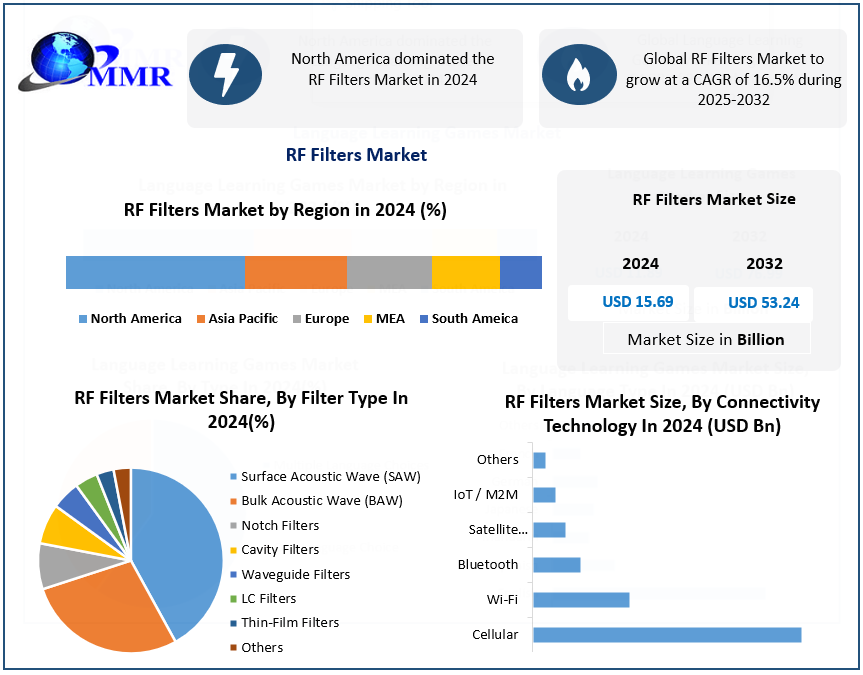
RF Filters Market was valued at USD 15.69 billion in 2024, and total global RF Filters Market revenue is expected to grow at a CAGR of 16.5% from 2025 to 2032, reaching nearly USD 53.24 billion. Rapid growth of 5G networks.
Overview
Radiofrequency (RF) filters are the type of electronic filters, which are designed to operate on signals in the megahertz to gigahertz frequency ranges. It is used to remove or to filter some unnecessary features or components from a signal and allow other generated signals. RF filters are used to pass radio frequencies within the desired band. It helps to block the undesired or unwanted radio frequencies in a wireless communication chain. Technological advancements in filter technology drive RF Filters Market growth.
 To know about the Research Methodology :- Request Free Sample Report
In the market, operating key players are focusing on the developments to make greater use of the millimeter wave (3-30 GHz) and the Extremely High Frequency (EHF) ranges (30-300 GHz). With the advancement, the presence of high consumer base for consumer goods are enabling the adoption of next-generation Electronic Warfare (EW) systems, space-based Wi-Fi, other SATCOM applications, that are expected to drive the demand for RF filters.
RF Filters Market Dynamics
Rising Demand for 5G Technology Drives RF Filters Market Growth
The RF Filters Market is experiencing robust growth, primarily driven by the widespread adoption of 5G technology. With 5G networks rolling out globally, the need for RF filters in smartphones, base stations, and other communication devices has surged. These filters are essential for managing the increased frequency bands and preventing interference, ensuring seamless connectivity and high-speed data transmission. The adoption of 5G continues to thrive in the mobile devices market and is expected to become more diverse and expand exponentially across all types and price tiers. However, device democratization of the 5G experience is expected constrained, not just by the modem and application processor, but by the Radio Frequency Front-End (RFFE). In turn, within the RF, it is the filters that is most challenging and essential area to address fully as the market moves to 5G.

The integration of RF filters into 5G infrastructure allows for more efficient spectrum usage and improved network performance. This demand is further bolstered by the rapid proliferation of IoT devices and smart technologies, all of which require reliable and efficient communication systems. As 5G becomes more ubiquitous, the RF Filters Market is poised for continued expansion, driven by the necessity to support the next generation of wireless communication. For instance, RF filters are crucial for 5G's high bandwidth, requiring more than 50 filters per device to manage signals and avoid interference. The shift to 5G, operating at higher frequencies, necessitates new resonator structures to enhance performance. Acoustic filters, using the piezoelectric effect, are vital due to their size and efficiency. They face challenges like power handling, isolation, and complex multiplexing due to increased data demands. Effective RF filter design must optimize signal paths to reduce power consumption and complexity, ensuring seamless integration within the RF front end (RFFE) module for improved performance and user experience.
The miniaturization of RF filters represents a unique and powerful driver for the RF Filters Market. As electronic devices become increasingly compact, there is a growing demand for smaller, highly efficient, RF components. This trend is particularly evident in smartphones, wearable devices, and IoT gadgets, where space constraints are critical. Advances in microfabrication and materials science have enabled the production of RF filters with reduced size without compromising performance. This miniaturization not only saves valuable space within devices but also enhances their overall functionality by allowing more components to be integrated. As manufacturers continue to innovate, the ability to produce miniaturized RF filters is key factor driving market growth, to the ever-evolving consumer electronics landscape.
Expanding Automotive Sector Presents New Opportunities for RF Filters and Boost the Market
The expanding automotive sector offers significant opportunities for the RF Filters Market. With the advent of connected cars and autonomous driving technologies, the demand for robust communication systems within vehicles has intensified. RF filters play a crucial role in ensuring the reliability and efficiency of these communication systems by filtering out unwanted signals and minimizing interference. Modern vehicles require sophisticated RF solutions to support a variety of functions, from GPS navigation and remote diagnostics to in-car entertainment and vehicle-to-everything (V2X) communication.
Foreign direct investment continues to play an increasingly important role in the United States automotive industry. There are now nine foreign-based motor vehicle companies producing vehicles in fifteen auto plants in the U.S. The list includes one Korean firm, six Japanese companies and two German companies. To varying degrees, these companies have encouraged their traditional supplier firms to co-locate new facilities in the U.S. to supply their new operations. According to the Bureau of Economic Analysis, these manufacturers have investments valued at over $66 billion in the United States ($44.7 billion from motor vehicle producers). Many of these firms, such as Toyota, have announced new investments over the next few years. In addition, there are new players on the horizon, including Hyundai’s subsidiary Kia, with plans to open U.S. plants. The trend has been for foreign-based companies to locate their operations in the southern U.S., away from the traditional center of U.S. auto manufacturing in Michigan, and into areas without strong pro-union sentiment. The most recent new plants or plant announcements, from Hyundai, Kia and Toyota are (or will be) located in Alabama, Georgia, Texas and Mississippi. These foreign-based companies have proven to be good corporate citizens adding high-paying, quality jobs to local communities.
As automotive technology continues to advance, the integration of RF filters become increasingly important, opening up new avenues for market growth. Companies that innovate and provide advanced RF filtering solutions tailored to the automotive industry's needs will be well-positioned to capitalize on this burgeoning opportunity for RF Filters Market.
Cost of Implementation and Maintenance to Hinder the Market Growth
RF filters, especially those designed for advanced applications like 5G networks and satellite communications, require sophisticated materials and intricate manufacturing processes. This leads to elevated production costs, which is prohibitive for many businesses, particularly small and medium-sized enterprises (SMEs). This is one of the significant restraining factors for the RF filters market is the high cost associated with their implementation and maintenance. Additionally, the maintenance of these filters is crucial to ensure optimal performance and longevity. Any degradation or malfunction result in substantial downtime and repair costs. The necessity for skilled technicians to handle the installation and ongoing maintenance further escalates the overall expense. This potential buyer might be deterred by these financial barriers, impacting the market growth. Thus, the economic burden associated with RF filters remains a significant challenge, limiting their widespread adoption despite their critical role in modern communication systems.
RF Filters Market Segment Analysis
Based on Filter Type, in 2024, SAW filters dominated the RF Filters Market. Their dominance is primarily driven by their extensive use in smartphones, tablets, and wireless communication devices. SAW filters are compact, cost-effective, and provide high performance in the frequency range used for 4G LTE and early 5G sub-6 GHz bands. With billions of mobile devices in circulation, telecom operators’ rapid 5G rollout, and IoT expansion, SAW filters remain the most widely deployed. Although Bulk Acoustic Wave (BAW) filters are gaining traction for higher frequency 5G applications, SAW continues to lead due to its mass-market scalability and affordability.
Based on Connectivity Technology, in 2024, the Cellular connectivity segment held the largest share of the RF Filters Market. The dominance of this segment is tied to the global expansion of 4G LTE networks and aggressive deployment of 5G infrastructure. Cellular networks demand high-performance filters to manage spectrum interference, improve signal quality, and handle the surge in data traffic. The rising number of smartphones, tablets, and IoT devices that rely on cellular connectivity further strengthened this segment. Additionally, telecom investments in spectrum auctions, network densification, and small-cell deployments fueled demand for cellular RF filters, making it the undisputed leader in connectivity technology.
RF Filters Market Regional Analysis
North America dominated the largest RF Filters Market share in 2023. This growth is driven by the increasing demand for video streaming and online gaming. Approximately 59% of US households and 84% of households nationwide have at least one paid music streaming subscription. Also, North America is at the forefront of 5G technology adoption, necessitating the installation of advanced RF filters for optimal performance. As 5G networks continue to expand, the demand for RF filters is expected to rise. Furthermore, the growing deployment of Internet of Things (IoT) devices across homes, businesses, and industries is another key factor boosting the RF filter market in
North America. This surge in IoT device usage is anticipated to significantly increase the demand for RF filters in the coming years.
Asia Pacific is an emerging RF Filters Market due to the growing production and adoption of 4G and 5G Smartphone is increasing adoption of LTE and VoLTE networks and technological advancements in 5G infrastructures and various wireless communication standards for wireless applications is increasing the growth of the RF Filters Industry in the region. China held the largest market share in the APAC region. The growth is attributed to the well-established semiconductor manufacturing, electronics, and telecommunication industry across the region. Also, the massive presence of consumer electronics products manufacturing companies across the region is driving the growth of the market. The rapid development in the 5G technology across the developing economies and the high expected rate of adoption of 5G technology is projected to offer key opportunities in the near future for RF filters market in Asia Pacific. An uninterrupted mobile network connectivity among the smartphone users are increasing at a rapid rate. The availability of high-speed internet connectivity at affordable prices are growing smartphone penetration across developing economies, which is also resulting in high demand for RF filters.
In the recent years, network traffic is growing exponentially because of the number of adoptions of smart phones and integration of progressive wireless technology for instance LTE and Wi-Fi. The demand for better network connectivity is expected to increase the demand for RF filters market in the near future. The competitive rivalry among industry key players operating in the Asia Pacific market is extensive because the number of players operating in RF filters industry. With an attempt to gain a competitive edge in the market, the key players are adopting various organic and inorganic growth strategies such as merger& acquisitions, collaborations, expansion, diversification and investing large amounts in R&D to develop innovative solutions.
The objective of the report is to present a comprehensive analysis of the global RF Filters Market to the stakeholders in the industry. The past and current status of the industry with the forecasted market size and trends are presented in the report with the analysis of complicated data in simple language. The report covers all the aspects of the industry with a dedicated study of key players that include market leaders, followers, and new entrants.
PORTER, PESTEL analysis with the potential impact of micro-economic factors of the market have been presented in the report. External as well as internal factors that are supposed to affect the business positively or negatively have been analyzed, which will give a clear futuristic view of the industry to the decision-makers.
The reports also help in understanding the RF Filters Market dynamic, structure by analyzing the market segments and projecting the RF Filters Market size. Clear representation of competitive analysis of key players by Application, price, financial position, product portfolio, growth strategies, and regional presence in the RF Filters Industry make the report investor’s guide.
RF Filters Market Scope: Inquire before buying
| RF Filters Market | |||
|---|---|---|---|
| Report Coverage | Details | ||
| Base Year: | 2024 | Forecast Period: | 2025-2032 |
| Historical Data: | 2019 to 2024 | Market Size in 2024: | USD 15.69Bn. |
| Forecast Period 2025 to 2032 CAGR: | 16.5% | Market Size in 2032: | USD 53.24 Bn. |
| Segments Covered: | by Filter Type | Surface Acoustic Wave (SAW) Bulk Acoustic Wave (BAW) Notch Filters Cavity Filters Waveguide Filters LC Filters Thin-Film Filters Others |
|
| by Connectivity Technology | Cellular Wi-Fi Bluetooth Satellite Communication IoT / M2M Others |
||
| by Functional Type | Cellular Devices GPS Devices Radio Broadcast TV Broadcast Radar / Defense Systems IoT / Wearable Devices |
||
| by Application | Mobile Communication Aerospace & Defense Industrial Consumer Electronics Automotive Others |
||
RF Filters Market, by Region
Asia Pacific (China, South Korea, Japan, India, Australia, Indonesia, Malaysia, Vietnam, Taiwan, Bangladesh, Pakistan and Rest of APAC)
Europe (UK, France, Germany, Italy, Spain, Sweden, Austria and Rest of Europe)
North America (United States, Canada and Mexico)
Middle East and Africa (South Africa, GCC, Egypt, Nigeria and Rest of ME&A)
South America (Brazil, Argentina Rest of South America)
RF Filters Key Players
North America Leading Manufacturers
1. Skyworks Solutions Inc (USA)
2. Qorvo (USA)
3. Broadcom (USA)
4. Avnet Inc (USA)
5. Abracon (USA)
6. Bird Technologies (USA)
7. Crystek Corporation (USA)
8. Akoustis Technologies (USA)
9. Qualcomm (USA)
10. AVX Corporation (USA)
11. CTS Corporation (USA)
12. Analog Devices (USA)
13. Broadcom Limited (USA)
Asia Pacific RF Filters Key Players
14. Tai-SAW Technology Co. Ltd (Taiwan)
15. Murata Manufacturing Co. Ltd (Japan)
16. TDK Corporation (Japan)
17. Yageo (Taiwan)
Europe RF Filters
18. RTX Technology (Denmark)
19. Epcos AG (Germany)
20. NXP Semiconductors (Netherlands)
21. Others
Frequently Asked Questions:
1. Which region has the largest share in the Global RF Filters Market?
Ans: The North America region held the highest share in the Global RF Filters Market in 2024.
2. What is the growth rate of the Global RF Filters Market?
Ans: The global market is growing at a CAGR of 16.5% during the forecasting period 2025-2032.
3. What is scope of the Global RF Filters Market report?
Ans: The global market report provides insights into PESTEL, Porter's Five Forces, and COVID-19 Impact analysis, Recommendations for investors and leaders, and market estimation for the forecast period.
4. What was the Global RF Filters Market size in 2024?
Ans: The Global RF Filters Market was valued at USD 15.69 Bn. In 2024.
5. What is the study period of this Market?
Ans: The Global RF Filters Market is studied from 2024 to 2032.