
5G Technology Market – Industry Structure Evaluation, Demand Drivers Analysis, Regional Growth Analysis and Identification, Competitive Positioning Review & Global Market Size Forecast to 2034
Overview
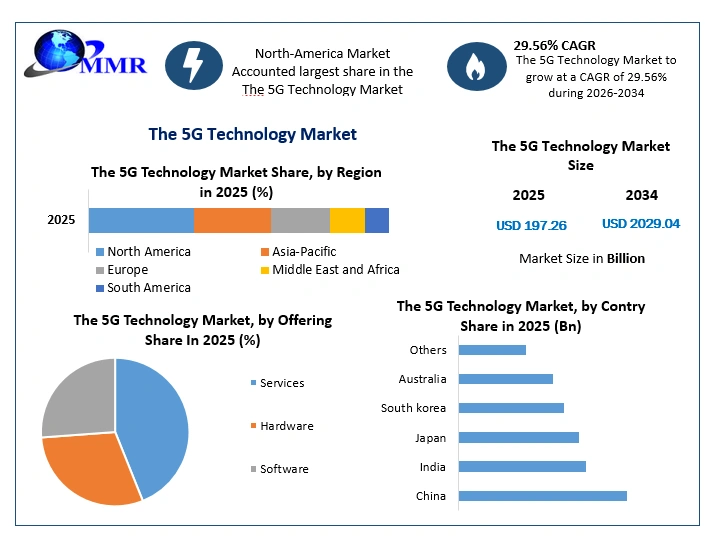
The 5G Technology Market size is expected to grow at a CAGR of 29.56% from 2025 to 2034, reaching nearly USD 197.26 Billion.
5G Technology Market Overview:
5G technology, or the fifth generation of mobile networks, is the latest standard for cellular networks and wireless communication. It represents a significant advancement over its predecessor, 4G LTE (Long-Term Evolution), offering improved speed, capacity, and capabilities to meet the growing demands of mobile communication and emerging technologies.
The advent of 5G is poised to be one of the most significant 5G technology market opportunities in the coming years, characterized by the extensive deployment of infrastructures and the swift adoption of 5G devices and services. Beyond catalysing the growth and expansion of the telecommunications sector, 5G is set to reshape and expedite industries such as automotive, entertainment, computing, and manufacturing. With its impressive throughput and minimal latency, 5G stands out as a highly promising technology capable of addressing high-value areas like 3D robotic control, virtual reality monitoring, and remote medical control—issues that current technologies have yet to fully tackle. Nevertheless, the considerable investment needed for 5G development and the uncertain landscape regarding killer applications pose challenges to its future. This report offers a comprehensive perspective on 5G technologies and vertical applications, providing essential insights into the vast 5G technology market opportunity presented by
5G Technology Market Growth and Share Analysis
 To know about the Research Methodology :- Request Free Sample Report
5G Technology Market Dynamics:
The dynamics of the 5G technology market are shaped by several key factors. Firstly, there is a surging demand for high-speed data connectivity driven by the increasing reliance of individuals and businesses on internet-related activities, such as streaming videos, downloading large files, and utilizing cloud-based applications. The remarkable speed enhancements offered by 5G position it as a pivotal solution to effectively meet this escalating demand.
The growth of the Internet of Things (IoT) plays a crucial role in the 5G technology market dynamics. With billions of interconnected devices generating and consuming vast amounts of data, 5G's capability to handle massive machine-type communication (mMTC) becomes essential for efficiently connecting and managing IoT devices on a large scale. Furthermore, 5G is a catalyst for the development and deployment of innovative applications that were previously unattainable with earlier generations of cellular networks. The advent of 5G opens up possibilities for groundbreaking applications such as autonomous vehicles, augmented reality (AR), virtual reality (VR), and solutions for industrial IoT. Government support and substantial investments globally contribute significantly to the dynamics of the 5G technology market. Governments worldwide recognize the strategic importance of 5G technology and are dedicating substantial resources to its development and deployment. This support not only expedites the rollout of 5G networks but also fosters innovation in the creation of diverse 5G applications, contributing to the dynamic evolution of the 5G technology landscape.
| Projections For Consumer Adoption by 2025- 5G | ||
| Region | 5G Adoption (%) | Number of Subscribers (Millions) |
| Developed Asia Pacific | 64 | 640 |
| North America Greater | 63 | 630 |
| China | 52 | 520 |
| GCC Arab States | 49 | 490 |
| Europe | 44 | 440 |
| Rest of MENA | 12 | 120 |
| Latin America | 11 | 110 |
| CIS | 9 | 90 |
The deployment of 5G technology requires the installation of new infrastructure, including towers and advanced radio-access technologies. However, the high cost associated with this implementation poses a significant barrier, particularly for small and medium-sized businesses. The price range of small towers and 5G cell sites, averaging between US$30,000 and US$50,000, deters many businesses from adopting 5G technology market. Factors such as the cost of base stations, required throughput density, and prevailing interest rates collectively contribute to the overall high expenses associated with 5G implementation.
Critical components like spectrum, suitable locations, power distribution systems, and robust fiber for extensive network coverage demand substantial investments. Consequently, the cost implications make it challenging for developing and underdeveloped nations to afford the necessary infrastructure for 5G technology. In the 5G technology market, businesses must carefully evaluate their budgets to navigate the financial implications of adopting 5G. Additionally, the concern for 5G networking security is actively being monitored, further influencing decision-making processes in the business landscape.
5G Technology Market segment analysis:
Based on Connectivity, Enhanced Mobile Broadband (eMBB) sub segment held the largest market share of 41% in 2025. Because 5G network operators initially focused on supplying greater internet capabilities for applications like high-speed cloud-based gaming, AR/VR, UHD video, and uninterrupted video discussions, the high proportion is attributable to this. The initial phase of the rollout will likely focus on a non-standalone 5G wireless deployment paradigm. For both home and commercial use, eMBB offers incredibly fast data speeds. As a result, eMBB is likely to serve a variety of use cases, including in-vehicle infotainment, 4K video access, and virtual meetings, driving the industry forward. By End User, the IT & Telcom Industry, commanding a largest revenue share in 2025 within the 5G Technology market. The transformative impact of 5G technologies on IoT-driven industries is anticipated due to its key features such as high speed, large capacity, and extremely low latency. Within the telecom industry, mobile broadband, ultra-reliable low latency communication (URLLC), and massive machine-type communication (MMTC) are the three pivotal connection categories.
According to estimates from the International Data Corporation, in 2021, 70% of G2000 enterprises allocated approximately US$1.2 billion to connectivity management solutions, a direct result of the widespread enablement of IoT use cases facilitated by 5G. Noteworthy benefits of 5G in the IT and telecom sector encompass connected automobiles, advancements in virtual and augmented reality (VR and AR), improved video services, and other areas. The surge in investment and adoption underscores the pivotal role 5G technology is playing in reshaping and enhancing the landscape of the IT and telecom industry.
5G Technology Market Regional Insight:
In 2025, North America dominates the global 5G Technology market, accounting for more than two-thirds of total market share. In addition, the country is significantly pushing toward smart technologies and smart city development. In recent years, smart gadgets have become more popular for banking and bill payment. Solar power grids, self-driving cars, and other IoT-based technologies are all on the rise in North America 5G Technology market. In addition, consumer preferences have shifted; they now anticipate decreased latency, virtual reality in work and leisure, and no performance degradation.
The 5G Fast Plan, introduced by the US Federal Communications Commission (FCC), aims to accelerate the establishment of 5G infrastructure throughout the nation. In China, considerable investments in research, development, and infrastructure have been earmarked, accompanied by ambitious targets set by the government for the progress of 5G technology. Companies specializing in 5G infrastructure play a pivotal role, providing the essential technologies, equipment, and solutions required for the deployment, maintenance, and operation of 5G wireless networks. The implementation of these companies involves substantial capital investments in new equipment, hardware, and infrastructure upgrades. However, the process encounters challenges in identifying suitable locations for new towers, small cells, and 5G infrastructure due to regulatory hurdles, zoning restrictions, and the need for site approvals, potentially causing delays in deployment.
5G Technology Market Deployment Strategies:
The implementation of 5G networks involves a range of strategies designed to ensure effective deployment and expansion. These strategies encompass phased rollouts, network densification, spectrum efficiency, infrastructure sharing, fiber backhaul, cloud-native architecture, industry collaborations, rigorous testing, public-private partnerships, and user engagement. The goal is to efficiently extend 5G networks, tackle challenges, and foster innovation across various sectors. This focus on 5G technology deployment strategies represents an emerging trend in the 5G technology market.
Chinese communication device manufacturer Fibocom introduced the FX170(W) Series on October 20, 2025, marking a new generation of 5G Sub-6GHz and mmWave Modules. This series provides a wireless communication experience comparable to fiber, offering improved network coverage, faster throughput, and enhanced functionality. Powered by the Snapdragon X65 5G Modem-RF System, these modules contribute to advancing the capabilities of 5G technology.
In February 2025, a collaborative initiative was announced between IBM and AT&T Inc., a global telecommunications holding corporation based in Dallas, Texas. The joint effort aims to showcase the potential of 5G wireless networking and edge computing for digital transformation. AT&T Inc. and IBM have created a simulated environment allowing enterprise clients to physically experience the synergy of AT&T Inc.'s connectivity with hybrid cloud and IBM's AI technology, demonstrating the transformative possibilities of 5G.
In January 2025, AT&T Inc., headquartered in Texas, launched its 5G+ services in select population areas and venues across Tampa. Notable locations include the channel district, Raymond James Stadium, and Tampa International Airport in the U.S., reflecting the company's commitment to expanding 5G capabilities in key urban and public spaces.
5G Technology Market Recent Industry Developments
| Date | Company | Development | Impact |
|---|---|---|---|
| 05 March 2025 | Ericsson, Qualcomm Technologies & Thales Alenia Space | The partners successfully demonstrated a 5G NR Non-Terrestrial Network (NTN) call over a simulated LEO satellite, validating standards-based satellite connectivity. | The milestone accelerates 5G satellite integration, enabling broader global coverage and future commercial NTN deployments. |
| 22 September 2025 | Ericsson & Nokia | VodafoneThree awarded Ericsson and Nokia a £2 billion 5G network contract to modernize the UK's radio access and core network infrastructure. | The agreement expands deployment of AI-powered, energy-efficient 5G infrastructure, strengthening next-generation mobile connectivity across the UK. |
| 04 December 2025 | Nokia & Bharti Airtel | Nokia partnered with Bharti Airtel to provide Network as Code platform, enabling developers to access 5G network APIs for enterprise applications. | The collaboration promotes 5G application innovation and creates new monetization opportunities through programmable network services. |
| 01 March 2026 | Ericsson & Nokia | Ericsson and Nokia announced a strategic collaboration to advance Open RAN, cloud RAN, and autonomous network automation through interoperable rApp ecosystems. | The partnership enhances multi-vendor 5G network interoperability and accelerates intelligent network automation for telecom operators. |
| 27 February 2026 | Ericsson & Qualcomm Technologies | Ericsson and Qualcomm validated foundational 6G radio technologies through collaborative prototypes while building upon advanced 5G evolution. | The achievement provides a clear migration path from advanced 5G to commercial 6G, supporting long-term wireless ecosystem development. |
5G Technology Market Scope: Inquire before buying
| 5G Technology Market | |||
|---|---|---|---|
| Report Coverage | Details | ||
| Base Year: | 2025 | Forecast Period: | 2026-2034 |
| Historical Data: | 2020 to 2025 | Market Size in 2025: | US $ 197.26 Bn. |
| Forecast Period 2026 to 2034 CAGR: | 29.56% | Market Size in 2034: | US $ 2029.04 Bn. |
| Segments Covered: | by Connectivity | Enhanced Mobile Broadband (eMBB) Ultra-Reliable Low Latency Communication (URLLC) Massive Machine Type Communication (mMTC) |
|
| by Offering | Hardware Software Service |
||
| by Application | Connected Vehicles Monitoring & Tracking Automation Smart Surveillance VR & AR Enhanced Video Services Others |
||
| by End-User | IT & Telcom Industry Manufacturing Automotive Energy & Utilities Transportation & Logistics Healthcare Media & entertainment Others |
||
5G Technology Market, by Region
North America (United States, Canada and Mexico)
Europe (UK, France, Germany, Italy, Spain, Sweden, Austria and Rest of Europe)
Asia Pacific (China, South Korea, Japan, India, Australia, Indonesia, Malaysia, Vietnam, Taiwan, Bangladesh, Pakistan and Rest of APAC)
Middle East and Africa (South Africa, GCC, Egypt, Nigeria and Rest of ME&A)
South America (Brazil, Argentina Rest of South America)
5G Technology Market Key players:
1. Accenture Plc - Ireland
2. Cisco Systems Inc. - United States
3. CommScope Holding Co. Inc. - United States
4. Dell Technologies Inc. - United States
5. Deutsche Telekom AG - Germany
6. Fujitsu Ltd. - Japan
7. Huawei Technologies Co. Ltd. - China
8. Intel Corp. - United States
9. Nokia Corp. - Finland
10. Siemens AG - Germany
11. Samsung Electronics Co. Ltd. - South Korea
12. T-Mobile US Inc. - United States
13. Tech Mahindra Ltd. - India
14. Telefonaktiebolaget LM Ericsson - Sweden
15. Telstra Ltd. - Australia
16. Tietoevry - Finland
17. TIM S.p.A. - Italy
18. Viavi Solutions Inc. - United States
19. Qualcomm Inc. - United States
20. HCL Technologies Ltd. - India
21. ZTE Corporation - China
22. Verizon Communications Inc. - United States
23. AT&T Inc. - United States
24. NTT DOCOMO Inc. - Japan
25. China Mobile Limited - China
Freuently Asked Questions:
1. What are the growth drivers for the 5G Technology Market?
Ans: Demand for High-Speed Data Connectivity is expected to be the major drivers for the 5G Technology Market.
2. What is the major restraint for the 5G Technology Market growth?
Ans. High Infrastructure Deployment Costs is expected to be the major restraining factor for the 5G Technology Market growth.
3. Which region is expected to lead the global 5G Technology Market during the forecast period?
Ans. North America is expected to lead the global 5G Technology Market during the forecast period.
4. What is the projected market size & and growth rate of the 5G Technology Market?
Ans. The 5G Technology Market size is expected to grow at a CAGR of 29.56% from 2026 to 2034, reaching nearly USD 197.26 Billion.
5. What segments are covered in the 5G Technology Market report?
Ans. The segments covered in the 5G Technology Market report are Offering, Connectivity, Application and End-Use.