Red Rice Market - Industry Structure Evaluation, Demand Drivers Analysis, Regional Growth Analysis and Identification, Competitive Positioning / Landscape Review & Global Market Size Forecast to 2032

4.06%
CAGR (2026-2032)
3.63 USD Bn.
Market Size
304
Report Pages
164
Market Tables

Overview

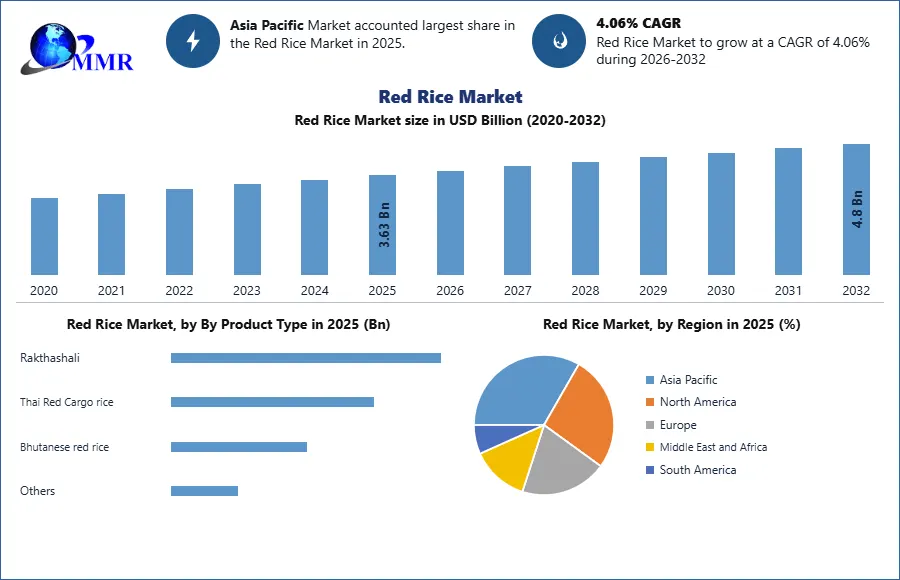
The Red Rice Market size was valued at USD 3.63 Billion in 2025 and the total Red Rice revenue is expected to grow at a CAGR of 4.06% from 2026 to 2032, reaching nearly USD 4.8 Billion by 2032.

Red Rice Market Overview:

Red rice is distinguished by its red hue, which results from the presence of anthocyanins in the rice. Red rice, which has a nutty flavour, is taken with the hulls or partially hulled form. Red rice contains more nutrients than regular polished rice. Rathashali, Thai red cargo rice, Bhutanese red rice, Camargue red rice, and other types of red rice exist. Red rice is sometimes known as weedy rice since it grows as a weed in fields. Iron, carbs, zinc, protein, fat, fibre, and potassium are all found in red rice. Red rice contains anti-oxidants, which aid in wound healing and the maintenance of the body's defence mechanism.
Red Rice MarketTo know about the Research Methodology :- Request Free Sample Report

Red Rice Market Dynamics:

Red rice consumption has increased due to an increase in demand for high fibre and nutrient-rich rice products. The presence of polyphenols is the primary cause for Red Rice's widespread consumption. Athletes and those who follow tough workout programmes, in addition to health-conscious people, consume Red Rice instead of Unpolished or Brown Rice. As a result, the Sports and Nutraceuticals industries have boosted their use of Red Rice.

Anthocyanin, a health-promoting chemical, is the main component in red rice. It is responsible for the beautiful red colour of this rice, as well as its ability to control blood pressure, prevent diabetes, improve vision, and reduce cancer cells. Furthermore, it contains anti-inflammatory and anti-bacterial effects. Red rice is also high in fibre, vitamins B1 and B2, calcium, and iron. Also, Anthocyanin's potent antioxidant qualities can help to prevent the appearance of premature ageing and UV-induced skin damage. Furthermore, it contains minerals and vitamins such as zinc, iron, and others, which assist to maintain the skin hydrated and clean. So, this major factor will drive the growth of red rice market during the forecast period.

Red rices are regarded highly nutritious and therapeutic in various parts of India. Whole grain rice is consumed; red gunja is chosen for baking bread and chapatti. In South India, glutinous rice is used to make puttu. Jatu crimson rice is renowned in Himachal Pradesh for its perfume and flavour. Himachal Pradesh's Matali and Lal dhan are used to treat high blood pressure and fever. Kafalya, which grows in the Himachal Pradesh and Uttar Pradesh hills, is used to treat leucorrhea and abortion problems.

Excessive consumption of Red Rice results in gastrointestinal problems. This is the major restraining factor here.

Red Rice Market Segment Analysis:

The global Red Rice Market is segmented by Nature, Product Type and End-User.

Based on Product Type, the global Red Rice market is sub-segmented into Thai Red Cargo Rice, Bhutanese Red Rice, Camargue Red Rice, Matta Rice, Ulikan and Others. The Thai Red Cargo Rice segment held the largest market share of xx% in 2025. Thai Red Cargo Rice is consumed by people who are allergic to Gluten. Bhutanese Red Rice and Camargue Red Rice grow in Bhutan and France respectively and are consumed on a large scale by the Food & Beverages and Nutraceuticals Industry. Matta Rice and Ulikan are the types of Red Rice found in India and Sri Lanka.

Based on End-User, the global Red Rice market is sub-segmented into Food & Beverage Industry, Cosmetics Industry, Nutraceuticals Industry, Healthcare Industry, Domestic and Other. The Food & Beverage Industry segment held large number of share 46% in 2025. An increase in demand for alternative medicines has resulted in a 2.7% increase in the consumption of Red Rice from the Healthcare Sector. An increase in demand for Healthy Rice substitutes has resulted in a 1.4% increase in consumption of Red Rice by people. An increase in consumption of plant-based cosmetics products has resulted in a 2.6% increase in consumption of Red Rice by the cosmetics industry.

An increase in consumption of fiber-rich rice products has resulted in a 1.7% increase in consumption of Red Rice by the Food & Beverages Industry. The rise in health consciousness has increased by 3.7% in demand for Red Rice from the Nutraceuticals Industry. An increase in preference for alternative medicine and a wide-scale consumption of homemade medicine has resulted in a 4% increase in consumption of Red Rice for manufacturing medicine on both industrial and domestic levels. The rising preference for organic cosmetics products has resulted in a 2.1% increase in sales of Rejuvenating and wrinkle-free cream and solutions made by using Red Rice. Different industries use Red Rice as per need and requirement.

Red Rice Market Regional Insights:

Asia Pacific held the largest market share of xx% in 2025. India, China, Indonesia, and Japan account for more than 70% of global Red Rice output. The choice for Red Rice as a food product has resulted in a 1.9% increase in demand from the Food and Beverage Industry. An increase in demand for plant-based cosmetics has resulted in a 3.1 percent increase in consumption by this region's Pharmaceutical Industry. India, China, Indonesia, and Japan account for more than 70% of global Red Rice output. The preference for Red Rice as a food product has resulted in a 1.9% increase in demand from the Food and Beverage Industry.

Red rice consumption in North America has increased by 2.7% due to a growing desire for it as a supplementary and dietary food production. The Healthcare Sector in this region has increased its consumption of Red Rice by 3.6% due to an increase in desire for alternative medications. Europe is the leading user of anti-aging and wrinkle-free products made from red rice. The Cosmetics Industry in this region has reported a 2.1% increase in demand for Red Rice due to rising demand for skin-care products.

The objective of the report is to present a comprehensive analysis of the global Red Rice Market to the stakeholders in the industry. The past and current status of the industry with the forecasted market size and trends are presented in the report with the analysis of complicated data in simple language. The report covers all the aspects of the industry with a dedicated study of key players that include market leaders, followers, and new entrants.

PORTER, PESTEL analysis with the potential impact of micro-economic factors of the market have been presented in the report. External as well as internal factors that are supposed to affect the business positively or negatively have been analyzed, which will give a clear futuristic view of the industry to the decision-makers.

The reports also helps in understanding the global Red Rice Market dynamic, structure by analyzing the market segments and project the global Red Rice Market size. Clear representation of competitive analysis of key players by product, price, financial position, product portfolio, growth strategies, and regional presence in the global Red Rice Market make the report investor’s guide.

Recent Industry Developments

Exact Date Company Development Impact
12 March 2026 Lundberg Family Farms Launched a new line of Regenerative Organic Certified red rice blends focused on soil health and carbon sequestration. This development strengthens the company's position in the premium sustainable grains segment in North America.
28 January 2026 LT Foods Limited Commissioned a new processing and fortification facility in India to enhance the iron and zinc content of its red rice products. The expansion addresses the rising demand for nutraceutical-grade functional foods in the Asia-Pacific region.
14 October 2025 Lotus Foods, Inc. Expanded its System of Rice Intensification (SRI) partnership to additional smallholder farms in Cambodia for red rice export. This partnership secures a stable, high-quality supply chain of specialty grains while promoting environmental sustainability.
22 July 2025 Ebro Foods, S.A. Integrated blockchain-based traceability for its Camargue red rice products to ensure geographic authenticity for European consumers. This technological milestone enhances consumer trust and brand loyalty within the high-end specialty rice market.
05 May 2025 Sresta Natural Bioproducts Announced the nationwide rollout of convenient red rice-based ready-to-eat (RTE) healthy meals in major retail chains. The move capitalizes on the convenience-seeking health-conscious demographic, diversifying the company’s product application.

Red Rice Market Scope: Inquire before buying

Red Rice Market
Report Coverage Details
Base Year: 2025 Forecast Period: 2026-2032
Historical Data: 2020 to 2025 Market Size in 2025: 3.63 USD Billion
Forecast Period 2026-2032 CAGR: 4.06% Market Size in 2032: 4.8 USD Billion
Segments Covered: By Product Type Rakthashali
Thai Red Cargo rice
Bhutanese red rice
Others
By Grain Type Long Grain
Short Grain
Medium Grain
By Nature Organic
Conventional
By Packaging Type Bags
Boxes
Bulk
Vacuum Sealed
Others
By Distribution Channel Supermarkets & Hypermarkets
Convenience Stores
Specialty / Gourmet Stores
Online Retail
Government / Co-op Stores
Others
By Application Culinary Uses
Processed Food Products
Functional Foods & Health Products
Others
By End User Food and Beverages
Nutraceuticals
Personal Care
Others

Key Players / Competitors Profiles Covered in Brief in Global Red Rice Market Report in Strategic Perspective:

  1. Lundberg Family Farms
  2. Swanson Health Products, Inc.
  3. Lotus Foods, Inc
  4. Shandong Zhonghui Biotechnology Co., Ltd.
  5. Hangzhou Twin-Horse Group Co., Ltd.
  6. Jiangr Bio-Technology Co., Ltd.
  7. Nanping Senfa Bio-Technology Co., Ltd.
  8. Zhejiang Sanhe Bio-Tech Co., Ltd.
  9. Ningbo HEP Biotechnology Co., Ltd.
  10. LT Foods Limited
  11. Millet Amma Foods Private Limited
  12. Sresta Natural Bioproducts Pvt. Ltd. (Organic Tattva)
  13. Brightcrop Agro
  14. URMATT Ltd.
  15. Veetee Rice Limited
  16. Blife S.r.l.
  17. Camargue Duck-Grown Red Rice Producers
  18. Fabrar Liberia, Inc.
  19. Raitong Organics Farm
  20. Foods Factory azienda agricola srl
  21. Greenature Grains and Noodle Co., Ltd.
  22. KRBL Limited
  23. Ebro Foods, S.A.
  24. SunRice (Ricegrowers Limited)
  25. Olam International Limited

Table of Contents

1. Red Rice Market: Market Introduction 1.1. Executive Summary 1.2. Market Size (2025) & Forecast (2026-2032), 1.3. Market Size (Value in USD Million and Volume in Tons) and Market Share (%) - By Segments, Regions and Country 2. Competitive Landscape 2.1. MMR Competition Matrix 2.2. Competitive Analysis of key players 2.3. Key Players Benchmarking 2.3.1 Company Name 2.3.2 Headquarter 2.3.3 Product Portfolio 2.3.4 Production Capacity (Tons) 2.3.5 Innovation Rate and New product launch 2.3.6 Packaging Format Adoption 2.3.7 Retail Channels 2.3.8 Marketing and Co-Branding Initiatives 2.3.9 Compliance & Certifications 2.3.10 Profit Margin (%) 2.3.11 Revenue Growth Rate (%) 2.3.12 Market Share (%) 2025 2.3.13 Revenue, 2025 2.3.14 R&D Investment 2.3.15 Global Reach 2.4. Market Structure 2.4.1 Market Leaders 2.4.2 Market Followers 2.4.3 Emerging Players 2.5. Mergers and Acquisitions Details 2.6. Market Share & Revenue Analysis (2025) 2.6.1 Global market share of top players by revenue 2.6.2 Regional market share distribution 2.6.3 Volume-based market share comparison 2.6.4 Growth trends of leading companies 2.7. Product Portfolio & Offerings 2.7.1 Variety of red rice products offered by key players 2.7.2 Packaging formats and premium product offerings 2.7.3 Organic vs conventional product availability 2.7.4 Functional and ready-to-cook product lines 2.8. Innovation & R&D Focus 2.8.1 Functional and fortified red rice product development 2.8.2 Hybrid and improved grain varieties 2.8.3 Packaging innovation and sustainability focus 2.8.4 Ready-to-cook and convenience products R&D 2.8.5 Technology adoption in cultivation and processing 2.9. Regional Presence & Distribution Network 2.9.1 Retail network coverage across key regions 2.9.2 E-commerce presence and online strategies 2.9.3 Specialty, gourmet, and premium store penetration 2.9.4 Regional production and supply hubs 3. Red Rice Market Dynamics 3.1. Red Rice Market Trends 3.2. Red Rice Market Dynamics 3.2.1 Drivers 3.2.2 Restraints 3.2.3 Opportunities 3.2.4 Challenges 3.3. PORTER’s Five Forces Analysis 3.4. PESTLE Analysis 4. Regulatory & Compliance Landscape 4.1 Global food safety standards and certification requirements 4.2 Organic certification, traceability, and compliance best practices 4.3 Packaging & labeling regulations by country and region 4.4 GMO and additive restrictions affecting product formulation 4.5 Import-export regulations, tariffs, and international trade compliance 5. Pricing Analysis (2025) 5.1 Price benchmarking by product type (2020–2025) 5.2 Organic vs conventional red rice price comparison 5.3 Long, medium, short grain price variations 5.4 Pricing trends for premium & aromatic red rice 5.5 Cost-to-retail analysis and margin evaluation 5.6 Regional pricing differences and consumer sensitivity 6. Product & Grain Analysis (2025) 6.1 Rakthashali demand trends and regional growth potential 6.2 Thai & Bhutanese red rice adoption and consumer preference 6.3 Grain size influence on culinary applications and market share 6.4 red rice premiumization and niche market potential 6.5 Organic vs conventional production volume and adoption 7. Packaging & Distribution Insights 7.1 Packaging format trends and impact on shelf appeal and sales 7.2 Retail pouches, vacuum packs, and ready-to-cook convenience adoption 7.3 Supermarket & hypermarket penetration and category management strategies 7.4 Specialty & gourmet store opportunities for premium products 7.5 E-commerce growth, digital consumer behavior, and online strategy 7.6 Distribution efficiency and logistics trends 8. Application & End-Use Analysis 8.1 Culinary usage trends: home cooking vs commercial demand 8.2 Functional foods and health-oriented product development potential 8.3 Processed food incorporation opportunities: snacks, cereals, ready meals 8.4 Ready-to-cook red rice growth and convenience-driven consumption 8.5 Food & beverage industry adoption trends and premium segment focus 8.6 Nutraceutical and personal care applications with functional benefits 9. Consumer Insights & Preference Trends (2025) 9.1 Health-conscious consumers and functional food adoption trends 9.2 Organic product demand, premiumization, and lifestyle influence 9.3 Convenience & ready-to-cook product preferences by demographic 9.4 Urban vs rural consumption patterns and regional differences 9.5 Purchasing behavior, willingness-to-pay, and brand loyalty analysis 9.6 Consumer awareness of nutritional and functional benefits 10. Supply Chain & Production Insights 10.1 Major cultivation regions and geographic distribution 10.2 Annual production volumes and yield trends 10.3 Milling, processing, and post-harvest practices 10.4 Storage, transportation, and logistics efficiency 10.5 Supply chain bottlenecks and risk assessment 10.6 Seasonal production variations and operational challenges 11. Raw Material & Input Cost Analysis 11.1 Cost of seeds, fertilizers, and organic inputs 11.2 Labor and harvesting cost trends 11.3 Milling and processing cost contribution 11.4 Packaging material and transportation cost impact 11.5 Cost variation by organic vs conventional production 11.6 Overall input cost structure and profitability implications 12. Innovation & Product Development Trends 12.1 Functional & fortified red rice product launches 12.2 Hybrid varieties and grain improvement initiatives 12.3 Ready-to-cook and convenience product innovations 12.4 Packaging innovations and sustainable formats 12.5 Product diversification: snacks, cereals, and nutraceuticals 12.6 R&D trends and innovation adoption strategies 13. Marketing & Promotional Strategies 13.1 Retail marketing campaigns and in-store promotions 13.2 Online & e-commerce advertising strategies 13.3 Health, lifestyle, and functional benefits promotion 13.4 Brand positioning and differentiation tactics 13.5 Consumer engagement and loyalty programs 13.6 Trade shows, exhibitions, and influencer marketing impact 14. Sustainability & ESG Insights 14.1 Environmental impact of red rice cultivation and processing 14.2 Water, soil, and energy usage efficiency trends 14.3 Carbon footprint assessment across production and logistics 14.4 Sustainable and organic farming adoption rates 14.5 Waste management, by-product utilization, and circular economy practices 14.6 ESG compliance, reporting standards, and regional benchmarks 15. Technology Adoption in Cultivation & Processing 15.1 Mechanization and modern farming practices adoption 15.2 Advanced milling, polishing, and post-harvest technologies 15.3 Quality control, traceability, and food safety systems 15.4 Smart irrigation, yield optimization, and precision farming techniques 15.5 Processing efficiency improvements and cost reduction technologies 15.6 Technological innovations driving product consistency and scalability 16. Consumer Lifestyle & Behavioral Analysis 16.1 Diet-driven consumption trends: vegan, gluten-free, health-conscious 16.2 Meal occasion and frequency-based consumption patterns 16.3 Awareness of nutritional and functional benefits 16.4 Premiumization and brand preference trends 16.5 Urban vs rural lifestyle influence on purchasing behavior 16.6 Adoption of convenience, ready-to-cook, and processed red rice products 17. Production Analysis by Major Country 17.1 Major red rice producing countries and regional distribution 17.2 Annual production volume and historical growth trends 17.3 Yield per hectare and productivity comparison across countries 17.4 Cultivation area expansion and land use trends 17.5 Country-level production cost and efficiency analysis 17.6 Seasonal variations, climate impact, and risk assessment 18. Distribution & Retail Pricing Insights 18.1 Channel-wise price benchmarking (supermarkets, online, specialty 18.1.1 stores) 18.2 Promotional pricing and discount strategy analysis 18.3 Regional and urban-rural price variations 18.4 Impact of packaging formats on retail pricing 18.5 Premium vs mass-market pricing trends 18.6 Seasonal and festival-driven pricing fluctuations 19. Investment & Partnership Opportunities 19.1 Market entry opportunities for new players 19.2 Mergers, acquisitions, and strategic alliances 19.3 Joint ventures in cultivation, processing, and distribution 19.4 Investment hotspots by region and country 19.5 Expansion potential in organic, functional, and ready-to-cook segments 19.6 Funding and government incentives for sustainable production 20. Consumer Segmentation & Demographics Analysis 20.1 Age-wise consumption trends and adoption patterns 20.2 Income-based purchasing behavior and premium preference 20.3 Urban vs rural consumption and lifestyle impact 20.4 Regional & cultural preference patterns 20.5 Household size, meal occasions, and demand frequency 20.6 Consumer awareness of health, functional, and organic benefits 21. Global Red Rice Market :Size and Forecast By Segmentation (By Value in USD Billion and Volume in Tons) (2025-2032) 21.1. Global Red Rice Market Size and Forecast, By Product Type 21.1.1 Rakthashali 21.1.2 Thai Red Cargo rice 21.1.3 Bhutanese red rice 21.1.4 Others 21.2. Global Red Rice Market Size and Forecast, By Grain Type 21.2.1 Long Grain 21.2.2 Short Grain 21.2.3 Medium Grain 21.3. Global Red Rice Market Size and Forecast, By Nature 21.3.1 Organic 21.3.2 Conventional 21.4. Global Red Rice Market Size and Forecast, By Packaging Type 21.4.1 Bags 21.4.2 Boxes 21.4.3 Bulk 21.4.4 Vacuum Sealed 21.4.5 Others 21.5. Global Red Rice Market Size and Forecast, By Distribution Channel 21.5.1 Supermarkets & Hypermarkets 21.5.2 Convenience Stores 21.5.3 Specialty / Gourmet Stores 21.5.4 Online Retail 21.5.5 Government / Co-op Stores 21.5.6 Others 21.6. Global Red Rice Market Size and Forecast, By Application 21.6.1 Culinary Uses 21.6.2 Processed Food Products 21.6.3 Functional Foods & Health Products 21.6.4 Others 21.7. Global Red Rice Market Size and Forecast, By End-use 21.7.1 Food and Beverages 21.7.2 Nutraceuticals 21.7.3 Personal Care 21.7.4 Others 21.8. Global Red Rice Market Size and Forecast, By Region 21.8.1 North America 21.8.2 United States 21.8.3 Canada 21.8.4 Mexico 21.8.5 Europe 21.8.6 United Kingdom 21.8.7 France 21.8.8 Germany 21.8.9 Italy 21.8.10 Spain 21.8.11 Sweden 21.8.12 Russia 21.8.13 Rest of Europe 21.8.14 Asia Pacific 21.8.15 China 21.8.16 S. Korea 21.8.17 India 21.8.18 Japan 21.8.19 Australia 21.8.20 Indonesia 21.8.21 Malaysia 21.8.22 Philippines 21.8.23 Thailand 21.8.24 Vietnam 21.8.25 Rest of Asia Pacific 21.8.26 Middle East and Africa 21.8.27 South Africa 21.8.28 GCC 21.8.29 Israel 21.8.30 Egypt 21.8.31 Nigeria 21.8.32 Liberia 21.8.33 United Arab Emirates (UAE) 21.8.34 Rest of ME&A 21.8.35 South America 21.8.36 Brazil 21.8.37 Argentina 21.8.38 Colombia 21.8.39 Chile 21.8.40 Rest Of South America 22. Company Profile: Key Players 22.01. Lotus Foods, Inc. 22.01.1 Overview 22.01.2 Business Portfolio 22.01.3 Financial Overview 22.01.4 SWOT Analysis 22.01.5 Strategic Analysis 22.01.6 Recent Developments 22.02. Lundberg Family Farms 22.03. URMATT Ltd 22.04. CEYLON PURE 22.05. Primera Rice 22.06. Woodland Foods. 22.07. Sresta Natural Bioproducts Pvt. (ITC). 22.08. LT Foods 22.09. Riviana Foods, Inc. 22.10. Brightcrop Agro 22.11. Amira Nature Foods Ltd. 22.12. Natureland Organic Foods 22.13. Double Horse 22.14. Ralston Family Farms, LLC 22.15 Jivika Pure 22.15.1 Others 23. Key Findings 24. Strategic Outlook & Future Opportunities 25. Global Red Rice Market : Research Methodology

Custom Market Research Services

We Will Customise The Research For You, In Case The Report Listed Above Does Not Meet With Your Requirements