
Global Recycled Elastomers Market by Raw Material, by Application, by Region and Forecast 2034
Overview
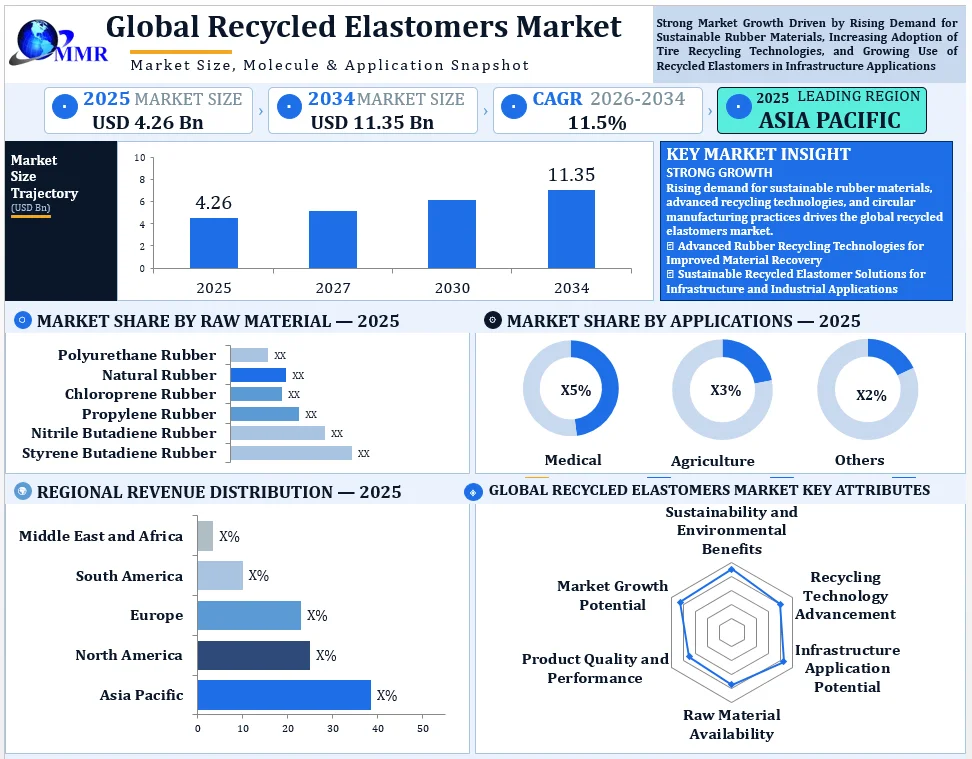
The Global Recycled Elastomers Market is projected to reach USD 4.26 billion in 2025 and USD 11.35 billion by 2034, growing at a CAGR of 11.5% during the 2025–2034 forecast period.
Global Recycled Elastomers Market Overview
The Global Recycled Elastomers Market experiences growth due to increasing environmental awareness, rising demand for sustainable materials, and expanding adoption of recycled rubber across automotive, construction, infrastructure, and industrial applications. Recycled elastomers are produced by processing post-consumer and post-industrial rubber waste into reusable materials that offer flexibility, durability, and cost advantages while reducing dependence on virgin raw materials. These materials find applications in road surfacing, playground surfaces, sports flooring, automotive components, industrial products, and construction materials. Growing concerns regarding rubber waste disposal and landfill accumulation encourage manufacturers to adopt recycling technologies and circular material solutions. Advancements in mechanical recycling, devulcanization, and chemical processing improve the quality, consistency, and performance of recycled elastomers, supporting their use in a wider range of applications. Increasing investments in sustainable manufacturing, waste recovery infrastructure, and resource-efficient production processes further strengthen market growth. Asia Pacific holds a significant position in the market, supported by expanding industrial activities, infrastructure development, and increasing demand for recycled materials. These factors support the continued expansion of the global recycled elastomers market.
Global Recycled Elastomers Market: Key Highlights
• Market Growth Outlook: The global recycled elastomers market is valued at USD 4.26 billion in 2025 and is projected to reach USD 11.35 billion by 2034, registering a CAGR of 11.5% during 2025–2034.
• Sustainability-Driven Demand: Increasing demand for sustainable materials, circular manufacturing, and efficient rubber waste management supports the adoption of recycled elastomers across automotive, construction, infrastructure, and industrial applications.
• Raw Material Recovery and Innovation: Advancements in mechanical recycling, devulcanization, and material recovery technologies improve recycled rubber quality and expand opportunities for value-added elastomer products.
• Infrastructure and Industrial Applications: Growing use of recycled rubber in road construction, playground surfaces, sports flooring, roofing materials, and industrial components strengthens demand for durable and resource-efficient materials.
• Asia Pacific Market Leadership: Asia Pacific leads the global recycled elastomers market, supported by expanding automotive manufacturing, infrastructure development, increasing tire production, and investments in rubber recycling technologies.
Global Recycled Elastomers Market Size, Growth and Share Analysis
To know about the Research Methodology :- Request Free Sample Report
Recycled Elastomers Market Dynamics;
Global Recycled Elastomers Market Drivers
Rising Demand for Sustainable and Recycled Materials: Growing environmental awareness and increasing emphasis on circular manufacturing drive demand for recycled elastomers in 2025. Manufacturers across the automotive, construction, and industrial sectors use recycled rubber to reduce waste generation, conserve raw materials, and support sustainable production. The global recycled elastomers market reaches USD 6.4 billion in 2025, reflecting the growing commercial importance of recycled rubber materials.
Growing Applications in Construction and Infrastructure: Expanding infrastructure development supports the use of recycled elastomers in road surfacing, playground flooring, sports surfaces, roofing materials, and vibration-control products. In 2025, the United States generates more than 300 million end-of-life tires annually, creating a substantial feedstock for tire recycling and rubber recovery. These applications help divert rubber waste from landfills while providing durable and cost-effective materials for infrastructure projects.
Global Recycled Elastomers Market Restraints
Variations in Recycled Material Quality: Inconsistent raw material quality limits the wider adoption of recycled elastomers in 2025. Differences in rubber composition, contamination levels, degradation, and processing methods affect the strength, elasticity, durability, and performance of recycled products. Manufacturers require effective sorting, cleaning, and quality-control procedures to maintain consistent material properties, increasing operational complexity and limiting use in applications with strict performance requirements.
High Processing Costs and Technical Limitations: Recycling elastomers involves collection, sorting, shredding, grinding, and, in some cases, devulcanization. These processes require specialized equipment, energy, and technical expertise. In 2025, high processing costs and difficulties in recovering the original properties of vulcanized rubber restrict the cost competitiveness of recycled elastomers against virgin materials. These limitations particularly affect applications that require high elasticity, strength, and consistent product quality.
Global Recycled Elastomers Market Opportunities
Advancements in Recycling and Devulcanization Technologies: Technological improvements in mechanical recycling, chemical processing, and devulcanization create opportunities to improve recycled elastomer quality in 2025. Global tire raw material consumption reaches 57.2 million metric tons in 2025, highlighting the scale of material use and the potential to recover valuable rubber resources. Improved recycling technologies help manufacturers recover reusable materials, reduce waste, and expand the use of recycled elastomers in higher-value applications.
Increasing Adoption of Recycled Rubber in Infrastructure Projects: Growing demand for durable and resource-efficient infrastructure materials creates opportunities for recycled elastomers in 2025. Recycled rubber supports the production of asphalt modifiers, sports flooring, playground surfaces, molded components, and vibration-resistant materials. Increasing attention to waste reduction and sustainable construction encourages infrastructure developers and manufacturers to incorporate recycled rubber into suitable projects, strengthening demand across construction and public infrastructure applications.
Global Recycled Elastomers Market Challenges
Establishing Efficient Rubber Waste Collection Systems: The availability of suitable waste rubber remains a key challenge for the recycled elastomers market in 2025. Fragmented collection networks, inadequate sorting facilities, transportation expenses, and contamination affect the steady supply of recyclable materials. Manufacturers require reliable collection and recovery systems to maintain production volumes, reduce raw material costs, and improve recycling efficiency.
Maintaining Performance and Cost Competitiveness: Manufacturers face challenges in balancing material performance, production costs, and recycled content in 2025. Recycled elastomers must meet application-specific requirements for durability, elasticity, strength, and resistance to wear. Variations in feedstock quality and additional processing requirements increase production complexity, while competition from virgin rubber and alternative materials places continued pressure on pricing and product consistency.
Global Recycled Elastomers Market Segment Analysis
By Raw Material
The global recycled elastomers market is segmented into Styrene-Butadiene Rubber, Nitrile-Butadiene Rubber, Propylene Rubber, Chloroprene Rubber, Natural Rubber, and Polyurethane Rubber. Styrene-Butadiene Rubber and Natural Rubber support recycling activities due to their extensive use in tires, footwear, and industrial rubber products. Nitrile-Butadiene Rubber and Chloroprene Rubber offer oil, chemical, and weather resistance, supporting their reuse in selected industrial components and protective products. Propylene-based elastomers, particularly EPDM rubber, provide durability and resistance to environmental exposure, making them suitable for roofing materials, automotive seals, and outdoor applications. Polyurethane Rubber offers flexibility, abrasion resistance, and impact absorption, supporting its use in selected molded products and industrial components. Increasing emphasis on rubber waste recovery, resource efficiency, and circular manufacturing encourages the recycling of these materials into secondary products for construction, automotive, and industrial applications.
By Application
The global recycled elastomers market is segmented into Medical, Agriculture, Sports Products, Playground Surfaces, Infrastructure, and Home & Garden. In agriculture, recycled elastomers support applications such as livestock flooring, protective mats, and selected equipment components. Sports products use recycled rubber in gym flooring, running tracks, and athletic surfaces due to its cushioning and wear resistance. Playground surfaces incorporate recycled elastomers in rubber tiles and impact-absorbing flooring to support safer recreational environments. Infrastructure applications include rubber-modified asphalt, road construction materials, and vibration-control products, supporting the recovery of discarded rubber. Home and garden applications include outdoor mats, landscaping materials, garden edging, and household products. Medical applications remain limited to suitable products that meet applicable safety, hygiene, and regulatory requirements. Growing environmental awareness and demand for resource-efficient materials support the adoption of recycled elastomers across these application areas.
Global Recycled Elastomers Market Regional Insights
Asia Pacific: Asia Pacific leads the global recycled elastomers market, supported by expanding automotive manufacturing, increasing tire production, rapid urbanization, and growing infrastructure development. China, India, Japan, and South Korea contribute to regional demand through established rubber industries and increasing investments in recycling technologies. Rising environmental awareness, sustainable manufacturing practices, and efficient rubber waste management strengthen the adoption of recycled elastomers across automotive, construction, and industrial applications. Growing demand for recycled rubber, sustainable elastomers, circular manufacturing, and eco-friendly construction materials further supports regional market growth.
North America: North America maintains a significant position in the global recycled elastomers market, driven by established tire recycling infrastructure, advanced material recovery technologies, and increasing demand for sustainable industrial materials. The United States and Canada support market development through applications in automotive components, rubber-modified asphalt, playground surfaces, and industrial products. Increasing emphasis on landfill waste reduction, resource conservation, and circular economy practices encourages manufacturers to incorporate recycled elastomers into suitable products. Growing demand for recycled rubber materials, tire recycling, sustainable infrastructure, and advanced rubber processing supports regional expansion.
Europe: Europe demonstrates strong development in the global recycled elastomers market through environmental regulations, established recycling networks, and increasing adoption of circular economy practices. Germany, France, the United Kingdom, and Italy support regional demand through automotive manufacturing, construction, and industrial production. Manufacturers increasingly focus on recovering rubber from end-of-life tires and industrial waste to reduce environmental impact and improve material efficiency. Advancements in rubber recycling, devulcanization, and material recovery technologies strengthen market development. Growing demand for recycled elastomers, sustainable automotive materials, rubber waste recovery, and environmentally responsible manufacturing supports regional growth.
South America: South America experiences increasing adoption of recycled elastomers as infrastructure development, automotive activities, and environmental awareness support demand for recovered rubber materials. Brazil and Argentina contribute through tire recycling initiatives and the use of recycled rubber in construction materials, agricultural products, flooring, and industrial applications. Improvements in waste collection systems and recycling infrastructure support the recovery and reuse of discarded elastomers. Growing interest in sustainable construction and resource-efficient manufacturing strengthens market opportunities. Increasing demand for recycled rubber products, sustainable infrastructure materials, tire recycling, and waste management solutions supports regional development.
Middle East and Africa: The Middle East and Africa recycled elastomers market develops through infrastructure investment, industrial expansion, and increasing attention to sustainable waste management. Saudi Arabia, the United Arab Emirates, and South Africa support demand through construction activities, industrial manufacturing, landscaping, and selected automotive applications. Investments in recycling facilities and resource recovery systems encourage the reuse of rubber waste in suitable products. Increasing emphasis on sustainable construction, landfill waste reduction, and material efficiency supports market development. Growing demand for recycled elastomers, rubber recycling technologies, sustainable construction materials, and circular economy solutions creates opportunities across the region.
Global Recycled Elastomers Market – Competitive Landscape
The Global Recycled Elastomers Market features a competitive environment shaped by recycling technology, raw material availability, product quality, processing capacity, and sustainability initiatives. Companies strengthen their market positions by improving rubber recovery processes, expanding recycled rubber product portfolios, and developing materials for automotive, construction, infrastructure, and industrial applications. Competition increasingly focuses on efficient tire recycling, advanced devulcanization technologies, consistent material performance, and cost-effective production.
Competitive Positioning and Strategic Focus
| Competitive Factor | Market Positioning and Strategy |
|---|---|
| Recycling Technology | Companies improve mechanical recycling, rubber grinding, and devulcanization processes to enhance material recovery and product quality. |
| Raw Material Supply | Market participants strengthen tire collection networks and industrial waste recovery systems to maintain a reliable supply of recyclable rubber. |
| Product Innovation | Manufacturers develop recycled rubber powders, granules, compounds, and customized elastomer materials for diverse industrial applications. |
| Application Expansion | Companies target automotive components, construction materials, sports surfaces, playground flooring, and industrial rubber products. |
| Sustainability | Businesses emphasize waste reduction, resource efficiency, circular manufacturing, and the reuse of end-of-life rubber products. |
| Production Capacity | Market participants improve processing infrastructure and operational efficiency to meet growing demand for recycled elastomers. |
Key Competitive Differentiators
• Technology and Product Quality: Companies that improve rubber recovery efficiency and maintain consistent product specifications strengthen their ability to serve demanding applications.
• Supply Chain Integration: Access to end-of-life tires, reliable collection networks, and efficient processing facilities supports operational continuity and cost management.
• Application Diversification: Manufacturers expand their customer base by supplying recycled elastomers to multiple industries rather than relying on a single application.
• Sustainable Manufacturing: Increasing demand for recycled materials encourages companies to prioritize circular production models, material traceability, and environmentally responsible processing.
Overall Competitive Outlook
The global recycled elastomers market remains competitive, with established tire recyclers, reclaimed rubber manufacturers, and advanced material processors serving different parts of the value chain. Companies that combine reliable waste collection, efficient recycling technologies, consistent product quality, and diversified applications strengthen their competitive positions. Growing demand for recycled rubber, sustainable elastomers, tire recycling, circular economy solutions, and eco-friendly construction materials supports continued competition and innovation across the market.
Global Recycled Elastomers Market: Recent Developments
| Date | Company | Development | Impact |
|---|---|---|---|
| February 2026 | Tolins Tyres Limited / Terra Rubber | Terra Rubber advances its reclaimed rubber manufacturing plans, focusing on converting scrap tires and rubber waste into reusable rubber through devulcanization. |
Strengthens backward integration, improves rubber waste recovery, and supports the supply of reclaimed rubber for manufacturing. |
| June 22, 2026 | Tinna Rubber and Infrastructure Limited | Begins commercial dispatch from its Varale, Maharashtra, facility producing recovered carbon black and tire pyrolysis oil from end-of-life tires. |
Expands commercial recovery of valuable materials from discarded tires and supports circular manufacturing. |
| April 2026 | AKIN | Files a patent for an enzyme designed for its Kinfinity Recovery platform, which targets the recovery of individual materials from end-of-life tires. |
Advances enzyme-based rubber recovery and creates opportunities for more selective separation of valuable tire materials. |
| September 3, 2026 | KBR Inc. and Klean Industries | Present TyreNova tire pyrolysis technology at Recovered Carbon Black Asia 2026, highlighting the recovery of carbon black, tire pyrolysis oil, and steel. |
Increases industry awareness of advanced tire recycling technology and supports the wider deployment of recovered materials. |
| August 24, 2026 | Terra Rubber Private Limited | Commences construction of a reclaimed rubber manufacturing facility in Palakkad, Kerala, using scrap tires and rubber waste as feedstock. |
Expands reclaimed rubber production capacity and supports domestic rubber recovery and resource efficiency. |
| October 15, 2026 | Tinna Rubber and Infrastructure Limited | Completes registration of 19 acres within a planned 40-acre land parcel in Andhra Pradesh for a proposed integrated tire and plastic recycling complex, with investment of up to ₹250 crore planned over three years. |
Supports future capacity expansion in tire recycling, pyrolysis, and recovered carbon black production. |
Recycled Elastomers Market Scope: Inquire before buying
| Recycled Elastomers Market | |||
|---|---|---|---|
| Report Coverage | Details | ||
| Base Year: | 2025 | Forecast Period: | 2026-2034 |
| Historical Data: | 2020 to 2025 | Market Size in 2025: | 4.26 USD Billion |
| Forecast Period 2026-2034 CAGR: | 11.5% | Market Size in 2034: | 11.35 USD Billion |
| Segments Covered: | by Raw Material | Styrene Butadiene Rubber Nitrile Butadiene Rubber Propylene Rubber Chloroprene Rubber Natural Rubber Polyurethane Rubber |
|
| by Application | Medical Agriculture Sports Product Playground Surfaces Infrastructure Home & Garden |
||
Recycled Elastomers Market Key Players
1. GRP Ltd.
2. Liberty Tire Recycling
3. American Tire Recycling
4. West Coast Rubber Recycling
5. Monmouth Rubber & Plastics Corp.
6. J. Allcock & Sons Limited
7. RubberForm Recycled Products LLC
8. American Recycling Center
9. Green Rubber Global
10. Austin Rubber Company LLC
11. Klean Industries
12. Genan Holding
13. Rubbergreen
14. Entech Inc.
15. Emanuel Tire Co.
16. Tire Disposal & Recycling Inc.
17. Global Tire Recycling Inc.
18. Lehigh Technologies
19. Scandinavian Enviro Systems
20. Tyromer Inc.
21. Eldan Recycling A/S
22. CRM Rubber Manufacturers
23. Shred-Tech Corporation
24. Rethink Tires
25. Enrestec Inc.
26. Eversafe Rubber
27. Huxar Reclamation
28. Swani Rubber Industries
29. Rolex Reclaim Pvt. Ltd.
30. High Tech Reclaim Pvt. Ltd.
31. Minar Reclamation Private Limited
32. Fishfa Rubbers Ltd.
33. SRI Impex Pvt. Ltd.
34. ELGI Rubber Company
35. Star Polymers Inc.
36. Lead Reclaim and Rubber Products Ltd.
37. ResourceCo
38. Contec
39. Ecolomondo Corporation
40. Bolder Industries
Frequently Asked Questions:
Q1. What is the global recycled elastomers market size in 2025?
Ans. The global recycled elastomers market is valued at USD 4.26 billion in 2025 and is projected to reach USD 11.35 billion by 2034, growing at a CAGR of 11.5% during the 2026–2034 forecast period.
Q2. What are the major factors driving the growth of the recycled elastomers market?
Ans. The major growth drivers include increasing demand for sustainable materials, rising rubber waste generation, expanding tire recycling infrastructure, advancements in devulcanization technologies, and growing adoption of recycled rubber in construction, automotive, and industrial applications.
Q3. Which region dominates the global recycled elastomers market?
Ans. Asia Pacific leads the global recycled elastomers market due to expanding automotive production, infrastructure development, increasing demand for recycled rubber, and investments in sustainable manufacturing and rubber recycling technologies.
Q4. What are the key applications of recycled elastomers?
Ans. Recycled elastomers are used in infrastructure materials, playground surfaces, sports flooring, agricultural products, home and garden products, and selected medical applications that meet relevant safety and regulatory requirements.
Q5. What are the major challenges facing the global recycled elastomers market?
Ans. The major challenges include inconsistent recycled rubber quality, high processing costs, limitations in restoring the properties of vulcanized rubber, inadequate waste collection systems, and competition from virgin elastomers. Advances in recycling technologies and improved material recovery processes help address these challenges.