
Quantum Sensor Market Forecast by Sensor Type, Technology, Application, End-Use Industry, Deployment, Component and Regional Analysis (2026–2034)
Overview
Global Quantum Sensor Market Size to Reach USD 1,860 Million by 2034 from USD 564 Million in 2025 at a CAGR of 14.2%, Driven by Quantum Navigation, Atomic Clocks, Magnetometers, and Defense Applications.
Quantum Sensor Market Overview and Industry Outlook
Quantum sensing is emerging as one of the fastest-commercializing segments within the broader quantum technology ecosystem. Unlike conventional sensors, quantum sensors leverage quantum mechanical properties to deliver ultra-high sensitivity and deliver ultra-sensitive sensing capabilities for measuring magnetic fields, gravity, acceleration, rotation, timing signals, temperature variation, and electromagnetic activity across complex operating environments. across navigation, timing, magnetic field detection, gravity measurement, biomedical diagnostics, and geophysical exploration.
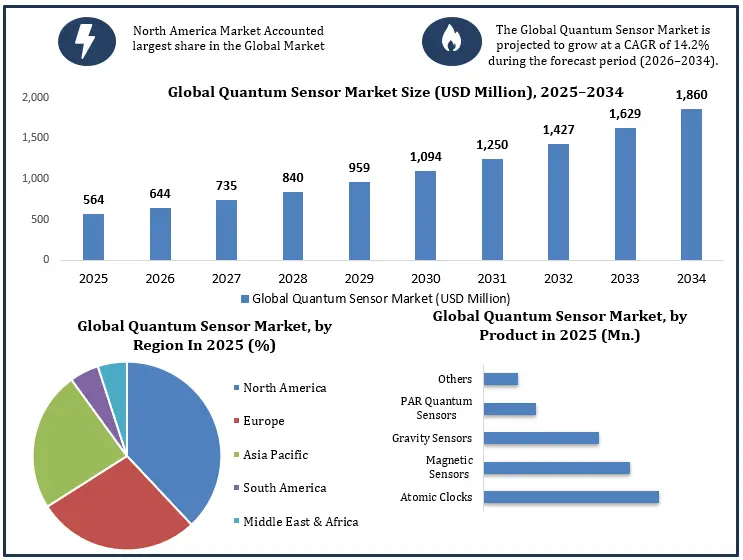
The Global Quantum Sensor Market was valued at USD 564 Million in 2025 and is projected to reach USD 1,860 Million by 2034, expanding at a CAGR of 14.2% during the forecast period (2026–2034). Growing investments in quantum computing infrastructure, defense modernization, GPS-independent navigation, and advanced medical diagnostics are accelerating commercialization across aerospace, healthcare, energy, automotive, telecommunications, and semiconductor industries. Commercial adoption is increasingly shifting from laboratory research toward deployable quantum sensing platforms supported by miniaturization, photonic integration, AI-assisted signal processing, and government-funded quantum innovation programs.
|
Quantum Sensor Key Market Highlights
|
Quantum Sensor Market Growth and Share Analysis
To know about the Research Methodology :- Request Free Sample Report
Quantum Sensor Market Dynamics: Drivers, Opportunities, Restraints, and Challenges:
Growing Demand for High-Precision, GPS-Independent Navigation and Quantum Measurement Technologies Driving Market Growth
Rising deployment of GPS-denied navigation systems, autonomous defense platforms, aerospace positioning systems, geophysical exploration equipment, medical imaging technologies, and semiconductor manufacturing is accelerating demand for quantum sensors capable of delivering ultra-high precision measurements beyond conventional sensing capabilities.
Rising Opportunities in Advanced Navigation and Resource Exploration
Growing commercialization of quantum navigation, gravity sensing, magnetometry, biomedical diagnostics, environmental monitoring, and infrastructure monitoring is creating long-term investment opportunities across both government-funded and commercial quantum technology ecosystems.
High Cost and Technical Complexity of Quantum Sensors Remain Major Market Restraints
High manufacturing costs, cryogenic infrastructure requirements, specialized photonic components, quantum-grade materials, calibration complexity, and limited availability of skilled quantum engineers continue to restrict large-scale commercial deployment, particularly for cost-sensitive industries and emerging markets.
Challenges in Commercialization and Scalability
Commercial scalability remains a major challenge as manufacturers must balance measurement accuracy, environmental stability, miniaturization, cost optimization, and production scalability while transitioning quantum sensing technologies from research laboratories to field-ready commercial systems.
MMR Opportunity Matrix — Quantum Sensor Market
| Opportunity | Market Size | CAGR | Investment Risk | Entry Difficulty |
| Quantum Navigation & GPS-Independent Systems | High | Very High | Medium | High |
| Quantum Gravimetry and Resource Exploration Solutions | Medium-High | High | Medium | High |
| Quantum Magnetometry for Healthcare & Diagnostics | Medium | High | Medium-High | High |
| Quantum Sensors for Aerospace & Defense | High | Very High | High | Very High |
| Quantum Sensing for Infrastructure & Environmental Monitoring | Medium | High | Medium | Medium-High |
Quantum Sensor Market Trends and Commercialization Outlook: Miniaturization, Ai Integration, Quantum Navigation, and Commercial Deployment
Quantum Navigation Emerging as a High-Growth Commercial Application
Quantum navigation is gaining attention as industries look for reliable positioning without depending fully on GPS. Advances in quantum accelerometers and gyroscopes are supporting applications in defense, aerospace, autonomous vehicles and marine navigation.
Miniaturization Accelerating Field Deployment of Quantum Sensors
Manufacturers are working to make quantum sensors smaller, lighter and easier to deploy. Improvements in miniaturized components and integrated systems are helping move quantum sensing from laboratories into field applications.
AI-Assisted Quantum Signal Processing Improving Sensor Accuracy
AI and machine learning are increasingly integrated with quantum sensing platforms to enhance signal interpretation, noise reduction, anomaly detection, predictive sensing, and real-time data analytics across healthcare, geophysical exploration, industrial monitoring, and autonomous navigation applications.
Quantum Gravimeters Expanding into Resource Exploration and Infrastructure Monitoring
Quantum gravimeters are emerging as an important technology for detecting small changes in gravity. Their growing use in mineral exploration, underground mapping, infrastructure monitoring and geological studies is creating new market opportunities.
Quantum Magnetometers Expanding Across Healthcare and Defense Applications
Quantum magnetometers are gaining traction because they can detect extremely weak magnetic fields with high sensitivity. New applications are developing in medical imaging, brain research, navigation, security and geological exploration.
Commercialization Accelerating Beyond Laboratory Research
Quantum sensing is gradually moving beyond academic research toward practical commercial use. Growing investments, improved sensor reliability, and partnerships between technology companies, research institutions, and governments are helping accelerate real-world deployment.
Quantum Sensor Market– Segments Analysis
Quantum Sensor Market, by End-use
The Global Quantum Sensor Market is segmented by end user into Government Agencies, Research Institutes, Commercial Enterprises, Energy & Utilities, and Telecommunications. Government Agencies represent a major end-user group, supported by defense, national security, navigation, and precision timing applications. Research Institutes contribute significantly through quantum technology development, scientific experiments, and advanced sensing research Commercial enterprises represent a rapidly growing end-user category, with adoption expanding across aerospace, automotive, healthcare, energy, semiconductor manufacturing, industrial automation, and mining through enterprise investments in precision sensing technologies. Energy & Utilities offer growing opportunities through infrastructure monitoring, resource exploration, and precision measurement, while Telecommunications is expected to benefit from demand for highly accurate timing, synchronization, and next-generation communication infrastructure.

Quantum Sensor Market Regional Analysis and Growth Opportunities:
North America — Strong Government Support and Early Commercial Adoption
North America held the largest Quantum Sensor Market share in 2025, supported by strong government funding, defense modernization programs, quantum computing investments, aerospace innovation, and commercialization of GPS-independent navigation and precision sensing technologies across the United States and Canada.
Europe — Strong Research Base and Industrial Applications
Europe's competitive advantage is supported by photonics manufacturing, quantum research infrastructure, semiconductor equipment manufacturers, precision engineering capabilities, healthcare innovation, and defense technology programs across Germany, France, the UK, Switzerland, and the Netherlands.
Asia Pacific — Rapid Growth through Government Investment and Technology Development
Asia Pacific is projected to be the fastest-growing regional market due to national quantum missions, semiconductor manufacturing leadership, photonics ecosystems, space programs, defense modernization, and government investments across China, Japan, South Korea, India, Singapore, and Australia.
South America — Emerging Opportunities in Resource and Environmental Applications
South America presents emerging opportunities through mining exploration, oil & gas reservoir mapping, geological surveying, environmental monitoring, and precision gravity sensing applications across Brazil, Chile, Argentina, and Colombia.
Middle East & Africa — Long-Term Potential through Strategic Applications
The Middle East & Africa market is expected to grow through defense modernization, energy exploration, smart infrastructure monitoring, environmental sensing, satellite navigation, and national quantum technology initiatives across GCC countries and South Africa.
Global Quantum Sensor Market Competitive Landscape:
The Global Quantum Sensor Market is evolving from a research-focused technology space into a broader commercial ecosystem covering precision measurement, navigation, healthcare, aerospace & defense, energy, mining, and industrial applications. Competition is no longer based only on achieving the highest sensitivity; companies are increasingly differentiating through measurement accuracy, miniaturization, low power consumption, environmental stability, scalability, integration, and field-deployment capabilities.
Specialized players such as AOSense, Infleqtion, Q-CTRL, Qnami, SBQuantum, Exail Technologies, ID Quantique, and SandboxAQ compete alongside established technology and defense companies developing quantum sensing and navigation solutions. The competitive environment also varies by application, with companies developing solutions for GPS-independent navigation, precision timing, magnetic-field detection, gravimetry, geophysical exploration, biomedical sensing, and infrastructure monitoring. Going forward, compact and field-ready quantum sensors, AI-assisted signal processing, integrated photonics, advanced quantum materials, and improved noise reduction are expected to become important competitive factors as the technology moves toward wider commercial adoption.
Companies that can combine high-performance quantum sensing with reliable hardware, application-specific solutions, software integration, and cost-effective deployment are likely to gain an advantage. Overall, the competitive landscape is shifting from “who can demonstrate the most sensitive quantum sensor?” to “who can deliver reliable, scalable, and commercially practical quantum sensing solutions for real-world applications?”, creating opportunities for both established technology companies and specialized quantum-sensing startups.
Quantum Sensors Market Scope: Inquiry Before Buying
| Quantum Sensor Market | |||
|---|---|---|---|
| Report Coverage | Details | ||
| Base Year: | 2025 | Forecast Period: | 2026-2034 |
| Historical Data: | 2020 to 2025 | Market Size in 2025: | USD 564 Mn. |
| Forecast Period 2026 to 2034 CAGR: | 14.2% | Market Size in 2034: | USD 1,860 Mn. |
| Segments Covered: | by Product | Atomic Clocks Photosynthetically Active Radiation (PAR) Quantum Sensors, Gravity Sensors Magnetic Sensors Others |
|
| by Industry | Military and Defense Automotive Agriculture Oil and gas Healthcare Others |
||
| by Technology | Quantum Entanglement Sensors Quantum Interference Sensors Quantum Imaging Sensors Quantum Timing Sensors Quantum Navigation Sensors |
||
| by Deployment | Ground-Based Airborne Marine Space-Based |
||
| by Component | Hardware Software Services |
||
| by End User | Government Agencies Research Institutes Commercial Enterprises Energy and Utilities Telecommunications |
||
Global Quantum Sensor Market, by Region
North America (United States, Canada, and Mexico)
Europe (UK, France, Germany, Italy, Spain, Sweden, Austria, and the Rest of Europe)
Asia Pacific (China, South Korea, Japan, India, Australia, ASEAN, Indonesia, Philippines, Malaysia, Vietnam, Thailand, ASEAN, Rest of Asia Pacific)
Middle East & Africa (South Africa, GCC, Nigeria, Rest of ME&A)
South America (Brazil, Argentina, Rest of South America)
Global Quantum Sensor Market Key Players:
North America
1. AOSense, Inc.
2. Infleqtion, Inc.
3. SandboxAQ
4. SBQuantum Inc.
5. QuSpin Inc.
6. Mesa Quantum
7. Twinleaf LLC
8. FieldLine Inc.
9. Microchip Technology Inc.
10. Spectra Dynamics
11. Vescent Photonics
12. Geometrics, Inc.
13. Excelitas Technologies Corp.
14. Honeywell International Inc.
15. IonQ, Inc.
16. Northrop Grumman Corporation
17. Lockheed Martin Corporation
18. L3Harris Technologies, Inc.
Europe
19. Exail Technologies
20. ID Quantique SA
21. Qnami AG
22. M Squared Lasers Limited
23. Q.ANT GmbH
24. QuantumDiamonds GmbH
25. Single Quantum B.V.
26. Miraex SA
27. Muquans SAS
28. TOPTICA Photonics SE
29. Menlo Systems GmbH
30. Oxford Instruments plc
31. QLM Technology Ltd.
32. Magnicon GmbH
33. Kwan-tek
34. Thales Group
35. QinetiQ Group
Asia-Pacific
36. Atomionics Pte. Ltd.
37. Nomad Atomics Pty Ltd.
38. Q-CTRL Pty Ltd.
39. Aquark Technologies
40. Bosch Quantum Sensing
41. KWAN-TEK Co., Ltd.
42. GuoCe Quantum Technology Co., Ltd.
43. QuantumCTek Co., Ltd.
44. Toshiba Corporation
45. Hamamatsu Photonics K.K.
Frequently Asked Questions:
1. What is the size of the Global Quantum Sensor Market?
Ans: The Global Quantum Sensor Market is estimated at USD 564 Million in 2025 and is projected to reach USD 1,860 Million by 2034, registering a CAGR of 14.2% during 2025–2034. Growth is supported by increasing adoption of quantum-enabled sensing for precision measurement, navigation, defense, healthcare, geophysical exploration, and industrial applications.
2. Which segment dominates the Global Quantum Sensor Market?
Ans: The Atomic Clocks segment is expected to hold a leading position by sensor type, supported by applications in precision timing, telecommunications, navigation, and defense. By end-use industry, Aerospace & Defense represents a major segment due to growing demand for GPS-independent navigation, advanced positioning, inertial sensing, and high-precision measurement systems.
3. Which region holds the largest share of the Global Quantum Sensor Market?
Ans: North America is expected to maintain the largest market share, supported by strong government funding for quantum technologies, advanced research infrastructure, defense applications, established technology companies, and early commercialization of quantum sensing solutions.
4. Which region is expected to grow fastest in the market?
Ans: Asia Pacific is expected to register strong growth during the forecast period, driven by increasing government investment in quantum technologies, expanding semiconductor and photonics capabilities, defense modernization, and growing research and commercialization activities in countries such as China, Japan, South Korea, India, and Australia.
5. What are the major trends shaping the Global Quantum Sensor Market?
Ans: Major trends include the development of compact and low-power quantum sensors, GPS-independent navigation, AI-enabled signal processing, integrated photonics, advanced quantum materials, improved noise mitigation, and field-deployable sensing systems. Increasing applications in geophysical exploration, healthcare, environmental monitoring, autonomous transportation, and defense are also expanding the commercial potential of quantum sensing technologies.