
Parental Control Software Market Size by Device Type, Operating System, Deployment, Application, Region – Revenue Pool Analysis, Margin Structure Assessment, Capital Flow Trends, Competitive Benchmarking & Forecast to 2032
Overview
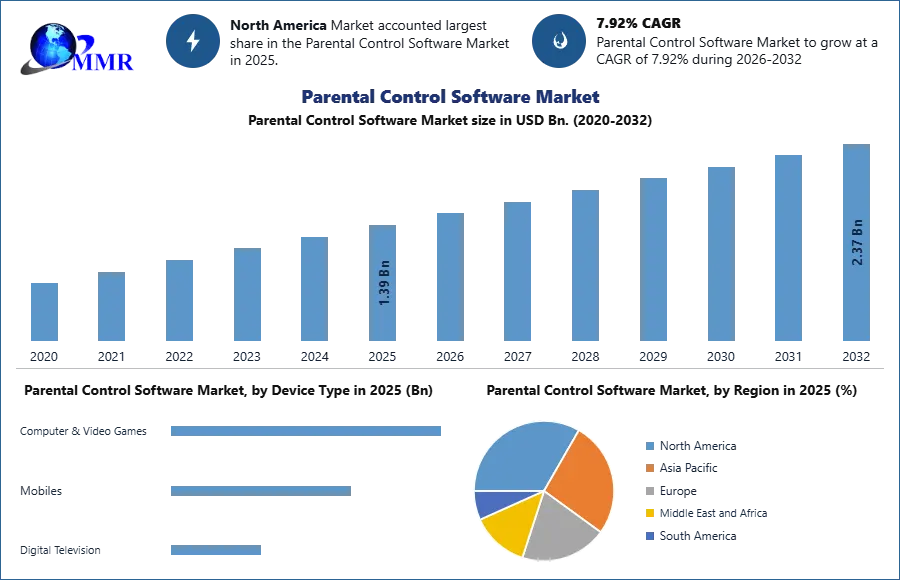
The Parental Control Software Market size was valued at USD 1.39 Billion in 2025 and the total Parental Control Software revenue is expected to grow at a CAGR of 7.92% from 2026 to 2032, reaching nearly USD 2.37 Billion.
Parental control software is a tool designed to monitor, restrict, or manage the online activities of children, typically by blocking access to certain websites or applications and setting usage limits.
The increasing prevalence of digital devices among children and adolescents, coupled with growing concerns regarding online safety and exposure to inappropriate content, has propelled the demand for parental control solutions and driving the growth of Parental Control Software Market. As parents seek to monitor and manage their children's digital activities across multiple devices and platforms, the market for parental control software has witnessed significant growth. The proliferation of social media platforms, online gaming, and streaming services has further accentuated the need for effective parental control measures.
To know about the Research Methodology:-Request Free Sample Report
Advancements in technology, such as artificial intelligence and machine learning algorithms, enabling more sophisticated content filtering and monitoring capabilities are some major Key growth factors driving the Parental Control Software Market growth. The implementation of stringent regulatory frameworks and initiatives to promote online safety, particularly for minors, has spurred the adoption of parental control software among households and educational institutions globally. Recent developments by market key players reflect a focus on enhancing product features and usability to cater to evolving consumer demands. For example, leading companies like NortonLifeLock, Qustodio, and Kaspersky have introduced comprehensive parental control suites with features such as real-time monitoring, content filtering, screen time management, and geolocation tracking, offering parents greater control and peace of mind in safeguarding their children's online experiences. These developments underscore the dynamic nature of the parental control software market, where innovation and responsiveness to evolving digital trends are crucial for sustaining growth and addressing emerging challenges in ensuring online safety for minors.
Parental Control Software Market Key Dynamics:
Increasing concerns about children's online safety boosting the Parental Control Software Market
Rising concerns about online safety among parents have propelled the demand for effective digital parenting solutions driving the growth of Parental Control Software Market. With instances of cyberbullying, inappropriate content, and online predators on the rise, tools like Norton Family Premier have gained popularity for their ability to monitor and regulate children's online activities, providing parents with peace of mind. Additionally, the proliferation of internet-enabled devices in households further drives market growth. Parents seek comprehensive solutions like Qustodio, which offer multi-platform support, allowing them to monitor and manage their children's device usage across smartphones, tablets, and computers seamlessly.
Legislative initiatives and regulatory requirements have played a significant role in shaping the parental control software market landscape. Regulations such as the General Data Protection Regulation (GDPR) in the EU emphasize the importance of safeguarding children's online privacy, prompting the adoption of compliant parental control solutions. Furthermore, advancements in technology have led to the development of sophisticated parental control tools with AI-powered features. For instance, FamilyTime utilizes AI algorithms for content filtering, ensuring adaptive protection against evolving online threats. Additionally, collaborations with educational institutions have expanded the reach of parental control software, with solutions like Securely providing cloud-based filtering to schools, fostering safer online environments for students. As awareness campaigns and parenting initiatives continue to promote digital well-being, and with the increasing affordability and accessibility of parental control solutions, the market is poised for sustained growth, catering to the evolving needs of families in the digital age.
Inaccurate content filtering frustrates users, undermining software credibility and hindering effective management of online activities
Parents face resistance from children regarding the implementation of parental control software, impacting adoption rates which hindering the growth of Parental Control Software Market. For instance, children may perceive such software as intrusive, leading to conflicts within households and hindering effective usage. The occurrence of false positives and negatives poses frustrations, where inaccurately blocked or allowed content diminishes the software's credibility and utility. Technical limitations further compound the issue, with compatibility issues across devices and platforms hindering seamless implementation and usage.
The persistent challenge of bypassing controls underscores the need for continuous innovation to stay ahead of evolving digital tactics. Tech-savvy children often find ways to circumvent parental control measures, reducing the software's efficacy and highlighting the ongoing battle for digital supervision. Privacy concerns also loom large, as data collection and storage through parental control software raise questions about security and parental oversight, potentially dissuading some users from adopting such solutions. The cost of implementation presents a barrier for many families, with subscription fees or upfront costs limiting accessibility to comprehensive parental control tools. The impact on parent-child relationships cannot be overlooked, as overly intrusive monitoring may strain trust and communication, ultimately undermining the intended benefits of the software. These challenges collectively underscore the need for adaptive solutions that balance efficacy with privacy, affordability, and user acceptance.
Parental Control Software Market Segment Overview:
Based On Operating Systems, the market is segmented into iOS, Android, and Windows. Windows Operating System segment is expected to hold the largest market share by 2032. The Windows operating system provides a built-in parental control application that allows you to block websites for free, as well as view online activity logs and ban any sites, apps, or games that you don't want them to use. This parental control programme also allows you to set screen time limits, monitor your child's purchases, and track their location. The Parental Control Software market is expected to be driven by the growing popularity of Windows systems and the availability of advanced applications.

Parental Control Software Market Regional Insights:
North America Dominated the Parental Control Software Market
North American region is expected to dominate the Parental Control Software Market during the forecast period 2026-2032. The North American region is expected to hold the largest. Online learning has exploded in popularity in the United States, as the internet and education have fused to give consumers with the chance to learn new skills. Colleges, universities, and corporations have been compelled to operate remotely as a result of the outbreak, which has boosted the usage of online learning. As schools and universities give lectures and classes online, students have begun to spend more time on the internet and on their phones. Google LLC has announced the introduction of Google+ TV in the United States, which includes parental controls and separate accounts for minors. Because of the increased amount of time spent online, worries regarding cybersecurity have grown critical. Parents around the country are investing in sophisticated control software solutions in response to incidents ranging from cyberbullying to exposure to sensitive or malicious content, as well as data leaks.
Asia Pacific region is expected to grow rapidly during the forecast period 2026-2032. Because of the rising use of internet-connected media devices and increased awareness of gaming and internet addiction among children. In addition, government laws requiring the use of parental control tools for student safety are likely to enhance their use in the residential and educational sectors. In February 2021, the Indian government unveiled a new set of policies and standards to manage digital material. OTT platforms must have parental lock solutions for people over the age of 13 in order to access classified content, according to these rules and standards. The National Commission for the Protection of Child Rights (NCPCR) has mandated that all schools include a cybersecurity curriculum, educating parents and children about the importance of online safeguards and security practises in order to prevent potential child exploitation in the virtual world. As a result, more focus is being placed on establishing parental control software across the country.
Recent Industry Developments (2025–2026) :
| Exact Date | Company | Development | Impact |
|---|---|---|---|
| 02 February 2026 | Aura and Qoria | The companies announced a strategic merger to integrate Aura’s AI-driven safety tools with Qoria’s global educational and parental network. | This consolidation creates a global leader in child safety technology, significantly expanding market share across US and APAC regions. |
| 12 January 2026 | McAfee LLC | Launched an AI-enhanced monitoring engine capable of identifying early signs of cyberbullying and predatory behavior in real-time messaging apps. | The update shifts the market focus from basic content filtering to proactive behavioral analytics and mental health protection. |
| 15 November 2025 | NortonLifeLock | Introduced FamilyGuard+, a cross-platform solution designed to comply with the UK Online Safety Act requirements ahead of the 2025 deadline. | Ensures regulatory compliance for the European market while setting a new benchmark for privacy-centric parental controls. |
| 10 September 2025 | Bark Technologies | Collaborated with major smart home hub manufacturers to integrate network-level parental controls directly into residential Wi-Fi 7 routers. | Enhances the residential segment dominance by providing a seamless, software-free way to manage unlimited household devices. |
| 22 May 2025 | Google LLC | Released a major update to Family Link featuring intelligent screen-time suggestions based on educational vs. entertainment app usage. | Promotes digital well-being and educational engagement, encouraging parents to transition toward data-informed parenting. |
| 02 February 2025 | Aura | Officially launched Aura Parents, an AI-powered safety platform developed in collaboration with psychological researchers. | Addresses rising digital anxiety by using non-invasive monitoring models to identify behavioral shifts in children's online activity. |
Parental Control Software Market Scope: Inquire before buying
| Parental Control Software Market | |||
|---|---|---|---|
| Report Coverage | Details | ||
| Base Year: | 2025 | Forecast Period: | 2026-2032 |
| Historical Data: | 2020 to 2025 | Market Size in 2025: | 1.39 USD Bn. |
| Forecast Period 2026-2032 CAGR: | 7.92% | Market Size in 2032: | 2.37 USD Bn. |
| Segments Covered: | by Device Type | Computer & Video Games Mobiles Digital Television |
|
| by Operating System | iOS Android Windows |
||
| by Deployment | Cloud Based On-premises |
||
| by Application | Residential Educational Institutes |
||
Parental Control Software Market, by Region:
North America (United States, Canada, and Mexico)
Europe (UK, France, Germany, Italy, Spain, Sweden, Austria, and the Rest of Europe)
Asia Pacific (China, South Korea, Japan, India, Australia, Indonesia, Malaysia, Vietnam, Taiwan, Bangladesh, Pakistan, and the Rest of APAC)
Middle East and Africa (South Africa, GCC, Egypt, Nigeria, and the Rest of ME&A)
South America (Brazil, Argentina Rest of South America)
Key Players / Competitors Profiles Covered in Brief in Global Parental Control Software Market Report in Strategic Perspective:
- McAfee LLC
- NortonLifeLock Inc.
- AT&T
- Qustodio LLC
- SaferKid
- Symantec Corporation
- Webroot Inc.
- Microsoft Corporation
- AO Kaspersky Lab
- Bark Technologies
- Avast Software
- Cisco Systems
- Alphabet Inc.
- Verizon
- Net Nanny
- Mobicip
- ESET Parental Control
- OurPact
- Covenant Eyes
- Screen Time Labs
- Kidslox
- Circle Media Labs Inc.
- Aura
- Qoria