Global Osmium Market By Product Type, By Form, By Purity Grade, By Application, By End-Use Industry, By Distribution Channel, by Region and Forecast 2034

7.2%
CAGR (2026-2034)
0.285 USD Mn.
Forecast Market Size
305
Report Pages
145
Market Tables

Overview

The Global Osmium Market was valued at USD 0.285 million in 2025 and is projected to reach USD 0.53279 million by 2034, growing at a CAGR of 7.2% during 2026-2034, according to Maximize Market Research (MMR). Osmium (Os, atomic number 76) is the densest naturally occurring element and the rarest, least-produced member of the platinum group metals (PGMs). The market covers osmium tetroxide (OsO4), osmium powder, osmium metal, osmium alloys and other osmium compounds sold for electron microscopy, chemical catalysis, precision components, luxury ornaments, collectible and investment material, and biomedical research.

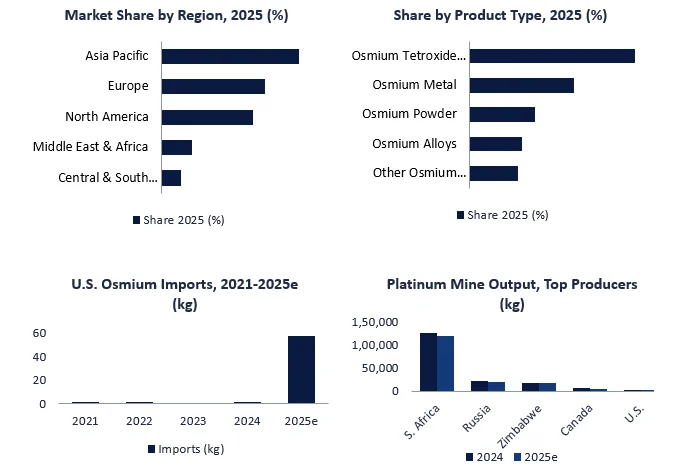
Osmium has no mine of its own. It is recovered as a by-product of platinum, palladium and nickel refining, so supply is small, inelastic and tied to PGM output in South Africa, Russia, Zimbabwe, Canada and the United States. One company page puts global osmium production at about 1 tonne a year, and U.S. Geological Survey (USGS) data show U.S. imports of osmium at just 57 kg in 2025 (estimate). Demand is therefore a story of niche, high-value uses rather than volume.

This report answers both sides of the search: what the osmium market is worth for producers, refiners, distributors and investors, and what buyers ask most, from osmium price per gram and osmium tetroxide uses in electron microscopy to crystalline osmium, purity grades, safety limits and where to buy osmium compounds.

Maximize Market Research provides a segment-level analysis of the global osmium market size, share, product type, form, purity grade, application, end-use industry and distribution channel, together with regional analysis, supply-chain mapping, competitive landscape and strategic scenarios through 2034.

Global Osmium Market Overview:

Size, Share, Trends and Outlook to 2034

MMR measures the market at supplier-selling-price level across osmium products sold worldwide: osmium tetroxide ampoules and solutions, osmium powder and sponge, ingots and crystalline osmium, osmium-bearing alloys and other osmium salts and complexes. The defining traits are extreme scarcity, a by-product supply chain, strict handling rules for OsO4 and a split between a research-and-chemistry core and a smaller, price-sensitive luxury and collectible edge.

Three shifts shape 2026-2034: research and life-science demand keeps osmium tetroxide steady and recurring; crystalline osmium and ultra-high-purity grades grow faster than the market as collectors and luxury brands look for rare materials; and supply security, recycling and compliance costs move from background issues to pricing factors.

MMR | MARKET SNAPSHOT 2025 - 2034

Osmium tetroxide leads, aqueous solutions lead by
form, electron microscopy leads by application.

Crystalline osmium, ultra-high purity, investment and collectible material
and online platforms outgrow the market.

KEY MARKET INSIGHT | SMALL VOLUME, HIGH VALUE

Supply is by-product and fixed; growth comes from price, purity and new niches.
Market about 1.9x larger by 2034; osmium tetroxide about 38% of 2025 sales;
USGS reports U.S. osmium imports of 57 kg in 2025 against 1 kg in 2024; PGM
supply from South Africa fell an estimated 9% in 2025.

osmium market Growth

To know about the Research Methodology :- Request Free Sample Report

Key Findings: Eight Insights Shaping the Global Osmium Market

MMR's analysis of USGS trade and supply data, occupational-safety limits and company catalogues points to eight findings that explain where osmium value is created through 2034

#

Finding

Evidence

So what

1

The market grows
about 1.9x by 2034

USD 285.0 Mn
(2025) to USD 532.8 Mn (2034) at 7.2% CAGR

Refining,
packaging and compliance capacity must scale with price, not tonnage

2

Supply is a
by-product and cannot flex

About 1 tonne a
year (Goodfellow); USGS tracks PGMs, not osmium alone

Price, not
volume, balances the market

3

Osmium tetroxide
is the revenue core

About 38% of 2025
sales; used as an EM fixative and catalyst

Research funding
cycles set baseline demand

4

Pack size drives
price per gram

Catalogue OsO4
ranges from about USD 80 to USD 995 per gram

Bulk and contract
channels carry the margin gap

5

Crystalline
osmium outgrows

Crystalline form
about 19% of 2025 sales; CAGR 9.4%

Luxury and
collectible demand is the swing factor

6

U.S. import data
are thin and volatile

1 kg (2024) to 57
kg (2025e), per USGS

Single shipments
move the series; track with care

7

Handling rules
shape the supply chain

OSHA PEL 0.002
mg/m3; NIOSH IDLH 1 mg/m3

Compliant
packaging and training are barriers to entry

8

PGM supply risk
feeds osmium

South Africa PGM
output down about 9% and Russia down about 6% in 2025 (USGS)

Refiner
relationships matter more than spot buying

Why Do Osmium Market Size Estimates Differ?

No government agency publishes an osmium market value. USGS reports osmium only inside the combined PGM group, and the osmium trade is small, bilateral and partly unreported, so published estimates differ by scope: some count only refined metal, others include OsO4 reagents, alloys and collectible material. MMR's estimate is built bottom-up from the physical and price anchors in this report and is reviewed against primary interviews.

Global Osmium Market Dynamics:

Growth Drivers, Restraints and Opportunities

Osmium Market Growth Drivers: Research, Catalysis, Luxury Demand and Tight Supply

• Electron microscopy and life-science research. OsO4 is the standard secondary fixative and stain for lipid-rich membranes in transmission and scanning electron microscopy, and suppliers such as Polysciences, SPI Supplies and Merck list it for that use. Recurring consumable demand follows lab budgets.
• Chemical catalysis and organic synthesis. Heraeus notes that chemical users employ osmium tetroxide, potassium osmate(VI) dihydrate and ammonium hexachloroosmate(IV) as dihydroxylation catalysts, the chemistry behind asymmetric dihydroxylation in pharmaceutical synthesis.
• Luxury, collectible and investment interest. Heraeus reports osmium is becoming more popular in jewelry; crystalline osmium is marketed as a rare-material alternative.
• Extreme properties. Goodfellow lists a density of 22.59 g/cm3, melting point of 3,033 C and hardness near 400 HB, which supports alloys for wear-resistant contacts, pivots and precision parts.
• Supply scarcity. With production near 1 tonne a year, small shifts in refiner output or buyer demand move prices.

Osmium Market Restraints: Toxicity, Opaque Pricing, Thin Supply and Substitutes

• Toxicity and handling. NIOSH lists OsO4 as irritating to eyes, skin and respiratory system, with an OSHA PEL of 0.002 mg/m3 and an IDLH of 1 mg/m3. Hazmat shipping and fume-hood handling raise cost per gram.
• No exchange benchmark. Osmium has no futures contract or continuous public reference price, which limits financial investors and complicates contracts.
• By-product supply risk. USGS reports South Africa's 2025 PGM output fell an estimated 9% on costs and power disruption, and Russia's fell about 6%.
• Substitutes in staining and catalysis. Other heavy-metal stains, ruthenium compounds and non-metal oxidation routes compete where cost or safety outweighs performance.
• Thin collectible liquidity. Resale markets for crystalline osmium are small and dealer-dependent.

What Are the Biggest Osmium Market Opportunities Through 2034?

• OsO4 recycling and recovery: reclaiming osmium from spent EM waste and catalyst residues relieves supply and handling cost.
• Ultra-high-purity and certified crystalline osmium: traceable grades above 99.95% support premium pricing.
• Safer delivery formats: sealed ampoules, pre-diluted solutions and immobilised catalysts expand the user base.
• Online specialty platforms: price transparency and small-lot ordering lower barriers for labs and collectors.
• Volume electron microscopy and biomedical research: growing structural-biology programmes rely on osmium-based contrast.

Global Osmium Market Segmentation:

By Product Type, Form, Purity, Application, End-Use Industry and Channel

Osmium Market by Product Type: Osmium Tetroxide, Powder, Metal, Alloys and Other Compounds
Osmium tetroxide (OsO4) is the largest product type at about 38% of 2025 sales, driven by EM fixatives and catalyst use. Osmium metal, including ingots and crystalline pieces, is the fastest-growing type at an 8.4% CAGR, followed by other osmium compounds at 7.5%. Osmium alloys, mainly with iridium and platinum, grow more slowly at 6.0%.

Product type

2025 share (%)

CAGR 2026-2034 (%)

Main use

Osmium Tetroxide (OsO4)

38.0

6.5

EM fixation,
dihydroxylation

Osmium Metal

24.0

8.4

Ingots,
crystalline, collectible

Osmium Powder

15.0

6.8

Catalyst, alloy
feedstock

Osmium Alloys

12.0

6.0

Contacts, wear
parts

Other Osmium Compounds

11.0

7.5

Osmates,
chloro-osmates, complexes

Osmium Market by Form: Powder, Sponge, Ingot, Crystalline Osmium, Aqueous Solutions and Granules

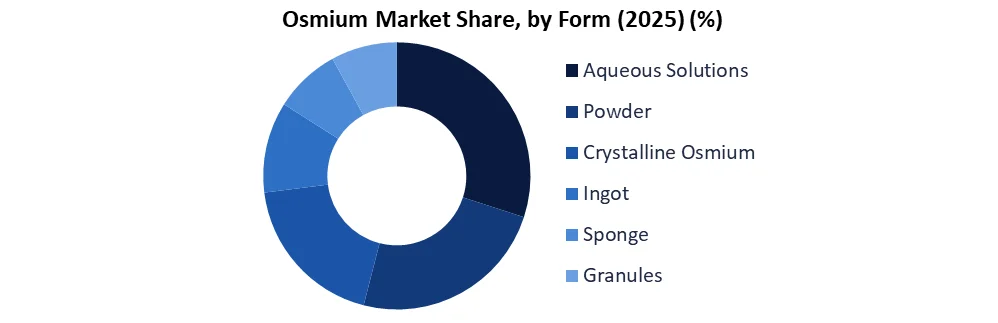
Aqueous solutions lead at 30% of 2025 sales because EM labs buy ready-to-use 2% and 4% OsO4 ampoules. Powder follows at 24%, while crystalline osmium, at 19%, is the form to watch.
osmium market share by form

Osmium Market by Purity Grade: Standard, High Purity and Ultra-High Purity

High-purity grade (99.9-99.95%) is largest at 42%. Ultra-high purity above 99.95% is the fastest-growing grade at a 9.0% CAGR as collectors, advanced-materials users and analytical labs demand certified material.

Osmium Market by Application: Electron Microscopy, Catalysts, Synthesis, Alloys, Jewelry and Investment

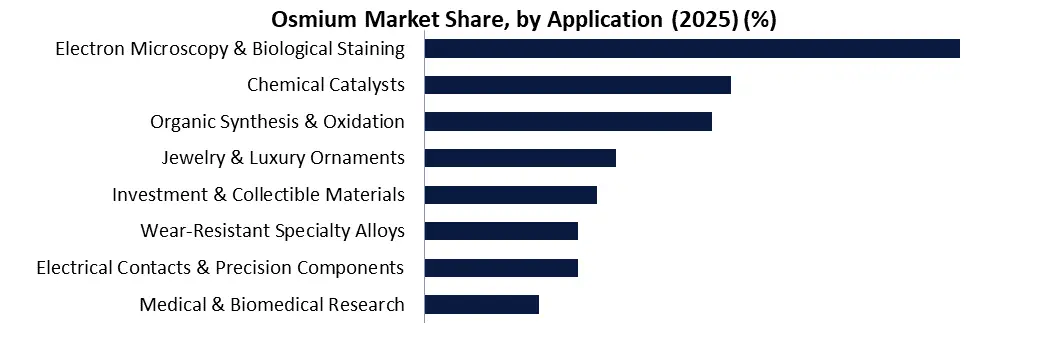
Electron microscopy and biological staining is the largest application at 28% of 2025 sales. Chemical catalysts and organic synthesis together add 31%. Investment and collectible materials grow fastest at a 9.2% CAGR.
osmium market share by application

Osmium Market by End-Use Industry: Research, Chemicals, Pharma, Electronics, Healthcare, Jewelry and Aerospace

Research and academic institutions account for 27% of 2025 demand, followed by chemical and petrochemical at 18% and pharmaceutical and biotechnology at 15%. Jewelry and luxury goods, at 13%, is the most price-sensitive end use.

Osmium Market by Distribution Channel: Direct Sales, Metal Distributors, Lab Suppliers and Online Platforms

Chemical and laboratory suppliers lead at 36% because EM-grade OsO4 sells through catalogues. Direct sales (30%) cover contract and refinery supply. Online specialty platforms are the fastest-growing channel at a 10.5% CAGR from a small base; Shanghai Metals Market launched separate osmium powder and ingot price points on 9 March 2026.

Global Osmium Market Regional Analysis: Asia Pacific, Europe, North America, Middle East & Africa, Latin America

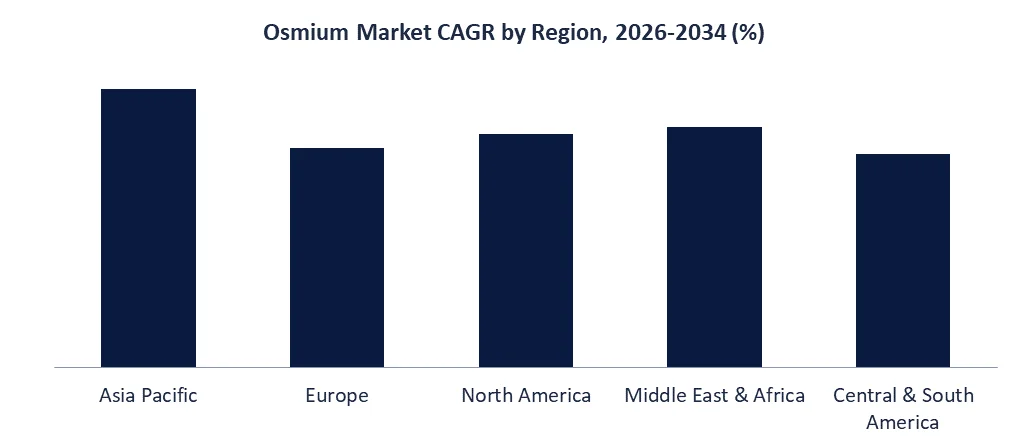
Asia Pacific is the largest demand region at about 36% of 2025 value, supported by research spending, jewelry and precision manufacturing in China, Japan and South Korea. Europe holds 27%, anchored by refining and distribution in Germany. North America holds 24%, with the U.S. importing small and variable volumes (57 kg in 2025e). Supply is concentrated differently: South Africa, Russia and Zimbabwe dominate PGM output (USGS).
osmium market share by region

Osmium Supply Chain: From PGM Mine to Osmium Tetroxide Ampoule

Layer

What happens

Examples

1. PGM mining

Ore and
concentrate from PGM and nickel mines

Bushveld Complex
(South Africa), Norilsk (Russia), Great Dyke (Zimbabwe)

2. Smelting and refining

PGMs separated;
osmium recovered in small amounts

Heraeus uses
pyrometallurgical and wet-chemical processes

3. Compound and form production

OsO4, osmates,
powder, ingots, crystalline pieces

Heraeus,
Goodfellow, Stanford Advanced Materials

4. Packaging and distribution

Ampoules, solutions,
catalogue sales, dealers

Merck/Sigma-Aldrich,
Polysciences, SPI Supplies, Agar Scientific

5. End users

Labs, chemical
firms, jewelers, collectors

Universities,
pharma R&D, luxury houses

Osmium Companies and Competitive Landscape: Who Supplies the Global Osmium Market?

The global osmium market comprises a limited number of specialized refiners, high-purity reagent suppliers, and metal distributors, with competition varying according to product applications and supply capabilities. Heraeus Precious Metals plays a significant role as a refiner and compound manufacturer, offering refined osmium, osmium tetroxide (OsO₄) ampoules, potassium osmate(VI), and ammonium hexachloroosmate(IV), with 26 listed products. Merck / Sigma-Aldrich supplies 2% and 4% osmium tetroxide solutions and solid OsO₄ for electron microscopy and chemical synthesis. Other specialized reagent suppliers include Polysciences, offering sealed 4% OsO₄ ampoules for electron microscopy post-fixation, SPI Supplies, providing 2% and 4% aqueous solutions, and Agar Scientific, supplying osmium compounds for microscopy staining and organic synthesis applications.

The metal and materials segment includes Goodfellow and Stanford Advanced Materials, which supply osmium metal primarily for research and specialized material applications, supported by technical specifications and published property information. Shanghai Metals Market contributes to market transparency through osmium powder and ingot price reporting, introduced in March 2026. Meanwhile, major PGM producers, including Anglo American Platinum (Valterra), Implats, Sibanye-Stillwater, and Nornickel, represent important upstream sources because osmium occurs as a by-product within their platinum-group metal processing streams. However, these companies generally do not market osmium through dedicated standalone product lines. Consequently, the market remains concentrated around specialized refining capabilities, high-purity reagent distribution, and limited upstream availability.

Competitive Strategies in the Osmium Market

• Refiner-integrated supply: control of PGM streams secures osmium feedstock (Heraeus model).
• Catalogue and ampoule specialisation: sealed, pre-measured formats win EM labs and reduce handling risk.
• Purity and traceability: certified assays and batch records support premium and ultra-high-purity sales.
• Digital price discovery: online platforms and price-reporting services shorten quote cycles.

Osmium Tetroxide Safety and Regulation: Exposure Limits and Compliance

Osmium tetroxide is a highly toxic and volatile compound that requires strict occupational exposure controls, appropriate handling procedures, and regulatory compliance. The key safety and regulatory parameters include:

OSHA Permissible Exposure Limit (PEL): 0.002 mg/m³ (8-hour time-weighted average).
NIOSH Recommended Exposure Limit (REL): 0.002 mg/m³ (0.0002 ppm) as a time-weighted average.
NIOSH Short-Term Exposure Limit: 0.006 mg/m³ (0.0006 ppm).
Immediately Dangerous to Life or Health (IDLH): 1 mg/m³.
Vapor Pressure: 7 mmHg.
Melting Point: 105°F (approximately 40.6°C).
U.S. Import Duty on Unwrought Platinum Group Metals (PGMs): Duty-free under normal trade relations.

These parameters highlight the stringent exposure limits and specialized handling requirements associated with osmium tetroxide, particularly in laboratory, pharmaceutical, and industrial applications.

Global Osmium Market Recent Developments

Date

Development

Source

Nov 2025

USGS publishes
the final 2025 List of Critical Minerals (60 minerals), keeping all 2022
entries

USGS / Federal
Register

Feb 2026

USGS Mineral
Commodity Summaries 2026 reports U.S. osmium imports of 57 kg in 2025e

USGS

Mar 2026

Shanghai Metals
Market launches osmium powder and ingot price points

Shanghai Metals
Market

2025

South Africa PGM
output down an estimated 9%; Russia down about 6%

USGS MCS 2026

Global Osmium Market Scope: Inquire before buying

Global Osmium Market

Report Coverage

Details

Base Year:

2025

Forecast Period:

2026-2034

Historical Data:

2020 to 2025

Market Size in 2025:

USD 0.285 Billion

Forecast Period 2026 to 2034 CAGR:

7.2%

Market Size in 2034:

USD 0.53279 Billion

Osmium Market Segments Covered:

By Product Type

Osmium Tetroxide (OsO₄)

Osmium Powder

Osmium Metal

Osmium Alloys

Other Osmium Compounds

By Form

Powder

Sponge

Ingot

Crystalline Osmium

Aqueous Solutions

Granules

By Purity Grade

Standard Purity (99.0–99.9%)

High Purity (99.9–99.95%)

Ultra-High Purity (Above 99.95%)

By Application

Chemical Catalysts

Organic Synthesis and Oxidation

Electron Microscopy and Biological Staining

Electrical Contacts and Precision
Components

Wear-Resistant Specialty Alloys

Jewelry and Luxury Ornaments

Investment and Collectible Materials

Medical and Biomedical Research

By End-Use Industry

Chemical and Petrochemical Industry

Pharmaceutical and Biotechnology Industry

Electronics and Electrical Industry

Healthcare and Medical Devices

Research and Academic Institutions

Jewelry and Luxury Goods Industry

Aerospace and Precision Engineering

By Distribution Channel

Direct Sales

Specialty Metal Distributors

Chemical and Laboratory Suppliers

Online Specialty Material Platforms

Global Osmium Market, By Region:

• North America (United States, Canada, Mexico, Rest of North America)
• Europe (United Kingdom, Germany, France, Italy, Spain, Rest of Europe)
• Asia Pacific (China, Japan, South Korea, India, Australia, Rest of Asia Pacific)
• Middle East & Africa (South Africa, Egypt, Nigeria, Algeria, Morocco, Angola, Kenya, Ghana, Rest of MEA)
• Central & South America (Brazil, Argentina, Rest of Central & South America)

Global Osmium Market  Key Players:

1. North America
1. Heraeus Precious Metals North America LLC
2. Johnson Matthey Inc.
3. BASF Metals LLC
4. American Elements
5. J & J Materials
6. MetalsTek Engineering
7. Sabin Metal Corporation
8. Metalor U.S.A. Refining Corporation
9. Platinum Group Metals Ltd.
10. Generation Mining
2. Europe
1. Heraeus Precious Metals GmbH & Co. KG
2. Johnson Matthey plc
3. Umicore
4. Ceimig
5. TRADIUM
6. C. HAFNER GmbH & Co. KG
7. SAXONIA Edelmetalle GmbH
8. Metalor Technologies SA
9. Argor-Heraeus SA
10. Boliden Group
3. Asia-Pacific
1. TANAKA PRECIOUS METAL TECHNOLOGIES Co., Ltd.
2. Furuya Metal Co., Ltd.
3. Ishifuku Metal Industry Co., Ltd.
4. DOWA Holdings Co., Ltd.
5. Jinchuan Group International Resources Co., Ltd.
6. Chengdu Guangming Paite Precious Metal Co., Ltd.
7. Shenzhen Cuilu Gold Refinery Co., Ltd.
8. Heesung PM Tech Corp.
9. Solar Applied Materials Technology Corp.
10. Arora Matthey Limited
4. Middle East & Africa
1. Valterra Platinum (Anglo American Platinum)
2. Impala Platinum Holdings Limited
3. Sibanye-Stillwater Limited
4. Northam Platinum Holdings Limited
5. African Rainbow Minerals Limited
6. Ivanhoe Mines
7. Heraeus PGM SA (Pty) Ltd.
8. CM MINING Corporation
5. South America
1. Vale S.A.
2. Bravo Mining
3. Glencore
4. Sihauli Chemicals

Osmium Market – Additional FAQs

1. Why is osmium considered one of the rarest commercially traded metals?
Ans: Osmium occurs in extremely low concentrations within platinum-group metal ores, making its extraction dependent on specialized refining processes and limited by-product availability.

2. Which industries generate demand for high-purity osmium?
Ans: Electronics, pharmaceutical research, chemical synthesis, microscopy, medical research and precision manufacturing generate demand for high-purity osmium and its specialized compounds.

3. How does platinum-group metal mining influence osmium availability?
Ans: Osmium supply depends heavily on platinum and nickel mining activities, as production is largely obtained as a secondary product during PGM refining.

4. What factors influence the pricing of crystalline osmium?
Ans: Crystalline osmium prices depend on purity, crystallization quality, processing complexity, certification, supplier availability and demand from luxury jewelry and collectible markets.

5. Why is osmium difficult to substitute in electron microscopy applications?
Ans: Osmium tetroxide provides strong electron contrast by binding with biological lipids, making it particularly valuable for preserving and visualizing cellular structures.

6. How does osmium recycling contribute to market supply?
Ans: Recovery of osmium from laboratory residues, chemical processing waste and industrial catalysts can improve material utilization and reduce dependence on limited primary production.

7. What challenges restrict large-scale commercialization of osmium?
Ans: Limited natural availability, complex extraction, high processing costs, toxic compound handling requirements and restricted industrial applications constrain large-scale osmium commercialization.

Table of Contents

1. Executive Market Landscape & Industry Overview 1.1. Global Osmium Market Size (Value USD Million), 2025–2034 1.2. Historical Evolution of Osmium Extraction and Commercialization 1.3. Osmium Definition, Chemical Properties and Market Classification 1.4. Osmium Positioning Within Platinum Group Metals 1.5. Global Osmium Production, Consumption and Availability Overview 1.6. Osmium Market CAGR Analysis and Long-Term Growth Outlook 2. Osmium Market Dynamics 2.1. Emerging Trends Across Specialty Osmium Applications 2.2. Market Dynamics Analysis 2.2.1. Drivers 2.2.2. Restraints 2.2.3. Opportunities 2.2.4. Challenges 2.3. PORTER's Five Forces Analysis 2.4. PESTLE Analysis 3. Osmium Market Macroeconomic Factors 3.1. Global Precious Metal Investment and Industrial Demand Trends 3.2. Platinum Group Metal Production and Mining Expenditure 3.3. Specialty Chemical Manufacturing and Laboratory Research Investments 3.4. Luxury Jewelry Expenditure and Collectible Metal Purchasing 3.5. Industrial Manufacturing Costs and Specialty Material Pricing 3.6. Foreign Exchange Movements and Precious Metal Trade Dynamics 4. Osmium Industry Trends & Emerging Technology Requirements 4.1. Increasing Demand for High-Purity Specialty Metal Materials 4.2. Expansion of Osmium-Based Chemical and Catalytic Applications 4.3. Growing Adoption of Osmium Tetroxide Laboratory Reagents 4.4. Advancements in Specialty Alloy Development and Engineering 4.5. Emerging Applications Across Electronics and Precision Components 4.6. Development of Advanced Osmium Refining and Recovery Technologies 5. Osmium Chemical Properties, Material Characteristics & Technical Landscape 5.1. Osmium Atomic Structure and Chemical Composition Characteristics 5.2. Density, Hardness and Mechanical Performance Characteristics 5.3. Melting Point, Thermal Stability and Heat Resistance 5.4. Oxidation Behavior and Chemical Reactivity Assessment 5.5. Corrosion Resistance and Environmental Stability Characteristics 5.6. Material Compatibility Across Industrial and Laboratory Applications 6. Osmium Extraction, Refining & Processing Ecosystem 6.1. Platinum Group Metal Ore Sources and Extraction Processes 6.2. Osmium Recovery from Nickel and Copper Concentrates 6.3. Separation of Osmium from Associated Platinum Group Metals 6.4. Chemical Refining, Purification and Recovery Process Technologies 6.5. Conversion into Commercial Osmium Products and Compounds 6.6. Refining Yield, Process Efficiency and Recovery Economics 7. Osmium Product Manufacturing & Technical Specifications 7.1. Osmium Tetroxide Production and Chemical Manufacturing Processes 7.2. Metallic Osmium Powder Production and Processing Technologies 7.3. Osmium Metal Fabrication and Specialized Product Manufacturing 7.4. Osmium Alloy Formulation and Material Engineering Processes 7.5. Commercial Product Specifications, Packaging and Material Standards 7.6. Product Quality Control, Purity Verification and Certification 8. Osmium Supply Sources, Mining & Resource Availability 8.1. Global Osmium Resource Occurrence and Geological Distribution 8.2. Primary Platinum Group Metal Mining-Based Osmium Supply 8.3. Secondary Osmium Recovery from Industrial Processing Residues 8.4. Major Producing Countries and Mining Supply Concentration 8.5. Mining Output, Refinery Recovery and Commercial Availability 8.6. Resource Constraints, Production Bottlenecks and Supply Vulnerabilities 9. Osmium Tetroxide & Specialty Chemical Products Landscape 9.1. Osmium Tetroxide Chemical Composition and Product Specifications 9.2. Laboratory-Grade Osmium Tetroxide and Research Reagent Demand 9.3. Biological Staining, Microscopy and Sample Preparation Applications 9.4. Organic Synthesis, Oxidation Reactions and Chemical Catalysis 9.5. Packaging Formats, Concentrations and Chemical Handling Requirements 9.6. Specialty Chemical Supplier Portfolio and Product Availability 10. Osmium Metal, Powder & Alloy Product Landscape 10.1. Metallic Osmium Product Specifications and Commercial Availability 10.2. Osmium Powder Particle Characteristics and Processing Requirements 10.3. Osmium Sponge Production and Specialty Material Applications 10.4. Osmium Ingot Manufacturing and Commercial Product Forms 10.5. Osmium-Based Alloy Composition and Performance Characteristics 10.6. Specialty Metal Fabrication, Customization and Product Differentiation 11. Osmium Form, Processing & Material Configuration Landscape 11.1. Powder-Based Osmium Products and Particle Size Specifications 11.2. Sponge Osmium Material Characteristics and Processing Applications 11.3. Ingot Osmium Formats and Metal Storage Requirements 11.4. Crystalline Osmium Formation and Structural Characteristics 11.5. Aqueous Osmium Solutions and Chemical Concentration Variations 11.6. Granular Osmium Products and Industrial Handling Requirements 12. Osmium Purity Grades & Quality Specifications 12.1. Standard Purity Osmium Product Specifications and Applications 12.2. High-Purity Osmium Refining and Certification Requirements 12.3. Ultra-High-Purity Osmium Production and Advanced Application Requirements 12.4. Impurity Composition, Trace Element Analysis and Characterization 12.5. Purity Testing Methods and Laboratory Verification Procedures 12.6. Quality Standards, Batch Consistency and Customer Qualification Requirements 13. Osmium Catalysts, Chemical Synthesis & Industrial Applications 13.1. Osmium-Based Catalysts and Specialty Chemical Reaction Applications 13.2. Organic Synthesis and Selective Oxidation Reaction Requirements 13.3. Chemical Process Optimization Using Osmium-Based Catalytic Systems 13.4. Specialty Pharmaceutical Synthesis and Intermediate Manufacturing Applications 13.5. Catalytic Performance, Reaction Efficiency and Material Consumption 13.6. Alternative Catalysts, Substitution Potential and Application Economics 14. Osmium Applications in Electron Microscopy & Biological Research 14.1. Electron Microscopy Sample Preparation and Contrast Enhancement 14.2. Osmium Tetroxide Fixation of Biological Tissue Samples 14.3. Lipid Preservation and Cellular Structure Visualization Applications 14.4. Histological Staining and Microscopic Imaging Techniques 14.5. Biomedical Research, Cell Biology and Laboratory Investigation Demand 14.6. Research Reagent Consumption and Laboratory Procurement Requirements 15. Osmium Applications in Electronics & Precision Components 15.1. Osmium-Based Electrical Contact Materials and Component Applications 15.2. Precision Instrumentation and Specialized Electrical Component Manufacturing 15.3. Wear-Resistant Contact Surfaces and Mechanical Performance Requirements 15.4. Electronic Material Compatibility and Advanced Component Engineering 15.5. Miniaturization, Durability and Performance Optimization Requirements 15.6. Specialty Metal Substitution and Electronic Material Selection 16. Osmium Applications in Wear-Resistant Alloys & Engineering 16.1. Osmium Alloy Hardness and Mechanical Strength Characteristics 16.2. Wear-Resistant Components and High-Durability Engineering Applications 16.3. Specialty Alloy Formulation and Material Performance Optimization 16.4. High-Stress Operating Conditions and Component Durability Requirements 16.5. Precision Engineering, Industrial Tooling and Specialized Manufacturing 16.6. Alloy Economics, Material Substitution and Application Feasibility 17. Osmium Jewelry, Luxury Ornaments & Collectible Materials 17.1. Crystalline Osmium Jewelry Manufacturing and Product Development 17.2. Osmium Luxury Ornaments and Premium Material Positioning 17.3. Investment Jewelry, Collectibles and Specialty Consumer Purchasing 17.4. Design Innovation, Product Customization and Luxury Brand Differentiation 17.5. Consumer Awareness, Authentication and Purchase Consideration Factors 17.6. Luxury Retail Distribution, Pricing and Market Accessibility 18. Osmium Investment, Collectibles & Asset Ownership Landscape 18.1. Osmium Investment Products and Collectible Material Offerings 18.2. Physical Osmium Ownership and Specialty Precious Metal Purchasing 18.3. Osmium Valuation, Market Pricing and Investment Considerations 18.4. Liquidity, Resale Markets and Investor Exit Challenges 18.5. Authentication, Documentation and Precious Metal Ownership Requirements 18.6. Investor Sentiment, Alternative Assets and Collectible Market Positioning 19. Osmium Applications in Pharmaceutical, Biotechnology & Healthcare 19.1. Pharmaceutical Research and Specialty Chemical Synthesis Applications 19.2. Biomedical Laboratory Reagents and Experimental Research Utilization 19.3. Biological Tissue Preparation and Microscopy-Based Research Requirements 19.4. Healthcare Research Institutions and Specialty Material Procurement 19.5. Chemical Safety, Exposure Prevention and Laboratory Handling Procedures 19.6. Emerging Biomedical Applications and Research-Based Demand Opportunities 20. Osmium End-Use Industry Demand & Customer Landscape 20.1. Chemical and Petrochemical Industry Osmium Consumption Patterns 20.2. Pharmaceutical and Biotechnology Research Material Requirements 20.3. Electronics and Electrical Component Manufacturing Demand 20.4. Healthcare, Biomedical Research and Medical Laboratory Utilization 20.5. Academic Institutions and Scientific Research Procurement Demand 20.6. Jewelry, Luxury Goods and Specialty Collectible Industry Consumption 21. Osmium Pricing, Business Models & Cost Economics 21.1. Osmium Pricing Across Product Forms and Purity Grades 21.2. Osmium Tetroxide Pricing and Specialty Chemical Cost Structures 21.3. Refining Costs, Recovery Yields and Manufacturing Economics 21.4. Specialty Metal Distribution Margins and Commercial Pricing Mechanisms 21.5. Industrial Procurement Costs and Application-Based Consumption Economics 21.6. Investment Osmium Valuation, Premiums and Resale Price Considerations 22. Osmium Distribution, Sales & Procurement Landscape 22.1. Direct Sales Through Refiners and Specialty Metal Manufacturers 22.2. Precious Metal Distributors and Specialty Material Supply Networks 22.3. Chemical Suppliers and Laboratory Reagent Distribution Channels 22.4. Online Specialty Metal Platforms and Digital Procurement Channels 22.5. Institutional Procurement, Research Purchasing and Industrial Contracting 22.6. Technical Support, Product Documentation and Customer Service Requirements 23. Osmium Supply Chain & Operational Ecosystem 23.1. Platinum Group Metal Ore Sourcing and Mining Supply Networks 23.2. Concentrate Processing, Smelting and Refinery Feedstock Procurement 23.3. Osmium Separation, Recovery and Refining Supply Chain Processes 23.4. Specialty Chemical Manufacturing and Product Conversion Operations 23.5. Secure Packaging, Hazardous Material Transportation and Storage 23.6. Global Trade, Inventory Management and Supply Chain Resilience 24. Osmium Safety, Toxicity & Environmental Management 24.1. Osmium Tetroxide Toxicity and Occupational Exposure Risks 24.2. Chemical Handling Procedures and Laboratory Safety Requirements 24.3. Storage Conditions, Containment Systems and Emergency Response 24.4. Hazardous Chemical Transportation and Regulatory Compliance 24.5. Waste Treatment, Disposal and Environmental Risk Management 24.6. Worker Training, Protective Equipment and Exposure Monitoring 25. Osmium Regulatory, Trade & Technical Standards Landscape 25.1. Chemical Registration Requirements and Product Compliance Frameworks 25.2. Hazard Classification, Safety Data Sheets and Chemical Labeling 25.3. International Precious Metal Trade and Import Export Regulations 25.4. Laboratory Chemical Standards and Product Quality Certification 25.5. Hazardous Substance Restrictions and Transportation Compliance Requirements 25.6. Regional Regulatory Differences and Commercial Market Access Barriers 26. Osmium Technology Innovation, R&D & Product Development 26.1. Advanced Osmium Refining and Purification Technology Development 26.2. Improved Recovery Processes from Platinum Group Metal Feedstocks 26.3. Development of Specialized Osmium Compounds and Chemical Formulations 26.4. Novel Osmium Alloy Design and Engineering Material Applications 26.5. Research Investments, Intellectual Property and Technical Collaborations 26.6. Product Innovation, Application Development and Commercialization Strategies 27. Osmium Market Adoption, Utilization & Customer Economics 27.1. Osmium Adoption Across Specialty Industrial and Research Applications 27.2. Customer Procurement Frequency and Specialty Material Consumption Volumes 27.3. Product Qualification, Testing and Supplier Approval Requirements 27.4. Customer Switching Costs and Alternative Material Considerations 27.5. Laboratory Reagent Consumption and Repeat Purchase Behavior 27.6. Customer Value Assessment, Product Reliability and Purchase Decision Factors 28. Osmium Regional & Country-Level Market Landscape 28.1. North American Osmium Supply, Research and Industrial Demand 28.2. European Precious Metal Refining and Specialty Chemical Consumption 28.3. Asia-Pacific Osmium Processing, Electronics and Research Applications 28.4. Middle East & Africa Mining-Based Supply and Commercial Opportunities 28.5. South American Platinum Group Metal Resources and Supply Potential 28.6. Regional Refining Capacity, Trade Flows and Specialty Material Demand 29. Osmium Market Size & Forecast by Segmentation (Value USD Million), 2025–2034 29.1. Osmium Market Size and Forecast, By Product Type 29.1.1. Osmium Tetroxide (OsO₄) 29.1.2. Osmium Powder 29.1.3. Osmium Metal 29.1.4. Osmium Alloys 29.1.5. Other Osmium Compounds 29.2. Osmium Market Size and Forecast, By Form 29.2.1. Powder 29.2.2. Sponge 29.2.3. Ingot 29.2.4. Crystalline Osmium 29.2.5. Aqueous Solutions 29.2.6. Granules 29.3. Osmium Market Size and Forecast, By Purity Grade 29.3.1. Standard Purity (99.0–99.9%) 29.3.2. High Purity (99.9–99.95%) 29.3.3. Ultra-High Purity (Above 99.95%) 29.4. Osmium Market Size and Forecast, By Application 29.4.1. Chemical Catalysts 29.4.2. Organic Synthesis and Oxidation 29.4.3. Electron Microscopy and Biological Staining 29.4.4. Electrical Contacts and Precision Components 29.4.5. Wear-Resistant Specialty Alloys 29.4.6. Jewelry and Luxury Ornaments 29.4.7. Investment and Collectible Materials 29.4.8. Medical and Biomedical Research 29.5. Osmium Market Size and Forecast, By End-Use Industry 29.5.1. Chemical and Petrochemical Industry 29.5.2. Pharmaceutical and Biotechnology Industry 29.5.3. Electronics and Electrical Industry 29.5.4. Healthcare and Medical Devices 29.5.5. Research and Academic Institutions 29.5.6. Jewelry and Luxury Goods Industry 29.5.7. Aerospace and Precision Engineering 29.6. Osmium Market Size and Forecast, By Distribution Channel 29.6.1. Direct Sales 29.6.2. Specialty Metal Distributors 29.6.3. Chemical and Laboratory Suppliers 29.6.4. Online Specialty Material Platforms 29.7. Osmium Market Size and Forecast, By Region 29.7.1. North America 29.7.1.1 United States 29.7.1.2 Canada 29.7.1.3 Mexico 29.7.2. Europe 29.7.2.1 Germany 29.7.2.2 United Kingdom 29.7.2.3 France 29.7.2.4 Switzerland 29.7.2.5 Italy 29.7.2.6 Belgium 29.7.2.7 Netherlands 29.7.2.8 Austria 29.7.2.9 Spain 29.7.2.10 Rest of Europe 29.7.3. Asia-Pacific 29.7.3.1 China 29.7.3.2 Japan 29.7.3.3 India 29.7.3.4 South Korea 29.7.3.5 Australia 29.7.3.6 Taiwan 29.7.3.7 Singapore 29.7.3.8 Rest of Asia-Pacific 29.7.4. Middle East & Africa 29.7.4.1 South Africa 29.7.4.2 Egypt 29.7.4.3 Nigeria 29.7.4.4 Algeria 29.7.4.5 Morocco 29.7.4.6 Angola 29.7.4.7 Kenya 29.7.4.8 Ghana 29.7.5. South America 29.7.5.1 Brazil 29.7.5.2 Chile 29.7.5.3 Argentina 29.7.5.4 Peru 29.7.5.5 Rest of South America 30. Osmium Market Competitive Landscape 30.1. MMR Competition Matrix 30.2. Competitive Positioning of Leading Market Participants 30.3. Key Players Benchmarking 30.3.1. Company Name and Corporate Headquarters 30.3.2. Osmium Product Portfolio and Commercial Offerings 30.3.3. Osmium Processing and Refining Capabilities 30.3.4. Precious Metal Recovery and Recycling Capabilities 30.3.5. Specialty Chemical and Laboratory Product Offerings 30.3.6. Geographic Presence and Distribution Network 30.4. Market Structure 30.4.1. Established Precious Metal Refiners 30.4.2. Specialty Chemical and Material Suppliers 30.4.3. Emerging Osmium Product Specialists 30.4.4. Mining and Resource-Based Participants 30.5. Company Revenue Growth Rate Benchmarking 30.6. Company Profitability and Financial Performance Benchmarking 30.7. Precious Metal Processing and Refining Capacity Comparison 30.8. Revenue Versus Net Earnings Financial Benchmarking 30.9. Corporate Financial Performance and Business Portfolio Analysis 30.10. Mergers, Acquisitions and Strategic Collaborations 30.11. Recent Product Launches and Industry Developments 31. Osmium Refiners, Producers & Precious Metal Recovery Companies 31.1. Platinum Group Metal Refining and Osmium Recovery Companies 31.2. Specialty Precious Metal Processing and Refining Providers 31.3. Osmium Separation and Chemical Purification Technology Providers 31.4. Secondary Osmium Recovery and Recycling Industry Participants 31.5. Refining Capacity, Recovery Efficiency and Processing Capability Benchmarking 31.6. Feedstock Availability, Resource Access and Supply Reliability Benchmarking 32. Osmium Specialty Chemical & Laboratory Supplier Landscape 32.1. Osmium Tetroxide Chemical Manufacturers and Commercial Suppliers 32.2. Laboratory Reagent and Specialty Chemical Distribution Companies 32.3. Biological Staining and Microscopy Material Supplier Landscape 32.4. Research Chemical Product Portfolio and Grade Availability Benchmarking 32.5. Packaging, Concentration and Chemical Safety Specification Benchmarking 32.6. Supplier Reliability, Product Documentation and Procurement Capability Assessment 33. Osmium Specialty Metals, Alloys & Material Providers 33.1. Metallic Osmium Product Manufacturers and Material Suppliers 33.2. Osmium Powder and Sponge Metal Commercial Suppliers 33.3. Specialty Osmium Alloy Development and Fabrication Companies 33.4. Precision Component and Wear-Resistant Material Manufacturing Providers 33.5. Product Purity, Physical Form and Specification Benchmarking 33.6. Custom Manufacturing, Technical Support and Product Availability Assessment 34. Osmium Jewelry, Investment & Collectible Market Participants 34.1. Crystalline Osmium Jewelry Manufacturers and Product Specialists 34.2. Osmium Collectible Product Suppliers and Commercial Distributors 34.3. Luxury Jewelry Brands and Specialty Osmium Retailers 34.4. Investment Osmium Product Providers and Trading Platforms 34.5. Authentication, Product Certification and Valuation Service Providers 34.6. Retail Pricing, Product Design and Market Positioning Benchmarking 35. Osmium Market Manufacturers' Strategies & Expansion Plans 35.1. Expansion of Precious Metal Refining and Recovery Capabilities 35.2. Development of High-Purity Osmium Chemical Product Portfolios 35.3. Specialty Alloy Innovation and Advanced Material Development 35.4. Expansion into Laboratory, Electronics and Precision Engineering Applications 35.5. Strategic Partnerships with Research and Industrial Customers 35.6. Geographic Expansion Across Specialty Metal Markets 36. Osmium Industry SWOT, Investments & Strategic Developments 36.1. Competitive Strengths of Osmium Specialty Material Suppliers 36.2. Supply Constraints, Toxicity Risks and Market Limitations 36.3. Emerging Opportunities Across Specialty Chemical and Precision Applications 36.4. Competitive Threats from Alternative Materials and Metal Substitution 36.5. Investments in Osmium Recovery, Refining and Processing Technologies 36.6. Product Launches, Partnerships and Strategic Industry Developments 37. Osmium Competitive Outlook & Market Positioning 37.1. Competitive Dynamics Across Osmium Product Categories 37.2. Market Concentration Across Refining and Commercial Supply Networks 37.3. Competitive Differentiation Through Purity and Processing Capabilities 37.4. Established Refiners Versus Specialized Osmium Product Suppliers 37.5. Competitive Positioning Across Industrial and Research Applications 37.6. Future Market Opportunities and Commercialization Potential 37.7. Long-Term Competitive Positioning of Leading Market Participants 38. Company Profiles: Key Osmium Market Participants 38.1 Detailed Company Profile Parameters 38.2 Company Overview and Business Operations 38.3 Precious Metal and Osmium Product Portfolio 38.4 Osmium Refining, Processing and Recovery Capabilities 38.5 Product Specifications, Purity Grades and Commercial Offerings 38.6 Manufacturing Facilities and Operational Capabilities 38.7 Financial Overview and Revenue Performance 38.8 Geographic Presence and Distribution Network 38.9 SWOT Analysis 38.10 Strategic Analysis and Growth Initiatives 38.11 Recent Developments, Partnerships and Expansion Activities 38.12 North America 1. Heraeus Precious Metals North America LLC 2. Johnson Matthey Inc. 3. BASF Metals LLC 4. American Elements 5. J & J Materials 6. MetalsTek Engineering 7. Sabin Metal Corporation 8. Metalor U.S.A. Refining Corporation 9. Platinum Group Metals Ltd. 10. Generation Mining 10.1 Europe 1. Heraeus Precious Metals GmbH & Co. KG 2. Johnson Matthey plc 3. Umicore 4. Ceimig 5. TRADIUM 6. C. HAFNER GmbH & Co. KG 7. SAXONIA Edelmetalle GmbH 8. Metalor Technologies SA 9. Argor-Heraeus SA 10. Boliden Group 10.1 Asia-Pacific 1. TANAKA PRECIOUS METAL TECHNOLOGIES Co., Ltd. 2. Furuya Metal Co., Ltd. 3. Ishifuku Metal Industry Co., Ltd. 4. DOWA Holdings Co., Ltd. 5. Jinchuan Group International Resources Co., Ltd. 6. Chengdu Guangming Paite Precious Metal Co., Ltd. 7. Shenzhen Cuilu Gold Refinery Co., Ltd. 8. Heesung PM Tech Corp. 9. Solar Applied Materials Technology Corp. 10. Arora Matthey Limited 10.1 Middle East & Africa 1. Valterra Platinum (Anglo American Platinum) 2. Impala Platinum Holdings Limited 3. Sibanye-Stillwater Limited 4. Northam Platinum Holdings Limited 5. African Rainbow Minerals Limited 6. Ivanhoe Mines 7. Heraeus PGM SA (Pty) Ltd. 8. CM MINING Corporation 8.1 South America 1. Vale S.A. 2. Bravo Mining 3. Glencore 4. Sihauli Chemicals 39. Key Findings 40. Strategic Moves & Industry Outlook 41. Research Methodology

Custom Market Research Services

We Will Customise The Research For You, In Case The Report Listed Above Does Not Meet With Your Requirements