
Opto electronics Market – Global Market Size, Strategic Growth Drivers, Risk Assessment Framework, Regulatory Landscape Review, Competitive Intensity Mapping & Long-Term Industry Outlook to 2034
Overview
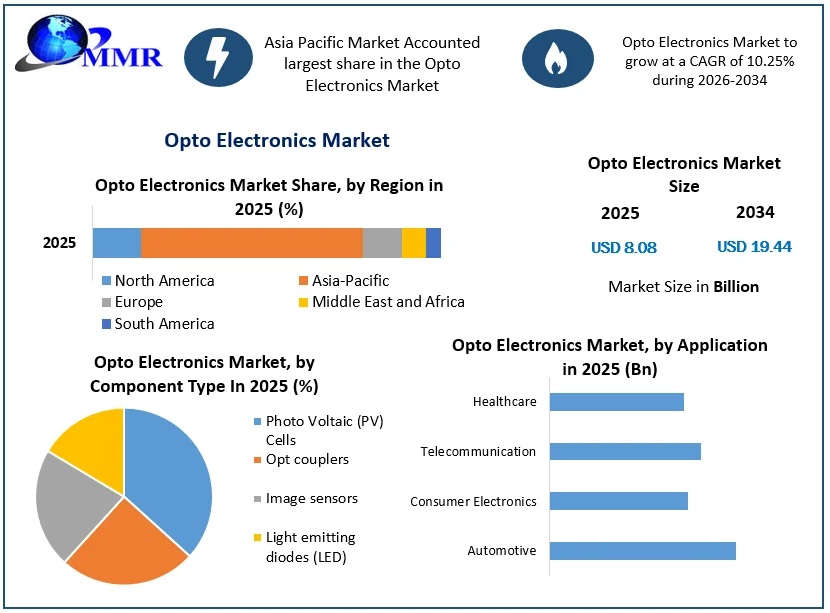
Opto Electronics Market was valued at USD 8.08 Bn. in 2025 and the total Global Opto Electronics Market revenue is Expected to grow at a CAGR of 10.25% from 2026 to 2034 reaching nearly USD 19.44 Bn. by 2034.
Opto electronics Market Overview
Optoelectronic devices are instruments or components that utilize the interaction between light and electricity, including a wide range of technologies such as photodiodes, LEDs, and photovoltaic cells. The optoelectronics market encompasses a diverse range of devices and technologies that leverage the interaction between light and electricity. With applications spanning from telecommunications to healthcare, the market is experiencing robust growth driven by increasing demand for high-performance optoelectronic components in various industries.
The growing adoption of optical communication systems is the major Opto electronics market growth driver. The integration of data-intensive applications such as cloud computing, streaming services, and 5G networks has driven the demand for high-speed, high-bandwidth optical communication solutions. Optoelectronic devices such as lasers, photodetectors, and optical fibres are essential components in these systems, driving substantial market growth. The automotive industry represents a burgeoning market for optoelectronic technologies.
Advanced driver-assistance systems (ADAS), including LiDAR (Light Detection and Ranging) sensors and LED headlights, are becoming increasingly prevalent in modern vehicles to enhance safety and improve driving experiences. This trend is expected to continue as autonomous driving technology evolves, further driving the demand for optoelectronic components. Geographically, Asia Pacific is expected major share in the Opto electronics market, driven by the rapid industrialization, technological advancements, and expanding consumer electronics market in countries such as China, Japan, and South Korea.
Opto Electronics Market Growth and Share Analysis
To know about the Research Methodology:-Request Free Sample Report
Opto electronics Market Dynamics:
Expansion of Display Technologies driving the growth of Opto electronics Market
The increasing demand for high-speed data transmission in telecommunications and data centers necessitates advanced optoelectronic components such as optical transceivers, particularly with the deployment of 5G networks driving the growth of Opto electronics Market. The automotive sector is embracing optoelectronic technologies, exemplified by the adoption of LiDAR sensors for autonomous driving, enhancing navigation precision in vehicles. Optoelectronics plays a major role in healthcare, with technologies such as optical coherence tomography (OCT) revolutionizing medical imaging for early disease detection and treatment planning.
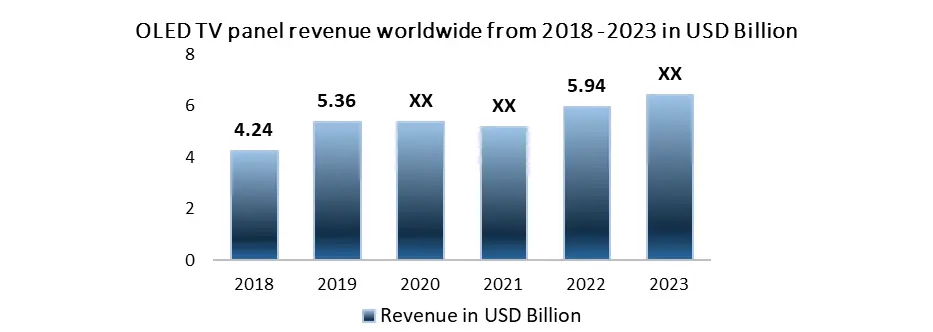
Energy efficiency is another key driver, as the market experiences a shift towards LED lighting solutions, such as those offered by Philips Lighting, which consume less energy and have longer lifespans than traditional lighting options. The demand for high-resolution displays, particularly OLED displays in smartphones and TVs, underscores the significance of optoelectronics in the consumer electronics market.
 Optoelectronic sensors find extensive applications in industrial automation and consumer electronics, facilitating functions like automatic screen dimming in smartphones using infrared proximity sensors. With the rise of IoT devices, optoelectronic sensors enable smart home automation and environmental monitoring. In security systems, optoelectronics is crucial, powering facial recognition technology for enhanced access control and surveillance. Similarly, VR/AR devices leverage optoelectronic components to create immersive experiences, exemplified by Oculus Rift VR headsets. optoelectronic devices such as solar cells are pivotal in renewable energy systems, contributing to the growth of the solar energy market, as demonstrated by companies such as SunPower.
High Initial Costs hindering the growth of Opto electronics Market
High manufacturing costs associated with optoelectronic components, such as those used in LEDs, limit affordability for both consumers and manufacturers due to expensive fabrication processes hindering the growth of Opto electronics Market. The intricate fabrication processes required for manufacturing optoelectronic devices, such as OLED displays, result in production bottlenecks and increased manufacturing costs, hindering scalability.
Technological limitations, such as heat dissipation issues in LEDs, impact their performance and reliability, particularly in high-power applications such as automotive lighting. Additionally, integrating optoelectronic components into existing systems poses challenges due to compatibility issues and design constraints, exemplified by the complexities involved in integrating LiDAR sensors into vehicles. Compliance with stringent regulatory standards, vulnerability to supply chain disruptions, environmental concerns related to manufacturing processes, and competition from alternative technologies like quantum dot displays and microLEDs further add to the challenges faced by the opto electronics market. Intellectual property rights and patent disputes contribute to market uncertainties and increased litigation costs, affecting innovation and market competitiveness.
Opto electronics Market Segment Analysis
Based on Component Type, Photo Voltaic (PV) Cells dominated the Opto electronics Market in 2025 it finds widespread use in renewable energy systems, particularly solar panels for generating electricity from sunlight, driving adoption in residential, commercial, and industrial sectors. Optocouplers, known for their ability to isolate electrical circuits, are extensively employed in telecommunications, automotive, and medical devices for signal transmission and noise reduction applications. Image sensors, integral to digital cameras and smartphones, dominate the consumer electronics market due to their role in capturing high-quality images and videos. Light Emitting Diodes (LEDs), renowned for their energy efficiency and durability, are increasingly replacing traditional lighting solutions in residential, commercial, and automotive lighting applications, driven by the global push for energy conservation and sustainability.
Based on Application the market is segmented into Automotive, Consumer Electronics
Telecommunication and Healthcare. Consumer electronics segment dominated the market in 2025 and is expected to hold largest share during the forecast period. Dominance due to widespread integration of opto electronic components like LEDs, image sensors, and laser diodes in smartphones, laptops, TVs, and wearable devices. The growing demand for high-resolution displays, facial recognition and advanced camera functionalities further fuels market growth.
Opto electronics Market Regional Insights
Asia Pacific dominated the Opto electronics Market in 2025, particularly in countries such as China, Japan, and South Korea, rapid industrialization, technological advancements, and a rising consumer electronics market drive significant growth in the optoelectronics sector. The region serves as a manufacturing hub for optoelectronic components, with China emerging as a major producer and consumer of LEDs, photovoltaic cells, and display technologies. Asia-Pacific is Expected to Hold a Significant Share in the global market, primarily due to the region's foremost consumer electronics and automobile markets. Development in optoelectronic devices is expected in other areas, including smart city initiatives, emerging innovations like virtual and simulated reality, big data, the Internet of Things (IoT), and intelligent industrial appliances.
North America is fast growing region in Opto electronics Market led by the United States, experiences robust demand for optoelectronic devices in sectors like automotive, healthcare, and aerospace, driven by strong investments in research and development. In Europe, steady growth is fueled by initiatives promoting energy efficiency and sustainability, while south America and the Middle East & Africa regions exhibit growing potential, albeit with challenges like limited technological infrastructure and economic uncertainties impacting Opto electronics Market growth. These regional insights underscore the diverse landscape of the optoelectronics market, shaped by varying economic, technological, and regulatory factors across different regions.
Opto Electronics Market Recent Development
| Date | Company | Development | Impact |
|---|---|---|---|
| 13 March 2025 | Applied Optoelectronics, Inc. | Applied Optoelectronics entered into a strategic transaction agreement with Amazon.com to supply advanced optical networking products, which includes an option for Amazon to acquire up to 7.9 million common shares. | The collaboration significantly scales the commercial deployment of high-speed optical transceivers for AI infrastructure and hyperscale cloud data centers. |
| 10 April 2025 | OMNIVISION | OMNIVISION introduced the OV50X, an ultra-high dynamic range 50-megapixel CMOS image sensor designed with a 1-inch optical format for mobile devices. | The sensor provides up to 110 dB single-exposure HDR via TheiaCel technology, setting a new performance benchmark for cinematic-grade mobile video recording. |
| 06 January 2026 | ams OSRAM AG | ams OSRAM announced the development of its 2nd generation VEGALED platform alongside advanced EVIYOS HD 25 lighting systems at CES 2026. | The platform improves energy efficiency and functional safety in automotive LED lighting and infrared sensing applications for next-generation smart vehicles. |
| 03 March 2026 | Semtech Corporation | Semtech Corporation completed the acquisition of HieFo Corporation for approximately $34 million in cash to enhance its high-efficiency InP-based laser and gain chip capabilities. | The acquisition enables tighter co-optimization of electronic-photonic chipsets for 1.6T and 3.2T optical transceivers used in AI data center interconnects. |
| 15 April 2026 | Sivers Semiconductors AB | Sivers Semiconductors partnered with Jabil to develop ultra-low power 1.6T linear receive optical (LRO) transceiver modules utilizing Sivers' high-performance Distributed Feedback (DFB) lasers. | The initiative expands high-speed, energy-efficient optical interconnect deployments across hyperscale AI data centers worldwide. |
Opto electronics Market Scope:Inquire before buying
| Opto electronics Market | |||
|---|---|---|---|
| Report Coverage | Details | ||
| Base Year: | 2025 | Forecast Period: | 2026-2034 |
| Historical Data: | 2020 to 2025 | Market Size in 2025: | USD 8.08 Bn. |
| Forecast Period 2026 to 2034 CAGR: | 10.25% | Market Size in 2034: | USD 19.44 Bn. |
| Segments Covered: | by Component Type | Photo Voltaic (PV) Cells Opt couplers Image sensors Light emitting diodes (LED) |
|
| by Product Type | Optical information instruments Optical sources & optoelectronics devices Optical communication Precision instruments Optical materials Optical instruments |
||
| by Application | Automotive Consumer Electronics Telecommunication Healthcare |
||
| by Material | Gallium Nitride (GaN) Gallium Arsenide (GaAs) Silicon Carbide (SiC) Silicon (Si) Others |
||
Opto electronics Market, by Region
North America (United States, Canada and Mexico)
Europe (UK, France, Germany, Italy, Spain, Sweden, Austria and the Rest of Europe)
Asia Pacific (China, South Korea, Japan, India, Australia, Indonesia, Malaysia, Vietnam, Taiwan, Bangladesh, Pakistan and the Rest of APAC)
South America (Brazil, Argentina Rest of South America)
Middle East & Africa (South Africa, GCC, Egypt, Nigeria and the Rest of ME&A)
Opto electronics Market, Key Players
Major Contributors in the Opto electronics Industry in North America:
1. Cree, Inc. - Durham, North Carolina, USA
2. Intel Corporation - Santa Clara, California, USA
3. Texas Instruments - Dallas, Texas, USA
4. Analog Devices, Inc. - Norwood, Massachusetts, USA
5. Broadcom Inc. - San Jose, California, USA
Leading players in the Europe Opto electronics Market:
1. Osram Licht AG - Munich, Germany
2. Infineon Technologies AG - Neubiberg, Germany
3. STMicroelectronics - Geneva, Switzerland
4. NXP Semiconductors - Eindhoven, Netherlands
5. Vishay Intertechnology
Key players driving the Asia-Pacific Opto electronics Market:
1. Nichia Corporation - Anan, Tokushima, Japan
2. Epistar Corporation - Hsinchu, Taiwan
3. AU Optronics Corp. - Hsinchu, Taiwan
4. LG Innotek - Seoul, South Korea
5. Sharp Corporation - Sakai, Japan
Frequently Asked Questions:
Q1. What was the market value of the Opto Electronics Market in 2025?
Ans: The Opto Electronics Market was valued at USD 8.08 Billion in 2025.
Q2. Which component dominated the market based on component type in 2025?
Ans: Photovoltaic (PV) Cells dominated the market in 2025 due to their widespread use in solar energy systems.
Q3. What is the expected CAGR of the Opto Electronics Market from 2026 to 2034?
Ans: The market is expected to grow at a CAGR of 10.25% during the forecast period 2026–2034.
Q4. Which application segment held the largest market share in 2025?
Ans: Consumer Electronics dominated the market in 2025 due to the integration of opto electronics in devices like smartphones and TVs.
Q5. Which material led the market in 2025 based on material segmentation?
Ans: Gallium Arsenide (GaAs) led the market due to its superior performance in high-frequency opto electronic applications.