
Global Methacrylate Copolymer Market Size By Type, By Physical Form, By Application, By End-Use Industry, by Region and Forecast 2034
Overview
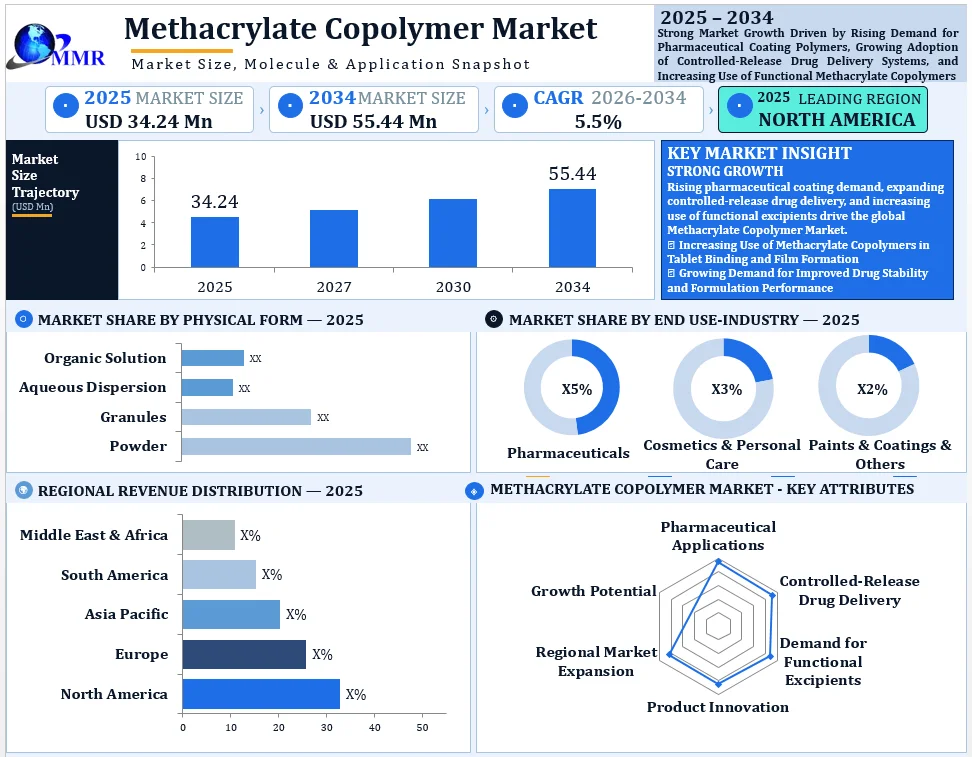
The Global Methacrylate Copolymer Market is valued at USD 34.24 million in 2025 and is projected to grow at a CAGR of 5.5% from 2026 to 2034, reaching USD 55.44 million by 2034.
Global Methacrylate Copolymer market Overview
The basic Methacrylate Copolymer is a cationic copolymer comprised of the monomers dimethylaminoethyl methacrylate, butyl methacrylate, and methyl methacrylate in the molar ratio of 1:2:1. The copolymer is manufactured by a controlled polymerization process using a free radical donor initiation system. After completion of polymerization, the viscous copolymer solution is fed into an extruder to remove solvents and volatile substances, by actively degassing through vacuum and heating. The solid granules of basic methacrylate copolymer formed in the extruder can be milled to a powder. The copolymer may contain residual monomers (dimethylaminoethyl methacrylate, butyl methacrylate, methyl methacrylate).
The methacrylate copolymers are bifurcate into three types basic, neutral or anionic whereas the basic and neutral methacrylate copolymers are used as solid food for special medical purposes (FSMPs) and glazing agent in solid food supplements. They are extensively used in pharmaceutical and food industries as an excipient from coating for example purely mechanical stabilization, moisture protection, taste or odour masking. In personnel care and cosmetic products, they are having the quality of emollient which is good for skinning condition agents as it contains sodium polyacrylate.
Other properties such as emulsion stabilizer, Binder, Artificial nail builder, personal cleanliness, Film former, hair fixative of methacrylate copolymer owing to these properties they are extensively used in the manufacturing of eye makeup, shaving, oral care, nail, fragrance, hair care & color and sun protections products. The government’s pharmaceutical standard regulations for instance, FDA and European Food safety regulations (EFSA) for food and toxic chemical may slow down the market growth.
Global Methacrylate Copolymer Market – Key Highlights
• Market Size and Growth: The Global Methacrylate Copolymer Market is valued at USD 34.24 million in 2025 and grows at a CAGR of 5.5% during 2025–2034, reaching USD 55.44 million by 2034.
• Dominant Application: Pharmaceutical coatings, enteric coatings, controlled-release drug delivery, and tablet coating technologies support demand for methacrylate copolymers. The supplied market data identifies pharmaceutical tablet coatings as a significant application.
• Product Innovation: Increasing demand for pharmaceutical excipients, film-forming polymers, permeability-control materials, and specialized drug-delivery systems encourages manufacturers to develop application-specific methacrylate copolymer grades.
• Regional Growth Opportunities: North America and Europe benefit from established pharmaceutical manufacturing and advanced drug formulation capabilities, while Asia Pacific gains opportunities through expanding generic drug production, pharmaceutical exports, and healthcare infrastructure.
• Competitive Landscape: Evonik Industries AG, BASF SE, Corel Pharma Chem, and Vikram Thermo (India) Limited participate in the competitive landscape. Product quality, polymer chemistry, formulation compatibility, regulatory compliance, and supply reliability influence competitive positioning.
Global Methacrylate Copolymer Market Size, Growth and Share Analysis
To know about the Research Methodology :- Request Free Sample Report
Global Methacrylate Copolymer Market Dynamics
Global Methacrylate Copolymer Market Drivers
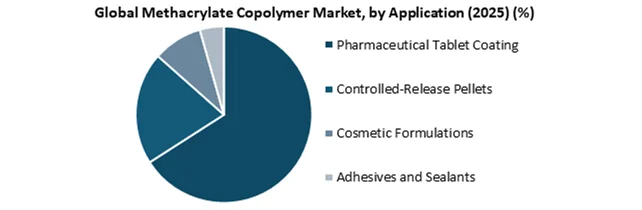
Rising Demand for Pharmaceutical Excipients and Controlled Drug Delivery: The Global Methacrylate Copolymer Market benefits from increasing demand for pharmaceutical excipients used in enteric coatings, taste masking, and controlled-release formulations. In 2025, pharmaceutical tablet coatings account for 65.92% of the basic methacrylate copolymer market, reflecting the importance of polymer-based coating technologies in oral drug delivery. Increasing demand for reliable dissolution profiles, gastrointestinal targeting, and improved drug stability supports market expansion.
Growing Adoption of Enteric Coating Technologies: Methacrylate copolymers support pH-dependent drug release by remaining resistant to acidic stomach conditions and dissolving at specific intestinal pH levels. In 2025, enteric coatings account for 54.83% of the methacrylic acid copolymer resins market, highlighting the importance of these materials in protecting acid-sensitive active ingredients and improving targeted drug delivery.
Global Methacrylate Copolymer Market Restraints
Fluctuating Raw Material Prices and Production Costs: Methacrylate copolymer production depends on raw materials such as methacrylic acid, methyl methacrylate, and ethyl acrylate. Changes in feedstock prices, energy costs, and supply availability influence manufacturing expenses and product pricing. These fluctuations create cost-management challenges for producers and can limit adoption among price-sensitive pharmaceutical manufacturers.
Stringent Quality Standards and Regulatory Requirements: Pharmaceutical-grade methacrylate copolymers require consistent molecular composition, controlled residual monomer levels, reproducible dissolution performance, and compliance with applicable pharmacopeial specifications. Maintaining these standards increases testing, documentation, and quality-control costs, creating barriers for new manufacturers and suppliers.
Global Methacrylate Copolymer Market Opportunities
Expansion of Advanced Oral Drug Delivery Formulations: Increasing demand for delayed-release, sustained-release, and gastrointestinal-targeted medicines creates opportunities for specialized methacrylate copolymers. Manufacturers develop polymer grades with differentiated pH-solubility profiles, improved film formation, and greater formulation compatibility to meet evolving pharmaceutical requirements.
Growth in Water-Based Polymer Dispersion Technologies: Pharmaceutical manufacturers increasingly value aqueous polymer dispersions that support efficient coating processes and reduce dependence on organic solvents. Methacrylate copolymer suppliers can expand their product portfolios through improved dispersion stability, processing efficiency, and application-specific formulations for tablets, capsules, granules, and pellets.
Global Methacrylate Copolymer Market Challenges
Technical Complexity in Formulation and Processing: Methacrylate copolymer performance depends on polymer composition, molecular characteristics, coating thickness, processing conditions, and the pH of the target release environment. Maintaining consistent dissolution and coating performance across different formulations requires specialized expertise and extensive product testing.
Competition from Alternative Pharmaceutical Polymers: Cellulose-based polymers and other enteric coating materials provide alternatives for pharmaceutical manufacturers. Methacrylate copolymer suppliers must demonstrate reliable release performance, formulation compatibility, consistent quality, and competitive pricing to maintain their position in pharmaceutical coating applications.
Global Methacrylate Copolymer Market Segment Analysis
By Type
The ammonium methacrylate copolymer segment supports pharmaceutical formulations requiring controlled permeability, flexible films, and modified drug-release properties. The butylated methacrylate copolymer segment offers film formation, moisture resistance, and protective coating properties. The amino methacrylate copolymer segment provides film-forming capabilities, binding properties, and pH-dependent solubility for pharmaceutical formulations. The ethylene methacrylate copolymer segment supports flexibility, adhesion, impact resistance, and durable polymer applications. Other methacrylate copolymers serve specialized requirements across pharmaceutical excipients, specialty polymers, coatings, and industrial formulations.
By Physical Form
The powder segment offers convenient storage, transportation, formulation flexibility, and compatibility with dry blending processes. The granules segment supports easier material handling, reduced dust generation, and improved processing efficiency. The aqueous dispersion segment enables water-based processing, uniform polymer distribution, and film formation while reducing reliance on organic solvents. The organic solution segment supports solvent-based formulations, polymer application, and coating processes that require consistent dissolution and application properties. Demand across physical forms depends on formulation compatibility, processing requirements, storage conditions, and end-use specifications.
By Application
The film formation segment uses methacrylate copolymers to create uniform polymer films that support surface protection, coating performance, and product stability. The surface modification segment improves surface properties, adhesion, durability, chemical resistance, and moisture resistance in suitable formulations. The binding segment uses methacrylate copolymers to improve cohesion, particle adhesion, and formulation stability. The permeability control segment supports controlled moisture transmission, barrier performance, and modified drug-release characteristics in pharmaceutical formulations. Other applications include specialized uses in polymer processing, specialty coatings, and industrial formulations that require tailored performance, formulation compatibility, and functional polymer properties.
Global Methacrylate Copolymer market Regional Insights:
North America holds a significant position in the global methacrylate copolymer market, supported by well-established pharmaceutical and chemical industries, advanced drug delivery technologies, and increasing demand for pharmaceutical excipients. The United States and Canada contribute through pharmaceutical manufacturing, drug development, and demand for specialized polymer formulations. Growing applications in pharmaceutical coatings, enteric coatings, controlled-release drug delivery, tablet coatings, and drug formulation support market demand. Increasing use of methacrylate copolymers in medicines and healthcare products, alongside advancements in pharmaceutical-grade polymers, strengthens regional market growth.
Europe maintains a strong position in the global methacrylate copolymer market, driven by established pharmaceutical and chemical industries, advanced manufacturing capabilities, and demand for specialized polymer excipients. Germany, France, the United Kingdom, and Italy contribute through pharmaceutical research, drug formulation development, and chemical production. Increasing demand for methacrylate copolymers, pharmaceutical excipients, enteric coating polymers, controlled-release formulations, and film-coating materials supports regional adoption. Stringent pharmaceutical quality standards and an emphasis on product safety encourage manufacturers to develop high-quality polymers for pharmaceutical applications.
Asia Pacific represents a key growth region in the global methacrylate copolymer market, supported by expanding pharmaceutical manufacturing, increasing healthcare expenditure, and rising demand for generic medicines. China, India, Japan, and South Korea contribute through pharmaceutical production, chemical manufacturing, and investments in drug formulation technologies. Growing demand for pharmaceutical-grade methacrylate copolymers, tablet coating materials, enteric coatings, drug delivery systems, and functional excipients supports regional consumption. Expanding healthcare infrastructure, increasing generic drug production, and growing pharmaceutical exports strengthen market opportunities.
South America experiences increasing demand in the global methacrylate copolymer market, supported by pharmaceutical manufacturing, expanding healthcare access, and growing consumption of medicinal products. Brazil and Argentina contribute through pharmaceutical production and demand for generic medicines and specialized drug formulations. Increasing adoption of methacrylate copolymers, pharmaceutical excipients, tablet coatings, enteric coating materials, and controlled-release drug delivery systems supports market development. Investments in healthcare infrastructure and pharmaceutical manufacturing capabilities further encourage the use of functional polymers in drug formulation and coating applications.
The Middle East & Africa methacrylate copolymer market benefits from expanding healthcare infrastructure, increasing pharmaceutical demand, and investments in local medicine production. Saudi Arabia, the United Arab Emirates, and South Africa contribute through pharmaceutical manufacturing initiatives and growing demand for medical formulations. Increasing use of pharmaceutical excipients, methacrylate copolymers, tablet coating polymers, enteric coatings, and drug delivery materials supports regional demand. Rising healthcare expenditure, pharmaceutical production initiatives, and improved access to medicinal products strengthen market development and encourage the adoption of specialized polymer solutions.
Global Methacrylate Copolymer Market Competitive Landscape
The Global Methacrylate Copolymer Market features competition among specialty polymer manufacturers, pharmaceutical excipient suppliers, and regional chemical producers. Companies compete through product quality, polymer composition, formulation performance, manufacturing consistency, regulatory compliance, and technical support for pharmaceutical applications. Evonik Industries AG maintains a notable position in pharmaceutical methacrylate copolymers through its EUDRAGIT product portfolio, which supports film coating, enteric protection, and modified-release drug delivery. Other participants, including Vikram Thermo, Valens Pharmachem, Dhara Lifescience, and Yuekang Pharmaceutical Group, contribute to the competitive environment through specialized products and regional supply capabilities.
Key Competitive Factors
• Specialized Polymer Chemistry: Manufacturers differentiate their products through variations in polymer composition, ionic properties, solubility, and film-forming characteristics to meet specific formulation requirements.
• Controlled-Release Technology: Companies compete by supplying methacrylate copolymers that regulate drug release, improve formulation performance, and support sustained-release and enteric-coated dosage forms.
• Pharmaceutical Quality and Compliance: Consistent product specifications, impurity control, batch reproducibility, and compliance with applicable pharmaceutical excipient standards influence supplier selection.
• Formulation Compatibility: Compatibility with active pharmaceutical ingredients, coating processes, and other excipients creates a competitive advantage for suppliers offering dependable formulation performance.
• Manufacturing and Supply Reliability: Consistent quality, scalable production, dependable raw-material sourcing, and reliable delivery support long-term relationships with pharmaceutical manufacturers.
• Regional Market Reach: Established distribution networks and technical support help suppliers serve pharmaceutical manufacturers across North America, Europe, and Asia Pacific.
Global Methacrylate Copolymer Market: Competitive Analysis of Key Players
| Company | Pricing Position |
Financial Position |
Product Portfolio |
Growth Strategies |
Regional Presence |
|---|---|---|---|---|---|
| Evonik Industries AG | Specialty, value-based pricing | Established global specialty chemicals group | EUDRAGIT® pharmaceutical methacrylate polymers | Develops functional polymers and advanced drug delivery solutions | Europe, North America, Asia Pacific |
| BASF SE | Grade- and application-based pricing | Large diversified chemical producer | Pharmaceutical excipients and related coating polymers | Expands product innovation and manufacturing efficiency | Global presence |
| Ashland Inc. | Specialty excipient pricing | Established specialty ingredients company | Pharmaceutical excipients and specialty polymers | Develops advanced formulation technologies | North America, Europe, Asia Pacific |
| Colorcon | Application-oriented pricing | Privately held pharmaceutical technology supplier | Pharmaceutical coating systems and formulation solutions | Expands coating technologies and technical services | Global presence |
| Dow Inc. | Application-dependent pricing | Diversified global materials science company | Specialty polymers and related coating materials | Focuses on high-performance materials | Global presence |
| Arkema S.A. | Performance-based specialty pricing | Diversified specialty materials group | Methacrylate-related materials and specialty polymers | Develops high-performance polymer applications | Europe, North America, Asia Pacific |
Global Methacrylate Copolymer Market: Recent Developments
| Date | Company | Development | Impact |
|---|---|---|---|
| October 5, 2026 |
Evonik Industries AG |
Develops a new biodegradable polymer platform for the next generation of EUDRAGIT functional excipients. Initial laboratory-scale materials are available for joint development projects. |
Supports sustainable pharmaceutical polymer development and creates opportunities for biodegradable excipients with targeted drug-release and solubility-enhancement properties. |
| October 1, 2026 |
SPI Pharma |
Announces a strategic global partnership with Colorcon to expand distribution and customer access to drug delivery technologies and oral solid dosage solutions. |
Expands commercial reach and technical support for pharmaceutical formulation technologies, strengthening competition in oral drug delivery. |
| April 13, 2026 |
Colorcon | Launches OneLock, an integrated pharmaceutical and nutraceutical packaging closure that incorporates a desiccant for moisture protection. |
Strengthens its broader pharmaceutical solutions portfolio and addresses moisture-control requirements for solid oral dosage forms. |
| March 30, 2026 |
BASF | Announces a global price increase of up to 20% for pharmaceutical excipients and selected active pharmaceutical ingredients in response to rising energy and raw-material costs. |
Highlights cost pressures across the pharmaceutical excipient supply chain and the potential influence of input costs on polymer pricing and procurement strategies. |
| July 1, 2026 |
Shoko Co., Ltd. / Hannong Chemicals |
Advances commercial production of Viscomedi, a partially neutralized polyacrylate pharmaceutical excipient, at a manufacturing facility in South Korea. Commercial production begins in February 2026. |
Introduces an additional pharmaceutical excipient option and demonstrates growing manufacturing capabilities in Asia. The material is polyacrylate-based, not a methacrylate copolymer. |
| June 9, 2025 |
Lubrizol | Reports that a drug formulation using its Apisolex polymer excipient enters Phase 1 clinical trials. The polymer supports solubility enhancement for poorly soluble active pharmaceutical ingredients. |
Highlights continued investment in advanced polymer excipients and formulation technologies for challenging drug-delivery applications. Apisolex is a polyamino acid-based polymer, not a methacrylate copolymer. |
The objective of the report is to present a comprehensive analysis of the global methacrylate copolymer market including all the stakeholders of the industry. The past and current status of the industry with forecasted market size and trends are presented in the report with the analysis of complicated data in simple language.
The report covers all the aspects of the industry with a dedicated study of key players that includes market leaders, followers, and new entrants. PORTER, SVOR, PESTEL analysis with the potential impact of micro-economic factors of the market have been presented in the report. External as well as internal factors that are supposed to affect the business positively or negatively have been analysed, which will give a clear futuristic view of the industry to the decision-makers.
The report also helps in understanding global market dynamics, structure by analyzing the market segments and project global market clear representation of competitive analysis of key players by price, financial position, by detection and equipment portfolio, growth strategies, and regional presence in the global market make the report investor’s guide.
Scope of Global Methacrylate Copolymer Market: Inquire before buying
| Methacrylate Copolymer Market | |||
|---|---|---|---|
| Report Coverage | Details | ||
| Base Year: | 2025 | Forecast Period: | 2026-2034 |
| Historical Data: | 2020 to 2025 | Market Size in 2025: | 34.24 USD Million |
| Forecast Period 2026-2034 CAGR: | 5.5% | Market Size in 2034: | 55.44 USD Million |
| Segments Covered: | by Type | Ammonium Methacrylate Copolymer Bytylated Methacrylate Copolymer Amino Methacrylate Copolymer Ethylene Methacrylate Copolymer others |
|
| by Physical Form | Powder Granules Aqueous Dispersion Organic Solution |
||
| by Application | Film Formation Surface Modification Binding Permeability Control Other Applications |
||
| by End-Use Industry | Pharmaceuticals Cosmetics and Personal Care Paints and Coatings Construction Other Industries |
||
Global Methacrylate Copolymer Market, by Region
North America (United States, Canada and Mexico)
Europe (UK, France, Germany, Italy, Spain, Sweden, Austria, Turkey, Russia and Rest of Europe)
Asia Pacific (China, India, Japan, South Korea, Australia, ASEAN and Rest of APAC)
Middle East and Africa (South Africa, GCC, Egypt, Nigeria and Rest of ME&A)
South America (Brazil, Argentina, Columbia and Rest of South America)
Global Methacrylate Copolymer Market, Key Players are
1. Evonik Industries AG
2. BASF SE
3. Corel Pharma Chem
4. Vikram Thermo (India) Limited
5. Huzhou Zhanwang Pharmaceutical
6. Lianyungang Wantai Pharmaceutical Excipients Technology
7. Youcare Pharmaceutical Group
8. Guangzhou Maofeng Pharmaceutical
9. Anhui Sunhere Pharmaceutical Excipients
10. Jiangxi Alpha Hi-Tech Pharmaceutical
11. The Dow Chemical Company
12. Croda International Plc
13. Akzo Nobel N.V.
14. ChemPoint.com Inc.
15. Network Polymers, Inc.
16. Merck KGaA
17. Thermo Fisher Scientific Inc.
18. Röhm GmbH
19. Mitsubishi Chemical Group
20. Sumitomo Chemical Co., Ltd.
21. Nippon Shokubai Co., Ltd.
22. Arkema S.A.
23. Trinseo PLC
24. LG Chem Ltd.
25. Eastman Chemical Company
26. Asahi Kasei Corporation
27. Kuraray Co., Ltd.
28. Mitsui Chemicals, Inc.
29. Chi Mei Corporation
30. Plaskolite LLC
31. SABIC
32. Lotte Chemical Corporation
33. Formosa Plastics Corporation
34. DIC Corporation
35. Denka Company Limited
36. Sekisui Chemical Co., Ltd.
37. Kaneka Corporation
38. Toray Industries, Inc.
39. INEOS Group
40. Celanese Corporation
41. DuPont de Nemours, Inc.
42. Lubrizol Corporation
43. Solvay S.A.
44. Synthomer plc
45. Scott Bader Company Ltd.
46. Unigel Group
47. Brenntag SE
48. IMCD N.V.
49. Azelis Group NV
50. Univar Solutions Inc.
Frequently Asked Questions:
1. What is the global methacrylate copolymer market size in 2025?
Ans. The global methacrylate copolymer market reaches USD 34.24 million in 2025.
2. What is the projected growth rate of the methacrylate copolymer market?
Ans. The global methacrylate copolymer market is projected to grow at a CAGR of 5.5% from 2025 to 2034.
3. What factors drive the growth of the methacrylate copolymer market?
Ans. Market growth is driven by increasing demand for pharmaceutical coating polymers, controlled-release drug delivery systems, film-forming materials, and functional pharmaceutical excipients.
4. Which segment contributes to the methacrylate copolymer market?
Ans. Pharmaceutical applications represent an important market segment due to the use of methacrylate copolymers in tablet coatings, drug-release control, and pharmaceutical formulation development.
5. Which region offers growth opportunities in the methacrylate copolymer market?
Ans. Asia Pacific offers growth opportunities through expanding pharmaceutical manufacturing, increasing generic drug production, and rising demand for pharmaceutical excipients.
6. Who are the key players in the global methacrylate copolymer market?
Ans. Key companies associated with methacrylate copolymers and related specialty polymers include Evonik Industries AG, BASF SE, Corel Pharma Chem, and Vikram Thermo (India) Limited.