
Polymer Alloys Market by Type, by Processing Technology, by Application and Regional Insights 2034
Overview
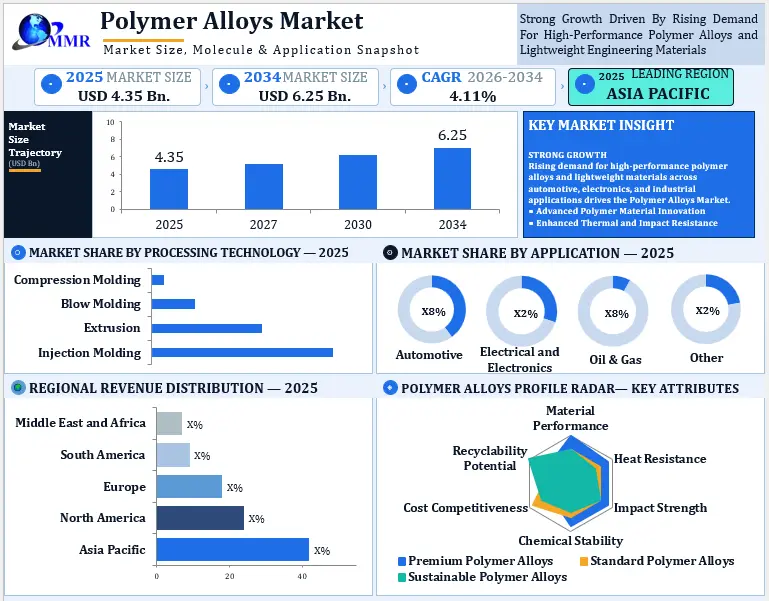
Global Polymer Alloys Market size was valued at USD 4.35 Bn. in 2025 and the total revenue is expected to grow at 4.11% through 2026 to 2034, reaching USD 6.25 Bn. by 2034.
Global Polymer Alloys Market Overview
Polymer alloys are advanced polymer materials produced by combining two or more polymers to achieve improved mechanical strength, impact resistance, thermal stability, chemical resistance, flexibility, and durability. These high-performance plastic materials support the development of lightweight, reliable, and cost-effective products across automotive, electronics, electrical equipment, construction, healthcare, and consumer goods industries. The Polymer Alloys Market is gaining importance as manufacturers seek innovative plastic materials that improve product performance, extend service life, and meet evolving industrial material requirements.
The Polymer Alloys Market is expanding as demand increases for lightweight automotive components, durable electronic devices, high-performance engineering plastics, and advanced materials for industrial manufacturing. The transition toward electric vehicles, miniaturized electronic components, and more efficient manufacturing processes is encouraging material developers to introduce polymer alloy solutions with enhanced strength, heat resistance, and processing capabilities. Key industry participants, including SABIC, Covestro, and Mitsubishi Engineering-Plastics Corporation, contribute to material innovation and the development of specialized polymer compounds. Government initiatives supporting advanced manufacturing, automotive electrification, and resource-efficient production also influence market development. Manufacturers, original equipment manufacturers, automotive suppliers, electronics producers, and industrial component manufacturers represent important buyers, while Asia Pacific remains a significant regional opportunity due to its established plastics processing, automotive production, and electronics manufacturing industries.
The MMR Polymer Alloys Market report examines industry trends, market dynamics, competitive positioning, regional developments, and segment-level growth opportunities. It evaluates key drivers, restraints, emerging applications, and technological advancements to help stakeholders identify promising investment areas, strengthen product development strategies, and understand evolving demand for advanced polymer alloy materials across end-use industries.
Polymer Alloys Market Growth and Share Analysis
To know about the Research Methodology :- Request Free Sample Report
Global Polymer Alloys Market Key Highlights
| Key Highlight | Insight |
| Market Growth Outlook | The Polymer Alloys Market is estimated at USD 4.35 billion in 2025 and is projected to reach USD 6.25 billion by 2034, reflecting a CAGR of 4.11% during 2026–2034. Demand for high-performance plastics and durable polymer compounds supports this growth outlook. |
| Leading Type Segment | PC-Based Alloys lead the type segment due to their impact resistance, thermal stability, and suitability for demanding applications. Their use in electronic components, automotive parts, and construction materials supports their market position. |
| Dominant Application | Automotive represents the leading application segment as manufacturers increasingly use polymer alloys for bumpers, interior panels, exterior components, and automotive hoses to reduce weight and improve durability. |
| Leading Regional Market | Asia Pacific leads the regional market, supported by its established electronics manufacturing base, automotive production, and demand for advanced polymer materials in China, India, and South Korea. |
| Competitive Landscape and Innovation | Major participants such as Covestro AG, BASF SE, SABIC, and Mitsubishi Engineering-Plastics Corporation compete through material innovation, specialized polymer formulations, and application-specific product development. Opportunities are emerging in electric vehicle components, advanced electronics, and recyclable polymer materials. |
Global Polymer Alloys Market Dynamics:
Driver: Rising Demand for Lightweight and High-Performance Engineering Materials Supports Polymer Alloys Market Growth
The Polymer Alloys Market is driven by increasing demand for lightweight, durable, and high-performance plastic materials across automotive, electronics, electrical equipment, and industrial manufacturing applications. Automotive manufacturers are adopting polymer alloys to reduce component weight, improve impact resistance, and support fuel efficiency and electric vehicle performance. According to the International Energy Agency, electric car sales exceeded 17 million units worldwide in 2024, highlighting the growing need for advanced materials in vehicle manufacturing. Polymer alloys also offer improved thermal stability, mechanical strength, and design flexibility, making them suitable for battery housings, interior components, electrical connectors, and protective enclosures. Rising demand for engineering plastics, advanced polymer compounds, and durable industrial components continues to create favorable conditions for polymer alloy adoption.
Restraint: High Raw Material Costs and Complex Polymer Processing Restrict Polymer Alloys Market Development
The Polymer Alloys Market faces challenges from fluctuating raw material prices, high compounding costs, and the technical complexity of combining polymers with different chemical and physical properties. Specialized additives, compatibilizers, precision blending equipment, and strict quality control requirements can increase production expenses, particularly for manufacturers developing customized polymer alloy formulations. Differences in polymer compatibility may also affect impact strength, dimensional stability, surface finish, and long-term material performance. Small and medium-sized manufacturers can face difficulties adopting advanced polymer processing technologies because of equipment investment and technical expertise requirements. In addition, inconsistent availability of selected engineering resins and fluctuations in petrochemical feedstock prices can create procurement uncertainty, affecting production planning and the commercial competitiveness of polymer alloys against conventional plastics and alternative materials.
Opportunities: Electric Vehicle Manufacturing and Recyclable Polymer Alloy Innovation Create New Market Opportunities
The Polymer Alloys Market presents opportunities through electric vehicle production, advanced electronics manufacturing, lightweight product design, and the development of recyclable high-performance polymer materials. Manufacturers can also develop polymer alloy formulations with improved flame resistance, thermal management, chemical durability, and dimensional stability for demanding industrial applications. Growing interest in recycled polymer feedstocks and circular material design creates additional opportunities for research into recyclable polymer blends, improved material separation, and high-quality recycled engineering plastics. Companies that develop application-specific polymer alloys for electric mobility, renewable energy equipment, medical devices, and electronic components can strengthen their competitive position by addressing evolving performance and sustainability requirements.
Challenges: Material Compatibility and Recycling Requirements Challenge Polymer Alloys Market Adoption
The Polymer Alloys Market faces technical challenges associated with polymer compatibility, consistent material quality, large-scale production, and end-of-life recycling. Combining different polymers does not always produce a uniform material, as differences in molecular structure, melting temperature, viscosity, and chemical affinity can lead to phase separation and reduced mechanical performance. Manufacturers must optimize blending conditions, compatibilizer selection, and processing temperatures to achieve consistent strength, durability, and product quality across production batches. Meeting industry-specific requirements for flame resistance, electrical insulation, chemical exposure, and long-term reliability can further increase product development complexity. Recycling also remains a concern because mixed-polymer materials can be difficult to separate and recover without compromising material properties. Addressing these challenges through advanced compounding technologies, material testing, improved polymer compatibility, and recyclable product design will be important for strengthening long-term adoption across automotive, electronics, construction, and industrial applications.
Global Polymer Alloys Market Key Trends
| Market Trends | Description |
| Lightweight Automotive Component Development | Automotive manufacturers are increasingly using polymer alloys in interior panels, instrument housings, structural covers, and electrical components to reduce vehicle weight while maintaining impact strength and dimensional stability. |
| Polymer Alloys for Electric Vehicle Components | The growing adoption of electric vehicles is encouraging material suppliers to develop polymer alloys with improved thermal stability, flame resistance, and electrical insulation for battery enclosures, charging systems, and high-voltage connectors. |
| Advanced Polymer Alloys for Consumer Electronics | Demand for compact electronic devices is driving the use of polymer alloys that provide heat resistance, dimensional accuracy, surface quality, and impact protection in device housings, connectors, and precision components. |
| Customized Engineering Plastic Formulations | Manufacturers are developing application-specific polymer alloys by combining different polymer grades and additives to meet particular requirements for flexibility, chemical resistance, toughness, and processing efficiency. |
| Recycled Content and Circular Material Design | Material producers are exploring polymer alloys incorporating recycled plastics to reduce dependence on virgin feedstocks and improve resource efficiency while maintaining acceptable mechanical performance and product quality. |
| High-Performance Materials for Industrial Equipment | Industrial manufacturers are adopting specialized polymer alloys for machinery housings, electrical enclosures, fluid-handling components, and equipment parts that require resistance to wear, chemicals, heat, and repeated mechanical stress. |
Global Polymer Alloys Market Segment Analysis:
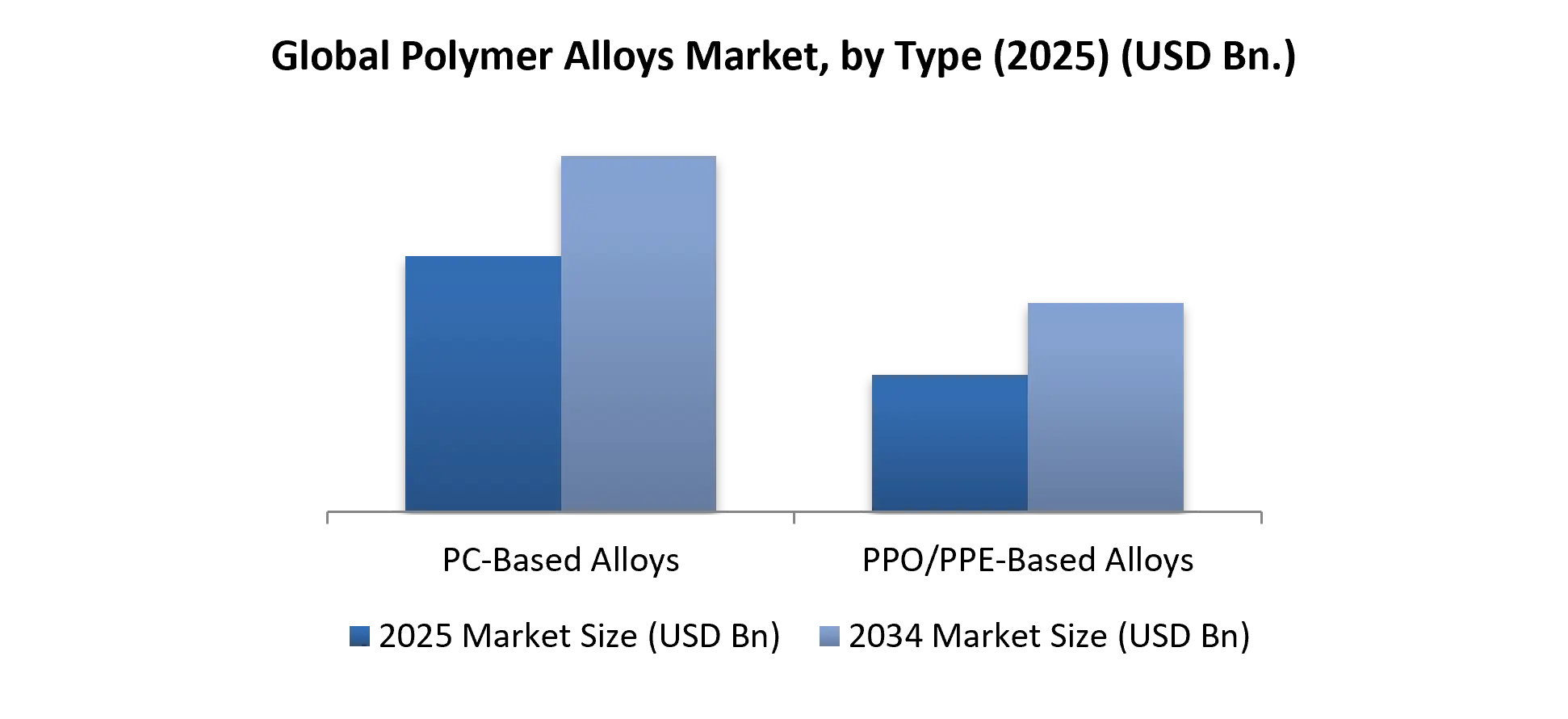
By Type, the segment is bifurcated into PC-Based Alloys and PPO/PPE-Based Alloys. PC-Based Alloys are dominating the polymer alloys market owing to their properties like better corrosion resistance, dielectric stability, and higher thermal resistance as compared to Poly(p-phenylene oxide) or poly(p-phenylene ether) based alloys. Due to their physical and mechanical properties like greater chemical stability, thermal stability, and dimensional stability polycarbonate-based alloys are greatly employed in various end-use applications like electronic components and construction materials.
 By Application. Oil and gas, Automotive, Electrical and Electronics, and Other. The automotive industry is dominating the application segment of the polymer alloys market. Polymer alloys account for 21% of the weight in materials used in passenger vehicles. Moreover, the trend for increasing light-weighted vehicles is further boosting the market growth of polymer alloys in near future. The rising consumption has simultaneously increased the production of polymer alloys with improved features to offer better efficacy standards.
Additionally, the growing population around the globe is giving rise to the expansion of the automotive industry and this factor is likely to drive the polymer alloy market in the forecast period. In the automotive industry, polymer alloys are used to crop rubber plates, propane gas hoses, making of plastic bumpers, and automotive hose covering. For the manufacturing of interior and exterior car parts, Polycarbonate and acrylonitrile-butadiene-styrene-based polymer alloy are widely used as they offer better mechanical property and durability to make it more eye-catching in passenger vehicles and others.
Global Polymer Alloys Market Regional Insights:
Global Polymer Alloys Market Regional Insights is segmented into North America, Asia Pacific, Europe, Latin America, Middle East, and Africa.
Asia-Pacific is dominating the polymer alloys market in the regional segment and has estimated a significant growth in the demand for polymer blend alloys probably in countries like China, South Korea, and India. The Asia Pacific has the world’s largest electronics industry. Due to growing advanced technologies and better electronics specification they are widely consumed and is simultaneously boosting the market growth of polymer alloys. Electronics like smartphones, portable speakers, tablets, and AI-assisted electronics in the region are growing at a rapid pace.
The objective of the report is to present a comprehensive analysis of the global Market to the stakeholders in the industry. The past and current status of the industry with the forecasted market size and trends are presented in the report with the analysis of complicated data in simple language. The report covers all the aspects of the industry with a dedicated study of key players that include market leaders, followers, and new entrants.
PORTER, SVOR, PESTEL analysis with the potential impact of micro-economic factors of the market have been presented in the report. External as well as internal factors that are supposed to affect the business positively or negatively have been analyzed, which will give a clear futuristic view of the industry to the decision-makers.
The report also helps in understanding the global Market dynamics, structure by analyzing the market segments and project the global Market size. Clear representation of competitive analysis of key players by Grade, price, financial position, Grade portfolio, growth strategies, and regional presence in the global Market make the report investor’s guide.
Global Polymer Alloys Market Competitive Landscape
The Polymer Alloys Market features strong competition among leading specialty polymer manufacturers, engineering plastics producers, and polymer compounding companies that focus on material innovation, product quality, and application-specific formulations. Key players such as SABIC, Covestro AG, BASF SE, Celanese Corporation, Mitsubishi Engineering-Plastics Corporation, Asahi Kasei Corporation, LG Chem Ltd., CHIMEI Corporation, JSR Corporation, and INEOS Styrolution Group are strengthening their market positions through advanced polymer alloy development, research and development investments, strategic partnerships, and product portfolio expansion. SABIC competes through its polycarbonate and polyphenylene ether alloy solutions, while Covestro focuses on high-performance polycarbonate-based materials and specialty polymer blends.
BASF and Celanese offer a broad range of engineering plastics and customized material solutions for automotive, electrical and electronics, and industrial applications. Mitsubishi Engineering-Plastics, Asahi Kasei, and LG Chem further contribute through specialized polymer compounds designed to improve impact strength, thermal stability, chemical resistance, and dimensional performance. Companies such as RTP Company, Daicel Corporation, LyondellBasell Industries, and Trinseo also participate in the competitive landscape through customized polymer compounds and alloy formulations. Overall, competition in the Polymer Alloys Market is increasingly shaped by lightweight automotive components, electric vehicle applications, advanced electronic materials, sustainable polymer solutions, and the development of high-performance engineering plastics.
Global Polymer Alloys Market Recent Development
| Month and Yeay | Company | Recent Development |
| March 2026 | SABIC | SABIC introduced new LNP ELCRIN SLX compounds containing post consumer recycled content for automotive applications. The materials offer weatherability and impact resistance, supporting the development of durable and recyclable automotive components. |
| April 2026 | Mitsubishi Engineering Plastics Corporation | Mitsubishi Engineering Plastics Corporation participated in CHINAPLAS 2026 with its group companies to showcase high performance engineering plastics, including modified PPE resins and polycarbonate materials for automotive, electronics, medical, and other applications. |
| June 2026 | SABIC | SABIC launched its LNP ELCRIN DC0051RC1 compound with 75 percent post consumer recycled content. The polycarbonate based material combines mechanical performance, dimensional stability, and flame retardancy for consumer electronics housings. |
| June 2026 | Celanese Corporation | Celanese announced the closure of its Engineered Materials compounding facility in Ulsan, South Korea, as part of its production network optimization strategy. The company planned to transition production activities to other regional manufacturing locations. |
| September 2026 | Covestro AG | Covestro announced the adoption of its Makroblend UT235M polycarbonate blend for a large exterior luggage panel on the Lexus ES. The component entered series production using an in mold coating process, demonstrating the use of polymer blends in automotive exterior applications. |
| September 2026 | BASF SE | BASF expanded its Ultradur portfolio with glass fiber reinforced PBT/PET compounds containing up to 30 percent post consumer recycled PET. The new grades target structural automotive components while maintaining mechanical strength and dimensional stability. |
Global Polymer Alloys Market Scope: Inquire before buying
| Polymer Alloys Market | |||
|---|---|---|---|
| Report Coverage | Details | ||
| Base Year: | 2025 | Forecast Period: | 2026-2034 |
| Historical Data: | 2020 to 2025 | Market Size in 2025: | 4.35 USD Billion |
| Forecast Period 2026-2034 CAGR: | 4.11% | Market Size in 2034: | 6.25 USD Billion |
| Segments Covered: | by Type | PC-Based Alloys PPO/PPE-Based Alloys |
|
| by Processing Technology | Injection Molding Extrusion Blow Molding Compression Molding |
||
| by Application | Oil and gas Automotive Electrical and Electronics Other |
||
Global Polymer Alloys Market, by Region
North America (United States, Canada, and Mexico)
Europe (UK, France, Germany, Italy, Spain, Sweden, Austria, and the Rest of Europe)
Asia Pacific (China, South Korea, Japan, India, Australia, ASEAN, Indonesia, Philippines, Malaysia, Vietnam, Thailand, ASEAN, Rest of Asia Pacific)
Middle East & Africa (South Africa, GCC, Nigeria, Rest of ME&A)
South America (Brazil, Argentina, Rest of South America)
Global Polymer Alloys Market, Key Players are
1. Covestro AG
2. BASF SE
3. JSR Corporation
4. Dow Inc.
5. LyondellBasell Industries
6. Mitsubishi Engineering-Plastics Corporation
7. Asahi Kasei Corporation
8. Daicel Corporation
9. SABIC
10. Celanese Corporation
11. LG Chem Ltd.
12. INEOS Styrolution
13. CHIMEI Corporation
14. RTP Company
15. Avient Corporation
16. Mitsubishi Chemical Group
17. TEIJIN LIMITED
18. Denka Company Limited
19. ZEON Corporation
20. The Lubrizol Corporation
21. Arkema S.A.
22. LANXESS AG
23. Solvay
24. DuPont de Nemours, Inc.
25. Eastman Chemical Company
26. Envalior
27. Kingfa Sci. & Tech. Co., Ltd.
28. Kraton Corporation
29. Teknor Apex Company
30. Aurora Plastics
31. Washington Penn Plastic Co., Inc.
32. Eurostar Engineering Plastics
33. SO.F.TER. Group
34. Ravago
35. Kuraray Co., Ltd.
36. Polyplastics Co., Ltd.
37. Sumitomo Bakelite Co., Ltd.
38. Toray Industries, Inc.
39. Evonik Industries AG
40. Syensqo
41. Foster Corporation
42. Adell Plastics, Inc.
43. PolyVisions, Inc.
44. Gujarat Petrosynthese Limited
45. Ovation Polymers, Inc.
46. DIC Corporation
47. Hanwha Solutions Corporation
48. Kumho Petrochemical Co., Ltd.
49. China XD Plastics Company Limited
50. MOCOM Compounds GmbH & Co. KG
Frequently Asked Questions:
1. Which region has the largest share in Global Market?
Ans: Asia Pacific region held the highest share in 2025.
2. What is the growth rate of Global Market?
Ans: The Global Market is growing at a CAGR of 4.11 % during forecasting period 2026-2034.
3. What is scope of the Global Market report?
Ans: Global Market report helps with the PESTEL, PORTER, COVID-19 Impact analysis, Recommendations for Investors & Leaders, and market estimation of the forecast period.
4. Who are the key players in Global Market?
Ans: The important key players in the Global Market are – Covestro AG, BASF SE, JSR Corporation, The Dow Chemical Company, Schulman Inc., Mitsubishi Engineering-Plastics Corporation, Asahi Kasei Corporation, Daicel Polymer Ltd, The Lubrizol Corporation, Ovation Polymers Inc., Essentra plc, Gujarat Petrosynthese Limited, RTP Company, Denka Company Limited, TEIJIN LIMITED., ZEON Corporation.
5. What is the study period of this Market?
Ans: The Global Market is studied from 2020 to 2034.