
Logistics Robots Market Size and Forecast by Type, Operation, Application, End-User, Region – Segment-Level Market Assessment
Overview
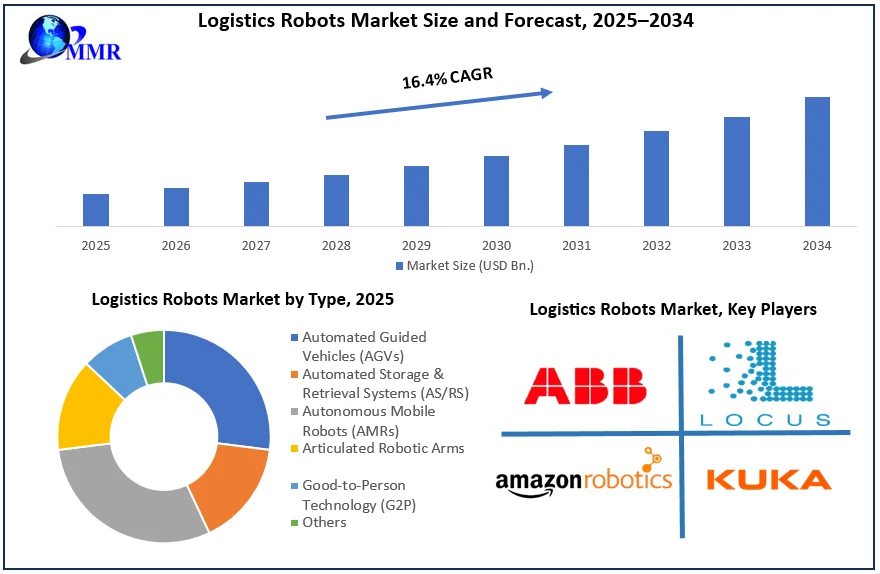
Global Logistics Robots Market was valued at USD 12.83 Billion in 2025 and is projected to reach USD 50.33 Billion by 2034, growing at a CAGR of 16.4%, driven by warehouse automation and e-commerce expansion.
Logistics Robots Market Overview and Industry Outlook
Logistics robots are increasingly becoming an important automation layer within modern warehouse operations, helping companies move, store, sort, pick, pack, and prepare goods with less manual intervention. The Logistics Robots Market covers robotic and automated systems used for transportation, material movement, storage, retrieval, picking, sorting, packaging, loading, unloading, and selected delivery activities across warehouses, distribution centers, fulfillment facilities, and logistics operations. The Logistics Robots Market is being shaped by the rapid expansion of warehouse automation, rising e-commerce order volumes, labour availability challenges, and the need to process orders faster and with greater accuracy. In our assessment, the global market is estimated at USD 12.83 billion in 2025 and is expected to reach USD 50.33 billion by 2034, reflecting strong double-digit growth as robotics moves from individual applications toward integrated warehouse operations.
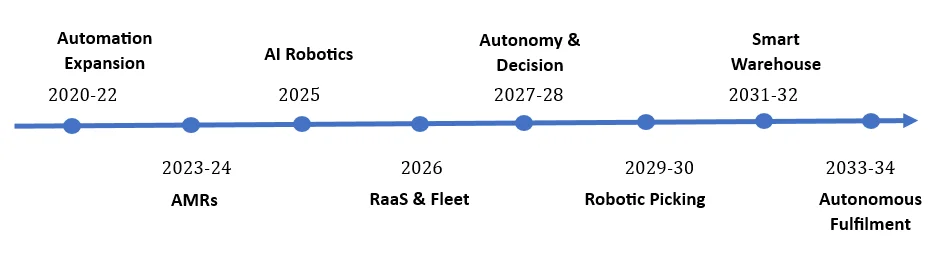
The Logistics Robots Market is also becoming an important part of Industry 4.0, where robots are no longer operating as standalone machines but are increasingly connected with warehouse management systems, artificial intelligence, machine vision, sensors, and fleet-management platforms. A key change in the Logistics Robots Market is the movement toward end-to-end robotic fulfilment—from replenishing inventory to robotically picking the orders for making them ready for dispatch. New developments such as AI-enabled picking, multi-robot coordination, human–robot collaboration, Robotics-as-a-Service (RaaS), and more flexible AMRs are allowing warehouses to automate tasks that were previously difficult to mechanise. Recent research also highlights fleet coordination, AI integration, interoperability, and scalability as important areas shaping the next phase of logistics robotics.
Logistics Robots Market Growth and Share Analysis
To know about the Research Methodology :- Request Free Sample Report
The Logistics Robots Market report will provide a detailed assessment of the Logistics Robots Market, covering market size and forecasts, market dynamics, technology and application trends, robot types, functions, payload capacities, end-use industries, regional and country-level opportunities, competitive landscape, and key developments by leading market participants. It will also examine how logistics robots are changing warehouse workflows, improving throughput and accuracy, and enabling businesses to build more flexible and increasingly autonomous supply-chain operations.
Logistics Robots Market Dynamics
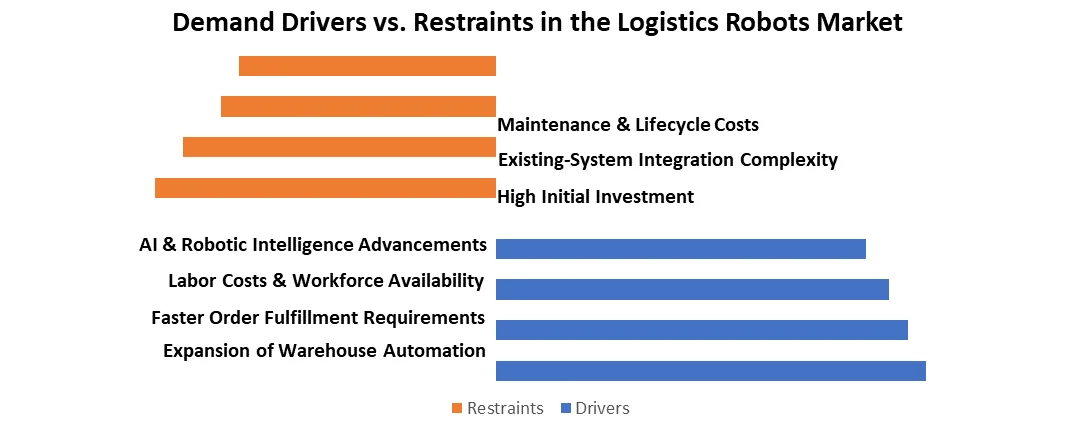
Drivers
1. Expansion of Warehouse Automation
Companies are increasingly automating material movement, replenishment, picking, sorting, and dispatch to improve warehouse throughput. The shift toward connected warehouse automation is creating sustained demand for logistics robots.
2. Growing Need for Faster Order Fulfillment
E-commerce and omnichannel distribution are increasing pressure on warehouses to process orders quickly and accurately. Robots can operate continuously and help shorten the time between order receipt and dispatch.
3. Rising Labor Costs and Workforce Availability Constraints
Warehouses face difficulties in scaling manual labor for repetitive and physically demanding activities. Logistics robots provide an alternative for handling high-volume tasks while allowing workers to focus on supervision and higher-value activities.
4. Advancements in AI and Robotic Intelligence
AI, computer vision, sensors, and improved navigation are making robots more capable of handling dynamic warehouse environments. These developments are expanding robotics beyond simple transportation toward intelligent picking and decision-making.
Restraints
1. High Initial Investment Requirements
Robotic adoption involves more than the cost of the machines, with spending also required for software, integration, infrastructure, safety systems, and training. This can delay adoption among smaller and cost-sensitive warehouse operators.
2. Complexity of Integrating With Existing Systems
Many warehouses operate with legacy WMS, conveyors, storage equipment, and manual processes. Integrating new robotic systems into these environments can increase deployment time and technical complexity.
3. Maintenance and Lifecycle Costs
Robots require regular maintenance, software updates, replacement components, and technical support. As fleets become larger, maintaining consistent uptime can add significantly to the overall cost of automation.
4. Shortage of Skilled Robotics Professionals
Advanced robotic warehouses require people who can manage fleet software, troubleshoot equipment, analyze operational data, and maintain robotic systems. The availability of these specialized skills can become a bottleneck for wider adoption.
Opportunities
1. Integration of AI-Powered Predictive Automation
The integration of AI, computer vision, and predictive analytics can enable warehouse robots to make real-time decisions, optimize routes, predict operational bottlenecks, and improve inventory accuracy. This creates opportunities for vendors to offer more intelligent and adaptive robotic solutions.
2. Growth of Robotics-as-a-Service (RaaS) Models
The increasing availability of Robotics-as-a-Service allows warehouses to adopt robotic systems with lower upfront capital requirements. Subscription- or usage-based models can make automation more accessible to small and mid-sized warehouses while creating recurring revenue opportunities for robotics providers.
Challenges
1. Complex Integration with Existing Warehouse Infrastructure
Deploying robots within warehouses that already use legacy warehouse management systems, conveyors, storage equipment, and other automation can create compatibility and coordination challenges. Seamless integration requires significant technical customization and operational planning.
2. Managing Workforce Transition and Operational Adaptation
As robotic systems take over repetitive warehouse activities, organizations need to retrain employees and redesign workflows around human–robot collaboration. Resistance to technological change and a shortage of workers with robotics-related skills can slow the adoption and effective utilization of automated systems.
Logistics Robots Market, Key Trend-Timeline
Logistics Robots Market Demand Analysis vs Future Projection
| Demand Area | Current Demand | Future Projection | Market Implication |
| Warehouse Automation | Warehouses are increasingly adopting robots for transportation, replenishment, storage, picking, sorting, and order handling to improve throughput and reduce manual dependency. | By 2032–2034, robotic systems are expected to become more deeply embedded into warehouse design, with new facilities increasingly planned around automated workflows rather than adding robots to existing processes. | Demand will shift from individual robotic machines toward integrated warehouse automation ecosystems. |
| Faster Order Fulfillment | Rising order volumes and shorter delivery expectations are encouraging warehouses to automate repetitive material-handling and fulfilment activities. | Automation is expected to extend further across the order cycle, from replenishing inventory to robotically picking orders and preparing them for dispatch. | Faster throughput and shorter order-processing times will remain major adoption drivers. |
| Labor Availability & Cost Pressure | Companies are using robots to handle repetitive, physically demanding, and high-volume tasks where maintaining sufficient warehouse labor is becoming challenging. | Human workers are expected to increasingly transition toward robot supervision, exception handling, maintenance, and other higher-value activities as robotic fleets expand. | Labor constraints will continue encouraging companies to substitute or augment manual processes with robotics. |
| AI & Computer Vision | AI, machine vision, sensors, and intelligent navigation are improving robots' ability to recognize products and respond to changing warehouse conditions. | AI is expected to become a core part of robotic warehouse operations, particularly for picking, object recognition, task allocation, navigation, and real-time decision-making. | The market will increasingly compete on robot intelligence and software capability, not only hardware performance. |
| Robotic Picking | Picking remains one of the largest opportunities for automation, but product variation makes it technically more challenging than transportation. | Robotic picking is expected to expand significantly as AI and vision systems improve robots' ability to identify, grasp, and handle different products. | Picking could become one of the fastest-growing application areas within logistics robotics. |
| Robotics-as-a-Service | Flexible payment and subscription models are helping companies reduce the burden of purchasing and deploying complete robotic systems upfront. | RaaS adoption is expected to increase among companies seeking scalable automation, particularly where order volumes fluctuate or capital budgets are limited. | The business model could broaden the addressable customer base for logistics robotics. |
Logistics Robots Market Segment
Logistics Robots Market, By Type

The Logistics Robots Market includes Automated Guided Vehicles (AGVs), Autonomous Mobile Robots (AMRs), Automated Storage and Retrieval Systems (AS/RS), articulated robotic arms, and Goods-to-Person (G2P) systems. AGVs support predictable material movement, while AMRs provide flexible navigation and dynamic route planning. AS/RS improves automated storage, space utilization, and inventory handling, while robotic arms support picking, palletizing, depalletizing, and sorting. G2P systems improve order fulfilment and warehouse productivity by bringing inventory directly to operators. Other solutions include autonomous forklifts, robotic sorters, and inventory robots. Growing warehouse automation, e-commerce fulfilment, and smart logistics are driving demand for flexible robotic systems that improve throughput and operational efficiency.
Logistics Robots Market, By Application
The Logistics Robots Market is expanding across warehouse automation, material handling, custom packaging, loading and unloading, piece picking, sorting, storage, and order fulfilment. Robotic picking is gaining importance with rising e-commerce volumes, SKU diversity, and demand for faster fulfilment. AMRs, AGVs, robotic packing systems, and automated storage and retrieval systems (AS/RS) improve warehouse productivity and operational efficiency. Other applications include palletizing, depalletizing, replenishment, inventory management, and last-mile delivery. Increasing adoption of AI, machine vision, autonomous navigation, fleet management software, and smart warehouse technologies is further driving the growth of the Logistics Robots Market.
Logistics Robots Market Regional Analysis
Asia Pacific
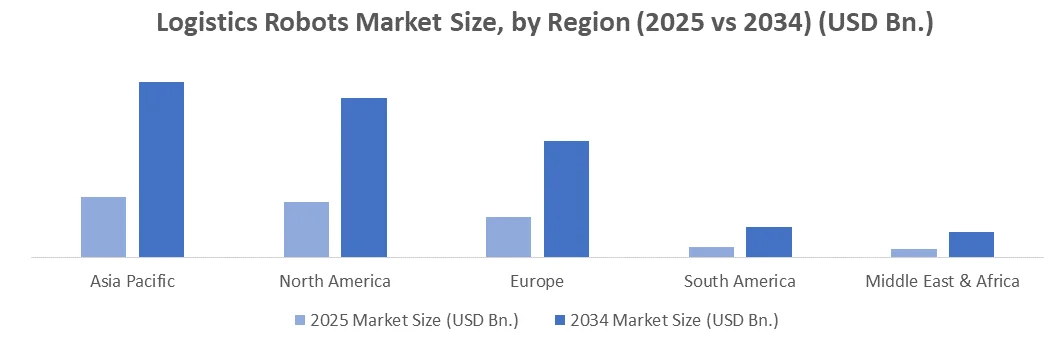
Asia Pacific is the leading region in the global Logistics Robots Market, supported by rapid e-commerce expansion, large-scale manufacturing, rising labor costs, and growing investment in warehouse automation and smart logistics. China remains the region’s major demand center, driven by its strong e-commerce ecosystem, advanced manufacturing base, and expanding robotics and automated material handling capabilities. Japan and South Korea are also key markets, where AMRs, AGVs, robotic picking, and automated storage and retrieval systems (AS/RS) are helping businesses address labor shortages and improve warehouse productivity. India and Southeast Asia are emerging as high-growth markets as organized retail, modern warehousing, and automated distribution networks expand. The region’s established industrial robotics ecosystem, AI adoption, and logistics automation infrastructure are expected to further strengthen Asia Pacific’s position in the Logistics Robots Market.
North America
North America is a mature and technology-driven region in the global Logistics Robots Market, supported by large e-commerce fulfillment networks, high warehouse labor costs, labor shortages, and strong investment in warehouse automation and material handling solutions. The United States accounts for most regional demand, with retailers, manufacturers, and third-party logistics (3PL) providers increasingly adopting AMRs, AGVs, robotic picking systems, and automated storage and retrieval systems (AS/RS). The region is also a major hub for robotics innovation, AI-powered warehouse automation, fleet management software, and Robotics-as-a-Service (RaaS), enabling flexible automation with lower upfront costs. Canada is also witnessing growing adoption as logistics operators modernize distribution centers, improve order fulfillment, and enhance warehouse productivity.
Europe
Europe is a mature and technology-intensive region in the global Logistics Robots Market, supported by advanced intralogistics infrastructure, Industry 4.0 adoption, warehouse automation, and rising labor shortages. Germany leads the regional market due to its strong manufacturing base, sophisticated logistics network, and established automation ecosystem. The UK, France, Italy, Spain, and the Netherlands are also expanding robotic fulfillment and smart warehouse solutions. Rising e-commerce volumes, limited warehouse space, and demand for higher productivity are driving the adoption of AMRs, AGVs, robotic arms, robotic picking systems, and automated storage and retrieval systems (AS/RS). Although growth is relatively slower than Asia Pacific, labor shortages, facility modernization, AI integration, and material handling automation will continue to support the Logistics Robots Market across Europe.
South America
South America is an emerging region in the global Logistics Robots Market, supported by e-commerce growth, distribution center modernization, and rising demand for efficient warehouse automation and order fulfillment. Brazil is the leading market, driven by large consumer base and expanding logistics network. Adoption of AMRs, AGVs, robotic picking, and automated storage and retrieval systems (AS/RS) is gradually increasing. While high upfront costs, fragmented infrastructure, and lower automation penetration remain challenges, growing investment in smart logistics, warehouse robotics, and e-commerce fulfillment creates significant long-term growth opportunities for the Logistics Robots Market.
Middle East & Africa
Middle East & Africa is an emerging region in the global Logistics Robots Market, with adoption concentrated in advanced logistics hubs and countries investing heavily in warehouse automation, smart logistics, and infrastructure modernization. The UAE and Saudi Arabia are leading markets, supported by e-commerce growth, smart logistics initiatives, and expanding port, airport, and distribution infrastructure. Automated sorting, AS/RS, AGVs, AMRs, and robotic material handling systems are increasingly deployed to improve warehouse throughput, order fulfillment, and operational efficiency. South Africa and Israel also offer strong opportunities due to their developing logistics and technology ecosystems. Although uneven infrastructure, varying automation maturity, and high upfront costs remain challenges, rising investment in AI-powered warehouse robotics, automated fulfillment, and intelligent logistics solutions is expected to create new growth opportunities in the Logistics Robots Market.
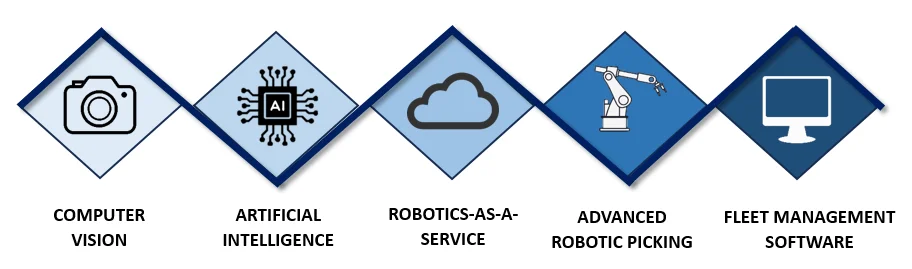
Logistics Robots Market Emerging Technology Landscape
The Logistics Robots Market is moving toward smarter and more adaptable automation as companies look beyond basic material movement and seek greater efficiency across warehouse operations. Artificial intelligence and computer vision are improving robots’ ability to recognize products, understand their surroundings, make decisions, and operate safely in changing warehouse conditions. Robotic picking is also becoming more capable of handling varied products and complex picking requirements, reducing the limitations of conventional automated systems. At the same time, fleet management software is gaining importance as warehouses deploy larger numbers of robots that need to work together without creating congestion or operational delays. Robotics-as-a-Service is further supporting market development by offering businesses a more flexible way to introduce automation without making large upfront investments. Going forward, the market is expected to increasingly favor connected robotic systems that combine intelligent software, autonomous machines, real-time data, and flexible deployment models rather than relying on isolated robotic equipment.
Emerging Technology Landscape - Logistics Robots Market
Logistics Robots Market Competitive Landscape
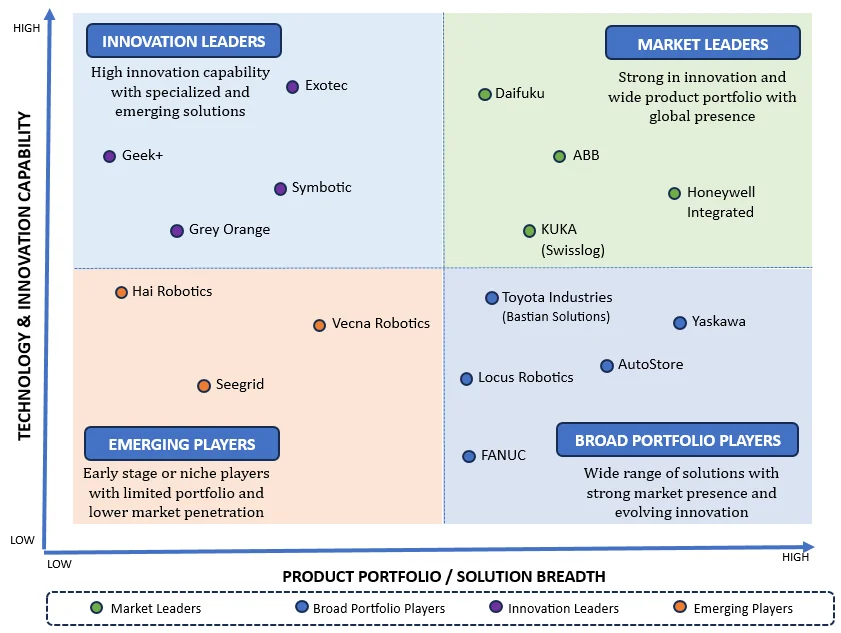
The global Logistics Robots Market is characterized by a mix of established industrial automation companies, warehouse automation specialists, robotics manufacturers, and emerging technology providers. Competition is increasingly centered on the ability to offer integrated robotics solutions rather than standalone machines, with companies expanding their capabilities across AMRs, AGVs, AS/RS, robotic picking, fleet management, and warehouse software. Large players benefit from established customer relationships, broad product portfolios, global service networks, and the ability to undertake large-scale automation projects, while specialized companies are competing through flexible robotic platforms, application-specific solutions, faster deployment, and Robotics-as-a-Service models. Leading participants are also strengthening their positions through product development, strategic partnerships, acquisitions, and integration of AI, computer vision, and advanced software into robotic systems. The competitive environment is therefore becoming increasingly technology-driven, with scalability, interoperability, deployment flexibility, system integration, and total cost of ownership emerging as important factors influencing customer selection.
LOGISTICS ROBOTS MARKET – COMPETITIVE POSITIONING MARKET
Logistics Robots Market – Investor Takeaways
The Logistics Robots Market is attracting investors as e-commerce growth, labor shortages, and rising warehouse automation are increasing demand for faster and more efficient operations. AMRs and AGVs offer strong growth potential by automating repetitive material handling, transportation, and warehouse workflows.
Investment opportunities extend beyond hardware into robotics software, fleet management, system integration, maintenance, AI, and Robotics-as-a-Service (RaaS), creating opportunities for recurring revenue. Advances in AI, computer vision, and autonomous navigation are making logistics robots more flexible and intelligent. Asia Pacific remains an attractive growth region, while high upfront costs, integration complexity, maintenance, and uncertain ROI remain key investment risks.
Logistics Robots Market Scope: Inquire before Buying
| Logistics Robots Market | |||
|---|---|---|---|
| Report Coverage | Details | ||
| Base Year: | 2025 | Forecast Period: | 2026-2034 |
| Historical Data: | 2020 to 2025 | Market Size in 2025: | 12.83 USD Billion |
| Forecast Period 2026-2034 CAGR: | 16.4% | Market Size in 2034: | 50.33 USD Billion |
| Segments Covered: | by Component | Hardware Sensors Controllers Drives & Motors Cameras Batteries Others Software Fleet Management Software (FMS) Warehouse Management Systems (WMS) Pick & Place/Sorting Software Others Services Integration & Deployment Maintenance & Support |
|
| by Deployment Type | Indoor Logistics Robots Outdoor Logistics Robots |
||
| by Navigation Technology | Laser Guidance Vision Guidance Magnetic Guidance GPS-Based Navigation LiDAR-Based Navigation Hybrid Navigation System |
||
| by Application | Warehouse Management Inventory Management Order Fulfillment Parcel Sorting Last-Mile Delivery Reverse Logistics Cross-Docking Operations Others |
||
| by Payload Capacity | Low Capacity (Up to 100 kg) Medium Capacity (100–500 kg) High Capacity (Above 500 kg) |
||
| by Function | Material Handling Picking & Packing Transportation & Delivery Sorting Palletizing & Depalletizing Inventory Management Loading & Unloading |
||
| by End User Industry | E-commerce Retail Third-Party Logistics (3PL) Manufacturing Food & Beverage Healthcare & Pharmaceuticals Automotive Aerospace & Defense Consumer Electronics Others |
||
| by Robot Type | Autonomous Mobile Robots (AMRs) Automated Guided Vehicles (AGVs) Picking Robots Sorting Robots Palletizing Robots Robotic Arms Drone-Based Logistics Robots |
||
Logistics Robots Market, by Region
North America (United States, Canada and Mexico)
Europe (UK, France, Germany, Italy, Spain, Sweden, Austria and Rest of Europe)
Asia Pacific (China, South Korea, Japan, India, Australia, Indonesia, Malaysia, Vietnam, Taiwan, Bangladesh, Pakistan and Rest of APAC)
Middle East and Africa (South Africa, GCC, Egypt, Nigeria and Rest of ME&A)
South America (Brazil, Argentina Rest of South America)
Key Players – Logistics Robots Market
1. ABB
2. FANUC
3. Yaskawa Motoman
4. KUKA
5. Kawasaki Robotics
6. Universal Robots
7. Premier Tech
8. Columbia Machine
9. Robotiq
10. Brenton Engineering
11. Geek+
12. Locus Robotics
13. GreyOrange
14. Hai Robotics
15. ForwardX Robotics
16. Quicktron Robotics
17. Hikrobot
18. AutoGuide Mobile Robots (Teradyne)
19. MiR (Mobile Industrial Robots)
20. OTTO Motors (Rockwell Automation)
21. Fetch Robotics (Zebra Technologies)
22. SEER Robotics
23. Syrius Robotics
24. Standard Bots
25. Mushiny
26. Daifuku
27. Dematic (KION Group)
28. Murata Machinery (Muratec)
29. JBT Corporation
30. Toyota Industries Corporation
31. SSI Schaefer
32. Elettric80
33. Oceaneering AGV Solutions
34. Swisslog
35. AGVE Group
36. Rocla AGV (Mitsubishi Logisnext)
37. EK Automation
38. DS Automotion
39. Kollmorgen
40. RightHand Robotics
41. Covariant
42. Berkshire Grey
43. Plus One Robotics
44. XYZ Robotics
45. Osaro
46. Kindred AI (Ocado Group)
47. Brightpick
48. Dexterity AI
49. Mujin
50. KNAPP AG
51. Vanderlande Industries
52. TGW Logistics Group
53. Körber Supply Chain
54. Honeywell Intelligrated
55. AutoStore
56. Bastian Solutions
57. Witron
58. Fives Group
59. Cimcorp
60. Mecalux
61. Interroll
62. Exotec
63. Beumer Group
64. Siemens Logistics
65. Solystic
66. Others
Frequently Asked Questions:
1. Which region has the largest share in Global Logistics Robots Market?
Ans: Asia Pacific region held the highest share in 2025.
2. What is the growth rate of Global Logistics Robots Market?
Ans: The Global Logistics Robots Market is growing at a CAGR of 16.4% during forecasting period 2026-2034.
3. What is scope of the Global Logistics Robots Market report?
Ans: Global Logistics Robots Market report helps with the PESTEL, PORTER, COVID-19 Impact analysis, Recommendations for Investors & Leaders, and market estimation of the forecast period.
4. What is the study period of this Market?
Ans: The Global Logistics Robots Market is studied from 2020 to 2034.